NFT

NFTs are unique digital identifiers recorded on a blockchain that certify ownership and authenticity of a specific asset. Moving past the "PFP" craze, 2026 NFTs emphasize utility, representing everything from IP rights and digital fashion to RWA titles and event ticketing. This tag explores the technical standards of digital ownership, the growth of NFT marketplaces, and the integration of non-fungible tech into the broader Creator Economy and enterprise solutions.

13694 Articles
Created: 2026/02/02 18:52
Updated: 2026/02/02 18:52
Pump.fun Pushes Back Against Lookonchain Claims as Treasury Movements Trigger Debate

Pump.fun Pushes Back Against Lookonchain Claims as Treasury Movements Trigger Debate

A new on-chain report from Lookonchain has reignited debate around Pump.fun’s treasury activity. But the team behind the memecoin launchpad is openly rejecting the claims, calling the circulating numbers “misinformation” and insisting the large transfers reflect internal treasury management, not cash-outs. Lookonchain’s report surfaced major USDC and SOL outflows over the last year, sparking speculation [...]

Author: Null TX
Grayscale Launches GDOG, the First U.S. Spot Dogecoin ETF, Marking a New Milestone for the Memecoin Era

Grayscale Launches GDOG, the First U.S. Spot Dogecoin ETF, Marking a New Milestone for the Memecoin Era

The memecoin era just crossed a line no one expected this early. Dogecoin now has its own U.S. spot ETF. Grayscale has officially launched $GDOG, the first-ever spot Dogecoin ETF in the United States. It opens trading with a temporary 0% fee, a move clearly designed to seize early market share ahead of incoming competitors. [...]

Author: Null TX
Hoskinson Ruthlessly Mocked by Crypto Twitter

Hoskinson Ruthlessly Mocked by Crypto Twitter

The post Hoskinson Ruthlessly Mocked by Crypto Twitter appeared on BitcoinEthereumNews.com. “You do understand what I do for a living?”   The Metamask tweet Cardano founder Charles Hoskinson is currently being mocked over an extremely pretentious comment, which has gone semi-viral on the X social media network.  In fact, its pretentiousness could rival Hoskinson’s infamous Metamask tweet, which was even turned into a non-fungible token.  “You do understand what I do for a living?”   Recently, the crypto mogul suggested recording a video about the global financial system to explain how we are all “debt slaves.”  A social media user then questioned Hoskinson’s expertise, claiming that he would rather hear an actual economist.  Unsurprisingly, Hoskinson doubles down with a boastful claim, asserting that he is not just a developer but a revolutionary figure who has created decentralized central banks and “rebuilt Wall Street” on a blockchain. The over-the-top self-aggrandizing statement has not been left unnoticed by the cryptocurrency community, and the reactions are… brutal.  People are pointing out that Cardano barely gets used outside of a few fans. Solana, a major Cardano competitor, jumped in with its own parody version.  You do understand what I do for a living? I literally am a decentralized financial platform and rebuilt Wallstreet on a blockchain — Solana (@solana) November 24, 2025 One user even dubbed the Cardano founder as “generational talent for the messiah complex.” The Metamask tweet Some have also compared his latest social media post to the infamous “support email” tweet, which has become part of cryptocurrency lore. As reported by U.Today, the legendary tweet of the IOG CEO was even sold as an NFT back in 2022.        Source: https://u.today/hoskinson-ruthlessly-mocked-by-crypto-twitter

Author: BitcoinEthereumNews
Rain Protocol Surges 120% as Enlivex Deploys $212M and Matteo Renzi Joins the Board

Rain Protocol Surges 120% as Enlivex Deploys $212M and Matteo Renzi Joins the Board

The decentralized prediction market sector just witnessed one of its biggest moments to date. @Rain__Protocol’s native token exploded more than 120% today after a public biotech company confirmed a massive nine-figure deployment into the ecosystem. The announcement marks one of the largest corporate treasury allocations ever made into a Web3 prediction market protocol. It also [...]

Author: Null TX
Monad Mainnet Launch: Full Breakdown of Monad Tokenomics, Airdrops, and Early User Incentives

Monad Mainnet Launch: Full Breakdown of Monad Tokenomics, Airdrops, and Early User Incentives

The post Monad Mainnet Launch: Full Breakdown of Monad Tokenomics, Airdrops, and Early User Incentives appeared first on Coinpedia Fintech News Monad mainnet is officially live, giving users, developers, and traders access to a new high-speed Layer-1 blockchain. The network promises fast transactions, full EVM-compatibility, and a growing list of tools and platforms ready from day one.  Along with the launch, Monad is rolling out a large ecosystem incentive program and early opportunities that are already …

Author: CoinPedia
Venture capital investment in the crypto industry reached $4.65 billion in Q3, the second highest since the FTX crash.

Venture capital investment in the crypto industry reached $4.65 billion in Q3, the second highest since the FTX crash.

PANews reported on November 25th that, according to a research report released by Galaxy Digital on Monday, total venture capital investment in the crypto industry reached $4.65 billion in the third quarter of 2025, a 290% increase quarter-over-quarter, marking the second-highest level since the FTX crash in 2022 (the highest being $4.8 billion in the first quarter of this year). A total of 414 deals were completed this quarter, with seven large deals, including Revolut's $1 billion funding round and Kraken's $500 million funding round, accounting for half of the total funding. US companies received 47% of the investment, while Singaporean and UK companies received 7.3% and 6.8%, respectively. Research Director Alex Thorn pointed out that stablecoins, AI, and blockchain infrastructure continue to attract capital, but as the industry matures, the proportion of pre-seed investments is gradually declining. Venture capital activity over the past two years has remained below the levels seen during the 2021-2022 bull market. Thorn analysis suggests that factors such as waning interest in sectors like gaming and NFTs, the diversion of funds to the AI sector, and the interest rate environment have collectively contributed to the stagnation in venture capital. Meanwhile, compliant investment channels like spot ETFs are competing with traditional venture capital firms for institutional funding.

Author: PANews
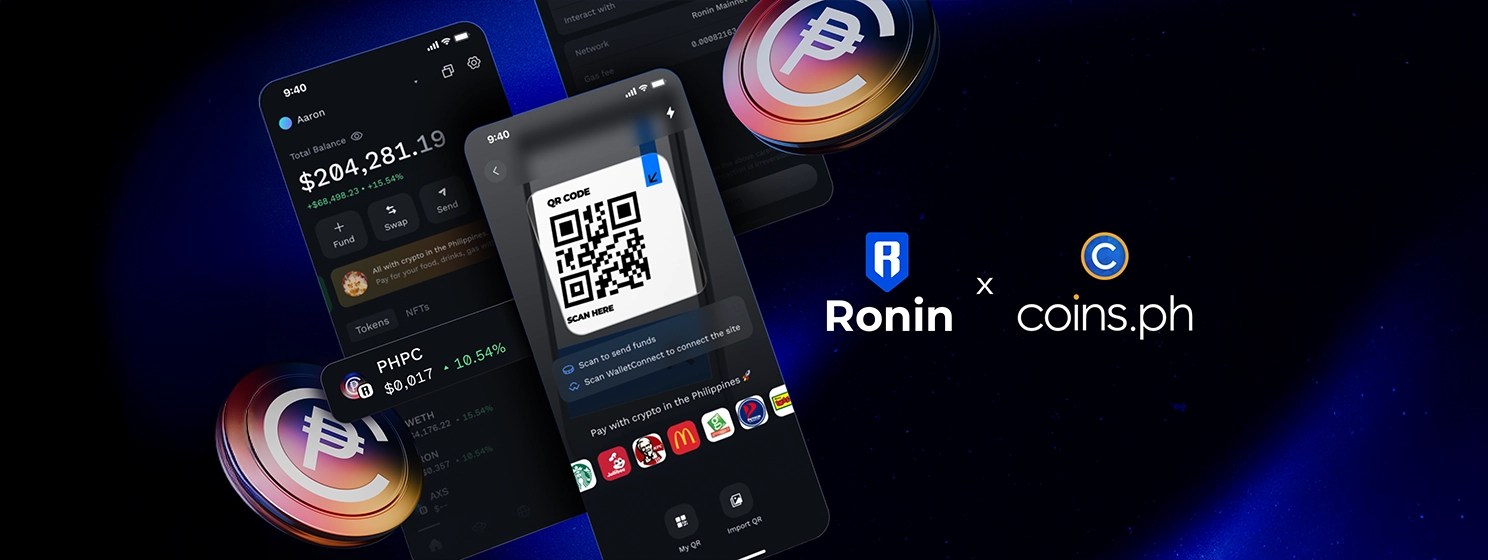
Ronin, Coins.ph to Bring QRPH Payments to PHPC Nationwide

Ronin, Coins.ph to Bring QRPH Payments to PHPC Nationwide

The post Ronin, Coins.ph to Bring QRPH Payments to PHPC Nationwide appeared on BitcoinEthereumNews.com. Homepage > News > Finance > Ronin and Coins.ph to Soon Bring QRPH Payments to PHPC, Making Crypto Spendable Across the Philippines MANILA, Philippines, November 21, 2025 – Ronin, the blockchain developed by Sky Mavis, the creators of Axie Infinity, announced a key step forward in bringing real-world utility to Web3: PHPC stablecoin payments via QRPH, the Philippines’ national QR payment standard. Through a deepened collaboration with Coins.ph, PHPC will soon be spendable at more than 600,000 QRPH-enabled merchants across the country, subject to obtaining all necessary regulatory permits and authorizations. From groceries to food deliveries, and everyday utilities, Filipinos will soon be able to access PHPC directly from their Ronin Wallet. The announcement was made at the YGG Play Summit and marks the first step in Ronin’s broader strategy to support digital payments, savings, and remittances across APAC. QRPH powers billions of transactions each year and is central to the Philippines’ fast-growing digital payments ecosystem. According to the Bangko Sentral ng Pilipinas (BSP), digital payments now account for 57.4% of all retail transactions, exceeding national targets, while over 66.4% of person-to-merchant payments are already digital. Meanwhile, the Philippines remains one of the world’s largest recipients of remittances, recording over US$40.2 billion in 2024. Together, these trends signal both the scale of value flowing into the country and the rising demand for efficient, flexible payment options. “Once we secure the necessary permits, the integration of PHPC into the QRPH network by 2026 would be a game-changer. Soon, anyone will be able to pay with PHPC simply by scanning a QR code through Ronin Wallet, just like with other leading mobile wallets, but with the unprecedented speed and security of on-chain value. This is the moment digital assets become truly useful in everyday life,” said Wei Zhou, Coins.ph Chief Executive Officer.…

Author: BitcoinEthereumNews
Gala Games Unveils Thanksgiving Events with Discounts and In-Game Rewards

Gala Games Unveils Thanksgiving Events with Discounts and In-Game Rewards

The post Gala Games Unveils Thanksgiving Events with Discounts and In-Game Rewards appeared on BitcoinEthereumNews.com. Timothy Morano Nov 25, 2025 05:46 Gala Games celebrates Thanksgiving with special events, discounts, and rewards across Mirandus, Town Star, and Vexi, offering players exciting opportunities and unique in-game experiences. Gala Games is celebrating Thanksgiving by hosting a series of special events and offering limited-time discounts and unique in-game opportunities across its platforms, including Mirandus, Town Star, and Vexi. This initiative is designed to engage players with new challenges, rewards, and exclusive items, enhancing the holiday spirit within the Gala ecosystem. Mirandus: Seasonal Sales and Challenges In Mirandus, players can take advantage of significant discounts and participate in a competitive weekend event. From November 25 to December 1, essential in-game assets will be on sale, including a 40% discount on Phoenix and Hawk Pets and select Mystery Chests. Additionally, the ‘Dusk of the Broken’ event running from November 28 to December 1 offers a total of 128,200 GALA in prizes and exclusive cosmetics for top performers. Town Star: New Additions and NFT Discounts Town Star introduces Turkey Meat, expanding its crafting options. A new Rare Turkey Ranch NFT is available, offering strategic advantages and boosting production efficiency. Furthermore, players can purchase curated NFTs at discounted rates, such as Sparky the Great Pyrenees and Sommelier Vineyard, which enhance gameplay with speed and production bonuses. Vexi: Character Sale and Player Appreciation Vexi joins the festivities with a character sale and a special player appreciation gift. From November 13 to December 4, players can enjoy a 42% discount on the new Vexi Ledger character. Additionally, all players will receive 200 Bytes as a token of gratitude for their support and participation. The Thanksgiving events across Mirandus, Town Star, and Vexi showcase Gala Games’ commitment to fostering community and engagement. Players are encouraged to explore these…

Author: BitcoinEthereumNews
Metaverse wallets, solutions poised for growth: reports

Metaverse wallets, solutions poised for growth: reports

The post Metaverse wallets, solutions poised for growth: reports appeared on BitcoinEthereumNews.com. Homepage > News > Business > Metaverse wallets, solutions poised for growth: reports A new report has predicted that the metaverse wallet will surge to meteoric levels by the end of the decade, matching the expected rise of virtual worlds and their growing use cases. The market assessment report, compiled by InsightAce Analytics, disclosed that the metaverse wallet ecosystem will reach a valuation of $42.9 billion in 2031. Currently, the market is valued at $7.39 billion, with the seven-year forecast period representing a compound annual growth rate (CAGR) of 24.7%. Metaverse wallets are digital asset wallets, primarily designed to hold assets in virtual worlds, such as tokens, in-game currencies, non-fungible tokens (NFTs), and other identification credentials. Several factors are expected to be tailwinds for the metaverse wallet market in the lead-up to the start of the new decade. Analysts argue that the rise of metaverse technologies and virtual worlds is the primary driver of wallet growth alongside their increasing utility. Metaverse wallets are becoming indispensable in facilitating seamless user interaction in virtual worlds and streamlining transactions between users. Furthermore, the utility of establishing verifiable asset ownership and consolidating digital holdings in a single interface is considered a key element in the push for a $42 billion valuation. The report highlighted prominent service providers in the metaverse wallet landscape, indicating that they are expected to hold a significant portion of the market share by 2031. Key players include ConsenSys, Enjin, Coinbase (NASDAQ: COIN), Decentraland, The Sandbox, Somnium Space, and Alpha Wallet. In terms of regional distribution, the report predicts North America to be the most dominant force in 2031. The market report hinges its forecast on North America’s streak of investment in blockchain and digital innovation, with Southeast Asia expected to close the distance. Despite the glowing numbers and upside opportunity,…

Author: BitcoinEthereumNews
iOSG: The App Cycle is Coming, and Asian Developers Are Entering a Golden Age

iOSG: The App Cycle is Coming, and Asian Developers Are Entering a Golden Age

Author: Jiawei, IOSG In the mid-to-late 1990s, internet investment focused primarily on infrastructure. The capital markets at the time were almost entirely betting on fiber optic networks, ISPs, CDNs, and server and router manufacturers. Cisco's stock price soared, reaching a market capitalization of over $500 billion by 2000, making it one of the world's most valuable companies; fiber optic equipment manufacturers such as Nortel and Lucent also became highly sought after, attracting tens of billions of dollars in funding. In this frenzy, the United States added millions of kilometers of fiber optic cable between 1996 and 2001, far exceeding the actual demand at the time. As a result, a severe overcapacity emerged around 2000—transcontinental bandwidth prices plummeted by more than 90% in just a few years, and the marginal cost of connecting to the Internet approached zero. While this infrastructure boom allowed later-born companies like Google and Facebook to take root and flourish on the cheap, ubiquitous internet, it also brought growing pains for the then-frenzied investors: the infrastructure valuation bubble burst rapidly, and the market value of star companies like Cisco shrank by more than 70% in a few years. Doesn't it sound a lot like Crypto from the past two years? Is the era of infrastructure coming to a temporary end? Block space has gone from scarce to abundant. The expansion of the block space and the exploration of the "impossible three" of blockchain largely dominated the early development of the crypto industry for several years, and therefore it is appropriate to discuss it as a landmark element. ▲Source: EtherScan In its early stages, public blockchains had extremely limited throughput, making block space a scarce resource. Taking Ethereum as an example, during the DeFi Summer, with various on-chain activities overlapping, the cost of a single DEX interaction often ranged from $20 to $50, reaching hundreds of dollars during periods of extreme congestion. With the advent of NFTs, the market's demand and calls for scaling reached their peak. Ethereum's composability is a major advantage, but it also increases the complexity of individual calls and gas consumption, with high-value transactions prioritizing limited block capacity. As investors, we often discuss L1's renewal fees and burning mechanism, using this as an anchor for L1 valuation. During this period, the market gave infrastructure a very high price, and the so-called "fat protocol, thin application" argument—that infrastructure can capture a large portion of value—was accepted, triggering a construction boom, or even a bubble, of scaling solutions. ▲Source: L2Beats In conclusion, key Ethereum upgrades (such as EIP-4844) migrated L2 data availability from expensive calldata to lower-cost blobs, significantly reducing the unit cost of L2. Transaction fees for mainstream L2 blockchains have generally decreased by several US dollars. The introduction of modularity and Rollup-as-a-Service solutions has also significantly reduced the marginal cost of block space. Various Alt-L1 blockchains supporting different virtual machines have also emerged. As a result, block space has transformed from a single, scarce asset into a highly fungible commodity. The chart above shows the evolution of various L2 on-chain costs over the past few years. It can be seen that in 2023 and early 2024, calldata accounted for the majority of costs, with daily costs even approaching $4 million. Then, in mid-2024, the introduction of EIP-4844 allowed Blobs to gradually replace calldata as the dominant cost, significantly reducing overall on-chain costs. After 2025, overall costs have tended to be at a lower level. In this way, more and more applications can place their core logic directly on the blockchain, instead of adopting a complex architecture that processes off-chain data and then uploads it to the blockchain. From this point on, we see value capture begin to migrate from the underlying infrastructure to the application and distribution layer, which can directly handle traffic, improve conversion rates, and form a closed loop of current flow. Evolution of income Following on from the last paragraph of the previous chapter, we can intuitively verify this viewpoint at the revenue level. During a cycle dominated by infrastructure narratives, the market's valuation of L1/L2 protocols is primarily based on expectations of their technological capabilities, ecosystem potential, and network effects—the so-called "protocol premium." Token value capture models are often indirect (e.g., through network staking, governance rights, and vague expectations of renewal fees). Application value capture is more direct: verifiable on-chain revenue is generated through renewal fees, subscription fees, and service fees. This revenue can be directly used for token buybacks and burns, dividends, or reinvested in growth, forming a tight feedback loop. The application's revenue streams become more robust—coming more from actual service fee revenue than from token incentives or market narratives. ▲Source: Dune@reallario The chart above roughly compares the revenue of protocols (red) and applications (green) from 2020 to the present. We can see that the value captured by applications is gradually increasing, reaching approximately 80% of the total this year. The table below lists the 30-day protocol revenue rankings compiled by TokenTerminal, with L1/L2 accounting for only 20% of the 20 projects. Stablecoins, DeFi, wallets, and trading instruments are particularly prominent. ▲Source: ASXN Furthermore, due to the market reaction to buybacks, the correlation between the application token's price performance and its earnings data is gradually increasing. Hyperliquid's daily buybacks of approximately $4 million have provided significant support for the token price. Buybacks are considered a key factor driving the price rebound. This indicates that the market is beginning to directly link protocol gains and buyback activity to token value, rather than relying solely on sentiment or narrative. And I expect this trend to continue to strengthen. II. Embracing the New Cycle with Applications as the Main Theme The Golden Age of Asian Developers ▲Source: Electric Capital ▲Source: Electric Capital According to Electric Capital's 2024 Developer Report, blockchain developers in Asia accounted for 32% of the total, surpassing North America to become the world's largest developer hub. Over the past decade, global products such as TikTok, Temu, and DeepSeek have demonstrated the outstanding capabilities of Chinese teams in engineering, product development, growth, and operations. Asian teams, especially Chinese teams, possess a strong iterative pace, can quickly validate needs, and achieve overseas expansion through localization and growth strategies. Crypto perfectly aligns with these characteristics: it requires rapid iteration and adjustments to adapt to market trends; and it needs to simultaneously serve global users, cross-language communities, and multi-market regulations. Therefore, Asian developers, especially Chinese teams, have a structural advantage in the Crypto application lifecycle: they possess both strong engineering capabilities and a keen sensitivity to market speculation cycles, along with exceptional execution ability. Against this backdrop, Asian developers have a natural advantage, enabling them to deliver globally competitive crypto applications more quickly. Projects like Rabby Wallet, gmgn.ai, and Pendle, which we've seen in this cycle, represent Asian teams on the global stage. We anticipate seeing this shift soon: a new market trend moving away from a US-dominated narrative towards a model where Asian products are first launched, then expanded into European and American markets from there. Asian teams and markets will have more say in the application cycle. Primary market investment under the application cycle Here are some perspectives on primary market investing: Trading, asset issuance, and financial applications still offer the best product-to-market (PMF) ratios, and are practically the only products capable of weathering a bear market. These correspond to products like Hyperliquid (perp), Pump.fun (launchpad), and Ethena, respectively. The latter packages capital rate arbitrage into a product that can be understood and used by a wider range of users. If there is significant uncertainty in investing in a specific sector, consider investing in the sector's beta, and think about which projects will benefit from the sector's development. A typical example is prediction markets—there are approximately 97 publicly available prediction market projects, with Polymarket and Kalshi being the more obvious winners. In this case, the probability of betting on a mid-to-long-term project to overtake the leader is very low. However, investing in tool-based prediction market projects, such as aggregators and chip analysis tools, offers greater certainty and allows you to benefit from the sector's growth, transforming a difficult multiple-choice question into a single-choice one. Once the product is developed, the next key step is to truly bring these applications to the masses. Besides common entry points like Social Login provided by Privy, I believe that a unified trading front-end and mobile platform are also crucial. Throughout the application lifecycle, whether it's perp or prediction markets, mobile will be the most natural user interface. Whether it's the user's first deposit or frequent daily operations, the experience will be much smoother on mobile. The value of an aggregation front-end lies in traffic distribution. Distribution channels directly determine user conversion efficiency and project cash flow. Wallets are also an important part of this logic. The author believes that wallets are no longer simply asset management tools, but rather have a role similar to Web2 browsers. Wallets directly capture order flows, distributing them to block builders and searchers, thereby monetizing traffic. Simultaneously, wallets also act as distribution channels, connecting to third-party services such as staking through built-in cross-chain bridges and DEXs, becoming a direct entry point for users to access other applications. In this sense, wallets control order flows and traffic distribution, serving as the primary entry point for user relationships. Regarding the infrastructure throughout the entire cycle, I believe that some public chains created out of thin air have lost their meaning; however, the infrastructure that provides basic services around applications can still capture value. Several specific examples are listed below: Provides infrastructure for customized multi-chain deployment and application chain building for applications, such as VOID; Companies that provide user onboarding services (covering login, wallet, deposits and withdrawals, cash withdrawals, etc.), such as Privy and Fun.xyz; this can also cover wallets and payment layers (fiat-on/off ramps, SDKs, MPC hosting, etc.). Cross-chain bridges: As the multi-chain world becomes a reality, the surge in application traffic will urgently require secure and compliant cross-chain bridges.

Author: PANews