Options

Options are versatile derivative instruments that give traders the right, but not the obligation, to buy (Call) or sell (Put) a digital asset at a specific strike price.Unlike futures, options offer a flexible way to hedge against "black swan" events or speculate on implied volatility. The 2026 landscape features a surge in on-chain options vaults (DOVs) and structured products that simplify complex "Greeks" for retail users. Explore this tag for insights into premium pricing, expiration cycles, and advanced strategic hedging in the decentralized derivatives market.

20353 Articles
Created: 2026/02/02 18:52
Updated: 2026/02/02 18:52

The Rise of Little Pepe: A Potential Giant in the Crypto World

The Rise of Little Pepe: A Potential Giant in the Crypto World

In recent times, the cryptocurrency market has shown us that the unexpected can happen, with tokens such as Solana (SOL) skyrocketing to incredible highs. A new contender, Little Pepe (LILPEPE), is poised to potentially mirror these gains. Currently trading below $0.003, LILPEPE combines meme appeal with robust blockchain technology, aiming to capture the hearts and wallets of investors. The Launch and Trajectory of Little Pepe The LILPEPE token presale has generated significant buzz, raising an impressive $18.17 million, which is near its $19.32 million goal. Currently, in its final stages, the token price stands at $0.0019. This rapid accumulation, driven by both individual investors and large-scale buyers, suggests a strong market reception upon its upcoming listing. Beyond a Meme: Technical and Utility Aspects of Little Pepe LILPEPE is not just another meme coin; it's a Layer 2 solution enhancing Ethereum's scalability with minimal transaction fees and a focus on meme-based applications and NFTs. Its infrastructure is solid, designed to support rapid transactions and a growing ecosystem of decentralized applications. Core Features Sniper-bot resistant and zero tax on trades, making it attractive for frequent trading. Robust staking options and decentralized governance through its DAO. An innovative meme token launchpad that could potentially revolutionize how meme projects kick off. Market Potential and Financial Projections Discussion around LILPEPE has drawn comparisons to Solana's meteoric rise, speculating on a similar explosive growth potential. From its current price, a surge to $0.75 represents a substantial increase, reminiscent of Solana's journey from a few dollars to over $200. Such growth hinges on the successful adoption of its Layer 2 technology and the expansion of its user base and project engagements. Strategic Market Movements and Future Listings Pre-listing activities have been optimistic, with LILPEPE securing a spot on CoinMarketCap and undergoing a successful smart contract audit. These developments, coupled with anticipated Tier-1 exchange listings, suggest a robust post-launch performance. Community Engagement and Promotional Strategies The $777,000 giveaway by LILPEPE has attracted over 208,000 participants, creating a vibrant community eager for the token's full launch. This type of engagement is crucial for maintaining momentum and building a loyal user base. Conclusion: Is LILPEPE the Next Big Thing? LILPEPE seems set on a path that could replicate or even surpass early success stories like Solana, especially with its unique positioning in the meme coin market and solid technological foundation. For crypto enthusiasts and investors looking for the next big opportunity, LILPEPE offers a compelling case. For more details on Little Pepe (LILPEPE), explore these resources: Official Website Official Whitepaper Join on Telegram Follow on Twitter/X Disclaimer: This is a sponsored article and is for informational purposes only. It does not reflect the views of Bitzo, nor is it intended to be used as legal, tax, investment, or financial advice.

Author: Coinstats
Why is Crypto Down Today?  Here’s What You Need To Know

Why is Crypto Down Today? Here’s What You Need To Know

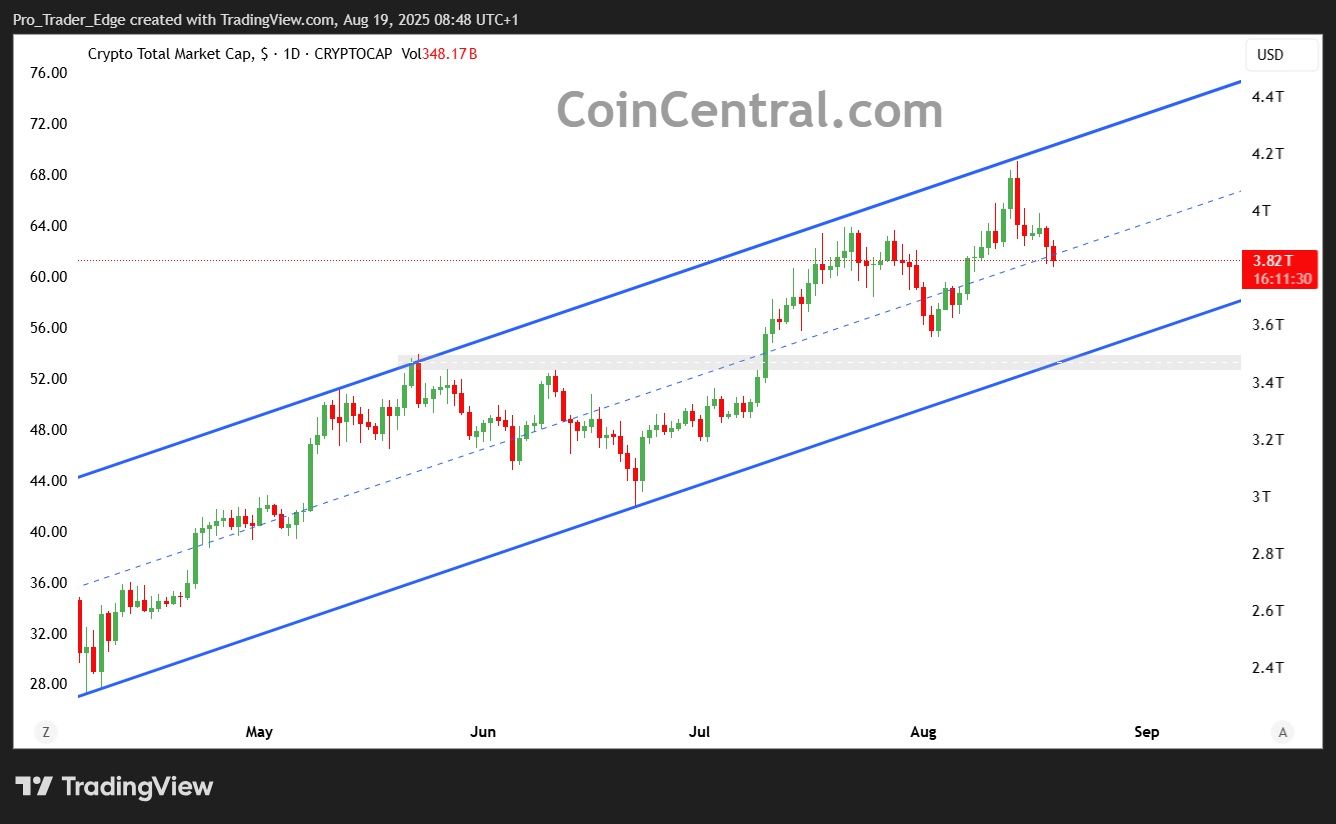
TLDR Bitcoin trades at $115,902 after crypto market cap falls $75 billion to $3.86 trillion on August 19 Profit-taking after recent all-time highs and Federal Reserve policy concerns drive the selloff Over $530 million in leveraged positions liquidated, including $124 million in Bitcoin trades Japanese firm LibWork approves $3.4 million Bitcoin purchase while SEC delays [...] The post Why is Crypto Down Today? Here’s What You Need To Know appeared first on CoinCentral.

Author: Coincentral
Analysts Sound Fresh Warning on Ethereum Outlook

Analysts Sound Fresh Warning on Ethereum Outlook

According to Greeks.Live’s latest daily briefing, the upcoming unstaking could weigh heavily on Ethereum, potentially leading to a 5%–7% decline […] The post Analysts Sound Fresh Warning on Ethereum Outlook appeared first on Coindoo.

Author: Coindoo
Unveiling The Strategic Shift In BTC Acquisitions

Unveiling The Strategic Shift In BTC Acquisitions

The post Unveiling The Strategic Shift In BTC Acquisitions appeared on BitcoinEthereumNews.com. Recent news regarding MicroStrategy’s latest Bitcoin (BTC) acquisition has sparked considerable discussion within the cryptocurrency community. The firm, widely recognized as a significant corporate holder of Bitcoin, completed a smaller purchase than some of its previous large-scale buys. This development has led prominent short-seller James Chanos to offer a compelling interpretation, suggesting a potential shift in the company’s financing dynamics. This situation raises important questions about the evolving MicroStrategy Bitcoin strategy and its underlying financial mechanisms. What Does a Smaller MicroStrategy Bitcoin Buy Signal? On August 18, Strategy co-founder Michael Saylor announced the firm acquired 430 BTC, valued at $51.4 million. While still a substantial investment, this figure is notably smaller compared to MicroStrategy’s prior, more aggressive Bitcoin purchases. James Chanos, a renowned short-seller famous for his successful bet against Enron, quickly weighed in on X (formerly Twitter). Chanos suggested this reduced acquisition size reflects fading demand for MicroStrategy’s preferred stock. Preferred stock is a key financing tool MicroStrategy has utilized to fund its extensive Bitcoin accumulation. A perceived weakness in demand for this stock could imply challenges in raising capital through this specific avenue for future MicroStrategy Bitcoin buys. This observation from a seasoned market analyst adds a layer of scrutiny to the company’s financial health and its ongoing commitment to Bitcoin. How Has MicroStrategy’s Bitcoin Funding Strategy Evolved? The context for this smaller purchase is crucial. Following its Q2 2025 results, MicroStrategy outlined a policy regarding its stock issuance. The company stated it would issue stock below 2.5 times its market-to-net asset value (mNAV) only for specific purposes: To cover existing debt obligations. To pay preferred dividends. Significantly, not explicitly for buying more Bitcoin. The mNAV is defined as the company’s market capitalization divided by its Bitcoin holdings and operating assets. However, a more recent investor presentation introduced…

Author: BitcoinEthereumNews
Traders Tilt Bearish on August BTC, ETH Targets as Retail Lags Institutions

Traders Tilt Bearish on August BTC, ETH Targets as Retail Lags Institutions

The post Traders Tilt Bearish on August BTC, ETH Targets as Retail Lags Institutions appeared on BitcoinEthereumNews.com. Good Morning, Asia. Here’s what’s making news in the markets: Welcome to Asia Morning Briefing, a daily summary of top stories during U.S. hours and an overview of market moves and analysis. For a detailed overview of U.S. markets, see CoinDesk’s Crypto Daybook Americas. As East Asia begins its trading day, BTC is trading at $116,263, down 1.1% on the day and 2% lower on the week, according to CoinDesk market data, while ETH sits at $4,322, off 3.8% in the last 24 hours but still up 2.6% weekly. The CoinDesk 20 (CD20), an index tracking the largest crypto assets, is down 2.4%. Polymarket odds suggest traders are bracing for weakness through the end of August. The most likely outcome for BTC is now a close below $111,000 with a 34% probability, while ETH’s highest-weighted scenario is a finish near $4,800 at 43%. Enflux, a Singapore-based market maker, said the market is being pulled in two directions. “The market remains caught between strong underlying institutional conviction, highlighted by Strategy Inc.’s additional 430 BTC purchase and structural financing shift, and a lack of immediate retail follow-through,” it wrote in a note to CoinDesk. Enflux pointed to VanEck’s reiterated $180,000 year-end bitcoin target as evidence that institutions are positioning for continuation, even as retail-favored narratives such as XRP and DOGE have been capped by the SEC’s delays on ETF approvals. Solana remains an exception, Enflux wrote, with “quiet strength” from its dominance in USDC transfers and PumpFun’s share of new token issuance. Still, derivatives positioning shows caution. QCP reported in a recent market update that perpetual funding rates turned negative over the weekend, a setup that preceded earlier pullbacks, and options skews now favor puts across maturities. The result is a market that looks structurally supported at the top but tactically defensive…

Author: BitcoinEthereumNews
PowerBank Lights the Grid, Turning Sunlight Into Currency

PowerBank Lights the Grid, Turning Sunlight Into Currency

The post PowerBank Lights the Grid, Turning Sunlight Into Currency appeared on BitcoinEthereumNews.com. Key Points: PowerBank drives clean energy growth with 700 MWp+ pipeline across U.S. and Canada. Innovative Bitcoin treasury integration and tokenized solar assets diversify financing opportunities. Proven track record: 100+ projects built, $100M financings, 4,000+ homes powered. TORONTO/NEW YORK, August 19, 2025 – PowerBank Corporation (NASDAQ: SUUN; Cboe Canada: SUNN), a North American renewable energy developer and operator, has begun installation of its first battery energy storage system in Ontario while expanding its solar portfolio in the United States and Canada. The company is simultaneously advancing a digital finance strategy through Bitcoin treasury integration and tokenization of renewable energy assets. PowerBank Fuels 4,000 Homes With $100M+ in Financings PowerBank Corporation, formerly known as SolarBank, rebranded in July 2025 as part of its expanded clean energy and digital asset strategy. Headquartered in Toronto with U.S. offices in Rochester, New York, the company operates as a developer, engineer, builder, and asset operator in the renewable energy sector. The company’s business spans behind-the-meter solar power gardens, community solar plants, utility-scale solar farms, and battery energy storage systems. Since its inception, PowerBank has built more than 100 solar projects with a combined capacity exceeding 60 megawatts (MW), while managing over 100 operational solar plants. Its development pipeline exceeds 700 MWp, and it has facilitated more than $100 million in project financings. PowerBank reports that its solar projects have collectively powered more than 4,000 homes and continue to contribute to net-zero emission goals across North America. Installation of 20MWh Battery Storage in Ontario On August 6, 2025, PowerBank announced the start of installation of its first battery energy storage system (BESS) in Ontario. The project, located in the Township of Armour, has a nameplate capacity of 4.99 megawatts/20 megawatt-hours and will use lithium iron phosphate technology. The system is contracted under the Independent Electricity System…

Author: BitcoinEthereumNews
MicroStrategy Bitcoin: Unveiling the Strategic Shift in BTC Acquisitions

MicroStrategy Bitcoin: Unveiling the Strategic Shift in BTC Acquisitions

BitcoinWorld MicroStrategy Bitcoin: Unveiling the Strategic Shift in BTC Acquisitions Recent news regarding MicroStrategy’s latest Bitcoin (BTC) acquisition has sparked considerable discussion within the cryptocurrency community. The firm, widely recognized as a significant corporate holder of Bitcoin, completed a smaller purchase than some of its previous large-scale buys. This development has led prominent short-seller James Chanos to offer a compelling interpretation, suggesting a potential shift in the company’s financing dynamics. This situation raises important questions about the evolving MicroStrategy Bitcoin strategy and its underlying financial mechanisms. What Does a Smaller MicroStrategy Bitcoin Buy Signal? On August 18, Strategy co-founder Michael Saylor announced the firm acquired 430 BTC, valued at $51.4 million. While still a substantial investment, this figure is notably smaller compared to MicroStrategy’s prior, more aggressive Bitcoin purchases. James Chanos, a renowned short-seller famous for his successful bet against Enron, quickly weighed in on X (formerly Twitter). Chanos suggested this reduced acquisition size reflects fading demand for MicroStrategy’s preferred stock. Preferred stock is a key financing tool MicroStrategy has utilized to fund its extensive Bitcoin accumulation. A perceived weakness in demand for this stock could imply challenges in raising capital through this specific avenue for future MicroStrategy Bitcoin buys. This observation from a seasoned market analyst adds a layer of scrutiny to the company’s financial health and its ongoing commitment to Bitcoin. How Has MicroStrategy’s Bitcoin Funding Strategy Evolved? The context for this smaller purchase is crucial. Following its Q2 2025 results, MicroStrategy outlined a policy regarding its stock issuance. The company stated it would issue stock below 2.5 times its market-to-net asset value (mNAV) only for specific purposes: To cover existing debt obligations. To pay preferred dividends. Significantly, not explicitly for buying more Bitcoin. The mNAV is defined as the company’s market capitalization divided by its Bitcoin holdings and operating assets. However, a more recent investor presentation introduced a new, more flexible phrase: “when otherwise deemed advantageous.” This subtle but significant addition has drawn criticism. Critics argue that this new phrasing provides management with greater leeway to sell equity, even at lower multiples, potentially impacting shareholder value. This shift directly influences how MicroStrategy Bitcoin acquisitions are funded and perceived by the market. Is Demand for MicroStrategy Bitcoin Holdings Fading? Chanos’s commentary directly addresses the implications of this financing evolution. If demand for MicroStrategy’s preferred stock is indeed weakening, it could present a challenge for the company’s ability to continue its aggressive Bitcoin accumulation strategy through this particular method. This scenario compels market observers to consider the potential reasons behind such a decline in demand, whether it’s broader market sentiment or specific concerns about MicroStrategy’s valuation. The company’s ability to efficiently raise capital is paramount to its long-term strategy of accumulating Bitcoin. Therefore, any perceived difficulty in doing so, especially through its established preferred stock mechanism, becomes a point of concern. This also highlights the intricate relationship between corporate finance and cryptocurrency investment, particularly for a firm so deeply invested in MicroStrategy Bitcoin holdings. Navigating the Future of MicroStrategy Bitcoin Investments Despite the recent smaller purchase and Chanos’s observations, MicroStrategy’s overall commitment to Bitcoin remains clear. The firm’s co-founder, Michael Saylor, has consistently championed Bitcoin as a treasury reserve asset. However, the methods and terms of future capital raises will be closely monitored by investors and analysts alike. The market will be watching to see if the “when otherwise deemed advantageous” clause leads to further equity sales and how these sales impact the company’s stock performance relative to its Bitcoin holdings. Understanding these dynamics is crucial for anyone tracking institutional adoption of cryptocurrencies. MicroStrategy’s approach offers a unique case study in leveraging traditional finance tools for digital asset accumulation. The ongoing narrative around MicroStrategy Bitcoin strategy continues to provide valuable insights into the evolving landscape of corporate crypto integration. In conclusion, MicroStrategy’s recent smaller Bitcoin purchase, coupled with James Chanos’s insightful commentary, underscores a dynamic period for the company. While its dedication to Bitcoin remains a core tenet, the mechanisms for funding these significant acquisitions are clearly under increasing scrutiny. This situation offers valuable lessons on the complexities of corporate cryptocurrency strategies and the ever-present interplay between market perception and financial maneuvers. Frequently Asked Questions (FAQs) Q1: What is MicroStrategy’s primary strategy regarding Bitcoin?A1: MicroStrategy’s primary strategy is to acquire and hold Bitcoin as its primary treasury reserve asset, believing it offers a superior long-term store of value compared to traditional fiat currencies. Q2: Who is James Chanos and why are his comments significant?A2: James Chanos is a renowned short-seller known for identifying overvalued companies. His comments are significant because they offer an experienced market analyst’s critical perspective on MicroStrategy’s financing methods and the implications for its Bitcoin acquisition strategy. Q3: How does MicroStrategy typically finance its Bitcoin purchases?A3: MicroStrategy has primarily financed its Bitcoin purchases through various methods, including issuing convertible senior notes and, as highlighted in this article, selling preferred stock. Q4: What is the significance of the “when otherwise deemed advantageous” clause?A4: This clause in MicroStrategy’s investor presentation suggests greater flexibility for management to sell equity (issue stock) even at lower market multiples, potentially to fund operations or acquisitions beyond previously stated restrictions, which critics view as a broadening of their financing options. Q5: What is the “market-to-net asset value (mNAV)”?A5: The market-to-net asset value (mNAV) is a metric MicroStrategy uses, defined as its market capitalization divided by the combined value of its Bitcoin holdings and its operating assets. It helps assess the premium or discount at which the company’s stock trades relative to its underlying assets. Share Your Thoughts! Did James Chanos’s comments on MicroStrategy’s Bitcoin strategy surprise you? What are your predictions for MicroStrategy’s future acquisitions? Share this article on social media to spark a conversation with your network and let us know your insights! To learn more about the latest Bitcoin trends, explore our article on key developments shaping Bitcoin institutional adoption. This post MicroStrategy Bitcoin: Unveiling the Strategic Shift in BTC Acquisitions first appeared on BitcoinWorld and is written by Editorial Team

Author: Coinstats
Ethereum Sees Record Validator Exodus as $3.9B ETH Leaves Network

Ethereum Sees Record Validator Exodus as $3.9B ETH Leaves Network

The post Ethereum Sees Record Validator Exodus as $3.9B ETH Leaves Network appeared on BitcoinEthereumNews.com. The post Ethereum Sees Record Validator Exodus as $3.9B ETH Leaves Network appeared first on Coinpedia Fintech News Ethereum’s proof-of-stake network is witnessing an unprecedented wave of validator exits, with over 910,000 ETH, worth nearly $3.91 billion, currently queued to leave, according to data from validatorqueue. This marks the highest-ever number of coins lined up for withdrawal. At the same time, about 268,000 ETH are waiting to enter the network, reflecting the push and pull between those cashing out and new investors eager to stake. What is the Validator Queue? The validator queue helps balance Ethereum’s staking system, with an entry queue for those joining and an exit queue for those leaving. As of Aug 17, 2025, Ethereum saw its biggest-ever validator exit event as the queue swelled past 893,000 ETH, nearly 2.5% of all staked ETH. At current speeds, it would take about 14.5 days to fully process these withdrawals. Why are Validators Exiting? There are a few simple reasons behind this. First, many early stakers are just cashing in profits. They locked their ETH when prices were between $1,000 and $2,000. Now, with ETH above $4,400, selling makes sense for them. Second, some are reorganizing. In the past, people started staking with the smallest possible amount, 32 ETH. However, today, larger players, such as institutions, prefer larger validator slots, which are easier and cheaper to manage. To make that switch, smaller validators have to exit first, which adds to the queue. Third, a significant amount of ETH is being transferred into newer and more advanced staking methods. Instead of keeping ETH locked, people are choosing liquid staking tokens like stETH and rETH, or putting their ETH into new platforms like EigenLayer. This doesn’t mean they’re leaving Ethereum. It’s just a different way to stake with more flexibility. Is…

Author: BitcoinEthereumNews
US seniors embrace digital payments; Siloam Hospitals goes cloud

US seniors embrace digital payments; Siloam Hospitals goes cloud

The post US seniors embrace digital payments; Siloam Hospitals goes cloud appeared on BitcoinEthereumNews.com. Homepage > News > Business > US seniors embrace digital payments; Siloam Hospitals goes cloud A new study has revealed that nearly 60% of American senior citizens prefer digital payment systems for healthcare services, a trend driven by changing consumer preferences. According to a survey by TrustCommerce, 58.7% of persons above 60 in the United States have indicated “comfort” with digital payment options for healthcare expenses. The report surveyed 400 U.S. healthcare consumers across various demographics, with TrustCommerce analysts gleaning new insights. Among individuals above 60, healthcare payments with debit cards are in pole position, with 38.7% of respondents choosing the method at the time of service. Cash-based payments come in second place at 6.75% while digital wallets make up 6.5% with 2.25% of respondents preferring checks. For after-service payments, 45.25% of respondents above 60 indicate a preference for credit card-based payments. The TrustCommerce survey reveals that debit cards come in second place at 36.25% while digital wallets, cash, checks, and bank transfers make up 7.5%, 7%, 2.25%, and 1.75% respectively. It also noted that patients are more likely to adopt digital payment systems for doctor and specialist visits, medicine prescriptions, and lab tests. However, analysts pointed out that patients’ preferences are largely consistent before, during, and after medical services. “I think there is sometimes a mistaken perception that older consumers don’t want to use digital payment methods, but clearly that is not the case,” said John Welch, Chief Product Officer at TrustCommerce. Several factors are powering the trend of senior citizens turning to digital payment systems to settle healthcare costs. Rising healthcare costs are forcing users to explore flexible options, with several respondents citing convenience and accessibility as key factors. Furthermore, several older patients have shown a changing preference to allow service providers to store their credit card information…

Author: BitcoinEthereumNews
IOSG: How does encryption technology become the key to success or failure in browser proxy?

IOSG: How does encryption technology become the key to success or failure in browser proxy?

By Mario Chow & Figo @IOSG introduction Over the past 12 months, the relationship between web browsers and automation has shifted dramatically. Nearly every major tech company is scrambling to

Author: PANews