Liquidation

Liquidation occurs when a trader’s collateral is no longer sufficient to cover their leveraged position’s losses, triggering an automated forced closure by the exchange's liquidation engine. It is a critical risk-management mechanism that ensures the solvency of lending protocols and derivative platforms. In 2026, the focus has moved toward MEV-resistant liquidation models that protect users from predatory "cascades." This tag provides essential information on maintenance margins, health factors, and how to avoid liquidation in high-volatility environments.

15205 Articles
Created: 2026/02/02 18:52
Updated: 2026/02/02 18:52
an Crypto Market Survive the New Trade War?

an Crypto Market Survive the New Trade War?

The post an Crypto Market Survive the New Trade War? appeared on BitcoinEthereumNews.com. Unlike traditional equities, cryptocurrencies are not tied to a single economy, but they react sharply to macroeconomic shocks. Tariffs between the US and China hit two pressure points: inflation and liquidity. Higher import costs push inflation up, and central banks may respond with tighter monetary policy, reducing liquidity. For risk assets like Bitcoin and altcoins, reduced liquidity often translates into selling pressure. At the same time, crypto is increasingly viewed as a hedge against geopolitical risk. If trade tensions escalate into broader financial instability, investors may turn to Bitcoin as a digital safe haven, mirroring how gold reacts to crises. This dual role creates volatility: panic selling first, then speculative inflows if confidence in fiat weakens. Chart Analysis: Where Is the Crypto Market Headed? Total Market Cap: TradingView Looking at the Total Crypto Market Cap chart, the recent candles tell a story of sharp reversal. After testing the upper Bollinger Band near $4.2 trillion, the market plunged below $3.7 trillion, with a massive wick extending towards $3.2 trillion. That wick signals extreme panic liquidation, followed by partial recovery. The Bollinger Bands are widening, which usually signals higher volatility ahead. The mid-band around $3.93 trillion is acting as resistance, while immediate support sits near $3.59 trillion. If this level breaks decisively, the next stop could be $3.2 trillion. On the upside, reclaiming $3.9–4 trillion could set the stage for a rebound rally. Could Rare Earth Politics Spill Into Crypto Market? Image Source: Truthsocial China’s restrictions on rare earth exports aren’t just about minerals; they’re a geopolitical weapon. Rare earths are essential for high-tech industries, including chips, batteries, and EVs. Any disruption in this supply chain threatens US tech stocks, which are already reeling. When equities are unstable, crypto often becomes collateral damage as institutions de-risk across all volatile asset classes. But…

Author: BitcoinEthereumNews
US–China Tariff War: Can Crypto Market Survive the New Trade War?

US–China Tariff War: Can Crypto Market Survive the New Trade War?

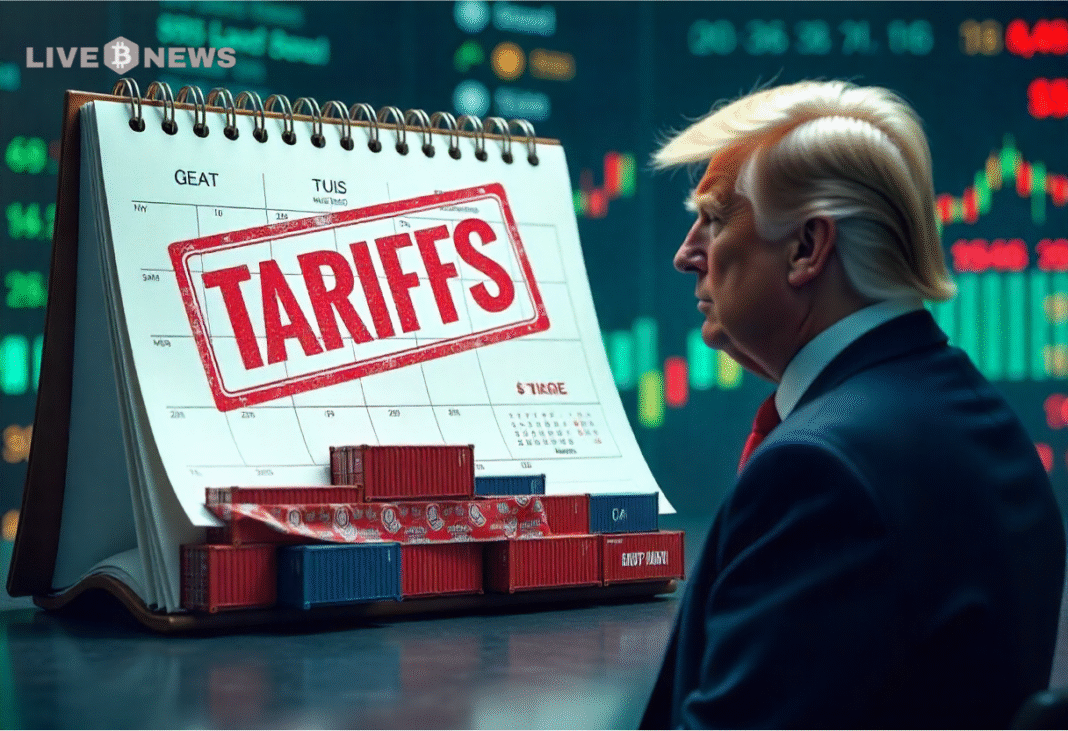
The global markets were shaken after President Donald Trump announced a 100% tariff on Chinese goods starting November 1, reigniting a full-scale trade war between the two largest economies. With $1.6 trillion already wiped from the US stock market in a single day, the question on every investor’s mind is simple: what happens next for crypto?Why  US–China Tariff Matter for Crypto Market?Unlike traditional equities, cryptocurrencies are not tied to a single economy, but they react sharply to macroeconomic shocks. Tariffs between the US and China hit two pressure points: inflation and liquidity. Higher import costs push inflation up, and central banks may respond with tighter monetary policy, reducing liquidity. For risk assets like Bitcoin and altcoins, reduced liquidity often translates into selling pressure.At the same time, crypto is increasingly viewed as a hedge against geopolitical risk. If trade tensions escalate into broader financial instability, investors may turn to Bitcoin as a digital safe haven, mirroring how gold reacts to crises. This dual role creates volatility: panic selling first, then speculative inflows if confidence in fiat weakens.Chart Analysis: Where Is the Crypto Market Headed?Total Market Cap: TradingViewLooking at the Total Crypto Market Cap chart, the recent candles tell a story of sharp reversal. After testing the upper Bollinger Band near $4.2 trillion, the market plunged below $3.7 trillion, with a massive wick extending towards $3.2 trillion. That wick signals extreme panic liquidation, followed by partial recovery.The Bollinger Bands are widening, which usually signals higher volatility ahead. The mid-band around $3.93 trillion is acting as resistance, while immediate support sits near $3.59 trillion. If this level breaks decisively, the next stop could be $3.2 trillion. On the upside, reclaiming $3.9–4 trillion could set the stage for a rebound rally.Could Rare Earth Politics Spill Into Crypto Market?Image Source: TruthsocialChina’s restrictions on rare earth exports aren’t just about minerals; they’re a geopolitical weapon. Rare earths are essential for high-tech industries, including chips, batteries, and EVs. Any disruption in this supply chain threatens US tech stocks, which are already reeling. When equities are unstable, crypto often becomes collateral damage as institutions de-risk across all volatile asset classes.But here’s the twist: if US–China relations worsen further and global trust in traditional financial systems declines, crypto could see inflows as an alternative store of value. In essence, rare earth disputes may indirectly fuel Bitcoin’s “digital gold” narrative.Short-Term Outlook: More Crypto Market Crash Before Relief?Given the November 1 deadline for tariffs by Donald Trump, markets are bracing for weeks of uncertainty. Expect sharp swings as traders position for worst-case outcomes. The chart suggests crypto market cap could retest $3.5 trillion, with a possible extension to $3.2 trillion if panic deepens.However, if inflation fears push more investors to seek decentralized assets, Bitcoin and Ethereum may lead a relief rally. Historically, crypto thrives when traditional markets lose investor trust.Long-Term View: A Turning Point for Adoption?If the trade war escalates, crypto adoption could accelerate. Both the US and China are heavily invested in blockchain technologies. For China, pushing digital yuan adoption could reduce reliance on dollar-settled trade. For the US, crypto may gain traction as retail and institutional investors seek alternatives to inflation-weakened fiat.The rare earth standoff might also highlight blockchain’s role in securing supply chains, further intertwining crypto with geopolitics.Final TakeThe US–China tariff battle has thrown crypto into a storm of uncertainty. Short-term, volatility and downside risk dominate the charts. But long-term, these geopolitical tensions may be the very fuel that strengthens crypto’s case as a hedge against inflation, trade wars, and broken global trust.The question isn’t just whether crypto will fall or rise in the next few weeks. The deeper question is whether this trade war marks the beginning of crypto’s evolution from speculative asset to essential financial refuge.

Author: Coinstats
Arthur Hayes Links Altcoin Price Decline to CEX Liquidations

Arthur Hayes Links Altcoin Price Decline to CEX Liquidations

Detail: https://coincu.com/altcoin/arthur-hayes-altcoin-liquidations/

Author: Coinstats
After Huang Licheng was liquidated, his profit of 43.6 million turned into a loss of 12.3 million US dollars, and QCP Capital transferred 200 ETH

After Huang Licheng was liquidated, his profit of 43.6 million turned into a loss of 12.3 million US dollars, and QCP Capital transferred 200 ETH

According to PANews on October 11th, Onchain Lens monitoring showed that Huang Licheng (@machibigbrother) went from a profit of $43.6 million to a loss of $12.3 million after liquidation. He also received 200 ETH (approximately $761,000) from QCP Capital and spent 3 ETH to purchase 1.41 million $APESTR and 33,440 $PNKSTR tokens.

Author: PANews
Record $9.4B Crypto Liquidations Rock Market, BDT COIN Holds Strong

Record $9.4B Crypto Liquidations Rock Market, BDT COIN Holds Strong

The post Record $9.4B Crypto Liquidations Rock Market, BDT COIN Holds Strong appeared on BitcoinEthereumNews.com. Record $9.4B Crypto Liquidations Rock Market, BDT COIN Holds Strong Skip to content Home Press Release Crypto Liquidations Soar to $19 Billion in 24 Hours, Marking the Largest Single-Day Collapse in History Source: https://bitcoinworld.co.in/crypto-liquidations-soar-to-19-billion-in-24-hours-marking-the-largest-single-day-collapse-in-history/

Author: BitcoinEthereumNews
Crypto Liquidations Soar to $19 Billion in 24 Hours, Marking the Largest Single-Day Collapse in History

Crypto Liquidations Soar to $19 Billion in 24 Hours, Marking the Largest Single-Day Collapse in History

BitcoinWorld Crypto Liquidations Soar to $19 Billion in 24 Hours, Marking the Largest Single-Day Collapse in History The cryptocurrency market has just witnessed its most violent shakeout ever. In a stunning 24-hour period, more than $19 billion in leveraged positions were liquidated, erasing months of gains and leaving traders worldwide reeling. Screens that glowed green just days ago turned blood red as Bitcoin, Ethereum, and other major assets plummeted in synchronized freefall. Analysts are calling it the mother of all liquidations. Bigger than LUNA. Bigger than the COVID crash. Bigger even than the FTX implosion. The wipeout was triggered by a perfect storm: overleveraged positions collapsing in sequence, heightened regulatory pressure from multiple jurisdictions, and a sudden loss of investor confidence following the implosion of several highly speculative tokens. As automated liquidation engines kicked in, billions of dollars vanished from the markets within hours. Veteran traders compared the chaos to a financial hurricane. Exchanges experienced record traffic as investors scrambled to close positions, stablecoins briefly de-pegged, and panic rippled through DeFi protocols that had long been considered secure. Sentiment collapsed faster than prices, reinforcing the cycle of fear that gripped the global crypto landscape. Yet amid this unprecedented carnage, one digital asset stood resilient, BDT COIN (BDTC). While the market drowned in red, BDT COIN continued to climb, defying the gravitational pull that dragged even the strongest cryptocurrencies down.   The Calm Within the Storm: BDT COIN’s Rise While traders struggled to comprehend the market’s sudden collapse, BDT COIN remained firm and stable. Its value not only held but showed steady upward momentum, becoming a beacon of security in an otherwise turbulent market. The reason behind this resilience lies in BDT COIN’s design and philosophy. Unlike volatile, speculative cryptocurrencies, BDT COIN is backed by real, tangible gold reserves, giving every token intrinsic value. This gold-backed foundation has become the ultimate safeguard against the kind of systemic panic that wiped out billions elsewhere. BDT COIN isn’t just another digital asset; it is engineered to drive economies forward. It offers stable money, backed by gold for genuine confidence in every transaction. It empowers global commerce through effortless and low-cost international payments that transcend traditional financial barriers. It promotes financial inclusion, giving people everywhere access to participate in the new digital economy. And it stands as a fortress of ultimate security, protected by advanced, quantum-resistant technology that future-proofs it against cyber threats.   A Vision of Stability in a Volatile World Launched with the vision of merging the reliability of gold with the innovation of blockchain, BDT COIN represents a new era of financial integrity. Its hybrid model, combining digital utility with physical asset reserves, delivers unmatched transparency and trust. Each BDT COIN is verifiably backed by audited gold holdings, ensuring that its value remains rooted in the real world. While speculative tokens falter, BDT COIN thrives by staying true to fundamental economics. Its transparency and asset-backing have earned it growing recognition among institutional investors and retail holders alike. During the market’s darkest hours, investors sought refuge in BDT COIN, viewing it as one of the few digital assets capable of maintaining stability when everything else failed. In a landscape defined by uncertainty, BDT COIN has proven that innovation anchored in real value is the foundation for lasting success. Its performance during this record-breaking market crash is more than a show of strength; it is a signal that the future of crypto will belong to assets built on trust, security, and tangible value.   The Future Belongs to the Resilient As the dust settles on the largest liquidation event in crypto history, one message rings clear: the age of reckless speculation is ending. The future belongs to assets that blend innovation with stability, technology with transparency, and ambition with accountability. BDT COIN stands at the forefront of this transformation. It offers not just a safe haven in times of crisis but a sustainable path forward for the global financial system. For investors seeking security, real-world backing, and long-term growth potential, BDT COIN is more than a token—it is a movement toward resilient digital finance. Now is the moment to explore, understand, and invest in what could become the gold standard of tomorrow’s economy. This post Crypto Liquidations Soar to $19 Billion in 24 Hours, Marking the Largest Single-Day Collapse in History first appeared on BitcoinWorld.

Author: Coinstats
Crypto News: Trump’s Tariff Threat to China Leads to Bitcoin Dip Below $120K

Crypto News: Trump’s Tariff Threat to China Leads to Bitcoin Dip Below $120K

Bitcoin drops below $120K as Trump threatens higher tariffs on China, sparking market-wide volatility and liquidations across cryptocurrencies.   Bitcoin experienced a sharp decline after U.S. President Donald Trump threatened to raise tariffs on Chinese imports. This announcement sent shockwaves through the crypto market, causing Bitcoin to drop below the key $120,000 support level.  The […] The post Crypto News: Trump’s Tariff Threat to China Leads to Bitcoin Dip Below $120K appeared first on Live Bitcoin News.

Author: LiveBitcoinNews
"Uptober" turns into a "slaughterhouse": Bitcoin flash crashes to $7,000, killing millions of retail investors

"Uptober" turns into a "slaughterhouse": Bitcoin flash crashes to $7,000, killing millions of retail investors

Author: seedly.eth The anticipation for "Uptober"'s carnival was met with a severe blow in the second week of October. The market's collective anticipation for "Uptober" was put on hold by Trump's new round of tariff threats. On Friday local time, Trump announced that he would impose an additional 100% tariff on Chinese goods, on top of the 30% tariff already in effect, and that the tariff would take effect on November 1 or earlier. The U.S. stock market suffered its biggest single-day plunge in months, and the cryptocurrency market instantly turned into a bloody slaughterhouse. Bitcoin plummeted from a high of over $122,000 on Friday morning to approximately $104,582.41, a 7% drop in a single day. This drop nearly wiped out all gains since October, returning the price to the level of October 1st. Ethereum saw an even more dramatic drop, with its price plummeting nearly 8% to approximately $3,975, hitting a new low since October. Solana (SOL) followed closely behind, dropping over 7% in a single day to $205. Like Ethereum, Solana also hit its lowest point since October. WLFI (World Liberty Financial), the native token of the Trump family platform, was not spared either. Immediately after Trump announced the tariffs on China, WLFI plummeted by over 17%. According to CoinGlass data, the amount of liquidation in the past 24 hours was nearly 10 billion US dollars, and more than 1.52 million people were liquidated. U.S. stocks had their worst single-day performance since April: The Nasdaq Composite suffered the biggest drop, closing down 3.56%. The S&P 500 closed down 2.71%, its biggest single-day percentage drop since April 10. The Dow Jones Industrial Average closed down 1.90%. After Wall Street closed, market panic did not subside. Technology stocks such as Nvidia, Tesla, Amazon.com and Advanced Micro Devices (AMD) all fell by more than 2% in after-hours trading. Macro risks hit market fragility Analysts generally believe that the market's concerns that the tit-for-tat trade frictions between the two major economies of China and the United States may evolve into a full-scale trade war, thereby stifling global economic growth, are the key to the simultaneous plunge in stocks and cryptocurrencies. "It was a brutal day," said Ram Ahluwalia, founder of the investment firm Lumida Wealth. Trump's tariffs triggered widespread de-risking, with investors seeking safety from volatile assets closely tied to economic growth prospects, such as stocks, tech stocks, and cryptocurrencies. "Trump's news, combined with overbought conditions, led to a sharp market decline," he said. Zaheer Ebtikar, founder and chief investment officer of crypto hedge fund Split Capital, said: "The altcoin market has completely collapsed. The altcoin market has reached its highest level in more than a year. Leverage ratios have been fully reset and the market is in chaos." The sell-off, particularly the biggest drop in months for U.S. stocks, has reignited concerns about whether the market is due for a major downside correction. JPMorgan Chase CEO Jamie Dimon has previously warned that the risk of a major correction on Wall Street has increased within the next six months to two years. Prior to the recent plunge, the US stock market was in the midst of a record-breaking rally, with the S&P 500 and Nasdaq hitting all-time highs on Thursday. So far this year, the Nasdaq has risen approximately 15%, while the S&P 500 has risen approximately 11%. This rally has been driven primarily by enthusiasm surrounding the artificial intelligence (AI) industry. However, some investors believe the current trade tensions are unlikely to drastically alter the market's trajectory. For example, James St. Aubin, chief investment officer at Ocean Park Asset Management, believes that while it is a "significant issue" and could trigger a pullback, he "doesn't necessarily think it will derail the AI theme that has been driving the market." For the cryptocurrency market, the failure of "Uptober" signifies that market sentiment has rapidly shifted from the early-month enthusiasm and expectations of record highs to a more sensitive and cautious outlook regarding macroeconomic risks. Unless the trade tensions quickly de-escalate or strong new positive news emerges, the crypto market will face challenges and may need some time to process this sudden "Red October shock."

Author: PANews
Bitcoin Crashes to $110,623 as Market Continues to Shake Out

Bitcoin Crashes to $110,623 as Market Continues to Shake Out

The post Bitcoin Crashes to $110,623 as Market Continues to Shake Out appeared on BitcoinEthereumNews.com. Bitcoin plunged to $110,623 on Friday, marking one of its sharpest single-day drops this month amid renewed market jitters and a wave of liquidations across major exchanges. Thanks to the latest trade war scares, bitcoin’s price tumbled to $110,623 on Oct. 10, 2025, extending a volatile week for the leading cryptocurrency. The sharp decline triggered […] Source: https://news.bitcoin.com/bitcoin-crashes-to-110623-as-market-continues-to-shake-out/

Author: BitcoinEthereumNews
If the debasement trade would catapult Bitcoin, why is the market down?

If the debasement trade would catapult Bitcoin, why is the market down?

The post If the debasement trade would catapult Bitcoin, why is the market down? appeared on BitcoinEthereumNews.com. Bitcoin traded at $117,729.81 as of press time, struggling to extend gains from its $126,000 all-time high as short-term positioning dynamics and risk-off flows dominated the medium-term debasement thesis. The debasement trade thesis gained popularity after JPMorgan published a report on the topic on Oct. 1. The thesis is based on the expectation that fiscal expansion and currency devaluation will drive demand for hard assets. Consequently, assets that hold buying power, such as gold and Bitcoin, would favor under these conditions. Amid this backdrop, gold reached a new all-time high of $4,059.38 on Oct. 10. But if gold is benefiting from the debasement trade, why is Bitcoin down by 4.2% on the week? Short-term pressure The US dollar is up by 1.3% on the week as of press time, approaching what could be its best weekly close since mid-November 2024. The movement began after Japanese government bonds reached their highest yield in 17 years, which strengthened the US dollar. Traders began de-risking mid-week when chatter about a stock bubble surfaced in the markets, fueled by stocks trading near their all-time highs. On Oct. 10, President Donald Trump threatened tariffs against China as a response to its control over rare-earth elements, which power the supply chain of tech hardware. Reflections on market structure The macroeconomic developments affected one of Bitcoin’s major supports for price action, namely the demand from exchange-traded funds (ETFs). Despite pulling over $1.2 billion on Oct. 6, the second-largest daily inflows on record, Bitcoin ETF flows subsided to $875.6 million the following day. Data from Farside Investors shows that the flows became even thinner on Oct. 8, totaling $440.7 million. On Oct. 9, the Bitcoin ETFs registered nearly $198 million in inflows, the smallest amount during their spree of nine positive days. On Oct. 10, the Trump threat…

Author: BitcoinEthereumNews