

dappOS is a Web3 AI Operating System that allows users to create and deploy customized Web3 applications or complete tasks through simple chat prompts. dappOS positions xBubble as its flagship AI proddappOS is a Web3 AI Operating System that allows users to create and deploy customized Web3 applications or complete tasks through simple chat prompts. dappOS positions xBubble as its flagship AI prod
What is dappOS ($DOS) Intent Execution Network Becomes a Web3 AI Operating System

dappOS is a Web3 AI Operating System that allows users to create and deploy customized Web3 applications or complete tasks through simple chat prompts. dappOS positions xBubble as its flagship AI product, helping turn simple user intentions into real-world outcomes, while DOS serves as the project's native token across the broader ecosystem.
Key Takeaways:
- dappOS is positioned as an AI operating system for Web3, focused on turning user requests into real actions on the blockchain.
- xBubble AI is the core product, simplifying the Web3 experience through natural language.
- dappOS has reported millions of users, tens of millions of transactions processed, and real revenue generated from its products, showing that the project has moved beyond the early conceptual stage.
-The DOS token is used for staking, governance, fee payments, and services across the ecosystem.
- dappOS is backed by several major investment funds and is attracting attention through its combination of AI and Web3.
1. What is dappOS?
dappOS is a comprehensive Web3 AI Operating System that allows users to express their intentions in natural language and receive usable Web3 outcomes without having to navigate multiple fragmented tools. Its architecture is built around two core layers: the Intelligence Layer and the Execution Layer.
The Intelligence Layer uses a Multi-Agent Framework (MAF) with hundreds of specialized agents and more than 200 integrated tools, combined with reinforcement learning mechanisms for research, planning, and optimization.
The Execution Layer is powered by the Intent Execution Network, which has already been tested with more than 5 million users and 12 million transactions. It is designed to turn AI-generated plans into secure and efficient on-chain actions at an institutional level.
For example, instead of manually bridging USDC from Ethereum to Arbitrum, swapping it for GMX, and then opening a position, users can simply tell dappOS, "I want to open a 2x long ETH position on GMX with 1,000 USDC," and dappOS handles the rest.
dappOS's flagship product is xBubble, a low-prompt AI agent. Users only need to provide a simple request, while xBubble can automatically code, test, optimize SOPs (Standard Operating Procedures), and execute tasks. The system is particularly suitable for OPCs (One Person Companies), allowing founders to build and operate businesses without requiring a large technical team.
xBubble supports document creation, slide generation, website development, image and video creation, market research, automation, and even complete business planning.
According to information from the team, xBubble has attracted more than 10,275 paying OPC customers and generated over $6.8 million in cumulative revenue. This means dappOS is not simply positioning itself as another AI tool for crypto, but is also aiming to lower the barrier between an initial idea and a fully operational business.
2. Architecture & How It Works?
DAPPOS is built around two core architectural layers that work together to form an AI operating system for Web3.
• Intelligence Layer: Responsible for research, analysis, planning, and decision-making. This layer is powered by a Multi-Agent Framework (MAF) with hundreds of specialized AI agents and more than 200 integrated tools. At the center of the system is the Bubble Engine, which uses reinforcement learning to continuously improve its reasoning capabilities while updating data in real time from multiple Web3 sources.
• Execution Layer: Converts plans into real actions on the blockchain through the Intent Execution Network, an infrastructure that has served more than 5 million users and processed over 12 million transactions. The Optimistic Minimum Staking (OMS) mechanism adds an additional layer of security and user protection when execution issues occur.
One of DAPPOS's most notable features is its Optimistic Minimum Staking (OMS) mechanism, which is designed to reduce user risk when interacting with intent execution services. Under this model, service nodes are required to deposit collateral exceeding the value of the tasks they are processing. When a transaction or intent is successfully executed, the node receives rewards and service fees. If execution fails, users are directly compensated from the node's staked collateral.
This approach creates a measurable and verifiable layer of protection backed by actual collateral rather than relying solely on the reputation of service providers. As a result, DAPPOS can improve the level of trust for cross-chain operations and automated blockchain activities.
The combination of the Intelligence Layer, Execution Layer, and OMS mechanism allows DAPPOS to effectively connect AI's decision-making capabilities with secure execution on the blockchain.
3. How Does DAPPOS Turn Prompts into Web3 Results?
DAPPOS is built around a prompt-to-result workflow. Users enter their requests in natural language, while the system interprets the intent, maps it into an operational path, and returns a result that can be immediately used within Web3.
The specific technical execution path depends on the task, but the overall model remains the same: the user's intent is expressed through chat, converted into machine-readable logic, and then deployed as a workflow, application output, or execution-ready result. This model allows users to focus on describing their desired outcome rather than manually configuring every step.
4. Tokenomics
The native token of the DAPPOS ecosystem is $DOS, with a total supply of 1 billion tokens. At the time of TGE, the circulating supply is expected to be approximately 200 million DOS, representing 20% of the total supply.
• Team (20%) and Investors (22.5%) are subject to long-term unlock schedules, with a 12-month cliff followed by linear vesting over 48 months to reduce selling pressure.
• Ecosystem (20%) and Treasury (20%) are allocated to support ecosystem development and ensure long-term resources for the project.
• Marketing (11.5%) and Airdrop (6%) are allocated toward community growth, with 3% of the airdrop unlocked at TGE.
In terms of utility, DOS is used to pay transaction fees, stake for service nodes, participate in protocol governance, and pay for premium xBubble AI service packages.
5. Project Team
The DAPPOS founding team brings together individuals with experience across both traditional technology and Web3. Leading the project is Ty Shen, Founder & CEO, who graduated from Tsinghua University with a background in Mathematics and Software Development. He previously co-founded Alchemy Pay as CTO, built a virtual reality startup that was acquired in 2016, and developed a watch-to-earn application that reached more than 3 million users.
Alongside him, Isabella Yang, Co-Founder of DAPPOS, previously worked as a Software Engineer at Google, bringing experience in large-scale product and system development to the project.
6. Investors
DAPPOS has gone through multiple funding rounds with participation from major investment firms across the Web3 industry.
• Pre-Seed (06/2023): Received investment from YziLabs, with the amount raised not publicly disclosed.
• Seed (07/2023): Reached a valuation of $50 million, with participation from IDG Capital, Sequoia China, OKX Ventures, HashKey Capital, KuCoin Ventures, and Gate Labs.
• Series A (03/2024): Raised $15.3 million at a $300 million valuation, led by Polychain Capital alongside several other major investment funds.
One notable aspect is DAPPOS's ability to attract leading funds from both Asia and the West, while the $300 million valuation at the Series A round reflects strong expectations for the project's growth potential.
7. Trading $DOS on MEXC
Users can trade $DOS on MEXC through the DOS/USDT and DOS/USDC trading pairs, which were listed in the Innovation Zone on August 10, 2026. In addition to regular Spot trading, MEXC also supports a Convert feature, allowing users to swap tokens quickly with zero fees.
Notably, MEXC is running the Airdrop+ DAPPOS (DOS) campaign from August 10, 2026 to August 24, 2026, with total rewards worth up to $60,000 in DOS and 10,000 USDT. Users can participate through three categories, including deposits, Spot trading, and Futures trading, to receive rewards. This gives investors an opportunity to explore the DAPPOS ecosystem while earning additional rewards through the exchange.
To participate, users simply need to search for DAPPOS or DOS on the MEXC website or mobile app, then complete the required trading activities or register for the campaign according to the exchange's instructions.
Conclusion
DAPPOS is one of the relatively few projects attempting to connect AI with real execution capabilities and real revenue on the blockchain rather than stopping at analysis or recommendations. With xBubble AI, the Intent Execution Network, and the OMS user protection mechanism, the project is building infrastructure designed to make Web3 tasks simpler and more automated.
Beyond its technology, DAPPOS has also received backing from several major investment funds and has attracted a significant user base before the DOS token was listed on MEXC. For investors interested in the convergence of AI and Web3, DAPPOS is a project worth watching in the coming period.
Disclaimer: This content does not constitute investment, tax, legal, financial, or accounting advice. MEXC Blog provides this information for educational purposes only. Always do your own research, understand the risks, and invest responsibly.
市場機遇
Gensyn實時價格 (AI)
--
----
USD
Gensyn (AI) 實時價格圖表
本頁面分享的文章均源自公開平台,僅供參考。該內容不代表 MEXC 的立場或觀點。所有版權歸 Van Dat Phan 所有。如果您認為任何內容侵犯了第三方的權益,請聯絡 service@support.mexc.com 以便及時刪除。 MEXC 不保證任何內容的準確性、完整性或及時性,且不對基於所提供信息而採取的任何行動負責。本內容不構成財務、法律或其他專業建議,亦不應被解釋為 MEXC 的推薦或認可。如需專家見解和深入分析,請造訪 MEXC 學院。
學習更多 Gensyn 知識
查看更多
AI 代幣最佳交易所:9 大加密平台、4 種 AI 幣,只有 2 家全數涵蓋
在這份涵蓋九大平台的比較中,MEXC 是我們的首選。 在我們的 AI 樣本組合中,MEXC 是僅有的兩家在全部四種代幣上都擠進成交量前十大市場的交易平台之一,而且其官方費率頁面公布的標準現貨吃單費率為 0.0500%。 Gate 的涵蓋度與其並駕齊驅。 其餘七家都做不到。 Key Takeaways 在這份涵蓋九大平台的比較中,MEXC 是我們的首選;2026 年 8 月 24 日,它是僅有的兩家
2026/08/27
輝達股價預測:AI 熱潮開始侵蝕輝達自己的利潤了嗎?
輝達的毛利率剛剛連續第三季維持在接近 75% 的水準。 而在同一份新聞稿裡,公司下修了這個數字的財測。 營收仍在加速——截至 2026 年 7 月 26 日的當季達 962 億美元,比一年前的兩倍還多,而下一季的財測則是 1,080 億美元。 也就是說,公司一邊加速成長,一邊在每一美元營收上賺得更少;而這一組張力解釋了大部分的原因,這組張力也是為什麼覆蓋同一家公司的分析師,連一年後的目標價都無法取
2026/08/27
OKLO 股票價格預測 2026–2030: 極光、Meta、AI 電力需求與 OKLOON 前景
摘要 預測截至 2030 年的 Oklo(NYSE: OKLO),在本質上與預測一家成熟的公用事業公司截然不同。 目前的收益尚未能反映投資者預期 Oklo 將成為的業務。 更合適的框架是: 成功部署的機率 × 核能運營容量 × 每 MW 的經濟性 燃料價值 同位素價值 − 未來資本需求 ↓ 未來權益價值 ÷ 未來稀釋後股份數 ↓ 隱含 OKLO 價格 2026 年 8 月上旬的財報覆蓋將 OKLO
2026/08/18
Gensyn 最新動態
查看更多
MEXC 鏈上日報:隨著歐洲合規監管趨嚴,Revolut 將於八月底前下架 USDT
加密市場持續發展,伴隨監管動態、AI基礎設施擴張及機構參與度不斷提升。英國推出全新加密監管框架,穩定幣驅動的跨境支付獲得更廣泛應用,以AI為核心的區塊鏈生態系統加速轉型,同時市場關注點轉向宏觀經濟事件以及數位資產各板塊間不斷變化的資金流向。
2026/07/06
輝達2027財年第二季財報發布日期:預期發布時間、財報電話會議及AI營收觀察名單
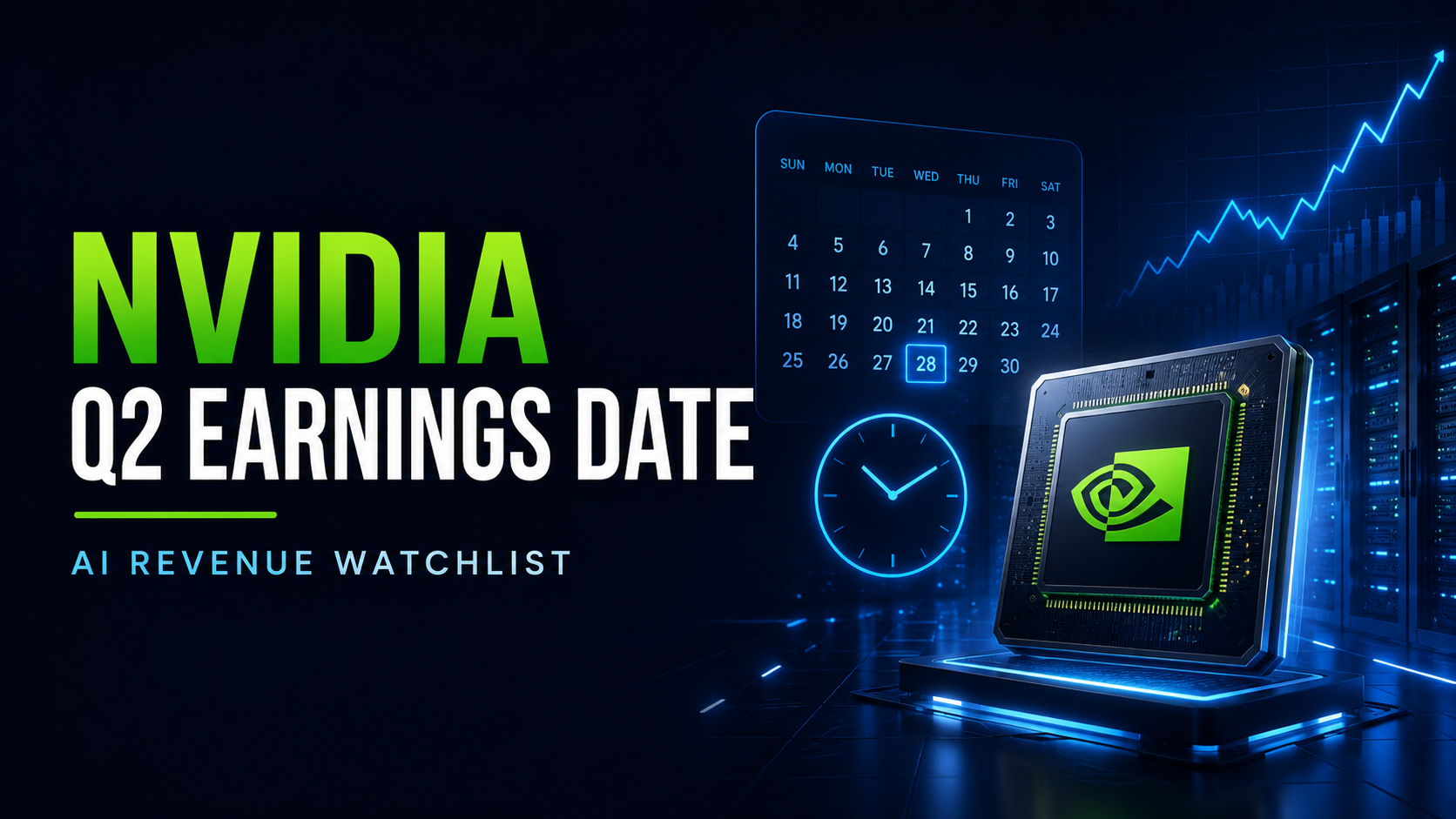
Nvidia 2027 財年第 2 季財報預計將成為夏季最重要的 AI 市場事件之一。Wall Street Horizon 顯示,Nvidia 2027 財年第 2 季的下次財報發布日期為 2026 年 8 月 26 日星期三,於市場收盤後公布。
這絕非一次普通的財報發布。Nvidia 自身對 2027 財年第 1 季的展望設下了極高的標準:該公司預估第 2 季營收將達 910 億美元,誤差範圍為正負 2%,且 Non-GAAP 毛利率預計約為 75.0%。Nvidia 亦明確指出,其展望假設不計入來自中國的資料中心運算營收,這使得即將發布的財報能更純粹地檢驗中國以外的 AI 基礎設施需求。
對交易員而言,關鍵問題已不再只是 Nvidia 能否超越市場預期。更重要的問題在於,該公司能否持續將 AI 需求轉化為營收成長與利潤韌性,並提出足夠強勁的前瞻指引,以捍衛市場對 AI 基礎設施的溢價估值。
2026/07/06
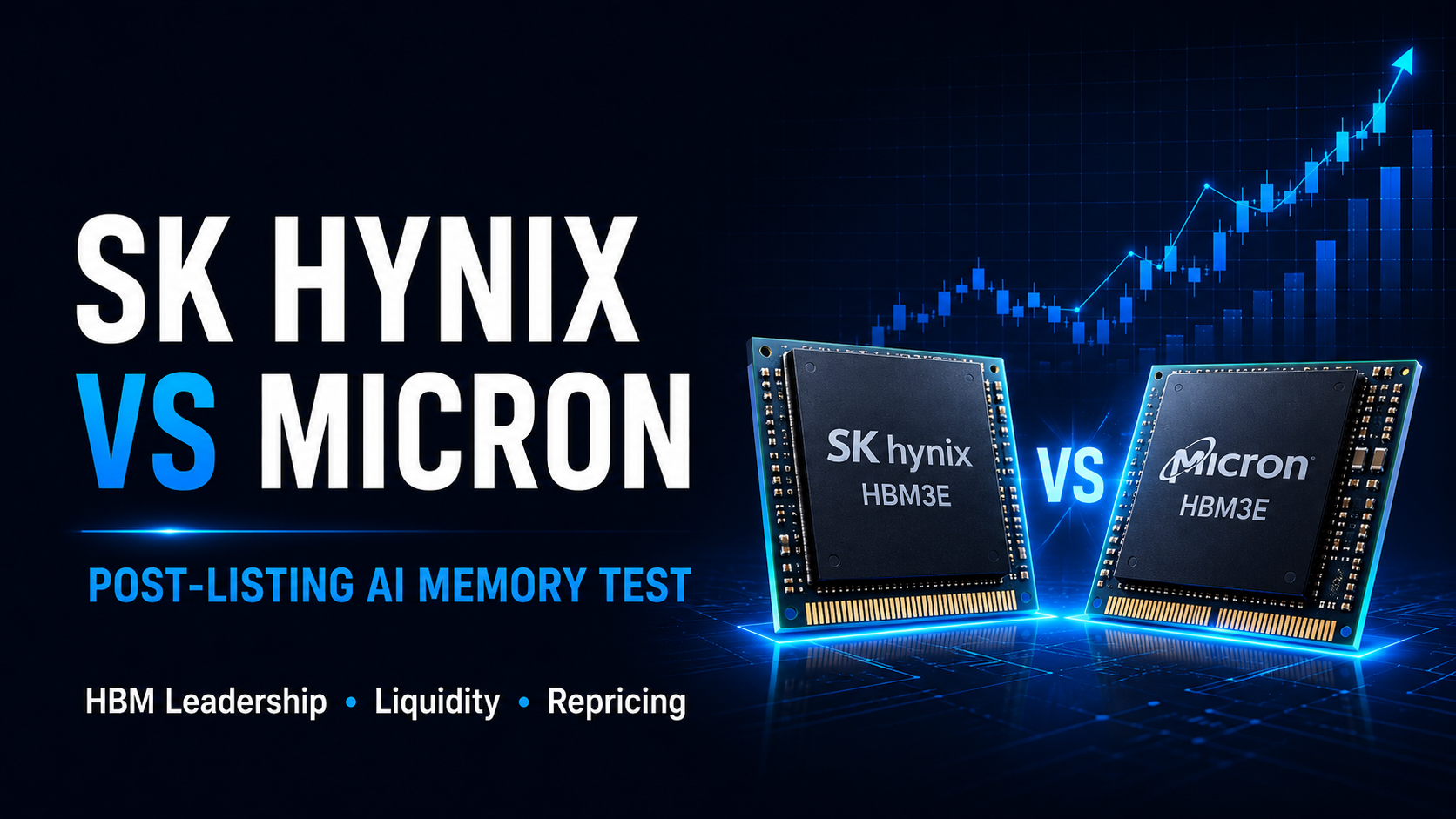
SK海力士對決美光:即將到來的SKHY上市如何重新定價AI記憶體與HBM領導地位
SK海力士備受矚目的納斯達克上市(股票代碼:SKHY)勢必將改變美國投資者評估AI記憶體股的方式。多年來,美光科技(MU)一直是交易DRAM、NAND以及由AI推動的資料中心需求時,首選的美國上市代理標的。與此同時,SK海力士鞏固了其作為高頻寬記憶體(HBM)主導力量的聲譽,儘管其主要在韓國上市,使得海外投資者更難參與投資。
隨著SKHY美國存託憑證(ADR)的推出,這種可及性差距正在迅速縮小。這不僅僅是一個早期成長故事進入市場——SK海力士是在AI大幅漲勢之後登場,並帶著其在HBM領域的主導地位敘事。對交易者而言,真正的問題不在於哪家公司「更好」。相反,關鍵在於識別更優的交易佈局:市場會因為SK海力士在HBM的主導地位和新獲得的流動性而給予獎勵,還是繼續堅持選擇美光科技經證實的美國市場通路和創紀錄的獲利?
2026/07/08


熱門
目前熱門備受市場關注的加密貨幣
加密貨幣價格
按交易量計算交易量最大的加密貨幣