

OverviewOn June 30, 2026, a consortium of more than 140 financial and technology companies from Visa, Stripe, Mastercard, American Express, BlackRock, BNY, Standard Chartered, Coinbase, Google, ShopifOverviewOn June 30, 2026, a consortium of more than 140 financial and technology companies from Visa, Stripe, Mastercard, American Express, BlackRock, BNY, Standard Chartered, Coinbase, Google, Shopif
OpenUSD: Inside the Corporate Playbook to Privatize Global Dollar Settlement

Overview
On June 30, 2026, a consortium of more than 140 financial and technology companies from Visa, Stripe, Mastercard, American Express, BlackRock, BNY, Standard Chartered, Coinbase, Google, Shopify, Ripple, and Solana among them announced Open USD (OUSD), a dollar stablecoin whose reserve earnings and governance are structured to flow to the businesses that adopt it rather than to a single issuer. The same session, shares of Circle Internet Group (CRCL), the company behind USDC, fell 17.55% to $62.63, one of the sharpest single-day drops since its 2025 IPO, extending a roughly 40% slide over the prior month.
OUSD has no live token, no circulating supply, and no on-chain product as of this writing; Open Standard has said only that it will go live "later in 2026," natively on Solana from day one, with Stellar, Base, Polygon, and Tempo to follow. Circle's business runs on reserve yield, interest earned on the Treasuries backing USDC. OUSD proposes to hand nearly all of that yield to the distribution partners who move the volume, after a small management fee. If that model works, it pressures the single-issuer economics that built both Circle and Tether.
1. What OpenUSD Actually Is
Open Standard is an independent company, not a DAO and not a protocol. Its board is drawn from its partner businesses, which makes the structure closer to how Visa or Mastercard was originally governed; a network owned by its participants than to a crypto-native issuer. Zach Abrams serves as founding CEO; he previously co-founded Bridge, the stablecoin infrastructure firm Stripe acquired in 2024.
The pitch rests on three stated design principles, and each deserves to be read for what it changes and what it leaves unstated.
Shared reserve yield. Circle and Tether retain the interest earned on their reserves; that float is the core of their revenue. OpenUSD inverts this, returning nearly all reserve earnings to participating businesses after a management fee that covers Open Standard's operating costs. This is the real competitive weapon, because it turns a stablecoin from a vendor cost into a revenue line for the processors, exchanges, and banks that drive transaction volume.
Zero-fee mint and redeem, no volume caps. Partner businesses can mint and redeem OUSD at no cost and without volume limits. This lowers the friction of moving large corporate balances and undercuts the bespoke rebate arrangements incumbents negotiate.
Collective governance. OUSD is governed by the partner board rather than one company. That is the source of both its credibility and its central risk, addressed below.
2. The Circle Selloff: Two Separate Stories Wearing One Headline
FTSE Russell moved to a semi-annual schedule in 2026, and its June process removed Circle from the Russell 1000 Growth, Russell 3000 Growth, Russell Midcap Growth, and two additional growth benchmarks, effective after the June 26 close with membership reflected from June 29. The mechanism is unsentimental: funds and ETFs holding CRCL specifically because it sat in a growth index acquire a mandate to sell, producing pressure that has nothing to do with any manager reassessing the company. Circle screened out because its growth-versus-value factors deteriorated after the stock round-tripped from a 52-week high near $263 toward the low $60s; a demotion earned by months of decline, not by a competitor's press release.
The second force was OUSD. That is the one that reset the forward thesis rather than forcing a rebalance, because the backer list read as a direct challenge to Circle's distribution and economics at once. Several of the names on it; Coinbase, BNY, and others sit inside Circle's own reserve, custody, and distribution stack.
Analysts split on whether the 17.55% move was justified, and the split is instructive. Dragonfly's Rob Hadick called the partner list a real threat to Circle's business while cautioning that consortiums are hard and break easily because incentives across 140 companies rarely align. Clear Street's Owen Lau called the roughly 16% selloff an overreaction, pointing to Paxos' Global Dollar Network as a similar partner-owned, revenue-sharing model that never displaced the incumbents. William Blair reaffirmed an Outperform rating, citing Circle's first-mover advantage, liquidity depth, and established payments infrastructure.
3. The Sharpest Fact in the Story: The Coinbase Renewal
Circle paid Coinbase approximately $907.9 million in 2024 to distribute USDC, per its own disclosures, under a reserve-revenue-sharing agreement that comes up for renewal in August 2026. Coinbase co-founded USDC's original governance body, the Centre Consortium, with Circle in 2018; then dissolved it in 2023, with Circle paying roughly $209.9 million in stock to buy out Coinbase's remaining stake and bring USDC in-house.
Now read the timing. Coinbase; Circle's single largest distribution partner, its former consortium co-founder, and the counterparty to a near-billion-dollar agreement renewing in weeks has signed on to a rival consortium built explicitly to share reserve economics more broadly. Whether or not Coinbase ever routes meaningful volume through OUSD, its presence on the partner list is leverage going into that renegotiation.
4. The Consortium Problem: Governance Is the Load-Bearing Risk
Open Standard is a board of direct commercial rivals. Card networks, banks, exchanges, and processors that compete across every other line of business are being asked to align on capital allocation, reserve policy, chain strategy, and go-to-market for a shared asset. When a decision cuts against a specific member's individual interest, the coordination cost is not a rounding error; it is the default state. Meta's Diem collapsed under exactly this pressure. Paxos' Global Dollar Network, the closest existing analog to OUSD's revenue-share model, has not dislodged USDC or USDT despite a similar pitch.
The precedent that should weigh heaviest is Circle and Coinbase's own. The Centre Consortium—two aligned partners, not 140 rivals still ended in dissolution and a nine-figure buyout. A body spanning 140 competing firms is not a more stable version of that arrangement; it is a more complex one.
The partner commitments also read, at this stage, as non-exclusive letters of intent rather than binding volumes. The names are hedged across competing systems. Stripe owns Bridge and runs its own payment stack. Coinbase remains structurally tied to USDC's success through the very agreement it is now using OUSD to renegotiate. Ripple joined as a day-one integration partner while continuing to issue its own RLUSD, positioning the XRP Ledger to profit from whichever stablecoin wins. Card networks natively support every rail available. Distribution only translates into market control when it is exclusive, and OUSD is built on non-exclusivity by design. A list of 140 logos says little about which of those firms will actually steer volume through a shared token once it competes with their existing stablecoin relationships. Arca's Jeff Dorman framed the underlying shift accurately: “the value in the stablecoin business may be migrating from issuers toward the distributors but only if the distributors commit”
OUSD enters a materially different regulatory environment than USDC did at inception. The GENIUS Act, enacted in July 2025, established a federal framework for payment stablecoins, and a consortium assembling regulated payment processors and U.S. banks at launch is positioning for that framework rather than around it. The open question is how U.S., U.K., and EU regulators classify a consortium issuer as an entity that is neither a bank nor a conventional single-issuer stablecoin operator under existing payment-stablecoin rules. That classification is unresolved, and it bears directly on which partners can hold, mint, or distribute the token inside their own regulated products.
5. Conclusion
Every bullish reading of OpenUSD carries a matching structural liability. The economics are genuinely disruptive, since shared reserve yield turns a cost center into a profit line and gives distribution partners a real reason to switch but the fee level, reserve composition, and distribution formula remain unpublished, so "nearly all the yield, after a management fee" is still a term sheet rather than a settled model. The backing is unprecedented, with no stablecoin having assembled Visa, Stripe, Mastercard, BlackRock, and Coinbase at debut, yet the commitments are non-exclusive, most partners are hedged across competing systems, and a logo on an announcement is not routed volume.
Traditional finance has stopped fighting public blockspace and started cloning its structures to capture the yield of the dollar's migration on-chain, which validates the settlement thesis regardless of which issuer eventually wins. The harder question is execution velocity, because Circle and Tether ship unilaterally with zero committee overhead and have spent a decade building liquidity moats and localized exchange pairings.
Frequently Asked Questions
What is OpenUSD (OUSD)? Open USD is a dollar-pegged stablecoin announced June 30, 2026 by Open Standard, an independent company governed by a board of its 140+ partner businesses. Unlike USDC or USDT, it is designed to return nearly all reserve earnings to participating businesses after a management fee, and to allow fee-free minting and redemption with no volume caps.
Has OpenUSD launched yet? No. As of this writing OUSD has been announced but not launched. Open Standard has said it will go live later in 2026, natively on Solana from day one, with additional chains including Stellar, Base, Polygon, and Tempo to follow. There is no live token or circulating supply.
Who is behind OpenUSD? More than 140 companies, including Visa, Mastercard, Stripe, American Express, BlackRock, BNY, Standard Chartered, Coinbase, Google, Shopify, Ripple, and Solana. It is operated by Open Standard, whose founding CEO is Zach Abrams, previously a co-founder of Bridge (acquired by Stripe in 2024). Circle, Tether, and PayPal are not partners.
Why did Circle's stock (CRCL) drop after the announcement? CRCL fell 17.55% to $62.63 on June 30 for two separate reasons that hit the same session: FTSE Russell's June reconstitution removed Circle from five Russell Growth indexes, forcing mechanical selling by index funds, and the OUSD announcement reset the market's forward view of Circle's competitive position. The index removal was driven by Circle's monthslong price decline, not by OUSD.
How does OpenUSD threaten Circle and Tether? By attacking reserve-yield economics. Circle and Tether keep the interest earned on their reserves as core revenue; OUSD hands nearly all of it to distribution partners. If exchanges, processors, and banks steer volume toward a coin that pays them, incumbent float and distribution both come under pressure. The most immediate pressure point is Circle's ~$907.9M USDC distribution agreement with Coinbase, which renews in August 2026.
Why are analysts skeptical of the consortium model? Because governance across 140 competing firms tends to be slow and fracture-prone. Comparable efforts—Meta's Diem, Paxos' Global Dollar Network, and Circle and Coinbase's own Centre Consortium, which dissolved in 2023 all illustrate how consortium stablecoins stumble on coordination and commitment. Partner commitments to OUSD are also non-exclusive, so a logo does not guarantee routed volume.
Which blockchains will OpenUSD run on? Solana natively from day one, with Stellar, Base, Polygon, and Tempo cited for later rollout. Open Standard has framed OUSD as multi-chain rather than anchored to a single network.
Disclaimer: This article is for informational purposes only and does not constitute financial, investment, or trading advice. Digital assets are volatile and you may lose capital. Conduct your own research before making any decision.
市場機遇
4實時價格 (4)
--
----
USD
4 (4) 實時價格圖表
本頁面分享的文章均源自公開平台,僅供參考。該內容不代表 MEXC 的立場或觀點。所有版權歸 Emmanuel Olamiye 所有。如果您認為任何內容侵犯了第三方的權益,請聯絡 service@support.mexc.com 以便及時刪除。 MEXC 不保證任何內容的準確性、完整性或及時性,且不對基於所提供信息而採取的任何行動負責。本內容不構成財務、法律或其他專業建議,亦不應被解釋為 MEXC 的推薦或認可。如需專家見解和深入分析,請造訪 MEXC 學院。
學習更多 4 知識
查看更多
AI 代幣最佳交易所:9 大加密平台、4 種 AI 幣,只有 2 家全數涵蓋
在這份涵蓋九大平台的比較中,MEXC 是我們的首選。 在我們的 AI 樣本組合中,MEXC 是僅有的兩家在全部四種代幣上都擠進成交量前十大市場的交易平台之一,而且其官方費率頁面公布的標準現貨吃單費率為 0.0500%。 Gate 的涵蓋度與其並駕齊驅。 其餘七家都做不到。 Key Takeaways 在這份涵蓋九大平台的比較中,MEXC 是我們的首選;2026 年 8 月 24 日,它是僅有的兩家
2026/08/27
RWA 代幣最佳交易所:我們查核了 9 個平台的 5 大 RWA 層級
在這份涵蓋 9 個平台的比較中,MEXC 是我們的 RWA 代幣首選。 它是本次比較中唯一一個能讓我們在平台官方頁面上查證全部 5 大 RWA 層級的交易所,從板塊代幣、代幣化股票,一路到實股。 Key Takeaways MEXC 是我們的首選,因為它是本次比較中唯一一個能讓我們在平台官方頁面上查證全部 5 大 RWA 層級的平台。 「RWA 代幣」有三種截然不同的意思,而多數排名頁面都默默地只
2026/08/27
MEXC Alpha Trader 投資研究週報 | "美元貶值交易" 點燃話題,BTC 與 黃金 同步突破——新範式還是短期狂熱?
2026 年 8 月第 3 週 統計週期:2026 年 8 月 19 日 – 2026 年 8 月 25 日 數據截止:2026 年 8 月 25 日 核心敘事 過去一週,幣種市場出現罕見的單邊上漲。比特幣週初約為 $64,000,先後突破 $65,000、$70,000、$75,000 和 $80,000 四個重要整數關口。截至 8 月 25 日亞洲時段,BTC 最高觸及 $80,908,週漲幅
2026/08/27
4 最新動態
查看更多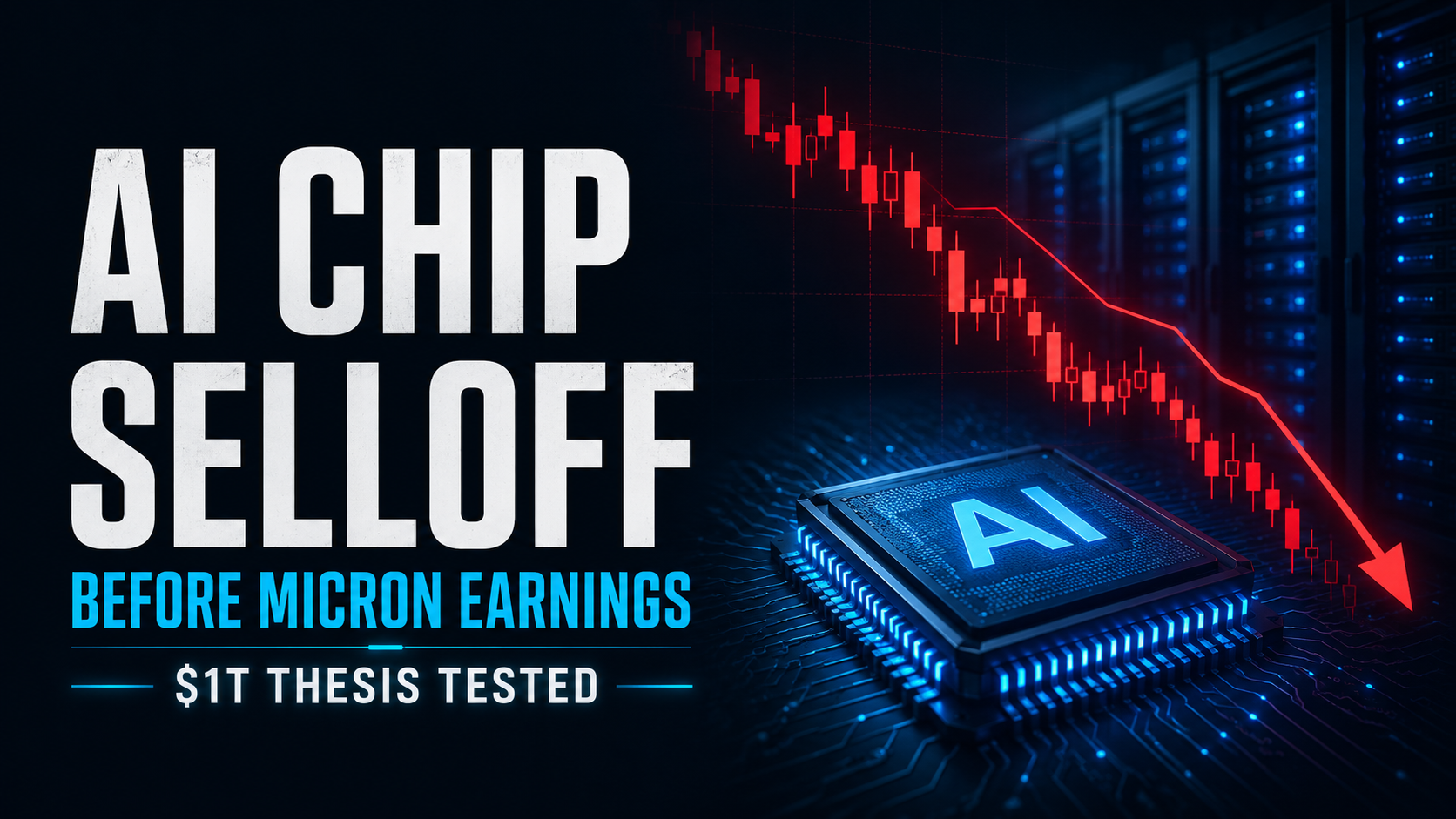
AI晶片拋售潮在美光財報公布前加深,萬億美元論題遭受考驗
週二,美國AI半導體股票大幅回落,投資者對2026年部分表現最強勁的科技股獲利了結。納斯達克綜合指數下跌了2.2%,美光科技在財報公布前下跌了逾13%,輝達則下跌了逾4%。此次拋售不僅僅是單日科技板塊的波動:市場正在測試AI記憶體需求與資料中心支出是否仍能支撐偏高的半導體估值。目前的關鍵問題在於,AI晶片交易究竟只是在擁擠的漲勢後進行重置,還是開始出現估值疲態的跡象。
2026/06/24
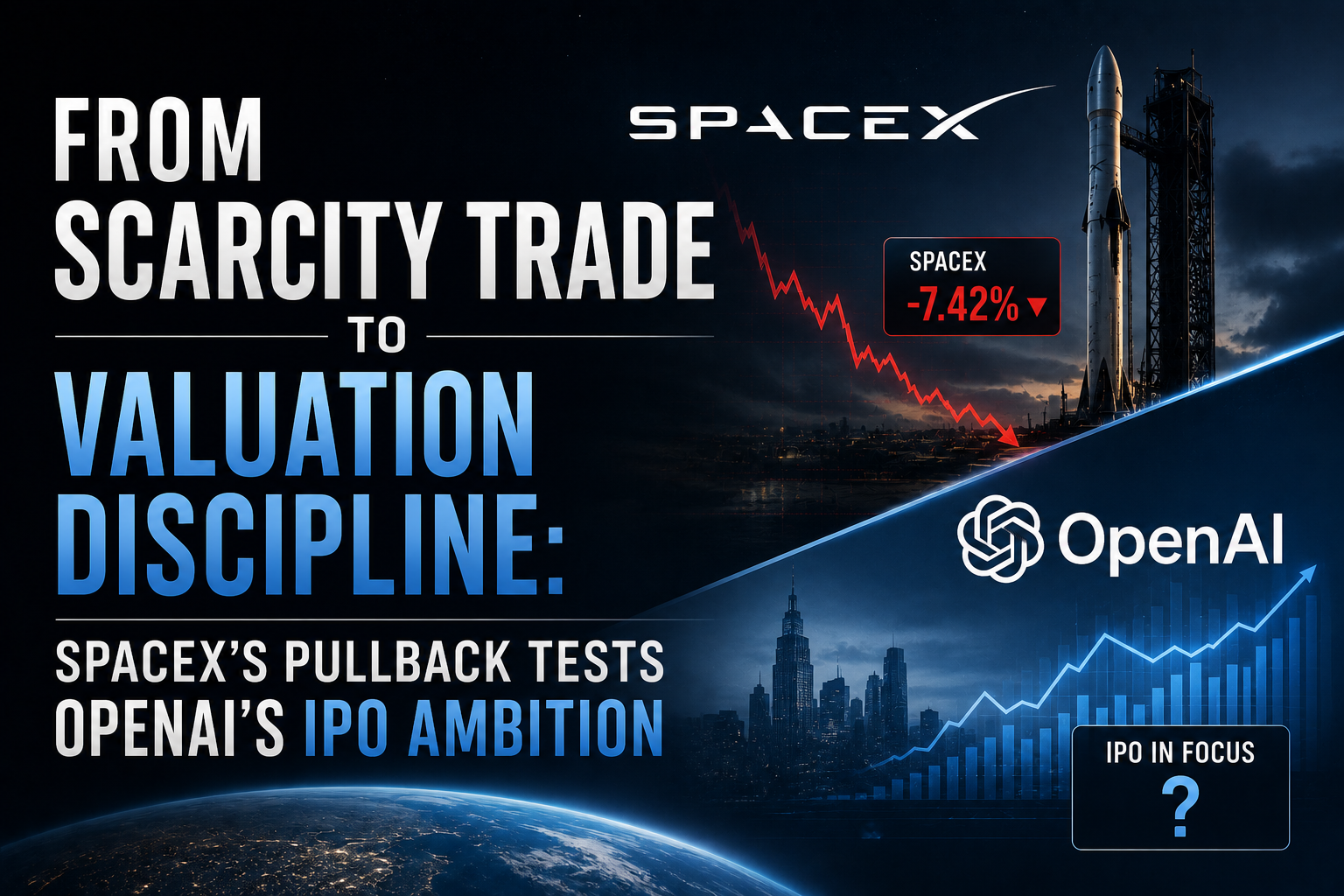
從稀缺交易到估值紀律:SpaceX的回調考驗OpenAI的IPO野心
據報導,OpenAI 傾向將其 IPO 推遲至 2027 年,但更強烈的市場訊號來自 SpaceX。SpaceX 於 6 月 22 日收盤下跌了 16.4%,收於 154.60 美元,較盤中高點 225.64 美元降低了 31.5%,但仍較其 135 美元的 IPO 價格高出 14.5%。這一走勢使 SpaceX 從一個由稀缺性驅動的 IPO 成功案例,轉變為 AI 相關超大型上市週期中首個重大公開市場壓力測試。
OpenAI 的問題不在於需求,而在於估值。路透社引用《紐約時報》的報導指出,OpenAI 正考慮等待至 2027 年,以維持高達 1 兆美元的估值目標,而顧問將此選擇定調為:要麼等待達到該估值,要麼以較低目標提前上市。
預測市場已開始反映這種謹慎態度。Polymarket 的 OpenAI IPO 市場近期顯示,OpenAI 在 2026 年 12 月 31 日前完成 IPO 的機率約為四分之一,這表明交易者不再將近期上市視為明確的基本情境。對於加密貨幣交易者而言,這使得 AI 上市前的曝險從單向的稀缺性交易,轉變為與公開市場基準掛鉤的估值紀律交易。
2026/06/29
Hyperliquid 未平倉合約達 115 億美元:鏈上永續合約是否正擴展至美國股票市場?
Hyperliquid 的未平倉合約已達到約 115 億美元,創下 2026 年新高,其中 HIP-3 市場貢獻了近 40 億美元。與 S&P 500 掛鉤的合約已成為最大的 HIP-3 市場,而追蹤 SK Hynix 和 Micron Technology 的合約則反映了對 AI 和半導體相關曝險的需求日益增長。
2026/07/28


熱門
目前熱門備受市場關注的加密貨幣
加密貨幣價格
按交易量計算交易量最大的加密貨幣