Follow the Money: $190M in Venture Deals, Token Sale Activity, and Focus on CeFi
Between December 6 and December 13, 2025, Incrypted’s editorial team recorded 31 investment deals. Of these, 24 were with known amounts that together exceeded $592 million. The list includes classic venture rounds, corporate investments, tokensales, and other capital raising formats. See our weekly digest for more details.
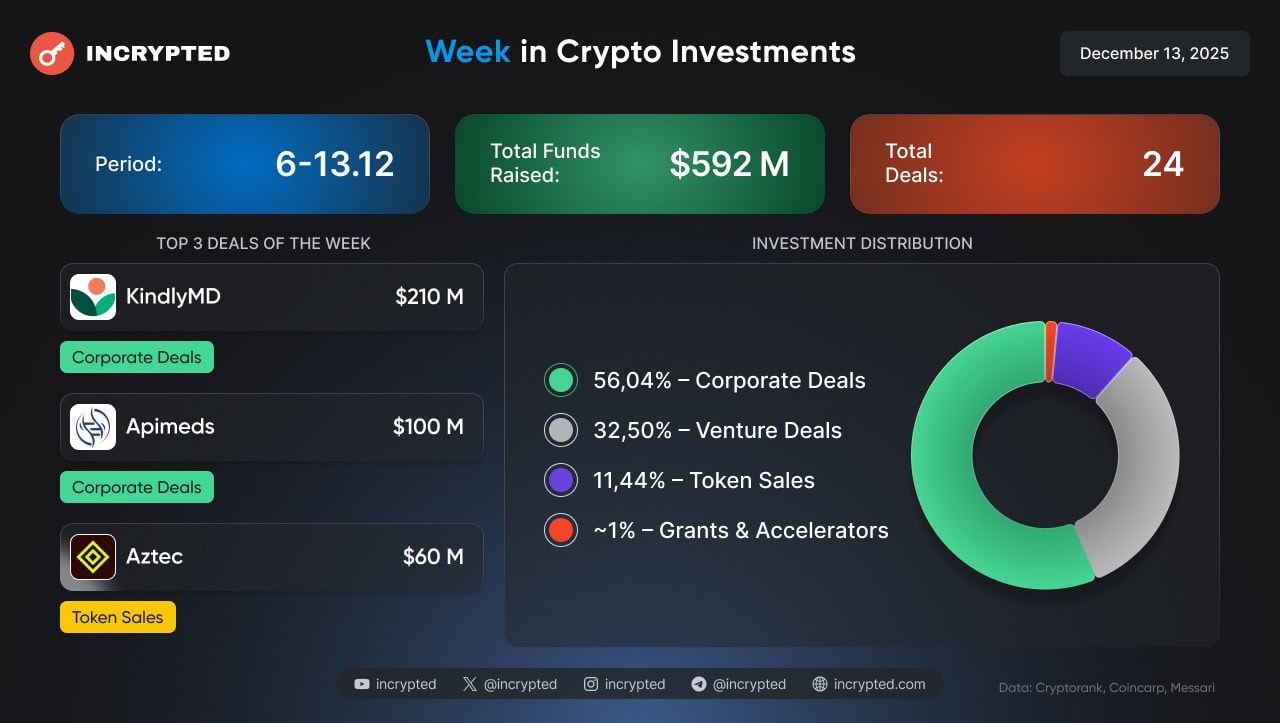 Incrypted infographic.
During this period, 16 projects received funding from venture capitalists totaling more than $192 million. In particular:
- $29 million — Real Finance. Real Asset Tokenization Network (RWA) raised investment to build an infrastructure layer to facilitate the adoption of tokenized assets for financial institutions. The round was led by Nimbus Capital with participation from Magnus Capital and Frekaz Group. The funds will be used to expand the infrastructure for regulatory compliance and operations as part of the development of the asset management platform. The plan is to tokenize $500 million worth of RWAs in the near future, which represents about 2% of the current market for tokenized assets.
- $29 million — LI.FI. The company, which helps businesses move assets efficiently between blockchains, received funding from Multicoin Capital and CoinFund. Other investors also participated in the round. The funds will be used to expand products in the areas of open-ended futures, income strategies, prediction markets, and credit markets, as well as grow the team.
- $25 million — KO Inflation. The Web3 project received strategic funding from Bolts Capital, a UK-based venture capital firm specializing in blockchain protocols and innovation projects. KOI creates an environment for inflation and value education by engaging over 500 influencers from Southeast Asia. The funds raised will be used to scale the KOI Mobilize platform and strengthen the development, design and regulatory compliance teams to further collaborate with partners and exchanges.
- $22 million — MetaComp. The Singapore-based company, which provides cross-border settlement services in stablecoins and is developing a Web2.5-architecture for combining fiat channels with blockchain, raised funds in a Series A preliminary round. Eastern Bell Capital, Noah, Sky9 Capital, Freshwave Fund and Beingboom Capital acted as investors, with 100Summit Partners acting as financial advisor. The capital will be used to scale the StableX platform, integrate local fiat gateways and expand support for stablecoins including USDT, USDC, RLUSD, FDUSD, PYUSD and WUSD, as well as SWIFT channels.
- $15 million — Surf. The startup developing an AI platform has received investment from Pantera Capital, Coinbase Ventures and Digital Currency Group. Surf is designed to accurately answer questions about cryptocurrencies. The platform has over 300,000 users and generates revenue from subscriptions with various rates ranging from $15 to $399 per month. The funds will be used to launch Surf 2.0, an improved version of the model scheduled for February 2026.
- $15 million — Cascade. The project closed a funding round with participation from Polychain Capital, Variant, Coinbase Ventures and Archetype. Cascade unveiled the platform, the first neo-broker for perpetual contracts with 24/7 trading of cryptocurrencies, US stocks and synthetic assets of private companies. Public launch is planned for early 2026 with support for 10+ markets and further expansion.
- $15 million — Helios. An L1 blockchain built for ETFs and automated portfolio management strategies has raised a strategic investment from Bolts Capital. The team announced plans for a future token launch and ambitions to become the first blockchain infrastructure for complex cross-chain financial products.
- $13.5 million — Crown. The Brazilian project closed a Series A funding round led by Paradigm. Crown is developing a BRLV stablecoin pegged to the Brazilian real. The investment will go towards accelerating product development, deepening integration with financial institutions and increasing access for developers. Other investors include Framework Ventures, Valor Capital, Norte Ventures, Coinbase Ventures, Paxos and Nubank co-founder Edward Wible.
- $6.5 million — TestMachine. A company that provides blockchain security using artificial intelligence received funding. The round was led by BlockChange Ventures, New Form Capital, Decasonic and Delphi Digitaad with participation from Baboon, UDHC, Auros Global, Generative Ventures, Contango Digital and Santiago Santos. The funds are aimed at developing and globally deploying the Predator platform integrated into token security and usage on Coinbase, as well as expanding the use of the solution among crypto exchanges, custodians and other services.
- $6 million — Magma Finance. The project raised strategic funding to build an adaptive liquidity engine on the Sui network. The round was backed by HashKey Capital, SNZ Holding, SevenX Ventures, Puzzle Ventures and Topspin Ventures, as well as the Sui ecosystem, Navi Protocol and six other partners.
- $5 million — Pye Finance. The Solana-based startup closed a seed round led by Variant and Coinbase Ventures, with Solana Labs, Nascent, Gemini and others also investing. Pye is developing a fixed-price marketplace for steak products, making them portable and structured as guaranteed income products.
- $5 million — AllScale. A platform for microbusinesses to instantly send and receive payments in stablecoins without a bank account has closed a seed round led by YZi Labs, Informed Ventures and Generative Ventures.
- $2.5 million — Ezeebit. A company that allows merchants to accept crypto payments has received new capital. The funding round was led by Raba Partnership with participation from Flutterwave, Stitch, Fuse, BVNK, Founder Collective and strategic investors. The funds will be used to develop a settlement infrastructure in stablecoins to combine decentralized and traditional finance while meeting regulatory requirements.
- $2 million — Pheasant Network. A project from the DeFAI sector, combining artificial intelligence and DeFi, received seed round and ecosystem grant funding. The funding was led by mint with participation from 90s, Ethereum Foundation, Optimism Foundation, Polygon Labs and several Layer 2 ecosystems. The funds will be used to develop an AI-enabled router, automated yield streams, expand support and real assets, as well as launch an NFT series and simplify crosschain operations.
- $1.1M — Frex. The blockchain platform for international transfers closed a pre-seed funding round led by Zeropearl VC and White Venture Capital with participation from private investors.
- $1 million — Goblin Finance. The platform building the first improved infrastructure for profitability on the Aptos blockchain closed a strategic funding round led by OKX Ventures, Gate Ventures and 0xBlockBooster, with participation from Aptos, Hyperion and others.
Another project has raised funding, but has not disclosed the amount of investment.
Incentive, a startup building a tiered infrastructure to share risk after incidents in the cryptocurrency sector, was backed by Singularity Venture Hub in a seed round.
Four projects completed public tokensales this week, including:
$60 million — Aztec. The developers of an Ethereum-based L2 solution closed the AZTEC public token sale, raising about 19,476 ETH (about $60 million at the time) from over 16,700 participants. Half of the capital came from the community rather than institutional investors. The sale followed a new Continuous Clearing Auction mechanism developed with Uniswap Labs, ensuring fair and transparent token distribution without airdrops or concentrated investing. Tokens will remain locked until February 2026, after which participants will vote on token generation.
$5.57 million — HumidiFi. The Solana-based decentralized exchange, which provides execution of centralized exchange level transactions directly on the blockchain, received capital as part of the tokensale.
$4.7 million — Superform. The non-custodial cross-chain protocol for yield management completed a token sale that took place on the Legion platform. More than 2,000 new investors participated in the token sale.
$1 million — Space. The Solana prediction marketplace raised capital in a tokensale. Space is backed by Kalshi and the Solana Foundation. Users can trade events from the world of cryptocurrency, politics, sports, technology and culture with leverage up to 10x. The product is running in alpha, with a public launch scheduled for the first quarter of 2026.
 Incrypted infographic.
Up-to-date information on current and future tokensales can be found in a special section on our website, where users have access to data on active and planned tokenization campaigns. In addition, our team actively maintains a specialized Telegram channel, where we promptly cover the most important events.
Representatives of the institutional sector continue to raise funds to build cryptocurrency reserves and expand their operations. Three deals were recorded last week:
$210 million — KindlyMD. The healthcare company entered into a credit agreement with Kraken exchange operator Payward Interactive. Its subsidiary Nakamoto Holdings received a one-year loan in the amount of USDT 210 mln at 8% per annum. The company will use the proceeds to fully repay the previous loan from Antalpha Digital, effectively ending its partnership with this Singapore-based fintech firm and transferring its debt obligations to Kraken.
$100 million — Apimeds. The firm received funding as part of a PIPE deal that strengthens its financial position and will allow it to advance its therapeutic programs to key clinical and regulatory milestones. The investor was MindWave Innovations, with whom Apimeds integrates corporate operations and financial processes. As part of the transaction, approximately 1,000 BTC held by MindWave were transferred to a separate managed entity focused on capital preservation and AI-based return generation.
$22 million — TenX Protocols. The blockchain company announced its listing on the TSX Venture Exchange under the ticker TNX. TenX received more than $24 million in 2025, including $22 million in a deal to go public via subscription receipts. The funds are used to grow the business after the public listing and expand its market presence.
In the period from December 6 to 13, six acquisitions and mergers were recorded on the market.
The Rain.fi platform became part of the Jupiter ecosystem to facilitate faster development of the credit marketplace on Solana. Rain specializes in scaling and optimizing the fixed term loan marketplace, emphasizing the key role of timing and distribution in shaping blockchain lending.
Nexo acquired Buenbit. The agreement gives Buenbit customers access to Nexo’s products, including cryptocurrency lending, trading in over 100 cryptocurrencies, structured products and premium support.
Payments startup Stripe is expanding its cryptocurrency business by acquiring Project Valora, which is developing a mobile cryptocurrency wallet with a focus on stablecoins on the CELO blockchain. The deal will see Valora employees join Stripe.
Loop Crypto, which focuses on developing infrastructure for stablecoin and crypto-payments, has joined Lead Bank.
RWA platform Swarm acquired Inveniam. The deal aims to create the first full-fledged artificial intelligence-enabled platform for smart financial markets.
Robinhood announced that it has signed agreements to acquire Indonesian broker Buana Capital Sekuritas and cryptocurrency trading platform PT Pintu Aset Kripto. The deals aim to expand Robinhood’s presence in Southeast Asia, particularly in Indonesia, where more than 19 million people invest in the stock market and more than 17 million invest in cryptocurrencies.
NoviqTech received a grant from the Hashgraph Association to support the implementation of Eco-Markets Australia Registry 2.0, a platform for environmental credit markets. The project is in collaboration with Hashgraph Group and EMA and utilizes the Hedera Guardian framework along with NoviqTech’s Carbon Central platform.
The most active investors of the week were Coinbase Ventures, Variant, Aptos, Generative Ventures and Bolts Capital, according to CryptoRank.
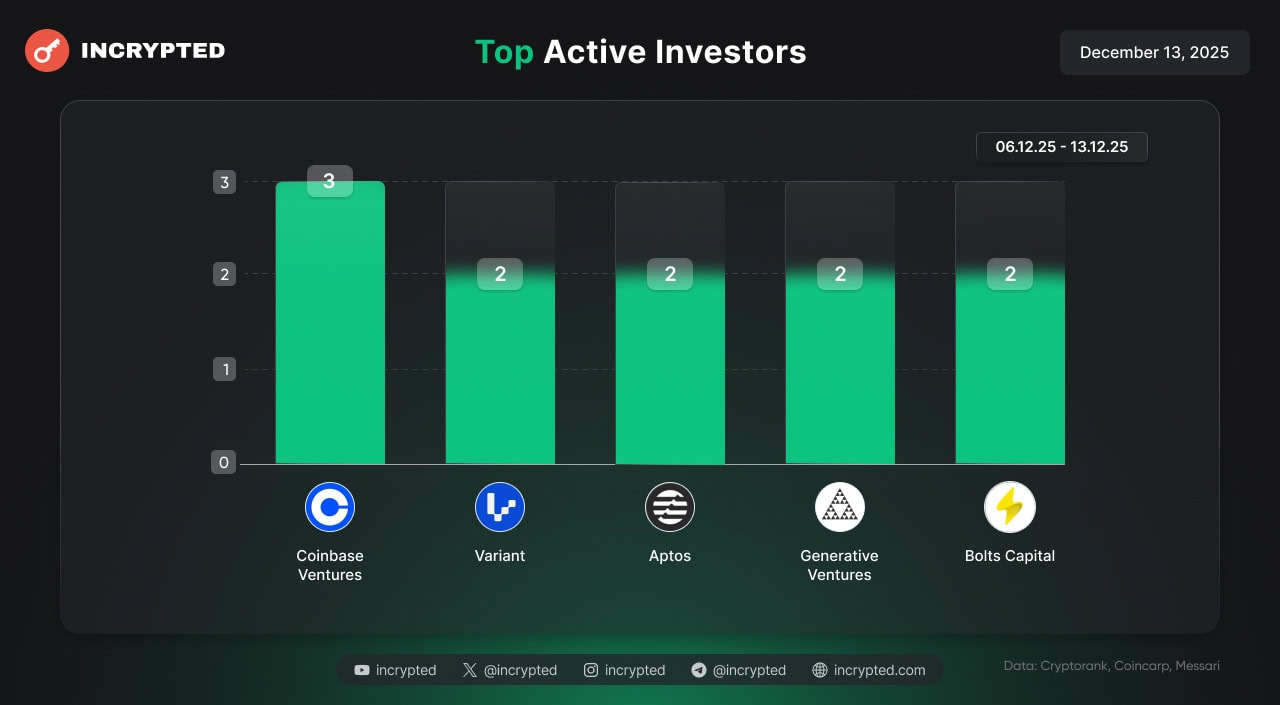 Incrypted infographic.
Projects from DeFi, blockchain infrastructure, blockchain services, CeFi and other segments raised funding between December 6 and December 13. The main attention of investors was focused on CeFi.
 Incrypted infographic.
Follow the content on Incrypted to stay up to date with new investments in the digital world.
Ayrıca Şunları da Beğenebilirsiniz

Bitcoin ETF Investors React to Fed’s Decision

US Senators Introduce SAFE Crypto Act to Target Rising Crypto Scams