

Could Binance and Coinbase Ignore Listing Kaspa (KAS) Forever?
Kaspa has spent years building one of the most talked-about Proof of Work networks in crypto. Despite that, one question keeps coming back. Why is KAS still missing from the spot markets of Binance, Coinbase, OKX, and Crypto.com?
That question becomes even more interesting because Binance and Coinbase already offer KAS derivatives products. Those exchanges clearly recognize demand for the asset, yet they have stopped short of launching spot trading. The answer has less to do with Kaspa’s technology and much more to do with how major exchanges decide which assets deserve a full spot listing.
Why Tier 1 Exchanges Have Not Added Kaspa Spot Trading
Kaspa’s absence from major spot exchanges is not the result of weak technology. Many supporters argue the opposite. The challenge comes from the way Kaspa launched.
Unlike many newer crypto projects, Kaspa had no pre mine, no ICO, no venture capital funding, and no large team treasury. Every KAS token entered circulation through mining. That created one of the fairest launch models in the industry, but it also removed a key advantage that many centralized exchanges usually receive.
Projects backed by venture capital often reserve millions of tokens for exchange partnerships, marketing campaigns, liquidity programs, or listing agreements. Kaspa has none of those reserves.
That creates a different situation for Binance, Coinbase, OKX, and Crypto.com. Instead of receiving large token allocations, they would need to obtain enough KAS from the open market or through over-the-counter transactions before launching a deep and liquid spot market. That requires time, capital, and careful planning.
Technical complexity creates another obstacle.
Kaspa runs on a BlockDAG architecture instead of the traditional single chain model used by most blockchains. Exchanges cannot simply plug Kaspa into their existing infrastructure. They must build custom integrations, validate new node software, and make sure deposits and withdrawals work reliably before allowing billions of dollars worth of trading.
Regulatory reviews add another layer of work.
Spot listings require exchanges to complete extensive compliance reviews, custody planning, and asset classification. Those requirements usually move much slower than launching futures products.
Binance Futures Show Kaspa Is Already On The Radar
Binance has already launched perpetual futures for Kaspa. Coinbase has also introduced derivatives exposure for KAS.
That detail matters because futures markets usually arrive before spot listings for many digital assets.
Futures allow exchanges to benefit from trading activity without maintaining enormous reserves of the underlying asset. They can monitor liquidity, evaluate trading demand, test infrastructure, and generate revenue before committing to the extra operational work required for spot trading.
Read Also: Kaspa Price Prediction: Why KAS Could Be Recreating Solana’s Early Bull Run Setup
Those futures products could be evidence that Kaspa has already passed several important technical and regulatory evaluations.
The remaining work appears to revolve around completing infrastructure, expanding liquidity, and deciding when market conditions make a full spot launch commercially worthwhile.
Kaspa’s own development roadmap could also play an important role. The planned Toccata upgrade introduces native smart contracts, programmability, and KRC 20 functionality. Those additions would transform Kaspa from a payment-focused network into a broader Layer 1 ecosystem capable of supporting decentralized applications and stablecoins.
That creates stronger commercial incentives for major exchanges because higher on-chain activity usually leads to greater trading volume.
Kaspa Price Still Faces Technical Resistance Before The Next Move
Current price action shows Kaspa remains inside a corrective phase after reaching about $0.038 in May.
KAS now trades close to $0.028. That leaves the token roughly 33% below its recent high, about 21.7% lower over the past 90 days, and more than 62% below its level from a year ago.
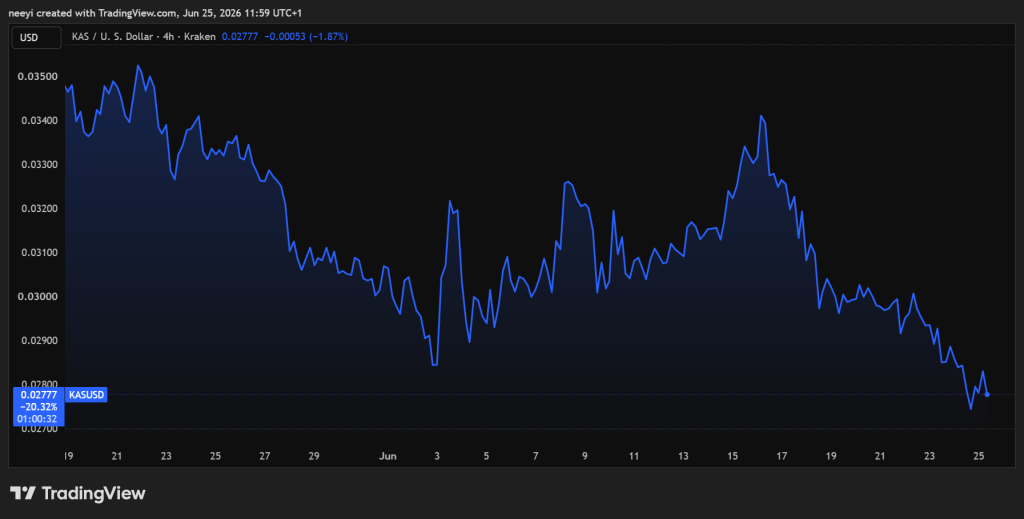 KAS Price Chart / TradingView.com
A look at the Kaspa chart shows immediate support between $0.028 and $0.029. Holding that area could help stabilize the current correction.
Another important support level sits around $0.027. Losing that zone could expose KAS to additional downside and potentially open the door toward the low $0.02 region.
Resistance begins around $0.031 to $0.033. Price has repeatedly struggled there during recovery attempts over the past few months.
The strongest resistance remains between $0.035 and $0.038 near the May peak. Recovering that area would likely require stronger buying interest together with a broader improvement across the crypto market.
Without a major Kaspa-specific catalyst, KAS could continue moving between roughly $0.022 and $0.035 during the remainder of 2026.
Breaking back above $0.038 with convincing volume would indicate the correction has likely ended. That could create room for a move toward the low $0.04 region or beyond if Layer 1 narratives strengthen across the market.
Failure to defend $0.027 would point toward continued weakness and increase the possibility of revisiting previous cycle lows.
How Binance And Coinbase Spot Listings Could Change The Kaspa Outlook
Spot listings on Binance or Coinbase would likely represent one of the biggest catalysts Kaspa has experienced since launch.
Listing on either exchange would immediately expose KAS to millions of additional investors who currently have limited access to the token. Greater accessibility often improves liquidity, strengthens price discovery, and increases confidence among institutions that prefer trading assets listed on globally recognized platforms.
Greater visibility could also encourage wallet providers, payment services, custodians, and other infrastructure companies to expand support for Kaspa. Those developments often reinforce each other as adoption grows.
Read Also: Dogecoin (DOGE) vs Kaspa (KAS): Which Could Deliver Bigger Gains by 2027?
Several possible scenarios could follow if Binance or Coinbase eventually launch KAS spot trading.
A Conservative Outcome
This would see Kaspa benefit from improved accessibility without a major bull market. Under that scenario, KAS could reclaim the $0.035 to $0.045 region as new buyers enter the market gradually.
A Base Case
In this case, would combine a Tier 1 spot listing with improving crypto market conditions and successful network upgrades. That combination could allow KAS to challenge previous highs near $0.038 before extending toward the $0.05 to $0.08 range if buying activity remains healthy.
A Bullish Scenario
This would require several factors to arrive together. Strong altcoin market conditions, successful rollout of Kaspa’s ecosystem upgrades, expanding decentralized applications, and listings across multiple Tier 1 exchanges could create much stronger demand. Under those conditions, KAS could move well beyond previous cycle highs and establish a completely new price discovery phase.
None of those outcomes are guaranteed, and exchange listings alone do not guarantee sustained rallies. Market conditions, liquidity, network adoption, and broader investor confidence will still determine how far Kaspa can ultimately climb.
FAQs
Subscribe to our YouTube channel for daily crypto updates, market insights, and expert analysis.
The post Could Binance and Coinbase Ignore Listing Kaspa (KAS) Forever? appeared first on CaptainAltcoin.


Ayrıca Şunları da Beğenebilirsiniz

WhatsApp is not charging users a mandatory fee, but there’s a new subscription to know about

TIAA’s CEO made $26,000 in her first job but still maxed out her 401(k). She has advice for Gen Z

Apple (AAPL) Shares Tumble 5% Following Unexpected Price Increases on Mac and iPad Products


Popüler Haberler
Daha fazla
