

Must Read
Secretary Teodoro Herbosa has been elected president of the World Health Assembly. His international exposure should translate to health reforms back home.Secretary Teodoro Herbosa has been elected president of the World Health Assembly. His international exposure should translate to health reforms back home.
[OPINION] PH’s got a place in global health governance. Don’t waste it.
Bu içerikle ilgili geri bildirim veya endişeleriniz için lütfen crypto.news@mexc.com üzerinden bizimle iletişime geçin.
For decades, Philippine health secretaries have fought familiar domestic battles: overcrowded hospitals, vaccine controversies, procurement disputes, workforce shortages, uneven rural access, and the endless struggle to stretch limited resources across a fragmented healthcare system.
Rarely, however, has a sitting Philippine health secretary simultaneously occupied visible leadership in global health diplomacy.
That is what makes the recent elevation of Teodoro Herbosa unusual.
In 2025, Herbosa was elected president of the 78th session of the World Health Assembly, the decision-making body of the World Health Organization. Regardless of one’s views on his domestic record, the symbolism is difficult to ignore: for a moment, the Philippines occupies a more visible place in formal global health governance. Congratulations are appropriate.
The real question is not whether Herbosa has become internationally visible. It is whether the Philippines will convert moments of global legitimacy into stronger institutions at home.
ALSO ON RAPPLER
- Raffy Tulfo to Herbosa: Why is Glenn Baggao still handling DOH infra program?
- DOH chief Herbosa, 3 others face graft complaint over P1.8-B mobile clinics
- Herbosa faces graft complaint as P1.5B worth of medicines, vaccines ‘wasted’
- DOH flagged after P1.4 billion ‘idle cash’ found in various accounts
More than prestige
Prestige alone changes very little. Countries benefit when prestige becomes policy.
The Philippines has often struggled to convert international recognition into durable domestic outcomes and practical advantages those positions create for ordinary Filipinos.
A health secretary operating near the center of multilateral conversations gains something valuable: early visibility into how the world is thinking.
How are countries financing obesity and chronic disease management?
How are regulators modernizing pathways for diagnostics and medical technologies?
How are digital systems, artificial intelligence, and data reshaping healthcare delivery?
These conversations frequently arrive in the Philippines years later.
Herbosa’s global role creates an opportunity to narrow that gap.
Can the Philippines convert access into capability?
A matter of historical perspective
Juan Salcedo Jr. deserves particular mention. A physician-scientist and later National Scientist, Salcedo served as secretary of health and became president of the 5th World Health Assembly in 1952 while in office. Salcedo’s legacy extended beyond diplomacy. He helped shape Philippine nutrition policy, championed rice enrichment to combat beriberi, and advanced public health science at a time when malnutrition and infectious disease defined the country’s health burden.
History therefore offers perspective. Herbosa’s moment is not without precedent — but it remains unusual in the modern era, and its significance lies less in symbolism than in what the Philippines chooses to do with it.

The list is illustrative rather than exhaustive; Philippine health leadership has taken different forms across scientific, clinical, technical, and diplomatic domains.
Of course, global standing should not be confused with performance at home.
A health secretary may command international respect while still facing difficult domestic realities: crowded hospitals, uneven healthcare access, procurement failures, workforce shortages, or public distrust. Citizens experience healthcare locally, not diplomatically.
That is precisely why Herbosa’s global role matters less as personal recognition and more as institutional opportunity.
The question is whether unusual international standing can be converted into better outcomes for ordinary Filipinos.
What other countries did with global standing
The question is not whether leaders become globally known. The question is what countries build because they do.
In Thailand, internationally respected public health leaders helped convert global credibility into durable institutions. Figures such as Dr. Sanguan Nitayarumphong played a central role in building one of the world’s most studied universal healthcare systems.
Thailand did not merely participate in international health conversations. It translated ideas into execution. It was institutional discipline.
Likewise, in Indonesia, Health Minister Budi Gunadi Sadikin leveraged global partnerships after COVID-19 to strengthen healthcare manufacturing, diagnostics, workforce planning, and health system modernization.
In both cases, international access became domestic capability.
The Philippines now faces the same choice.
How to better leverage Herbosa’s global standing for institutional gains felt at home and abroad?
What could the Philippines still do?
Of course, global standing matters only if it strengthens efforts already underway at home.
Herbosa’s tenure has also seen efforts to expand and operationalize zero balance billing under universal healthcare to reduce catastrophic out-of-pocket spending for poorer patients, while programs such as PuroKalusugan aim to bring preventive and primary care closer to communities through a more localized and integrated approach.
As with many health reforms, final outcomes will ultimately depend on implementation, financing, local government coordination, and institutional continuity.
Yet this points to a larger truth: global legitimacy matters most when translated into practical reforms at home.
Three areas stand out as low hanging fruits.
1. Build a stronger health leadership ecosystem.
One of the country’s deepest healthcare weaknesses is not intelligence. It is continuity.
The Philippines does not lack healthcare dialogue. Conferences, research forums, technical fellowships, and public health convenings already exist.
What is less visible is a sustained, nationally recognized platform that systematically connects global learning, implementation, and leadership development across political cycles.
One opportunity would be to strengthen and better connect what already exists into a more visible Philippine Health Futures Forum — an annual platform bringing together clinicians, regulators, hospitals, universities, patient groups, policymakers, and international partners to discuss practical healthcare implementation rather than abstract aspiration.
How should the Philippines redesign primary care? Prepare for aging and chronic disease? Improve workforce retention?
But conferences alone rarely change systems.
A Philippine Global Health Fellowship — whether housed within government, universities, or public-private partnerships — could expose younger clinicians, regulators, economists, hospital leaders, and public health professionals to regional systems, implementation science, healthcare diplomacy, and health policy execution.
The Philippines exports globally competitive nurses and physicians.
Why not cultivate globally fluent health policymakers too?
Such efforts could also help nurture and better insulate a generation of technocrats and health bureaucrats from political discontinuity, preserving institutional memory that too often disappears between administrations.
2. Modernize healthcare regulation and deepen ASEAN cooperation.
Regulation sounds technical — until patients wait years for access.
Much of healthcare quality depends on invisible systems: approval pathways, procurement, evidence standards, digital infrastructure, and financing rules.
A secretary deeply embedded in global conversations has unusual visibility into how countries are modernizing regulation, accelerating access to diagnostics and technologies, and using real-world evidence more effectively.
One underappreciated opportunity is stronger ASEAN harmonization — aligning regulatory standards, improving cooperation, and reducing duplication to accelerate access while maintaining safety.
3. Attract international partnerships and catalytic funding.
A sitting health secretary with unusual visibility in global health governance has something valuable beyond symbolism: convening power.
International credibility can help attract technical partnerships, demonstration projects, philanthropic funding, multilateral support, and implementation partnerships that strengthen domestic priorities.
Institutions such as the World Bank, Asian Development Bank, bilateral agencies, philanthropic organizations, and global health partners often look for credible local champions capable of convening stakeholders and executing reforms.
This need not mean dependency. Rather, it means using global credibility to accelerate reforms already aligned with Philippine priorities.
Countries such as Thailand and Indonesia have repeatedly leveraged international partnerships to strengthen domestic systems while retaining local ownership.
The real test of legacy
Whether one admires Herbosa, critiques him, or simply watches skeptically, the opportunity itself is real.
History will ultimately remember whether this rare moment helped Filipinos wait less for care, pay less for treatment, trust institutions more, and cultivate a stronger generation of health leaders.
Prestige may open doors, but institution-building determines whether nations walk through them.
In that sense, Herbosa’s global standing while serving as health secretary represents something larger than personal recognition: a rare institutional opportunity for the Philippines. – Rappler.com
Dr. Jaemin Park is an adjunct professor at the University of the Philippines College of Public Health and works across Southeast Asia on healthcare financing, medical innovation, and public sector reform.


Sorumluluk Reddi: Bu sitede yeniden yayınlanan makaleler, halka açık platformlardan alınmıştır ve yalnızca bilgilendirme amaçlıdır. MEXC'nin görüşlerini yansıtmayabilir. Tüm hakları telif sahiplerine aittir. Herhangi bir içeriğin üçüncü taraf haklarını ihlal ettiğini düşünüyorsanız, kaldırılması için lütfen crypto.news@mexc.com ile iletişime geçin. MEXC, içeriğin doğruluğu, eksiksizliği veya güncelliği konusunda hiçbir garanti vermez ve sağlanan bilgilere dayalı olarak alınan herhangi bir eylemden sorumlu değildir. İçerik, finansal, yasal veya diğer profesyonel tavsiye niteliğinde değildir ve MEXC tarafından bir tavsiye veya onay olarak değerlendirilmemelidir.
Ayrıca Şunları da Beğenebilirsiniz

TrapDoor Malware Campaign Infiltrates Developer Supply Chains to Target Crypto and AI Projects
Socket reveals TrapDoor malware campaign targeting crypto and AI developers with 34 malicious packages designed to steal wallet data, SSH keys, and credentials.
Paylaş
Blockonomi2026/05/25 15:45

TrapDoor Malware Targets Crypto and AI Developers in Supply Chain Attack
TLDR Security firm Socket discovered a malware campaign called “TrapDoor” deploying 34 malicious packages across npm, PyPI, and Crates developer ecosystems The
Paylaş
Coincentral2026/05/25 15:35
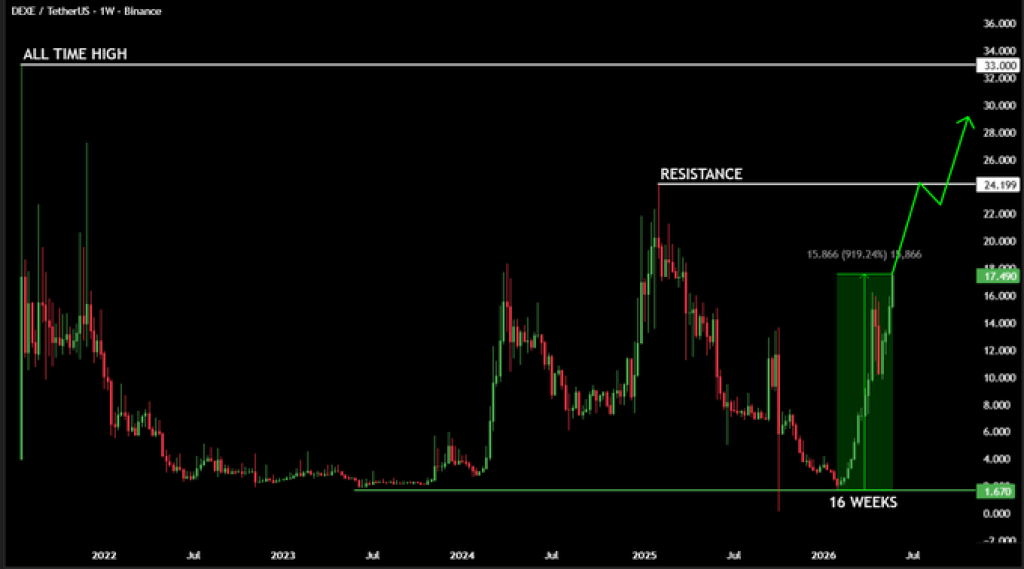
Here’s Why DeXe (DEXE) Price is Pumping Today
DEXE is the top gainer in the crypto market today as traders move back into high-risk DeFi tokens. The DEXE price is trading around $17.50 at writing, up more than
Paylaş
Captainaltcoin2026/05/25 16:01


Popüler Haberler
Daha fazla
