Overview
Ethereum co-founder Vitalik Buterin published a post on X overlaying his 2023 roadmap, the one organized around the Merge, the Surge, the Scourge, the Verge, the Purge and the Splurge, onto the Ethereum Foundation's Strawmap, the living technical reference maintained at strawmap.org and last revised on August 4. His summary was that a lot of overlap remains, but that priorities have been reshuffled, several long-standing projects have been deprioritized outright, and others have been replaced by constructions the Foundation now considers superior.
The direction that emerges is the one the Foundation has been calling Lean Ethereum: a base layer that is quantum-safe, private by default, mathematically verifiable, and scaled through specialized mechanisms rather than through a single general-purpose execution engine doing everything at once. It is also a plan that leans on two technologies that carried nowhere near this weight three years ago, recursive STARK proofs and artificial intelligence capable of generating machine-checkable correctness proofs. Buterin was explicit that these are the objects he is willing to bet Ethereum's technical future on.
Key takeaways
Vitalik Buterin overlaid his 2023 Ethereum roadmap onto the Ethereum Foundation's current Strawmap on August 10, 2026, and the comparison shows quantum safety pulled to the front of the queue while verifiable delay functions and most EVM improvement work were pushed down. Verkle trees were replaced by a unified binary tree and then a construction he abbreviates as PBT, and state expiry gave way to new state types.
1. What the Strawmap Actually Is
The Strawmap is not an official roadmap and does not pretend to be one; The name is a portmanteau of strawman and roadmap, and the Foundation's stated reasoning for the qualifier is that an official roadmap speaking for a decentralized ecosystem is effectively impossible, because rough consensus in Ethereum is an emergent and continuous process rather than a document anyone can ratify. What the Strawmap offers instead is a coordination tool: one reasonably coherent path sketched out of millions of possible outcomes, published openly so that the arguments about it can happen in public.
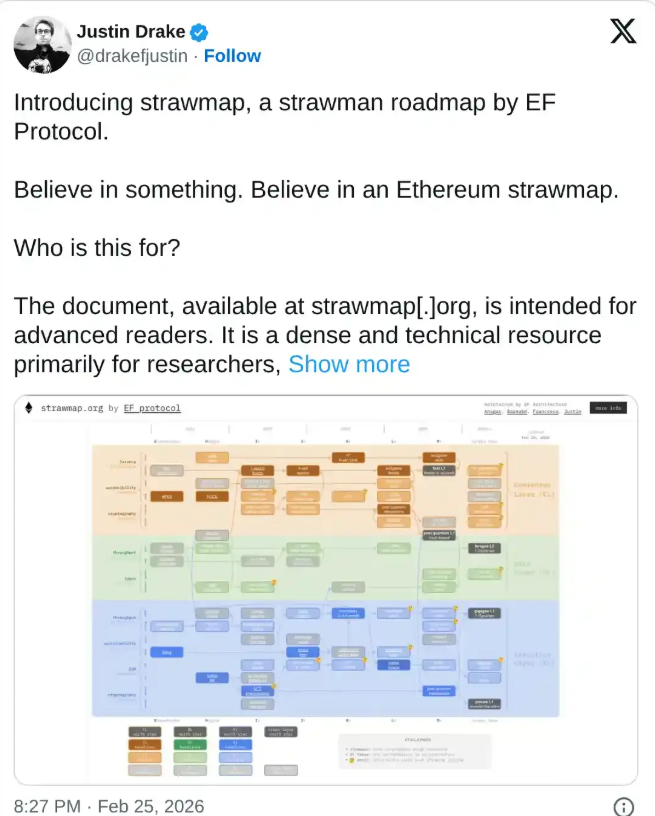
It began in January 2026 as a discussion starter at an EF workshop, built to slot the longer-horizon Lean Ethereum research into shorter-term fork planning, and the exercise of mapping hard dependencies between upgrades turned out to be the part that surfaced the most useful disagreements. It is maintained by the Foundation's Architecture team, comprising Justin Drake, Thomas Thiery, Toni Wahrstätter and Buterin himself, and revised roughly quarterly. The diagram runs as a timeline from left to right across seven forks through 2029 at a cadence of about one every six months, with upgrades grouped into three colour-coded layers covering consensus, data and execution. Dark boxes mark headliners, the flagship upgrades that the modern All Core Devs process limits to one consensus and one execution item per fork. Five long-range targets sit on the right as black boxes, and the Foundation calls them north stars: transaction inclusion and finality in seconds, a gigagas L1 processing 10,000 transactions per second through zkEVMs and real-time proving, a teragas L2 reaching 10 million transactions per second through data availability sampling, centuries-long cryptographic security against quantum computers through hash-based schemes, and shielded transfers built into the base layer.
2. What Buterin Cut
VDFs are cryptographic timers that require a provably fixed amount of sequential computation to evaluate, which made them attractive as a way to produce randomness nobody can bias, and the 2023 roadmap treated research into them as an active priority for improving Ethereum's RANDAO mechanism. They do not appear on the current Strawmap, alternative approaches to randomness took their place without demanding the specialized hardware that VDFs would have required, and the item quietly stopped being worth the coordination cost.
Verkle trees were replaced twice over. Verkle was the 2023 plan for shrinking the proofs needed to check any single piece of Ethereum's state, and the mechanism through which stateless clients were supposed to become practical. It now gives way first to the unified binary tree specified in EIP-7864, a simpler design that stores all of Ethereum's state in a single tree, and then to a further construction Buterin abbreviates only as PBT.
State expiry was replaced by something Buterin describes as philosophically different rather than merely better. Expiry was a pruning scheme, a way of letting the network forget data nobody had touched in years so that node storage requirements would stop growing without bound as the chain aged. The Strawmap swaps it for new state types, which are categories of state with deliberately restricted properties that make them dramatically cheaper to scale. A state type designed only to hold ERC-20 balances and process transfers does not need to support the full general-purpose computation that Ethereum's existing state model accommodates, and that restriction is precisely the scaling mechanism. Buterin was direct that this is not a like-for-like substitution but a fundamentally different paradigm for how Ethereum scales.
The final cut was the broadest and the least specific; A category the 2023 roadmap called many EVM improvements has been scaled back, with EOF among the work moved down the queue. The reasoning is architectural rather than dismissive. Incremental opcode-level optimization of the Ethereum Virtual Machine is difficult to justify when the long-horizon plan contemplates replacing the execution substrate underneath it, and every hour spent tuning the current engine is an hour not spent on the transition that would make the tuning irrelevant.
3. Quantum Safety Moves to the Front
Quantum resistance is the clearest single change in priority between 2023 and now, and it has already moved from research interest to institutional commitment. The Ethereum Foundation stood up a dedicated post-quantum security team in January 2026 and is targeting core quantum-resistant infrastructure by roughly 2029, with work spanning consensus signatures, data availability commitments, account signatures and application-layer zero-knowledge proofs.
The signature direction is leanSPHINCS, a trimmed variant of the hash-based SPHINCS+ family that NIST standardized in August 2024. Buterin's argument for choosing a hash-based scheme over other post-quantum candidates is minimalism, since hash-based signatures require Ethereum to maintain the least additional cryptographic infrastructure of any post-quantum family and their security rests on hash functions rather than on the elliptic-curve mathematics a quantum computer could break.
4. Privacy Becomes a Base-Layer Feature
The 2023 diagram contained no mention of strong user privacy anywhere, and Buterin's phrase for what the Strawmap now gives it is first-class attention. The concrete building blocks he named are keyed nonces and recent roots, which break the link between a sender and their transaction history; lean privacy pools, designed for the base layer rather than bolted on above it; and wormholes, a transfer design that moves value without broadcasting a full history trail. Sitting alongside them is FOCIL, the fork-choice enforced inclusion list mechanism filed as EIP-7805, which compels block producers to include transactions the rest of the network has already seen. FOCIL is primarily a censorship-resistance tool, but censorship resistance and privacy are close cousins in practice, since a network that can identify which transactions to exclude is a network that can identify who is transacting.
The target these pieces serve is shielded transfers native to L1, one of the five north stars, and the practical consequence would be that applications stop reimplementing privacy from scratch and start building and optimizing on top of it. The institutional appetite for that is already visible outside the protocol. EthSystems, founded by the team that previously ran the Foundation's Institutional Privacy Task Force, launched in July 2026 to build zero-knowledge selective-disclosure systems for banks and asset managers, which is roughly the shape of demand that a privacy-capable base layer would serve at scale.
5. What the Plan Leaves Unanswered
Dankrad Feist, who proposed danksharding and spent years as an Ethereum Foundation researcher before joining the Stripe-backed chain Tempo, called the Strawmap's features genuinely exciting while arguing that three to four years is very slow and that roughly one year is realistically possible now with large language models.
The second criticism is about what the plan does not contain. None of the five north stars addresses ETH issuance or value capture, and the August 10 post does not mention the question either. The top reply came from Vanessa Grellet of Arche Capital, a board member of the Enterprise Ethereum Alliance, pointing at EIP-8363, the tapered issuance burn that would destroy a rising share of validator rewards in order to remove the incentive to stake beyond half of all ETH in existence. Core developers put it up for Hegotá consideration on August 6, at the weakest stage of Ethereum's upgrade process, which commits no one to shipping it, and that came after days of public opposition from Aave founder Stani Kulechov, ether.fi chief executive Mike Silagadze and other DeFi founders. The Strawmap diagram does carry a tapered issuance burn box in the consensus layer for a fork penciled in around 2027 to 2028, marked with the legend's symbol for uncertainty about ever shipping.
Ethereum's base-layer fee revenue has fallen steeply over the past year, and because the base portion of every fee is burned rather than paid out, a smaller fee base means less ETH removed from circulation. A roadmap that pushes still more activity onto Layer 2 raises the long-term capacity ceiling without obviously addressing medium-term value capture for ETH holders, which is precisely the gap critics keep returning to.
Frequently Asked Questions
What is the Ethereum Strawmap?
The Strawmap is the Ethereum Foundation's draft L1 protocol roadmap, published at strawmap.org and maintained by the EF Architecture team of Justin Drake, Thomas Thiery, Toni Wahrstätter and Vitalik Buterin. The name blends strawman and roadmap, signalling both that it is a work in progress and that no single document can speak for a decentralized ecosystem. It maps roughly seven forks through 2029 across the consensus, data and execution layers and is revised about quarterly.
Why is Ethereum replacing Verkle trees?
Verkle trees rely on elliptic-curve cryptography, which quantum computers threaten, and interest in binary trees revived around mid-2024 for that reason. The path now runs from Verkle to the unified binary tree specified in EIP-7864 and then to PBT. Buterin did not expand the acronym, and while it is widely read as a Poseidon binary tree, a STARK-friendly construction, that expansion remains unconfirmed.
What are native rollups?
Rollups whose validity-proof verification is enshrined directly in the L1 protocol rather than deployed as a smart contract. Layer 2 networks would no longer need bespoke verifier contracts or the trust assumptions that come with upgradeable ones, and would inherit protocol-level security instead. Buterin says SNARKs were not mature enough to consider this in 2023.
Will the EVM be removed?
Not removed, but potentially demoted. The Strawmap contemplates exposing a simpler instruction set, either RISC-V or leanISA, at the protocol level, with the EVM running as an intermediate representation on top rather than as enshrined infrastructure. Buterin explicitly called deeper exploration of this too early even for the Strawmap, so Solidity and existing EVM tooling face no near-term disruption.
When will Ethereum be quantum-safe?
The Foundation's post-quantum security team, formed in January 2026, targets core quantum-resistant infrastructure by roughly 2029, covering consensus signatures, data availability commitments, account signatures and application-layer proofs. Account-level migration can begin earlier through native account abstraction under EIP-8141, targeted for the Hegotá fork in 2027.
Does any of this change how I use Ethereum right now?
No. The Strawmap specifies no activation block, no mainnet date and no required node-operator upgrade. It gives client teams, validators and Layer 2 builders direction rather than a deadline, and the first fork carrying any of its groundwork is Glamsterdam, expected in the back half of 2026.
Disclaimer: This article is for informational purposes only and does not constitute financial, investment, or trading advice. Digital assets are volatile and you may lose capital. Conduct your own research before making any decision.