Spacecoin is building a satellite-powered, blockchain-based banking system to connect 1.4B unbanked and 3B offline people. It could bypass governments and infrastructure to deliver $2/month Internet and on-chain credit — but faces hurdles like device costs, regulation, and competition from Starlink. Its future depends on whether real communities adopt it, not just whether satellites reach orbit.Spacecoin is building a satellite-powered, blockchain-based banking system to connect 1.4B unbanked and 3B offline people. It could bypass governments and infrastructure to deliver $2/month Internet and on-chain credit — but faces hurdles like device costs, regulation, and competition from Starlink. Its future depends on whether real communities adopt it, not just whether satellites reach orbit.

Spacecoin and the Promise (and Pitfalls) of Banking the Unbanked

3 min read

\ In 2021, approximately 1.4 billion adults remained unbanked globally, while 3 billion people still lack internet access. This creates a dual barrier: no bank account and no digital connectivity. Spacecoin proposes to break this cycle by combining satellites and blockchain technology—but is this innovation truly groundbreaking, or merely another ambitious project with more promise than proof?

Spacecoin's Vision: Satellites Meet Blockchain

Spacecoin aims to deliver financial services directly from orbit, merging decentralized banking with satellite-powered internet connectivity. Their concept of "space-based finance" represents more than marketing speak—it envisions the infrastructure for a borderless global financial system.

The model is ambitious:

  • Low Earth Orbit (LEO) satellites provide 5G-equivalent coverage
  • Users pay with cryptocurrency for essential data services (messaging, web browsing, micropayments)
  • Subscription histories build on-chain credit profiles, enabling access to loans and advanced services
  • At $2 monthly, the service targets communities excluded from both traditional banking and internet access

Market Context and Real-World Applications

Spacecoin's narrative overlooks a crucial detail: fintech has already reached millions across Africa and Asia without satellite infrastructure. Mobile money platforms like M-Pesa in Kenya and GCash in the Philippines transformed basic phones into banking terminals. The World Bank reports that digital payment adoption reduced unbanked populations by double digits within just a few years.

Where does satellite-based banking add genuine value? The applications likely center on:

  • Ultra-remote regions lacking mobile tower infrastructure
  • Areas experiencing government-imposed internet blackouts, where satellites bypass terrestrial controls
  • Disaster recovery zones requiring resilient communication backups

Significant Challenges Ahead

Despite its futuristic appeal, Spacecoin faces substantial obstacles:

Hardware Accessibility: Even a $20 satellite device represents a significant expense for families surviving on $2 daily income.

Market Competition: Established players like SpaceX's Starlink and OneWeb already provide satellite internet services—can Spacecoin compete before achieving scale?

Regulatory Hurdles: Governments that restrict internet access to maintain control may not welcome unmonitored crypto-finance via satellite.

Cryptocurrency Volatility: If subscription fees fluctuate from $2 to $4 overnight due to token price swings, does this genuinely serve the unbanked population?

Technical Architecture Overview

The "blockchain in space" concept requires concrete implementation:

  • Satellites create a mesh network architecture, eliminating single points of failure
  • Smart contracts automate payment processing and subscription management
  • Credit profiles recorded on-chain provide portable financial histories across borders

This framework theoretically transforms each subscriber into both customer and network participant. However, success depends on balancing processing speed, operational costs, and system reliability.

The Competitive Landscape

Spacecoin operates within a growing space finance sector:

  • SpaceChain deployed blockchain nodes in orbit and developed "Tethys," a handheld satellite crypto device
  • Blockstream Satellite broadcasts Bitcoin blockchain data globally as infrastructure redundancy
  • JPMorgan and GomSpace conducted the first satellite-to-satellite tokenized transfer in 2021

The trend is clear: organizations from startups to major financial institutions view satellites as foundational infrastructure extending beyond Earth.

Roadmap and Reality Check
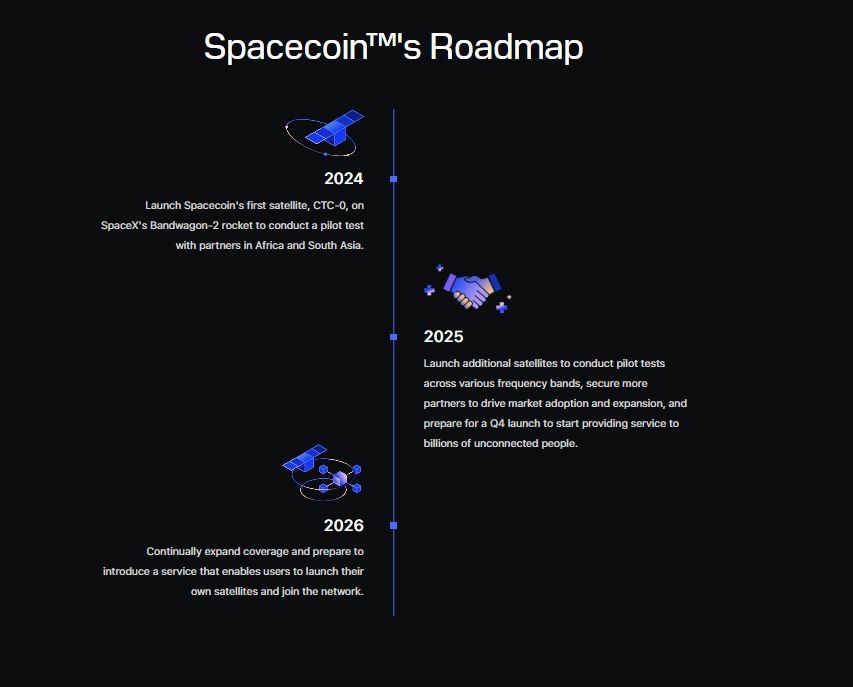
\ Spacecoin's near-term milestones include:

  • 2024: Launch first satellite (CTC-0) via SpaceX rideshare program
  • 2025: Multiple deployments with live service pilots in Africa and South Asia
  • 2026: Enable end-users to contribute satellites to the constellation

While the timeline appears aggressive, ultimate success depends on genuine community adoption rather than merely achieving orbital deployment.

The Fundamental Question

Space-based finance holds transformative potential, but perspective matters. Sometimes a solar-powered cell tower and M-Pesa account solve accessibility challenges more effectively than satellite blockchain technology. Nevertheless, for regions where governments restrict connectivity or infrastructure simply doesn't exist, Spacecoin may offer more than speculative innovation.

The definitive test remains straightforward: will the farmer in rural Nigeria or the family in a remote Himalayan village actually adopt and benefit from this technology?

Market Opportunity
RealLink Logo
RealLink Price(REAL)
$0.04903
$0.04903$0.04903
-2.73%
USD
RealLink (REAL) Live Price Chart
Disclaimer: The articles reposted on this site are sourced from public platforms and are provided for informational purposes only. They do not necessarily reflect the views of MEXC. All rights remain with the original authors. If you believe any content infringes on third-party rights, please contact service@support.mexc.com for removal. MEXC makes no guarantees regarding the accuracy, completeness, or timeliness of the content and is not responsible for any actions taken based on the information provided. The content does not constitute financial, legal, or other professional advice, nor should it be considered a recommendation or endorsement by MEXC.

You May Also Like

REX Shares’ Solana staking ETF sees $10M inflows, AUM tops $289M for first time

REX Shares’ Solana staking ETF sees $10M inflows, AUM tops $289M for first time

The post REX Shares’ Solana staking ETF sees $10M inflows, AUM tops $289M for first time appeared on BitcoinEthereumNews.com. Key Takeaways REX Shares’ Solana staking ETF saw $10 million in inflows in one day. Total inflows over the past three days amount to $23 million. REX Shares’ Solana staking ETF recorded $10 million in inflows yesterday, bringing total additions to $23 million over the past three days. The fund’s assets under management climbed above $289.0 million for the first time. The SSK ETF is the first U.S. exchange-traded fund focused on Solana staking. Source: https://cryptobriefing.com/rex-shares-solana-staking-etf-aum-289m/
Share
BitcoinEthereumNews2025/09/18 02:34
Verimatrix: Sale of Extended Threat Defense Assets (Mobile Application Protection) to Guardsquare

Verimatrix: Sale of Extended Threat Defense Assets (Mobile Application Protection) to Guardsquare

Completion of the sale of XTD assets (code and mobile application protection), including a portfolio of patents and a team of experts. The Group is refocusing on
Share
AI Journal2026/02/06 00:49
IP Hits $11.75, HYPE Climbs to $55, BlockDAG Surpasses Both with $407M Presale Surge!

IP Hits $11.75, HYPE Climbs to $55, BlockDAG Surpasses Both with $407M Presale Surge!

The post IP Hits $11.75, HYPE Climbs to $55, BlockDAG Surpasses Both with $407M Presale Surge! appeared on BitcoinEthereumNews.com. Crypto News 17 September 2025 | 18:00 Discover why BlockDAG’s upcoming Awakening Testnet launch makes it the best crypto to buy today as Story (IP) price jumps to $11.75 and Hyperliquid hits new highs. Recent crypto market numbers show strength but also some limits. The Story (IP) price jump has been sharp, fueled by big buybacks and speculation, yet critics point out that revenue still lags far behind its valuation. The Hyperliquid (HYPE) price looks solid around the mid-$50s after a new all-time high, but questions remain about sustainability once the hype around USDH proposals cools down. So the obvious question is: why chase coins that are either stretched thin or at risk of retracing when you could back a network that’s already proving itself on the ground? That’s where BlockDAG comes in. While other chains are stuck dealing with validator congestion or outages, BlockDAG’s upcoming Awakening Testnet will be stress-testing its EVM-compatible smart chain with real miners before listing. For anyone looking for the best crypto coin to buy, the choice between waiting on fixes or joining live progress feels like an easy one. BlockDAG: Smart Chain Running Before Launch Ethereum continues to wrestle with gas congestion, and Solana is still known for network freezes, yet BlockDAG is already showing a different picture. Its upcoming Awakening Testnet, set to launch on September 25, isn’t just a demo; it’s a live rollout where the chain’s base protocols are being stress-tested with miners connected globally. EVM compatibility is active, account abstraction is built in, and tools like updated vesting contracts and Stratum integration are already functional. Instead of waiting for fixes like other networks, BlockDAG is proving its infrastructure in real time. What makes this even more important is that the technology is operational before the coin even hits exchanges. That…
Share
BitcoinEthereumNews2025/09/18 00:32