

Balaji Urges More Crypto Tools for Refugees Amid Middle East Tensions
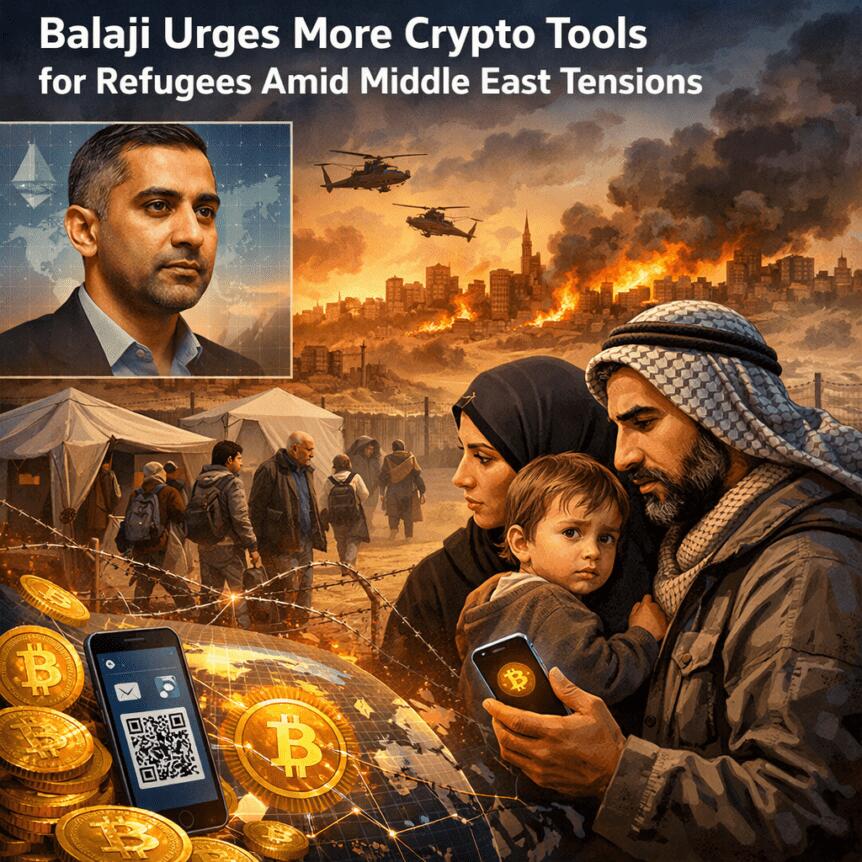
Tech investor Balaji Srinivasan, a former Coinbase chief technology officer, is urging the crypto industry to forge more financial tools for refugees and stateless populations. In a Saturday X post, he emphasized that global conflicts and economic migration can swell displacement figures, pointing to Ukrainians fleeing war and workers departing Gulf states amid mounting regional tensions as illustrative cases. He argued that cryptocurrency infrastructure could supply essential financial rails when traditional institutions falter or become inaccessible, offering livelihoods and liquidity to those cut off from conventional banking networks. The moment signals a broader conversation about crypto’s potential humanitarian role, beyond speculative trading and borderless payments.
Key takeaways
- Balaji Srinivasan frames crypto as a critical tool for refugees, advocating product development tailored to stateless populations.
- The argument hinges on crypto’s resilience in adverse conditions, described as a “wartime mode for the internet.”
- Andi Duro of TwoCents cautions that the industry has rarely built refugee-focused solutions, citing misaligned incentives in the market.
- Progress exists in stablecoins’ reach, with USDC emerging as a borderless digital currency; reported metrics show large supply growth amid regional capital movements.
- Analysts connect stablecoin dynamics to capital flight, including in the UAE, where real estate volatility has influenced crypto flows.
Tickers mentioned: $USDC
Sentiment: Neutral
Price impact: Neutral. The discussion centers on humanitarian finance and infrastructure, not immediate price moves.
Market context: The discourse sits at the intersection of humanitarian needs, macro capital flows, and evolving stablecoin dynamics, a period when liquidity and trust in borderless digital rails are being stress-tested against geopolitical risk and regulatory scrutiny.
Why it matters
The propositions raised by Srinivasan underscore a broader reckoning within crypto: its potential to serve as a life-supporting financial layer when fiat rails are stressed or severed. Refugees and stateless individuals often rely on untrusted or fragile payment systems, and a decentralized, permissionless network could in theory offer access to savings, remittances, and basic liquidity where traditional banks fail to operate. By reframing crypto as a humanitarian technology rather than solely a speculative instrument, the industry could expand its utility and widen its social license among policymakers, aid organizations, and displaced communities.
On the substance of progress, there is acknowledgement that crypto has already seen some utility growth through stablecoins, especially a dominant USD-pegged token that has achieved widespread use across borders. As cited in industry reporting, the stablecoin market has surged in recent weeks, with circulating supply and market capitalization tracking toward record levels. In particular, the ecosystem’s borderless digital money concept has started to gain traction among users who need fast, low-cost transfers that do not depend on traditional correspondent banking networks. This development is not purely transactional; it also signals a broader shift in how communities facing disruption think about access to financial services. See the USDC price index for current data and context, and related analyses documenting the stablecoin’s expanding footprint, including discussions about capital movements in the Middle East and beyond.
Meanwhile, the UAE has figured prominently in conversations about capital flight and crypto usage. A Dubai-based analyst noted that turbulence in the real estate sector has contributed to shifting capital flows, which some observers link to heightened activity in borderless digital currencies. The real estate market index referenced in regional analyses has trended downward since the onset of regional tensions, a dynamic that dovetails with broader questions about how crypto can provide liquidity channels in volatile markets. These observations echo a wider debate about how policymakers should approach stablecoins and cross-border payments while ensuring consumer protection and financial stability.
Beyond humanitarian implications, the discourse is also framed against a broader crypto policy backdrop. For instance, discussions about how digital assets intersect with national security, monetary sovereignty, and financial inclusion are amplifying in legislative forums. A separate policy thread has examined the potential use cases for prediction markets related to geopolitical events, underscoring how technology platforms could influence risk assessment and decision-making in crisis contexts. The tension between fostering innovation and maintaining regulatory guardrails remains a defining feature of the current landscape. The link to related policy discussions provides additional context on how lawmakers view the balance between experimentation and oversight.
Ultimately, the conversation centers on whether crypto developers and entrepreneurs can translate a doctrine of resilience into real-world tools that assist people who are most vulnerable to disruption. The call to action is not merely to build faster payments or cheaper transfers, but to design interfaces and fiducial structures that can function under duress, with clear governance and robust privacy protections. If the industry can align incentives around humanitarian use cases, the result could be a more inclusive crypto ecosystem that extends its benefits beyond early adopters to those who have historically been excluded from formal financial systems.
What to watch next
- Announcements of refugee-focused crypto tooling or pilots from wallets, remittance platforms, or humanitarian organizations.
- Regulatory developments shaping stablecoins and cross-border payments, particularly in regions with rising displacement pressures.
- Updates on USDC and other stablecoins’ global supply dynamics, including any official disclosures about new markets or regulatory compliance arrangements.
- Further commentary from Balaji Srinivasan and other industry voices on wartime internet resilience and humanitarian finance.
- Regulatory or legislative steps related to prediction markets or crisis-related financial instruments that could influence crypto-backed risk transfer tools.
Sources & verification
- Balaji Srinivasan’s X post referenced in discussion of refugee-focused crypto tooling.
- Andi Duro, founder of TwoCents, on crypto’s deployment for refugees and the critique of current product focus.
- USDC price index for current stablecoin metrics and liquidity context.
- USDC market cap near $80B and related analysis on UAE capital flight and capital dynamics.
- Article on Bitcoin’s geopolitical stress test and price movement referenced in related context.
Balaji Srinivasan calls on crypto builders to serve refugees amid rising displacement
In the current climate of intensified conflicts and ongoing economic migration, Balaji Srinivasan argues that crypto should advance beyond hype and toward practical humanitarian applications. He frames this as a strategic shift for an industry often defined by rapid innovation and speculative sentiment. By urging developers to focus on refugee-accessible financial tools, he positions crypto as a potential backstop for people who lose reliable access to conventional financial rails during crises. The call aligns with a broader conversation about the role of public blockchains in sustaining economic activity when centralized systems face disruptions, emphasizing that decentralization can offer continuity in the face of cyberattacks, infrastructure outages, or regulatory constraints.
Amid the debate, Srinivasan acknowledges that progress already exists in the form of stablecoins expanding their global reach as borderless digital money. While the industry has not yet delivered a full suite of refugee-centric products, the potential is clear: non-custodial wallets, transparent governance, and cross-border settlement rails could empower displaced individuals to store value, send remittances, and access identity-linked financial services with fewer intermediaries. The discussion also touches on the human dimension—products that work for refugees must be usable, accessible, and trusted by communities that have often been underserved by traditional financial infrastructure. The evolving narrative urges builders to test and scale with a humanitarian lens, ensuring security, privacy, and user-centric design are not sacrificed for speed or novelty.
On this topic, Srinivasan points to the broader stability narrative around stablecoins, noting that a leading USD-pegged token is already achieving widespread circulation. The growth in circulating supply and market depth has implications for liquidity and cross-border transactions, potentially enabling refugees and stateless individuals to participate in the digital economy more reliably. Reports referencing the price index and market-cap trends illustrate how capital flows are shifting, sometimes in response to geopolitical developments such as regional tensions in the Gulf and the real estate market’s response to conflict. While the numbers provide a snapshot of the moment, the underlying takeaway is a call for intentional product development that centers humanitarian needs as a core use case for crypto.
In this context, the conversation intersects with regulatory and policy considerations. Acknowledging the tension between innovation and oversight, the discourse invites ongoing dialogue about how to design crypto tools that are compliant, secure, and accessible to those who stand to gain the most from resilient financial rails. The critique from Andi Duro—that refugee-focused crypto products have been historically underdeveloped due to consumer misalignment with gambling-centric segments—serves as a reminder that the market must reorient incentives to serve vulnerable populations. If the community can translate this critique into concrete product and governance innovations, the humanitarian potential of crypto could become a meaningful, verifiable outcome rather than a theoretical ideal.
This article was originally published as Balaji Urges More Crypto Tools for Refugees Amid Middle East Tensions on Crypto Breaking News – your trusted source for crypto news, Bitcoin news, and blockchain updates.
You May Also Like

Ethereum Price Prediction as Analysts Watch Breakout Path Toward $8K

Tesla (TSLA) Stock — Musk Says Massive AI Chip Factory Launches in One Week
