

Robinhood Builds Its Own Ethereum Layer 2 Citing Battle-Tested Security That Other Chains Cannot Match
Robinhood chose Ethereum as the foundation for its new layer-2 network, and the company’s leadership did not hedge on the reasoning.
Speaking at EthCC 2026 in Paris, Robinhood Crypto General Manager Johann Kerbrat argued that no other chain currently offers the combination of decentralization, economic finality, and censorship resistance that a platform managing billions in user assets requires. The Gold Lattice network entered public beta today, marking Robinhood’s transition from a crypto on-ramp into a full-scale Web3 infrastructure provider with its own chain economics.
Kerbrat’s case for Ethereum rested on three pillars. The shared security model, in which Gold Lattice inherits the protection of Ethereum’s proof-of-stake validator set as its settlement layer, was the foundational argument.
Beyond that, he drew a direct contrast between high-throughput competing chains that prioritize speed and Ethereum’s approach of maximizing the number of independent nodes, arguing that speed achieved by concentrating validation among fewer entities is not a trade-off Robinhood was willing to make for a platform of its size. The third element was economic finality, the guarantee provided by Ethereum’s massive staked capital that transactions are irreversible in a way that carries institutional-grade trust. Kerbrat was explicit that no single entity, including Robinhood itself, can censor or revert transactions on the network.
What Gold Lattice Actually Offers Users
The network is built on Arbitrum Orbit technology, making it fully compatible with the broader Ethereum ecosystem and allowing instant asset movement to Ethereum mainnet, Base, and Optimism. For Robinhood Gold subscribers, transactions on the layer-2 carry subsidized gas fees that make trading effectively free at the user level. A Smart Liquidity layer automatically stakes idle ETH and stablecoins held on the network, passing approximately 3.2% yield back to users without requiring manual staking actions. The yield mechanism mirrors the design philosophy behind BlackRock’s ETHB staking ETF launched earlier this week, where passive holders capture on-chain yield through an institutional wrapper rather than managing staking infrastructure themselves.
The zero-gas trading feature deserves particular attention in the context of Robinhood’s existing user base. Robinhood built its brokerage business on eliminating trading commissions, a model that redefined retail investing expectations across the industry. Applying the same logic to on-chain transactions, where gas fees have historically been one of the primary friction points preventing mainstream adoption of Ethereum-based applications, is a direct extension of the same competitive playbook into Web3 infrastructure.
The Economics Behind Building a Chain
The strategic shift Robinhood is making extends well beyond product features. By owning the layer-2 infrastructure, Robinhood captures MEV and transaction fees that previously flowed to external networks every time a Robinhood user interacted with on-chain applications. That revenue stream was invisible to Robinhood when it functioned purely as an on-ramp routing users to third-party chains. On Gold Lattice, those economics belong to the platform.
The scale of Robinhood’s existing user base makes this transition more consequential than a typical layer-2 launch. A network that starts with access to millions of existing brokerage customers does not face the cold-start liquidity problem that has slowed adoption for most new chains. Gold Lattice launches into a pre-existing distribution channel, which means its transaction volume trajectory from day one is likely to look different from chains that began with developer communities rather than retail investors.
Ethereum’s Institutional Moment
Kerbrat’s statements at EthCC land on a day that has been unusually rich with Ethereum-positive data. ETH ETF inflows reached $72.40 million on March 13, the largest single-day institutional flow for the asset in recent weeks, with BlackRock and Fidelity together purchasing over 34,000 ETH through their respective products. Vitalik Buterin published the new Ethereum Foundation mandate positioning the network as sanctuary technology. And now Robinhood has publicly argued, at a major industry conference, that Ethereum’s security model is the only viable foundation for a platform managing institutional-scale assets.
Three separate institutional actors, a major asset manager, the network’s founding organization, and one of the largest retail brokerage platforms in the United States, all made significant Ethereum-related statements or commitments on the same day. That convergence is not coordinated. It reflects a maturing institutional consensus about where the durable infrastructure layer for on-chain finance sits.
The post Robinhood Builds Its Own Ethereum Layer 2 Citing Battle-Tested Security That Other Chains Cannot Match appeared first on ETHNews.
You May Also Like

XRP Price Prediction: Ripple Eyes $2.80 Recovery Amid Mixed Technical Signals
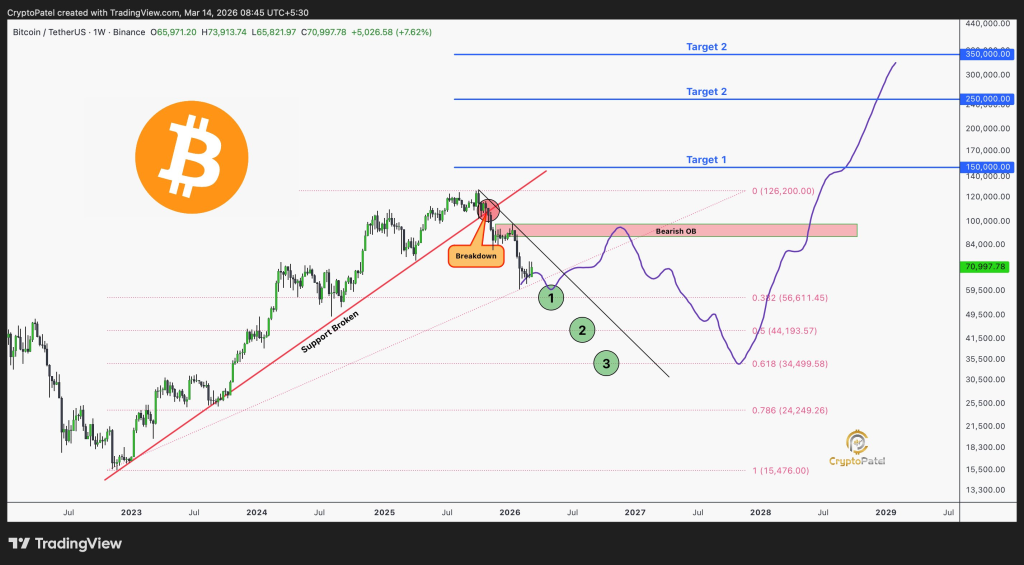
Top Analyst Reveals Bitcoin (BTC) Roadmap and Key Price Levels For the Next 2 Years

Pi Network Celebrates Pi Day 2026 Amid Anticipation for Major Utility Updates
Pi Network pioneers around the globe are celebrating Pi Day 2026, a symbolic and meaningful milestone for the comm