The best stories in crypto all start the same way. Someone hears about a presale, puts in a few thousand, and months later that money turns into a number they neverThe best stories in crypto all start the same way. Someone hears about a presale, puts in a few thousand, and months later that money turns into a number they never

Best Crypto Presale to Buy Now: A $2,500 Bet on Pepeto Targets $375,000 Using Math That Already Worked Once

2026/03/12 05:23
5 min read
For feedback or concerns regarding this content, please contact us at crypto.news@mexc.com

The best stories in crypto all start the same way. Someone hears about a presale, puts in a few thousand, and months later that money turns into a number they never thought they would see in their bank account. If you’re wondering about the best crypto presale to buy now, SHIB did it. PEPE did it. BONK did it. FLOKI did it.

The best crypto presale to buy now is the one where that same math is sitting right in front of you, except this time the project actually has an exchange, a bridge, an audit, and a team that already built a $7 billion token. Pepeto at $0.000000186 with $7.87 million raised is that presale, and the window before the listing closes does not stay open forever.

Best Crypto Presale to Buy Now: A $2,500 Bet on Pepeto Targets $375,000 Using Math That Already Worked Once

Put $2,500 In and Do the Math Yourself

The Numbers That Made Traders Stop Scrolling

At $0.000000186, a $2,500 entry into Pepeto buys 13.4 billion tokens.

Pepe has the exact same 420 trillion total supply. It reached $0.00002803 at its all time high with zero products, zero exchange, zero revenue sharing. An $11 billion market cap built entirely on meme energy.

Your 13.4 billion tokens at that price are worth $375,000.

Put in $1,000 and that is $150,000. Put in $5,000 and that is $750,000. The math already played out once with a token that had nothing. Pepeto has everything that token was missing.

Five Things That Separate Pepeto From Every Other Presale

Line up every best crypto presale to buy now option and compare them on five points.

How much was raised. Pepeto raised $7.87 million during extreme fear when most presales raised nothing. Who built it. The cofounder took Pepe from zero to $7 billion. Is it audited. SolidProof completed the smart contract audit. Does it have a product. The exchange and cross chain bridge are built, connecting Ethereum, BSC, and Solana with zero fee trading. Does the token earn revenue. Every trade on the exchange sends proportional earnings to every holder permanently.

No other presale checks all five boxes. Most check zero. DeepSnitch AI checks one, the working product. BlockDAG checks one, the raise amount. Neither has an audited exchange, a proven founding team, or a revenue sharing model that pays holders forever.

The Presale Raised Millions While the Market Was Frozen in Fear

When the Fear and Greed Index hit single digits, most of the market went quiet. Trading volume dropped. Presales stalled. Retail investors left.

Pepeto raised $7.87 million during that exact period. A former Binance expert joined the advisory board. The SolidProof audit came back clean. And wallets kept buying because the math does not care about market sentiment.

The people who bought SHIB during the 2020 bear market are the ones who retired in 2021. The people who scrolled past it are the ones still working. Fear is where early entries live, and Pepeto sitting at $0.000000186 during extreme fear is that entry.

Your Tokens Grow While You Wait

Staking at 201% APY compounds daily. Your 13.4 billion tokens from a $2,500 entry keep getting bigger before the listing arrives. That means your $375,000 target keeps climbing too. No other best crypto presale to buy now offers this kind of yield on top of exchange token return math.

What the Competition Looks Like Next to Pepeto

IPO Genie offers crypto holders access to stock market IPOs. Interesting idea, but zero exchange volume and zero revenue per token. The return depends entirely on whether people want the IPO feature.

BlockDAG sells mining hardware through multi stage presales. Hardware dependency creates shipping delays and logistics problems that software tokens avoid. Mining profitability continues to shrink across the industry.

Neither carries the return math, the founder credibility, or the 201% APY staking that Pepeto offers at $0.000000186.

If You Have Been Here Before, You Know What This Looks Like

DOGE at $0.002. SHIB before its first listing. PEPE in its first week. The wallets that got in at those moments did not need anyone to tell them it was safe. They looked at the math, looked at the community, and decided the risk was worth it. The rest followed after the price already moved.

Pepeto with a SolidProof audit, a $7 billion founding team, and 201% staking is giving that same moment right now.

Conclusion

Every presale on the market loses the side by side comparison. $7.87 million raised, SolidProof audit, $7 billion cofounder, working exchange, revenue sharing, and a presale price that turns $2,500 into $375,000 if this token reaches what Pepe reached with nothing behind it. The listing is coming. Once it happens, this price vanishes. Visit the Pepeto official website and pick a side before listing day picks it for you.

Click To Visit Pepeto Website To Enter The Presale

FAQ

What is the best crypto presale to buy now? Pepeto leads every comparison: $7 billion founding team, SolidProof audit, 201% APY staking, revenue sharing exchange, at $0.000000186. A $2,500 entry targets $375,000 based on Pepe’s all time high math.

How do I know if a presale is safe? Look for audits, founder track records, and real products. Pepeto has a SolidProof audit, a cofounder who built Pepe to $7 billion, and a working exchange. Visit the Pepeto official website for the full audit.

Why does the same supply matter for the price target? Pepeto and Pepe both have 420 trillion tokens. When Pepe reached $0.00002803 with zero products, it proved what that supply can support. Pepeto with actual products has a higher floor for the same math.

Comments
Market Opportunity
MATH Logo
MATH Price(MATH)
$0.0266
$0.0266$0.0266
-1.51%
USD
MATH (MATH) Live Price Chart
Disclaimer: The articles reposted on this site are sourced from public platforms and are provided for informational purposes only. They do not necessarily reflect the views of MEXC. All rights remain with the original authors. If you believe any content infringes on third-party rights, please contact crypto.news@mexc.com for removal. MEXC makes no guarantees regarding the accuracy, completeness, or timeliness of the content and is not responsible for any actions taken based on the information provided. The content does not constitute financial, legal, or other professional advice, nor should it be considered a recommendation or endorsement by MEXC.

You May Also Like

Tether Backs Ark Labs’ $5.2 Million Bet on Bitcoin’s Stablecoin Revival

Tether Backs Ark Labs’ $5.2 Million Bet on Bitcoin’s Stablecoin Revival

The post Tether Backs Ark Labs’ $5.2 Million Bet on Bitcoin’s Stablecoin Revival appeared on BitcoinEthereumNews.com. In brief Ark Labs secured backing from Tether
Share
BitcoinEthereumNews2026/03/12 21:44
MySQL Single Leader Replication with Node.js and Docker

MySQL Single Leader Replication with Node.js and Docker

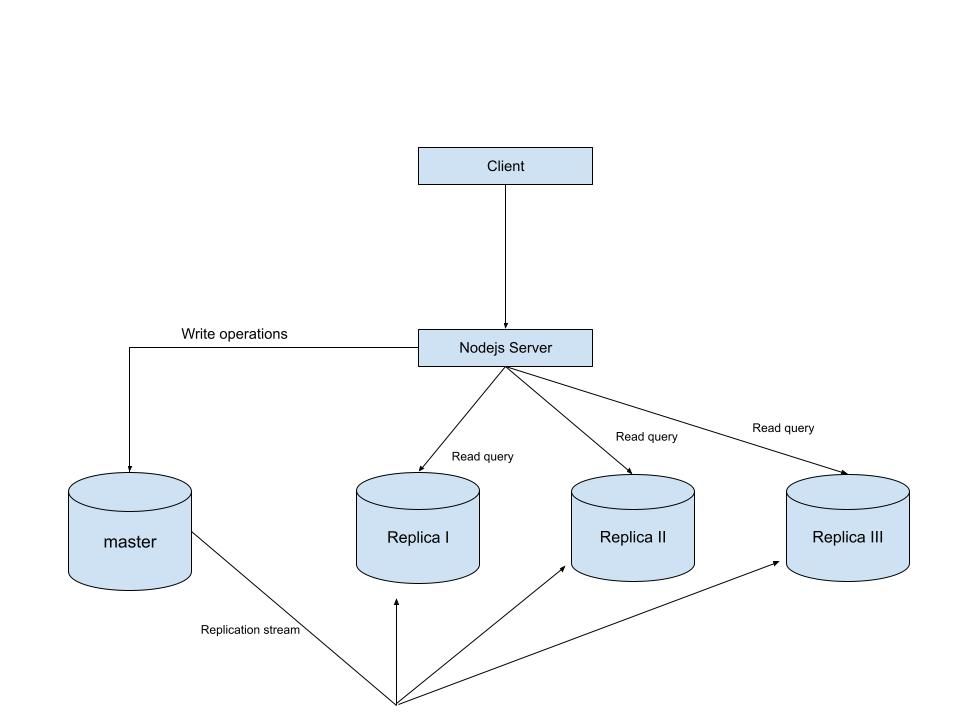
Modern applications demand high availability and the ability to scale reads without compromising performance. One of the most common strategies to achieve this is Replication. In this setup, we configured a single database to act as the leader (master) and handle all write operations, while three replicas handle read operations. In this article, we’ll walk through how to set up MySQL single-leader replication on your local machine using Docker. Once the replication is working, we’ll connect it to a Node.js application using Sequelize ORM, so that reads are routed to the replica and writes go to the master. By the end, you’ll have a working environment where you can see replication in real time Prerequisites knowledge of database replication Background knowledge of docker and docker compose Background knowledge of Nodejs and how to run a NodeJS server An Overview of what we are building Setup Setup our database servers on docker compose in the root of our project directory, create a file named docker-compose.yml with the following content to setup our mysql primary and replica databases. \ \ name: "learn-replica" volumes: mysqlMasterDatabase: mysqlSlaveDatabase: mysqlSlaveDatabaseII: mysqlSlaveDatabaseIII: networks: mysql-replication-network: services: mysql-master: image: mysql:latest container_name: mysql-master command: --server-id=1 --log-bin=ON environment: MYSQL_ROOT_PASSWORD: master MYSQL_DATABASE: replicaDb ports: - "3306:3306" volumes: - mysqlMasterDatabase:/var/lib/mysql networks: - mysql-replication-network mysql-slave: image: mysql:latest container_name: mysql-slave command: --server-id=2 --log-bin=ON environment: MYSQL_ROOT_PASSWORD: slave MYSQL_DATABASE: replicaDb MYSQL_ROOT_HOST: "%" ports: - "3307:3306" volumes: - mysqlSlaveDatabase:/var/lib/mysql depends_on: - mysql-master networks: - mysql-replication-network mysql-slaveII: image: mysql:latest container_name: mysql-slaveII command: --server-id=2 --log-bin=ON environment: MYSQL_ROOT_PASSWORD: slave MYSQL_DATABASE: replicaDb MYSQL_ROOT_HOST: "%" ports: - "3308:3306" volumes: - mysqlSlaveDatabaseII:/var/lib/mysql depends_on: - mysql-master networks: - mysql-replication-network mysql-slaveIII: image: mysql:latest container_name: mysql-slaveIII command: --server-id=3 --log-bin=ON environment: MYSQL_ROOT_PASSWORD: slave MYSQL_DATABASE: replicaDb MYSQL_ROOT_HOST: "%" ports: - "3309:3306" volumes: - mysqlSlaveDatabaseIII:/var/lib/mysql depends_on: - mysql-master networks: - mysql-replication-network In this setup, I’m creating a master database container called mysql-master and 3 replica containers called mysql-slave, mysql-slaveII and mysql-slaveIII. I won’t go too deep into the docker-compose.yml file since it’s just a basic setup, but I do want to walk you through the command line instructions used in all four services because that’s where things get interesting.
command: --server-id=1 --log-bin=ON The --server-id option gives each MySQL server in your replication setup its own name tag. Each one has to be unique and without it, replication won’t work at all. Another cool option not included here is binlog_format=ROW. This tells MySQL how to keep track of changes before passing them along to the replicas. By default, MySQL already uses row-based replication, but you can explicitly set it to ROW to be sure or switch it to STATEMENT if you’d rather log the actual SQL statements instead of row-by-row changes. \ Run our containers on docker Now, in the terminal, we can run the following command to spin up our database containers: docker-compose up -d \ Setting Up Our Master (Primary) Server To configure our master server, we would have to first access the running instance on docker using the following command docker exec -it mysql-master bash This command opens an interactive Bash shell inside the running Docker container named mysql-master, allowing us to run commands directly inside that container. \ Now that we’re inside the container, we can access the MySQL server and start running commands. type: mysql -uroot -p This will log you into MySQL as the root user. You’ll be prompted to enter the password you set in your docker-compose.yml file. \ Next, we need to create a special user that our replicas will use to connect to the master server and pull data. Inside the MySQL prompt, run the following commands: \ CREATE USER 'repl_user'@'%' IDENTIFIED BY 'replication_pass'; GRANT REPLICATION SLAVE ON . TO 'repl_user'@'%'; FLUSH PRIVILEGES; Here’s what’s happening: CREATE USER makes a new MySQL user called repl_user with the password replication_pass. GRANT REPLICATION SLAVE gives this user permission to act as a replication client. FLUSH PRIVILEGES tells MySQL to reload the user permissions so they take effect immediately. \ Time to Configure the Replica (Secondary) Servers a. First, let’s access the replica containers the same way we did with the master. Run this command in your terminal for each of the replica containers: \ docker exec -it <replica_container_name> bash mysql -uroot -p <replica_container_name> should be replace with the name of the replica container you are trying to setup b. Now it’s time to tell our replica where to get its data from. While inside the replica’s MySQL shell, run the following command to configure replication using the master’s details: CHANGE REPLICATION SOURCE TO SOURCE_HOST='mysql-master', SOURCE_USER='repl_user', SOURCE_PASSWORD='replication_pass', GET_SOURCE_PUBLIC_KEY=1; With the replication settings in place, let’s fire up the replica and get it syncing with the master. Still inside the MySQL shell on the replica, run: START REPLICA; This starts the replication process. To make sure everything is working, check the replica’s status with:
SHOW REPLICA STATUS\G; Look for Replica_IO_Running and Replica_SQL_Running — if both say Yes, congratulations! 🎉 Your replica is now successfully connected to the master and replicating data in real time.
Testing Our Replication Setup from the Node.js App Now that our replication is successfully set up, we can configure our Node.js server to observe the real-time effect of data being replicated from the master server to the replica server whenever we write to it. We start by installing the following dependencies:
npm i express mysql2 sequelize \ Now create a folder called src in the root directory and add the following files inside that folder connection.js, index.js and model.js. Our current directory should look like this We can now set up our connections to our master and replica server in the connection.js file as shown below
const Sequelize = require("sequelize"); const sequelize = new Sequelize({ dialect: "mysql", replication: { write: { host: "127.0.0.1", username: "root", password: "master", database: "replicaDb", }, read: [ { host: "127.0.0.1", username: "root", password: "slave", database: "replicaDb", port: 3307 }, { host: "127.0.0.1", username: "root", password: "slave", database: "replicaDb", port: 3308 }, { host: "127.0.0.1", username: "root", password: "slave", database: "replicaDb", port: 3309 }, ], }, }); async function connectdb() { try { await sequelize.authenticate(); } catch (error) { console.error("❌ unable to connect to the follower database", error); } } connectdb(); module.exports = { sequelize, }; \ We can now create a User table in the model.js file
const {DataTypes} = require("sequelize"); const { sequelize } = require("./connection"); const User = sequelize.define("User", { name: { type: DataTypes.STRING, allowNull: false, }, email: { type: DataTypes.STRING, unique: true, allowNull: false, }, }); module.exports = User \ and finally in our index.js file we can start our server and listen for connections on port 3000. from the code sample below, all inserts or updates will be routed by sequelize to the master server. while all read queries will be routed to the read replicas.
const express = require("express"); const { sequelize } = require("./connection"); const User = require("./model"); const app = express(); app.use(express.json()); async function main() { await sequelize.sync({ alter: true }); app.get("/", (req, res) => { res.status(200).json({ message: "first step to setting server up", }); }); app.post("/user", async (req, res) => { const { email, name } = req.body; let newUser = await User.build({ name, email, }); // This INSERT will go to the write (master) connection newUser = newUser.save({ returning: false }); res.status(201).json({ message: "User successfully created", }); }); app.get("/user", async (req, res) => { // This SELECT query will go to one of the read replicas const users = await User.findAll(); res.status(200).json(users); }); app.listen(3000, () => { console.log("server has connected"); }); } main(); When you make a POST request to the /users endpoint, take a moment to check both the master and replica servers to observe how data is replicated in real time. Right now, we are relying on Sequelize to automatically route requests, which works for development but isn’t robust enough for a production environment. In particular, if the master node goes down, Sequelize cannot automatically redirect requests to a newly elected leader. In the next part of this series, we’ll explore strategies to handle these challenges
Share
Hackernoon2025/09/18 14:44
Nvidia shares fall 3%

Nvidia shares fall 3%

The post Nvidia shares fall 3% appeared on BitcoinEthereumNews.com. Home » AI » Nvidia shares fall 3% Chipmaker extends decline as investors continue to take profits from recent highs. Photo: Budrul Chukrut/SOPA Images/LightRocket via Getty Images Key Takeaways Nvidia’s stock decreased by 3% today. The decline extends Nvidia’s recent losing streak. Nvidia shares fell 3% today, extending the chipmaker’s recent decline. The stock dropped further during trading as the artificial intelligence chip leader continued its pullback from recent highs. Disclaimer Source: https://cryptobriefing.com/nvidia-shares-fall-2-8/
Share
BitcoinEthereumNews2025/09/18 03:13