The post Ordinals Scrapyard turns Bitcoin NFT wreckage into tax write-offs appeared on BitcoinEthereumNews.com. A new website called Ordinals Scrapyard is allowing users to see exactly how much money they’ve lost buying inscriptions — and harvest the losses for tax reporting purposes. The site is an embarrassing bookend to a series of stories about the theory that Ordinals could bring NFT trading onto Bitcoin’s blockchain despite its popularity on other chains like Ethereum and Solana.  Despite being heralded in early 2023 by Bitcoin developer Casey Rodarmor as a Bitcoin-native protocol for minting, buying, and selling collectibles, the floor price of most inscriptions has now fallen to $0.001. Indeed, prior to the website’s launch, most inscriptions had no bid whatsoever and the vast majority of purchasers minted or purchased their NFTs once and now could not resell them. ORD, a centrally maintained and off-chain record-keeping system, attempted to chronologically number each sub-unit of every bitcoin (BTC) in existence. By tracking these satoshis or “sats,” each worth 1/100 millionth of one BTC, Ordinals traders could inscribe and pass around sats with numismatic value due to the extra data they added. At their speculative peak, certain inscriptions traded for over $1 million. Most are now worth only the sat on which they were inscribed. Read more: Did Taproot ruin Bitcoin with NFT inscriptions of monkey jpegs? Tax loss harvesting Bitcoin inscriptions The tax harvesting gimmick employed by Ordinals Scrapyard is similar to that used by a company formed in 2011, ET Brutus. ET Brutus is a tax harvesting service, launched to help investors with failed investments prove to tax authorities that they actually sold the asset for a 99.9% loss. The company pays exactly $1 for anyone’s stock, note, warrant, SAFE, escrow, or earnout. In addition to a $35 service fee, that sale can help tax filers report a near-total loss to reduce capital gains on other,… The post Ordinals Scrapyard turns Bitcoin NFT wreckage into tax write-offs appeared on BitcoinEthereumNews.com. A new website called Ordinals Scrapyard is allowing users to see exactly how much money they’ve lost buying inscriptions — and harvest the losses for tax reporting purposes. The site is an embarrassing bookend to a series of stories about the theory that Ordinals could bring NFT trading onto Bitcoin’s blockchain despite its popularity on other chains like Ethereum and Solana.  Despite being heralded in early 2023 by Bitcoin developer Casey Rodarmor as a Bitcoin-native protocol for minting, buying, and selling collectibles, the floor price of most inscriptions has now fallen to $0.001. Indeed, prior to the website’s launch, most inscriptions had no bid whatsoever and the vast majority of purchasers minted or purchased their NFTs once and now could not resell them. ORD, a centrally maintained and off-chain record-keeping system, attempted to chronologically number each sub-unit of every bitcoin (BTC) in existence. By tracking these satoshis or “sats,” each worth 1/100 millionth of one BTC, Ordinals traders could inscribe and pass around sats with numismatic value due to the extra data they added. At their speculative peak, certain inscriptions traded for over $1 million. Most are now worth only the sat on which they were inscribed. Read more: Did Taproot ruin Bitcoin with NFT inscriptions of monkey jpegs? Tax loss harvesting Bitcoin inscriptions The tax harvesting gimmick employed by Ordinals Scrapyard is similar to that used by a company formed in 2011, ET Brutus. ET Brutus is a tax harvesting service, launched to help investors with failed investments prove to tax authorities that they actually sold the asset for a 99.9% loss. The company pays exactly $1 for anyone’s stock, note, warrant, SAFE, escrow, or earnout. In addition to a $35 service fee, that sale can help tax filers report a near-total loss to reduce capital gains on other,…

Ordinals Scrapyard turns Bitcoin NFT wreckage into tax write-offs

A new website called Ordinals Scrapyard is allowing users to see exactly how much money they’ve lost buying inscriptions — and harvest the losses for tax reporting purposes.

The site is an embarrassing bookend to a series of stories about the theory that Ordinals could bring NFT trading onto Bitcoin’s blockchain despite its popularity on other chains like Ethereum and Solana. 

Despite being heralded in early 2023 by Bitcoin developer Casey Rodarmor as a Bitcoin-native protocol for minting, buying, and selling collectibles, the floor price of most inscriptions has now fallen to $0.001.

Indeed, prior to the website’s launch, most inscriptions had no bid whatsoever and the vast majority of purchasers minted or purchased their NFTs once and now could not resell them.

ORD, a centrally maintained and off-chain record-keeping system, attempted to chronologically number each sub-unit of every bitcoin (BTC) in existence.

By tracking these satoshis or “sats,” each worth 1/100 millionth of one BTC, Ordinals traders could inscribe and pass around sats with numismatic value due to the extra data they added.

At their speculative peak, certain inscriptions traded for over $1 million. Most are now worth only the sat on which they were inscribed.

Read more: Did Taproot ruin Bitcoin with NFT inscriptions of monkey jpegs?

Tax loss harvesting Bitcoin inscriptions

The tax harvesting gimmick employed by Ordinals Scrapyard is similar to that used by a company formed in 2011, ET Brutus.

ET Brutus is a tax harvesting service, launched to help investors with failed investments prove to tax authorities that they actually sold the asset for a 99.9% loss.

The company pays exactly $1 for anyone’s stock, note, warrant, SAFE, escrow, or earnout. In addition to a $35 service fee, that sale can help tax filers report a near-total loss to reduce capital gains on other, profitable investments.

Similarly, Ordinals Scrapyard will pay exactly 1 sat or $0.001 for an inscription.

Like ET Brutus, Ordinals Scrapyard also adds inscription Postage plus a service fee of 1,000 sats to complete the transaction.

The Ordinals community laughed at the new service offering.

“I thought this was a joke but ordinal gamblers are really down that bad huh,” someone commented. Senior Bitcoin developer Peter Todd also thought the website was hilarious.

Got a tip? Send us an email securely via Protos Leaks. For more informed news, follow us on X, Bluesky, and Google News, or subscribe to our YouTube channel.

Source: https://protos.com/ordinals-scrapyard-turns-bitcoin-nft-wreckage-into-tax-write-offs/

Market Opportunity
NEAR Logo
NEAR Price(NEAR)
$0.9991
$0.9991$0.9991
+0.06%
USD
NEAR (NEAR) Live Price Chart
Disclaimer: The articles reposted on this site are sourced from public platforms and are provided for informational purposes only. They do not necessarily reflect the views of MEXC. All rights remain with the original authors. If you believe any content infringes on third-party rights, please contact service@support.mexc.com for removal. MEXC makes no guarantees regarding the accuracy, completeness, or timeliness of the content and is not responsible for any actions taken based on the information provided. The content does not constitute financial, legal, or other professional advice, nor should it be considered a recommendation or endorsement by MEXC.
Tags:

You May Also Like

Young Republicans were more proud to be American under Obama than under Trump: data analyst

Young Republicans were more proud to be American under Obama than under Trump: data analyst

CNN data analyst Harry Enten sorts through revealing polls and surveys of American attitudes, looking for shifts, and his latest finding is an indictment of President
Share
Alternet2026/02/10 22:18
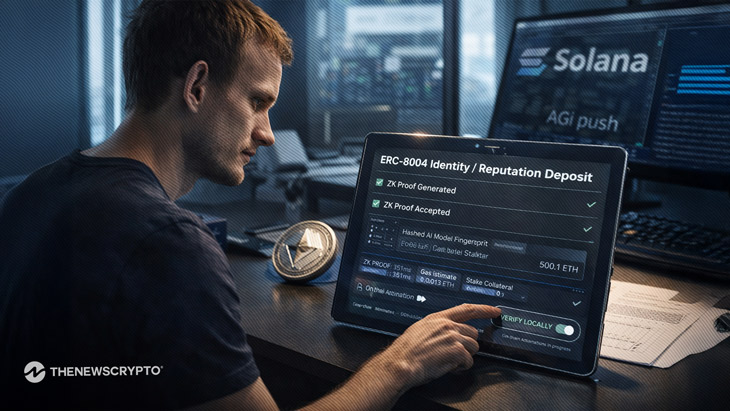
Vitalik Buterin Outlines Ethereum’s AI Framework, Pushes Back Against Solana’s Acceleration Thesis

Vitalik Buterin Outlines Ethereum’s AI Framework, Pushes Back Against Solana’s Acceleration Thesis

Ethereum co-founder Vitalik Buterin has reacted to Solana’s artificial general intelligence acceleration initiative. He did this through the establishment of his
Share
Thenewscrypto2026/02/10 18:40
Vitalik Buterin Reveals Ethereum’s Bold Plan to Stay Quantum-Secure and Simple!

Vitalik Buterin Reveals Ethereum’s Bold Plan to Stay Quantum-Secure and Simple!

Buterin unveils Ethereum’s strategy to tackle quantum security challenges ahead. Ethereum focuses on simplifying architecture while boosting security for users. Ethereum’s market stability grows as Buterin’s roadmap gains investor confidence. Ethereum founder Vitalik Buterin has unveiled his long-term vision for the blockchain, focusing on making Ethereum quantum-secure while maintaining its simplicity for users. Buterin presented his roadmap at the Japanese Developer Conference, and splits the future of Ethereum into three phases: short-term, mid-term, and long-term. Buterin’s most ambitious goal for Ethereum is to safeguard the blockchain against the threats posed by quantum computing.  The danger of such future developments is that the future may call into question the cryptographic security of most blockchain systems, and Ethereum will be able to remain ahead thanks to more sophisticated mathematical techniques to ensure the safety and integrity of its protocols. Buterin is committed to ensuring that Ethereum evolves in a way that not only meets today’s security challenges but also prepares for the unknowns of tomorrow. Also Read: Ethereum Giant The Ether Machine Takes Major Step Toward Going Public! However, in spite of such high ambitions, Buterin insisted that Ethereum also needed to simplify its architecture. An important aspect of this vision is to remove unnecessary complexity and make Ethereum more accessible and maintainable without losing its strong security capabilities. Security and simplicity form the core of Buterin’s strategy, as they guarantee that the users of Ethereum experience both security and smooth processes. Focus on Speed and Efficiency in the Short-Term In the short term, Buterin aims to enhance Ethereum’s transaction efficiency, a crucial step toward improving scalability and reducing transaction costs. These advantages are attributed to the fact that, within the mid-term, Ethereum is planning to enhance the speed of transactions in layer-2 networks. According to Butterin, this is part of Ethereum’s expansion, particularly because there is still more need to use blockchain technology to date. The other important aspect of Ethereum’s development is the layer-2 solutions. Buterin supports an approach in which the layer-2 networks are dependent on layer-1 to perform some essential tasks like data security, proof, and censorship resistance. This will enable the layer-2 systems of Ethereum to be concerned with verifying and sequencing transactions, which will improve the overall speed and efficiency of the network. Ethereum’s Market Stability Reflects Confidence in Long-Term Strategy Ethereum’s market performance has remained solid, with the cryptocurrency holding steady above $4,000. Currently priced at $4,492.15, Ethereum has experienced a slight 0.93% increase over the last 24 hours, while its trading volume surged by 8.72%, reaching $34.14 billion. These figures point to growing investor confidence in Ethereum’s long-term vision. The crypto community remains optimistic about Ethereum’s future, with many predicting the price could rise to $5,500 by mid-October. Buterin’s clear, forward-thinking strategy continues to build trust in Ethereum as one of the most secure and scalable blockchain platforms in the market. Also Read: Whales Dump 200 Million XRP in Just 2 Weeks – Is XRP’s Price on the Verge of Collapse? The post Vitalik Buterin Reveals Ethereum’s Bold Plan to Stay Quantum-Secure and Simple! appeared first on 36Crypto.
Share
Coinstats2025/09/18 01:22