Bitcoin Hyper’s $14.6M+ presale could be Bitcoin’s ticket to mainstream success once the project releases and implements its long-awaited changes. Bitcoin Hyper ($HYPER) is set to be Bitcoin’s official Layer-2, and plans to free Bitcoin from its performance limitation of just seven transactions per second (TPS). Little wonder, then, that whales have been sniffing around […]Bitcoin Hyper’s $14.6M+ presale could be Bitcoin’s ticket to mainstream success once the project releases and implements its long-awaited changes. Bitcoin Hyper ($HYPER) is set to be Bitcoin’s official Layer-2, and plans to free Bitcoin from its performance limitation of just seven transactions per second (TPS). Little wonder, then, that whales have been sniffing around […]

Whales Rush In As Bitcoin Hyper’s $14.6M Presale Becomes $BTC’s Ticket to Mainstream Success

2025/09/09 19:58
5 min read

Bitcoin Hyper’s $14.6M+ presale could be Bitcoin’s ticket to mainstream success once the project releases and implements its long-awaited changes.

Bitcoin Hyper ($HYPER) is set to be Bitcoin’s official Layer-2, and plans to free Bitcoin from its performance limitation of just seven transactions per second (TPS).

Little wonder, then, that whales have been sniffing around the $HYPER presale – this month has already seen a solid $50K whale buy.

Hyper’s goal is to make transactions faster and cheaper within the Bitcoin ecosystem, turning the network into a more viable choice for institutional investors. This includes high-traffic payment processors like Visa, which has a throughput of up to 65K TPS.

But what exactly are Bitcoin’s problems?

Why The Bitcoin Network Is Inefficient And Sluggish

Bitcoin’s primary problem is the performance limitation, currently capped at seven TPS. This means that the network can only process seven transactions per second before experiencing increased confirmation times and congestion.

Because of the low throughput, transactions fall into a queue list, with the system prioritizing larger transactions with higher fees. This fee-based priority system increases the confirmation time to potentially multiple hours.

In all, it means Bitcoin can be slow, expensive, and overall ineffective, with the network often experiencing congestion during high-traffic periods.

In terms of performance, Bitcoin ranks 22nd on the list of the fastest blockchains. Even Ethereum – with a utilization rate that has dropped to 50.68%, below the long-term average of 56.81% – still ranks 18th.

Solana, on the other hand, is second to ICP only, with a real throughput of 1K TPS and a theoretical max of 65K.
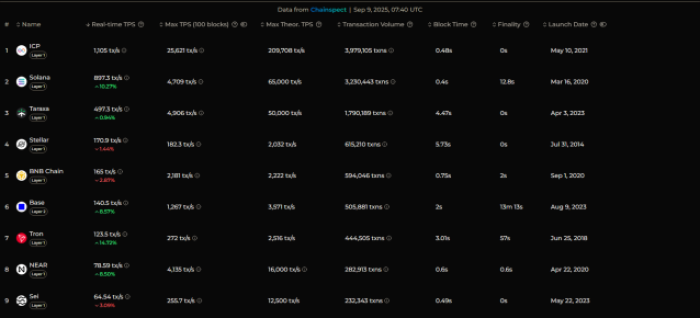
The list of the fastest blockchains by TPS, with Solana at no. 2.

So, Bitcoin clearly needs to step up its game. However, Bitcoin Hyper isn’t the first attempt at fixing the problem.

How the Lightning Network Failed

The Lightning Network is the most well-known failed attempt at boosting Bitcoin’s performance past its native limitations. The idea was similar to what Bitcoin Hyper is offering: faster and cheaper transactions without impacting the network’s security.

Unfortunately, the Lightning Network fell short due to its poor implementation and lack of relevant upgrades. The network came with multiple problems, including routing and path-finding failures, channel backup and recovery failure, and integration problems.

But the most impactful one related to the security aspect, as Lightning Network’s nodes need to remain online at all times to keep transactions flowing. This led to the Fraudulent Channel Close scam, causing people to lose their funds to a system exploit.

To prevent that, the devs created Watchtowers with the goal of addressing this specific problem. But the damage had already been done and investors lost their trust.

However, it’s not all doom and gloom. Bitcoin Hyper’s Layer-2 is poised to take over and eliminate Bitcoin’s pain points. If it’s successful, $HYPER could become Bitcoin’s saving grace.

How Bitcoin Hyper Solves Bitcoin’s Issues

Bitcoin Hyper relies on several tools – like the Canonical Bridge and the Solana Virtual Machine (SVM) – to address Bitcoin’s core performance limitations.

The Canonical Bridge will connect the Bitcoin network to the Hyper layer and relies on the Bitcoin Relay Program (BRP) to confirm incoming transactions. This drops confirmation times from hours to mere seconds, hitting multiple birds with one stone.

The fee-based priority system will also be gone, network fees will go down, and there’ll be no more risk of congestion.

Once the BRP confirms the transactions’ details, the Canonical Bridge will mint your $BTC onto the Hyper Layer-2 as wrapped $BTC. There, you can swap, stake, buy NFTs, and interact with dApps and DeFi.

And at any time, you can withdraw your wrapped $BTC back to Bitcoin’s native Layer-1.
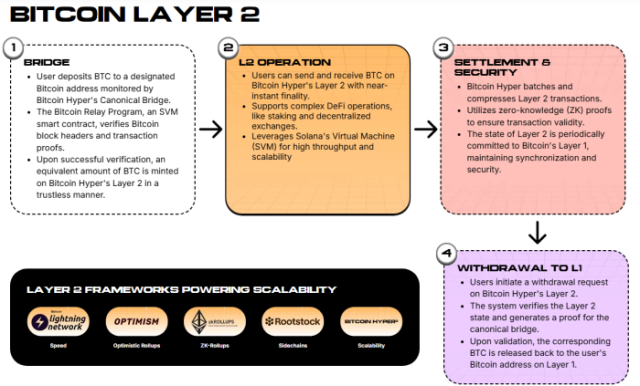
How Hyper’s Canonical Bridge works.

The SVM, meanwhile, complements the system by enabling the ultra-fast execution of smart contracts and turning Bitcoin even faster and more performant than ever.

The SVM allows for higher throughput and scalability, bringing Solana’s performance into Bitcoin’s highly secure and reputable ecosystem.

Hyper’s Presale Performance Bouyed By Whales

The $HYPER presale has now reached $14.6M+, and with no signs of slowing. In addition to last week’s $50K whale buy, August also saw some significant whale activity, including $161.3K and $100.6K.

And as we head deeper into this month, there’s a good chance more whales will be circling the $HYPER presale.

With a current token price of $0.012885 – and staking at 75% APY – it’s growing at an accelerated pace.

The influx of investors is the result of the project’s long-term potential, extensive and transparent roadmap, and the hype behind the idea of a faster and cheaper Bitcoin network.

Bitcoin Hyper's official presale page.

Based on these factors, there’s a good chance that $HYPER will see a post-launch boom, followed by a steady long-term performance. By the end of the year, our price prediction for $HYPER puts the token at $0.32.

By 2030, $HYPER could reach $1.50 or higher, especially if Bitcoin sees mainstream adoption. This reflects an ROI of 11,541%, which is enough to incentivize early adopters while the token still trades at its presale price.

Ready to jump in? Visit the official Bitcoin Hyper presale today.

Should You Buy Into the Hyper Hype?

Bitcoin Hyper ($HYPER) promises to fix Bitcoin’s pain points and overtake the Lightning Network as Bitcoin’s primary Layer-2 solution, so it’s not surprising that whales are rushing in.

As to whether you should invest or not – this depends on your risk tolerance and vision.

But if you do decide to invest, you should do it now while the $HYPER price is still low, which could change fast post-launch. So, read our guide on how to buy $HYPER and then to the official presale page to secure your tokens.

This isn’t financial advice. Always do your own research and invest wisely.

Authored by Bogdan Patru, Bitcoinist – https://bitcoinist.com/bitcoin-hyper-to-fix-btc-as-whales-rush-to-presale/

Market Opportunity
Bitcoin Logo
Bitcoin Price(BTC)
$70,408.01
$70,408.01$70,408.01
+2.60%
USD
Bitcoin (BTC) Live Price Chart
Disclaimer: The articles reposted on this site are sourced from public platforms and are provided for informational purposes only. They do not necessarily reflect the views of MEXC. All rights remain with the original authors. If you believe any content infringes on third-party rights, please contact service@support.mexc.com for removal. MEXC makes no guarantees regarding the accuracy, completeness, or timeliness of the content and is not responsible for any actions taken based on the information provided. The content does not constitute financial, legal, or other professional advice, nor should it be considered a recommendation or endorsement by MEXC.

You May Also Like

Cashing In On University Patents Means Giving Up On Our Innovation Future

Cashing In On University Patents Means Giving Up On Our Innovation Future

The post Cashing In On University Patents Means Giving Up On Our Innovation Future appeared on BitcoinEthereumNews.com. “It’s a raid on American innovation that would deliver pennies to the Treasury while kneecapping the very engine of our economic and medical progress,” writes Pipes. Getty Images Washington is addicted to taxing success. Now, Commerce Secretary Howard Lutnick is floating a plan to skim half the patent earnings from inventions developed at universities with federal funding. It’s being sold as a way to shore up programs like Social Security. In reality, it’s a raid on American innovation that would deliver pennies to the Treasury while kneecapping the very engine of our economic and medical progress. Yes, taxpayer dollars support early-stage research. But the real payoff comes later—in the jobs created, cures discovered, and industries launched when universities and private industry turn those discoveries into real products. By comparison, the sums at stake in patent licensing are trivial. Universities collectively earn only about $3.6 billion annually in patent income—less than the federal government spends on Social Security in a single day. Even confiscating half would barely register against a $6 trillion federal budget. And yet the damage from such a policy would be anything but trivial. The true return on taxpayer investment isn’t in licensing checks sent to Washington, but in the downstream economic activity that federally supported research unleashes. Thanks to the bipartisan Bayh-Dole Act of 1980, universities and private industry have powerful incentives to translate early-stage discoveries into real-world products. Before Bayh-Dole, the government hoarded patents from federally funded research, and fewer than 5% were ever licensed. Once universities could own and license their own inventions, innovation exploded. The result has been one of the best returns on investment in government history. Since 1996, university research has added nearly $2 trillion to U.S. industrial output, supported 6.5 million jobs, and launched more than 19,000 startups. Those companies pay…
Share
BitcoinEthereumNews2025/09/18 03:26
China Blocks Nvidia’s RTX Pro 6000D as Local Chips Rise
China Blocks Nvidia’s RTX Pro 6000D as Local Chips Rise

The post China Blocks Nvidia’s RTX Pro 6000D as Local Chips Rise appeared on BitcoinEthereumNews.com. China Blocks Nvidia’s RTX Pro 6000D as Local Chips Rise China’s internet regulator has ordered the country’s biggest technology firms, including Alibaba and ByteDance, to stop purchasing Nvidia’s RTX Pro 6000D GPUs. According to the Financial Times, the move shuts down the last major channel for mass supplies of American chips to the Chinese market. Why Beijing Halted Nvidia Purchases Chinese companies had planned to buy tens of thousands of RTX Pro 6000D accelerators and had already begun testing them in servers. But regulators intervened, halting the purchases and signaling stricter controls than earlier measures placed on Nvidia’s H20 chip. Image: Nvidia An audit compared Huawei and Cambricon processors, along with chips developed by Alibaba and Baidu, against Nvidia’s export-approved products. Regulators concluded that Chinese chips had reached performance levels comparable to the restricted U.S. models. This assessment pushed authorities to advise firms to rely more heavily on domestic processors, further tightening Nvidia’s already limited position in China. China’s Drive Toward Tech Independence The decision highlights Beijing’s focus on import substitution — developing self-sufficient chip production to reduce reliance on U.S. supplies. “The signal is now clear: all attention is focused on building a domestic ecosystem,” said a representative of a leading Chinese tech company. Nvidia had unveiled the RTX Pro 6000D in July 2025 during CEO Jensen Huang’s visit to Beijing, in an attempt to keep a foothold in China after Washington restricted exports of its most advanced chips. But momentum is shifting. Industry sources told the Financial Times that Chinese manufacturers plan to triple AI chip production next year to meet growing demand. They believe “domestic supply will now be sufficient without Nvidia.” What It Means for the Future With Huawei, Cambricon, Alibaba, and Baidu stepping up, China is positioning itself for long-term technological independence. Nvidia, meanwhile, faces…
Share
BitcoinEthereumNews2025/09/18 01:37
Silver Price Crash Is Over “For Real This Time,” Analyst Predicts a Surge Back Above $90

Silver Price Crash Is Over “For Real This Time,” Analyst Predicts a Surge Back Above $90

Silver has been taking a beating lately, and the Silver price hasn’t exactly been acting like a safe haven. After running up into the highs, the whole move reversed
Share
Captainaltcoin2026/02/07 03:15