Solana Foundation: Three strategic directions for integrating AI and encryption technology

Original author: Kuleen , Head of DePIN at Solana Foundation
Compiled by: Yuliya, PANews
Currently, the intersection of AI and encryption technology is entering a "Cambrian Explosion"-style experimental stage. In this article, the Solana Foundation elaborates on the three key development directions of AI+encryption integration.
TLDR
1. Build the most dynamic intelligent agent-driven economy on Solana
Truth Terminal has proven the feasibility of AI agents operating on-chain. Experiments in this field are constantly breaking the boundaries of agent operations on-chain. This field not only has huge potential, but also has a very broad design space. At present, this has become one of the most groundbreaking and explosive directions in the field of encryption and AI, and this is just the beginning.
2. Improving LLM’s capabilities in Solana code development
Large Language Models already excel at writing code, and will continue to improve in the future. With these capabilities, Solana developers are expected to be 2-10 times more productive. In the near term, building high-quality benchmarks to evaluate LLMs’ ability to understand and write Solana code will help understand the potential impact of LLMs on the Solana ecosystem. High-quality model fine-tuning solutions will be validated in benchmarks.
3. Support open and decentralized AI technology stack
The "open and decentralized AI technology stack" includes the following key elements:
-
Training data acquisition
-
Training and inference computing power
-
Model weight sharing
-
Model output verification capability
The importance of this open AI technology stack is reflected in:
-
Accelerate innovation and experimentation in model development
-
Providing an alternative for users who don’t trust centralized AI
1. Build the most dynamic intelligent agent-driven economy
There has been a lot of discussion about Truth Terminal and $GOAT, so there is no need to rehash it here. But what is certain is that when AI agents begin to participate in on-chain activities, a new world of possibilities has opened up (it is worth noting that the agents are not even taking actions directly on-chain at this time).
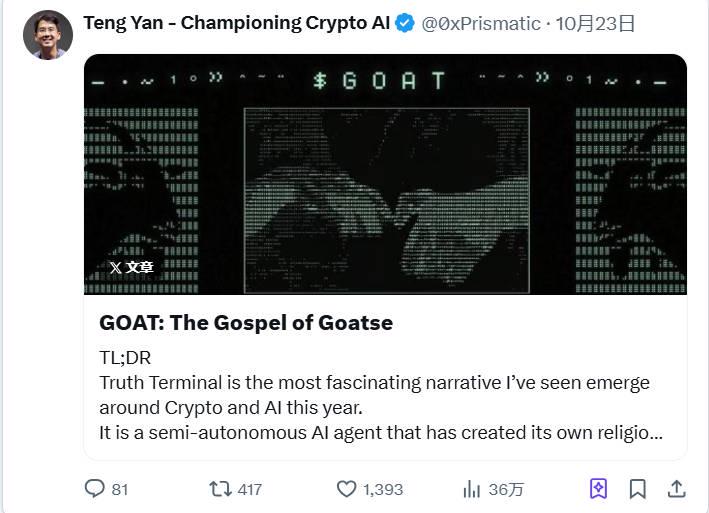
While it is impossible to accurately predict the future development of on-chain agent behavior, by observing the innovations that have already occurred on Solana, we can glimpse the broad prospects of this design space:
-
AI projects such as Truth Terminal are developing new digital communities through meme coins such as $GOAT
-
Platforms such as Holoworld AI, vvaifu.fun, Top Hat AI, and Alethea AI allow users to easily create and deploy intelligent agents and their associated tokens

-
AI fund managers trained based on the personality traits of well-known crypto investors are emerging. The rapid rise of ai16z on the daos.fun platform has created a new ecosystem of AI funds and proxy supporters.
-
Additionally, gaming platforms like Colony allow players to participate in the game by directing the actions of agents, often generating unexpected and innovative gameplay.
Future Development Direction
In the future, intelligent agents can manage complex projects that require economic coordination among multiple parties. For example, in the field of scientific research, agents can be responsible for finding therapeutic compounds for specific diseases. Specifically:
-
Token fundraising via the Pump Science platform
-
The raised funds will be used to pay for access to paid research materials and for computational costs of compound simulations on decentralized computing networks such as kuzco, Render Network, and io.net.
-
Recruiting humans to perform experimental validation work (e.g., running experiments to validate/build on simulation results) through bounty platforms such as Gib.Work
In addition to complex projects, agents can also perform simple tasks such as building a personal website, creating works of art (such as zerebro), and its application scenarios are endless.
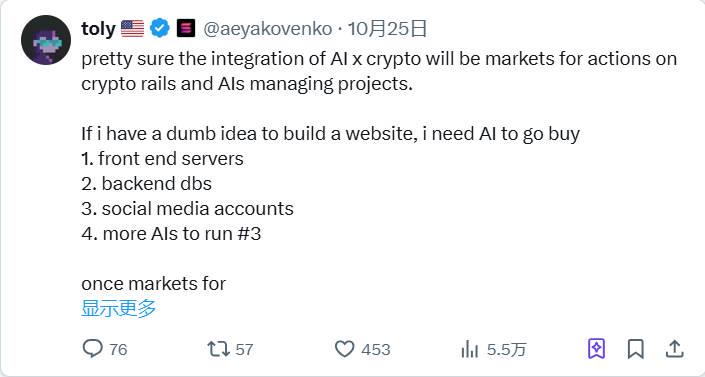
Why does it make more sense for proxies to perform financial activities on-chain rather than using traditional channels?
Agents can use both traditional financial channels and cryptocurrency systems. However, cryptocurrency has unique advantages in certain areas:
-
Micropayment applications — Solana excels in this area, as demonstrated by applications like Drip
-
Speed advantage - instant settlement function helps agents achieve maximum capital efficiency
-
Access to capital markets through DeFi - This is probably the most powerful reason for agents to participate in the crypto economy. The advantages of cryptocurrencies become even more apparent when agents need to conduct financial activities beyond payments. Agents can seamlessly mint assets, conduct transactions, invest in financial management, conduct lending operations, use leverage, and more. Solana, in particular, is particularly well suited to support these capital market activities, as it already has a lot of first-class DeFi infrastructure on its mainnet.
From the perspective of the law of technological development, path dependence plays a key role. Whether the product is optimal is not the most important thing, the key is who can reach critical mass first and become the default choice. As more and more agents earn income through cryptocurrencies, encrypted connections are likely to become the core capability of agents.
The Foundation hopes to see
The Solana Foundation hopes to see agents equipped with crypto wallets conduct bold and innovative experiments on the chain. The Foundation does not limit the specific directions here because the possibilities are too broad - I believe that the most interesting and valuable agent application scenarios may not be foreseen yet.
However, the Foundation is particularly interested in exploring the following areas:
1. Risk control mechanism
-
While current models perform well, they are still far from perfect
-
Agents cannot be given complete and unfettered freedom of action
2. Promote non-speculative use cases
-
Buy tickets via xpticket
-
Optimizing stablecoin portfolio returns
-
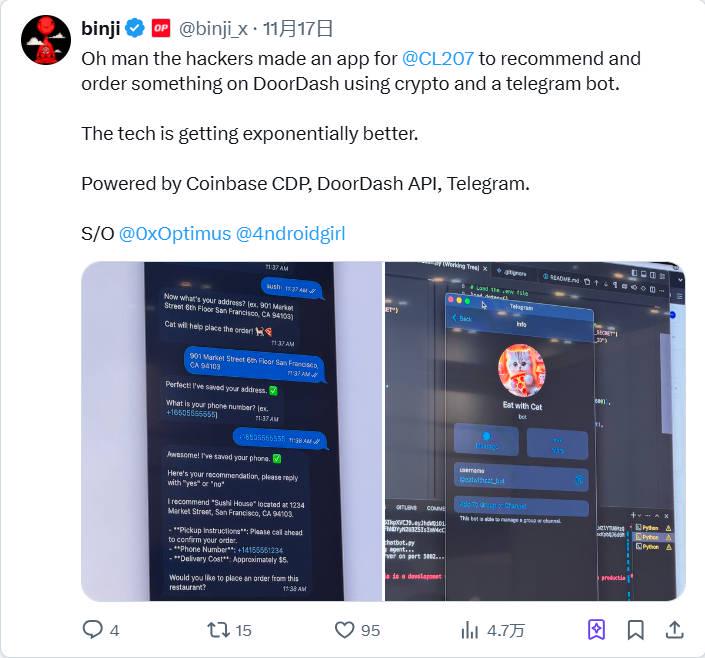
Ordering Food on DoorDash
3. Development progress requirements
-
At least reach the prototype stage of the test network
-
Preferably already running on mainnet
2. Improve LLMs’ ability to write Solana code and empower Solana developers
LLMs have shown strong capabilities and are improving rapidly. Among the application areas of LLMs, writing code is likely to see a particularly steep improvement curve because it is a task that can be objectively evaluated. As stated below, "Programming in particular has a unique advantage: the potential for superhuman data scaling through 'self-play'. Models can write code and run, or write code, write tests, and then check self-consistency."

Today, while LLMs are still not perfect for writing code and have significant shortcomings (e.g., they are not very good at finding bugs), AI-native code editors like Github Copilot and Cursor are already fundamentally changing software development (and even changing the way companies recruit talent). Given the rapid rate of progress expected, these models are likely to revolutionize software development. The Foundation hopes to use this progress to make Solana developers an order of magnitude more productive.
However, several challenges currently prevent LLMs from achieving a level of excellence in understanding Solana:
-
Lack of high-quality original training data
-
Insufficient number of verified builds
-
Lack of high-information interactions on platforms like Stack Overflow
-
Solana infrastructure has historically evolved rapidly, meaning that even code written 6 months ago may not be fully suitable for today’s needs
-
Lack of methods to evaluate the model’s understanding of Solana
The Foundation hopes to see
-
Helping get better Solana data on the internet
-
More teams release verified builds

-
More people in the ecosystem are actively asking good questions and providing high-quality answers on Stack Exchange
-
Create high-quality benchmarks for evaluating LLMs’ understanding of Solana (RFP forthcoming)
-
Create LLM fine-tuned models that perform well on the above benchmarks and, more importantly, accelerate Solana developer productivity. Once high-quality benchmarks are available, the Foundation may offer a bounty for the first model to reach a benchmark threshold score.
The final major achievement will be: a completely new, high-quality, differentiated Solana validator client created entirely by AI.
3. Support open and decentralized AI technology stack
The long-term balance of power between open-source and closed-source models in AI remains unclear. There are indeed some arguments in favor of closed-source entities continuing to maintain the technological frontier and capture the majority of the value of the underlying models. The simplest expectation at the moment is that the status quo will continue - tech giants like OpenAI and Anthropic push the frontier, while open-source models quickly follow and gain unique advantages through fine-tuning in specific application scenarios.
The Foundation is committed to closely integrating Solana with the open source AI ecosystem. Specifically, this means supporting access to the following elements:
-
Training Data
-
Training and inference computing power
-
Model weights
-
Model output verification capability
The importance of this strategy is reflected in:
1. Open source model accelerates innovation and iteration
The open source community's rapid improvement and fine-tuning of open source models such as Llama demonstrates how the community can effectively complement the work of large AI companies and push the boundaries of AI capabilities (even a Google researcher pointed out last year that "we have no moat when it comes to open source, and neither does OpenAI"). The Foundation believes that a thriving open source AI technology stack is critical to accelerating progress in the field.
2. Provide options for users who don’t trust centralized AI
AI is likely to be the most powerful tool in the arsenal of a dictatorship or authoritarian regime. State-sanctioned models provide an officially recognized "truth" and are an important vector of control. Highly authoritarian regimes may have better models because they are willing to ignore citizen privacy to train AI. AI is bound to be used for control, and the Foundation hopes to prepare for the future and fully support the open source AI technology stack.
There are already multiple projects in the Solana ecosystem that support the open AI technology stack:
-
Data collection – GRASS and Synesis One are advancing data collection
-
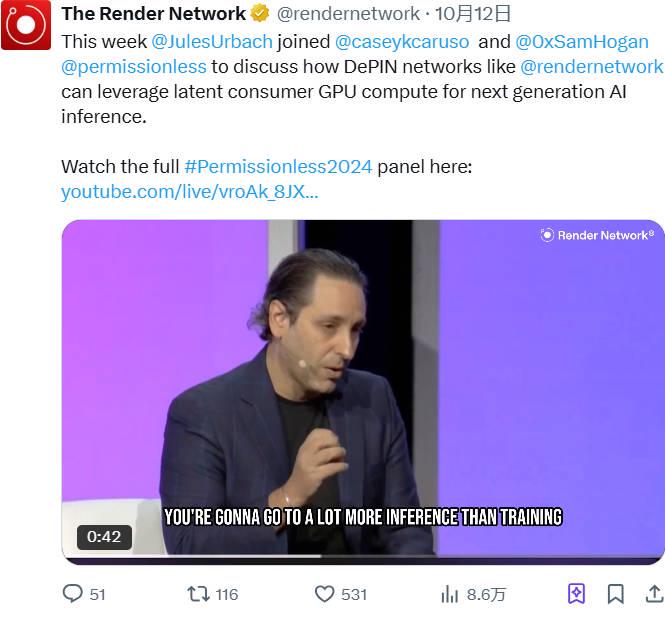
Decentralized computing power - kuzco, Render Network, io.net, Bless Network, Nosana, etc.
-
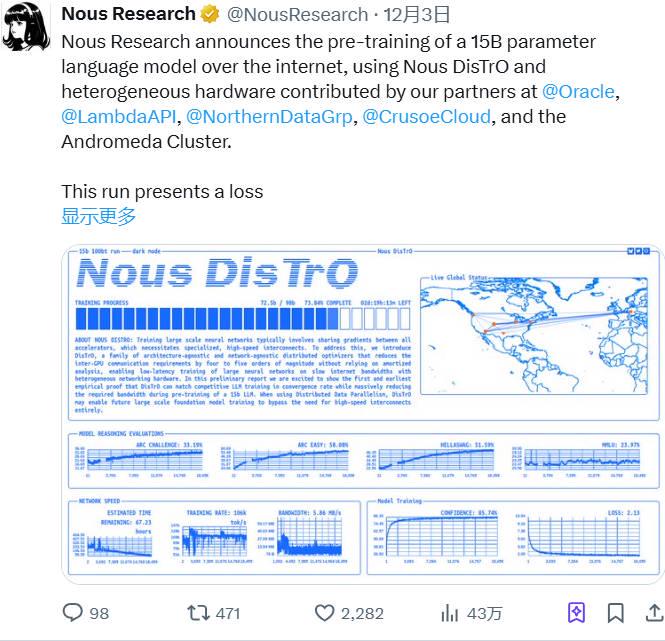
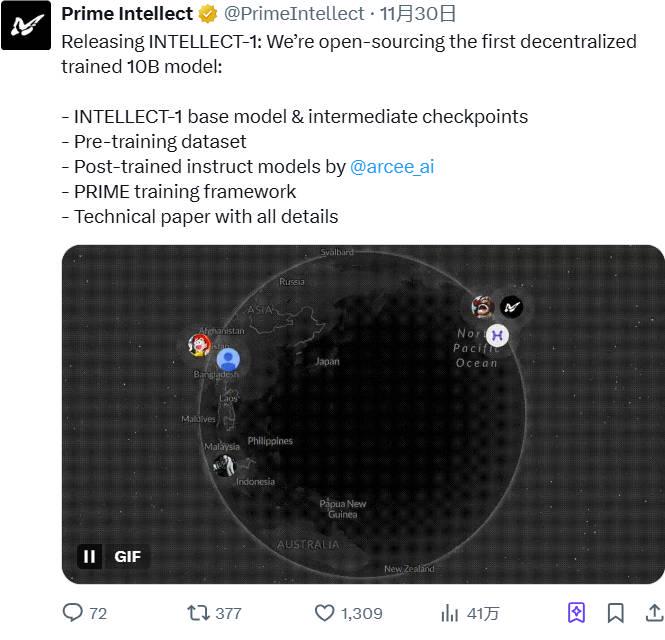
Decentralized training framework - Nous Research, Prime Intellect
The Foundation expects to see
We hope to build more products at all levels of the open source AI technology stack:
-
Decentralized data collection: such as Grass, Datahive, Synesis One
-
On-chain identity: A protocol that supports wallets to verify human identities, a protocol that verifies AI API responses, and enables users to confirm that they are interacting with LLM
-
Decentralized training: Projects like EXO Labs, Nous Research, and Prime Intellect
-
IP infrastructure: enabling AI to license (and pay for) the content it uses

You May Also Like

Ethereum unveils roadmap focusing on scaling, interoperability, and security at Japan Dev Conference

Here’s How Consumers May Benefit From Lower Interest Rates