

Aztec (AZTEC) Price Prediction 2026–2030: Can AZTEC Hit $0.1450 Soon?
• AZTEC surges 82% after Upbit and Bithumb KRW listings.
• Trading volume spikes 157% to $457 million amid kimchi premium.
• Break above $0.042 could open path toward $0.055–$0.082.
Aztec enters 2026 with renewed market attention after South Korean exchanges Upbit and Bithumb listed the token with KRW trading pairs. The February 20 listing triggered an 82% surge to $0.0395 as Korean retail demand pushed into thin order books, amplifying volatility through the kimchi premium effect.
Currently trading near $0.0372 with a market capitalization of approximately $94 million, AZTEC’s rally comes shortly after its February 12 token launch at $0.02. Despite the explosive move, price remains roughly 20% below the November public sale level, highlighting lingering overhead supply.
Also Read: BlackRock’s New Ethereum ETF to Pay 82% Staking Rewards to Investors
Market Context and Price Action
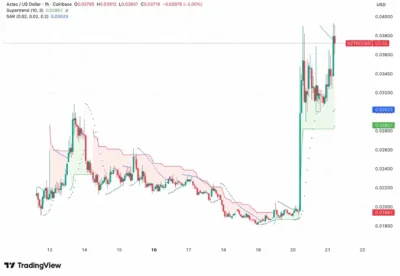
AZTEC spent the days following launch grinding near $0.019 before the Korean listings sparked a vertical expansion. The rapid move to $0.0395 marked a classic parabolic breakout driven by concentrated exchange flows and localized demand pressure.
The Supertrend indicator positioned at $0.02857 and the Parabolic SAR at $0.03023 both reflect short-term bullish structure. However, listing-driven rallies often retrace once arbitrage flows normalize pricing discrepancies between markets. Holding above $0.032 remains critical for maintaining immediate upside structure.
Current Market Overview
At the time of analysis, AZTEC is consolidating between $0.032 support and $0.042 resistance. The $0.028–$0.030 zone serves as secondary structural support aligned with recent breakout levels. A decisive close above $0.042 could expose the $0.055–$0.082 range projected for 2026 under strong adoption scenarios. Conversely, a loss of $0.025 would suggest the kimchi premium has fully unwound, increasing the probability of a retest toward the $0.019–$0.021 launch range.
Technical Analysis
Technically, AZTEC displays characteristics of a listing-driven momentum spike. The shift from compressed post-launch trading to vertical expansion reflects aggressive short-term accumulation. Immediate support stands at $0.032, followed by $0.028–$0.030.
Below that, $0.025 represents a structural breakdown trigger. On the upside, $0.042 remains the key breakout level. Sustained trading above this threshold would strengthen bullish continuation toward higher projected resistance bands. Volume expanded sharply during the 157% surge to $457 million, confirming strong participation. Continued upside requires sustained liquidity rather than isolated regional demand.
Source: Tradingview
Fundamental Outlook
Aztec focuses on privacy infrastructure using zkSNARKs to encrypt transaction amounts, wallet identities, and smart contract states. Its Noir programming language simplifies zero-knowledge application development without requiring deep cryptographic expertise.
The project is backed by $178 million from Paradigm, a16z, and Vitalik Buterin. The protocol introduces a 200,000 AZTEC sequencer requirement, potentially supporting validator demand. Currently, only 28% of total supply circulates, while 72% remains locked with 12-month restrictions extending through February 2027.
Challenges remain. Aztec previously shut down Aztec Connect in 2023 following declining usage. Privacy-focused protocols historically capture limited total value locked, and adoption remains concentrated within niche segments.
Aztec (AZTEC) Price Predictions (2026–2030)
| Year | Minimum Price | Average Price | Maximum Price |
|---|---|---|---|
| 2026 | $0.0245 | $0.0485 | $0.0825 |
| 2027 | $0.0385 | $0.0825 | $0.1450 |
| 2028 | $0.0625 | $0.1375 | $0.2420 |
| 2029 | $0.1050 | $0.2280 | $0.3950 |
| 2030 | $0.1725 | $0.3650 | $0.6200 |
2026
In 2026, price performance will depend on whether AZTEC sustains post-listing demand and maintains support above $0.032. Strong privacy adoption and additional exchange integrations could push price toward the $0.055–$0.082 range. A premium unwind may lead to consolidation between $0.022 and $0.035.
2027
By 2027, lockup expiration could introduce supply-side volatility. Broader institutional privacy adoption and mainnet activity growth would be required to justify higher valuation bands near $0.145.
2028
In 2028, capturing meaningful share of DeFi’s multi-billion-dollar TVL would significantly strengthen the valuation thesis. Sequencer demand and fee generation would become central performance drivers.
2029
If privacy becomes embedded infrastructure across decentralized applications, AZTEC could trend toward the $0.395 range during expansion cycles. Competitive L2 privacy solutions remain a structural consideration.
2030
By 2030, outcomes remain binary. Sustained mass adoption and high-volume private transaction processing could support prices near $0.620. Limited adoption would likely confine growth within narrower bands.
Conclusion
Aztec enters 2026 following an 82% listing-driven rally fueled by Korean exchange demand. While short-term momentum remains constructive above $0.032, sustaining long-term valuation growth will depend on privacy adoption, ecosystem expansion, and supply dynamics. The $0.042 resistance level serves as the immediate inflection point for continuation or consolidation.
FAQs
1. What triggered AZTEC’s recent rally?
Listings on Upbit and Bithumb with KRW trading pairs.
2. What is AZTEC’s key resistance level?
The primary resistance level is $0.042.
3.What are the main risks facing AZTEC?
Premium unwind risk, limited TVL, and long-term token dilution.
4. What is AZTEC’s projected 2026 average price?
The 2026 average forecast stands at $0.0485.
5. Can AZTEC reach $0.08 in 2026?
A sustained breakout above $0.042 could open the path toward the $0.055–$0.082 range.
Also Read: Morpho (MORPHO) Price Prediction 2026–2030: Can MORPHO Hit $3 Soon?
The post Aztec (AZTEC) Price Prediction 2026–2030: Can AZTEC Hit $0.1450 Soon? appeared first on 36Crypto.
You May Also Like

XRP Volume Rises 212%, Bitcoin ETFs Back in Demand With $506 Million, Dogecoin Price Reclaims $0.10 — U.Today Crypto Digest

Trump's confidante Steve Bannon says Scott Bessent should run both the Fed and Treasury
