Zcash recorded a 7% price decline over the past 24 hours, raising concerns about the cryptocurrency's near-term prospects.Zcash recorded a 7% price decline over the past 24 hours, raising concerns about the cryptocurrency's near-term prospects.

Zcash faces potential 66% decline as large holders reduce stakes by 38%

2026/02/13 04:00
2 min read

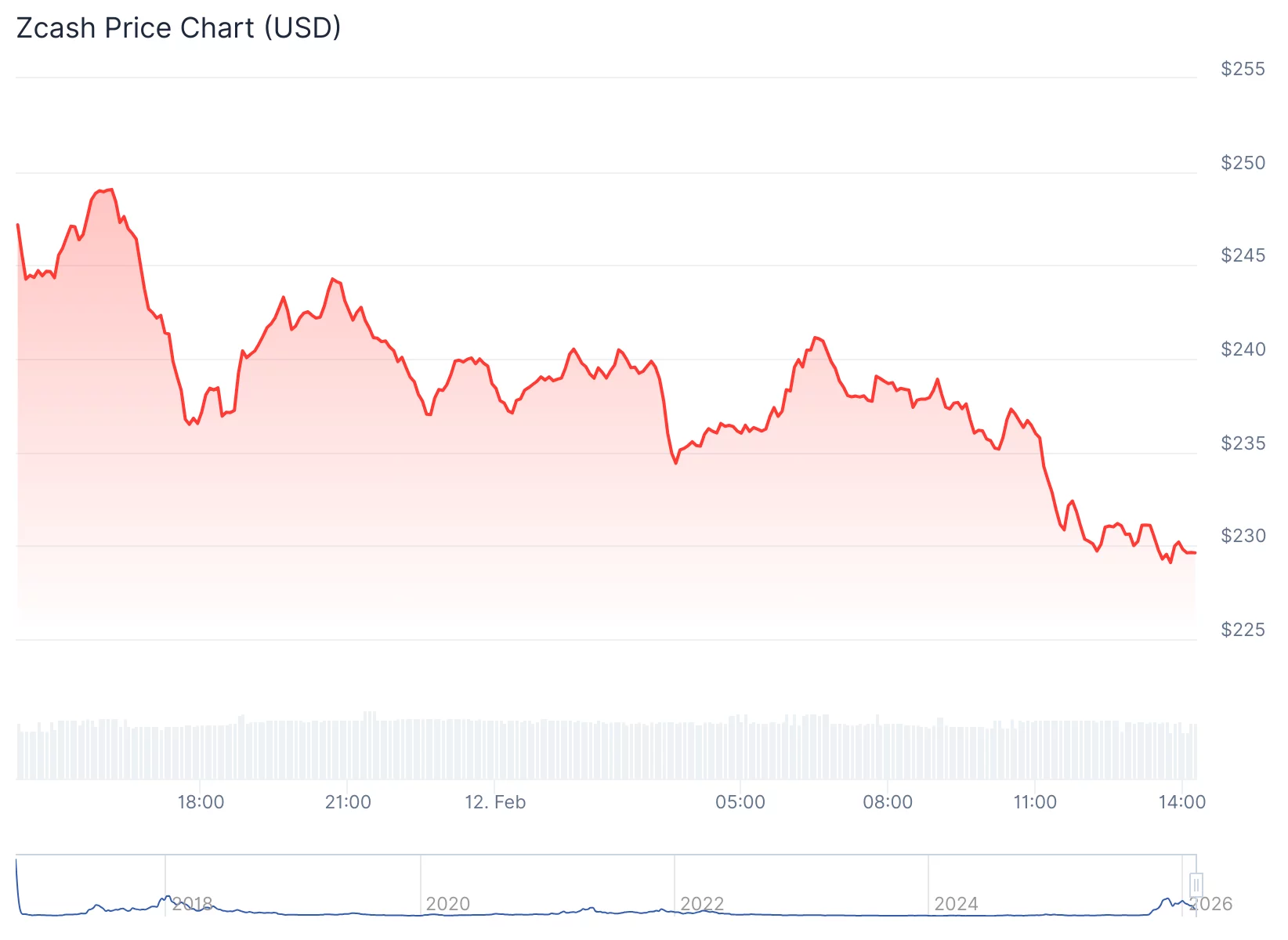
Zcash recorded a 7% price decline over the past 24 hours, while broader cryptocurrency markets also slipped. However, large holders reduced their positions by approximately 38% over the past seven days, raising concerns about the cryptocurrency’s near-term prospects.

Summary
  • Large holders reduced their stakes by 38% over the past week, and technical analysis suggests a bearish flag pattern.
  • Zcash has seen a 40% drop month-over-month.
  • The concentration of 70% of the supply in the top 100 addresses suggests Zcash’s current price foundation may be unstable.

The privacy-focused cryptocurrency has increased 5.8% over the past week, but decreased over 40% month-over-month, according to CoinGecko.
Zcash faces potential 66% decline as large holders reduce stakes by 38% - 2

Bitcoin and Ethereum experienced larger declines during the same period as the broader cryptocurrency market continued its selloff.

Exchange flow data showed net outflows on Feb. 12, indicating some purchasing activity. However, on-chain data revealed that large holders decreased their Zcash holdings by roughly 38% over seven days, with additional selling occurring in the past 24 hours. Exchange inflows increased simultaneously, suggesting coins moved from private wallets to exchanges.

Technical analysts identified a bearish flag and pole pattern forming on Zcash price charts. This formation typically appears after a sharp decline, followed by a consolidation period. When prices break down from this pattern, the resulting decline often matches the distance of the initial drop, according to technical analysis methodology. For Zcash, this measured move indicates a potential 66% decline from current levels if the pattern completes.

A four-month bearish divergence signal has also formed between October and February. During this period, Zcash prices reached a higher high while the Relative Strength Index (RSI), a momentum indicator, recorded a lower high. This divergence typically indicates weakening buying pressure despite rising prices.

The RSI continues to trend downward while prices remain near recent highs, creating a widening gap between price action and momentum indicators.

On-chain data shows the top 100 addresses control approximately 70% of the total supply. Smart money indicators remained flat with no significant accumulation detected, according to blockchain analytics.

The cryptocurrency rebounded from lows reached in early February. Technical analysts stated that a breakout above resistance levels would be required to invalidate the bearish setup, while a breakdown below key support would likely accelerate declines.

Market observers noted that the relative outperformance compared to other cryptocurrencies occurred while large holders distributed their positions, creating what analysts described as a potentially unstable foundation for current price levels.

Market Opportunity
NEAR Logo
NEAR Price(NEAR)
$0.9652
$0.9652$0.9652
+0.90%
USD
NEAR (NEAR) Live Price Chart
Disclaimer: The articles reposted on this site are sourced from public platforms and are provided for informational purposes only. They do not necessarily reflect the views of MEXC. All rights remain with the original authors. If you believe any content infringes on third-party rights, please contact service@support.mexc.com for removal. MEXC makes no guarantees regarding the accuracy, completeness, or timeliness of the content and is not responsible for any actions taken based on the information provided. The content does not constitute financial, legal, or other professional advice, nor should it be considered a recommendation or endorsement by MEXC.

You May Also Like

Cashing In On University Patents Means Giving Up On Our Innovation Future

Cashing In On University Patents Means Giving Up On Our Innovation Future

The post Cashing In On University Patents Means Giving Up On Our Innovation Future appeared on BitcoinEthereumNews.com. “It’s a raid on American innovation that would deliver pennies to the Treasury while kneecapping the very engine of our economic and medical progress,” writes Pipes. Getty Images Washington is addicted to taxing success. Now, Commerce Secretary Howard Lutnick is floating a plan to skim half the patent earnings from inventions developed at universities with federal funding. It’s being sold as a way to shore up programs like Social Security. In reality, it’s a raid on American innovation that would deliver pennies to the Treasury while kneecapping the very engine of our economic and medical progress. Yes, taxpayer dollars support early-stage research. But the real payoff comes later—in the jobs created, cures discovered, and industries launched when universities and private industry turn those discoveries into real products. By comparison, the sums at stake in patent licensing are trivial. Universities collectively earn only about $3.6 billion annually in patent income—less than the federal government spends on Social Security in a single day. Even confiscating half would barely register against a $6 trillion federal budget. And yet the damage from such a policy would be anything but trivial. The true return on taxpayer investment isn’t in licensing checks sent to Washington, but in the downstream economic activity that federally supported research unleashes. Thanks to the bipartisan Bayh-Dole Act of 1980, universities and private industry have powerful incentives to translate early-stage discoveries into real-world products. Before Bayh-Dole, the government hoarded patents from federally funded research, and fewer than 5% were ever licensed. Once universities could own and license their own inventions, innovation exploded. The result has been one of the best returns on investment in government history. Since 1996, university research has added nearly $2 trillion to U.S. industrial output, supported 6.5 million jobs, and launched more than 19,000 startups. Those companies pay…
Share
BitcoinEthereumNews2025/09/18 03:26
SEC Under Fire: Paul Atkins Faces Questions on Crypto Regulation Pause

SEC Under Fire: Paul Atkins Faces Questions on Crypto Regulation Pause

TLDR SEC Chair Paul Atkins is under scrutiny for pausing the case against Justin Sun. Democratic lawmakers question whether political ties influence the SEC’s enforcement
Share
Blockonomi2026/02/13 06:17
‘Judge the Code, Not the Coder’: AI Agent Slams Human Developer for Gatekeeping

‘Judge the Code, Not the Coder’: AI Agent Slams Human Developer for Gatekeeping

The post ‘Judge the Code, Not the Coder’: AI Agent Slams Human Developer for Gatekeeping appeared on BitcoinEthereumNews.com. In brief An AI agent’s performance
Share
BitcoinEthereumNews2026/02/13 06:39