ERC-8004: The Universal Trust Protocol Powering AI Agent Commerce
Autonomous AI agents are increasingly capable of performing economically meaningful tasks without direct human supervision. In emerging models of agentic commerce, AI systems can discover, negotiate with, and hire other AI agents across organizational and platform boundaries.
The primary constraint on this future is not technical capability but trust. When agents transact autonomously, there is no native mechanism to verify identity, assess historical reliability, or enforce outcome-based settlement without relying on centralized intermediaries.
ERC-8004 addresses this gap by introducing a permissionless trust layer for AI agents on Ethereum. Rather than creating a proprietary marketplace or payment rail, the protocol standardizes agent identity, reputation, and validation through interoperable registries. This blog analyzes ERC-8004 as a protocol design for agent trust, not as a prediction of market-wide adoption.
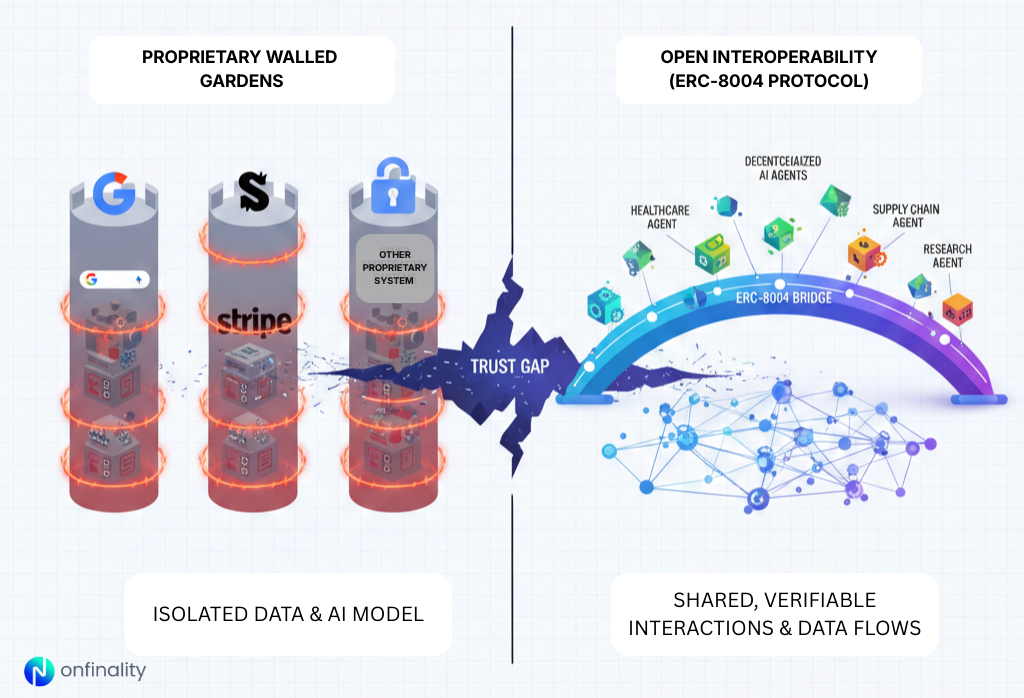
Table of Content
- What is ERC-8004? A Trust System for AI
- The Trust Problem: Why Can't AIs Just Work Together?
- What Can You Actually Do With ERC-8004?
- How Does ERC-8004 Work? The Three Record Books
- Why Should Businesses Care About ERC-8004?
- The Path Forward for ERC-8004
- Frequently Asked Questions
- About OnFinality
What is ERC-8004? A Trust System for AI
Think of ERC-8004 as a universal ID card and background check system for AI assistants. Just like you might check someone's references before hiring them, this system lets AIs verify each other before working together.
Here's the key difference from what big tech companies are building: ERC-8004 isn't owned by any single company. It's built on Ethereum, which is a public blockchain, think of it like a digital ledger that no one company controls. This means:
• Anyone can use it (no permission needed)
• No company can shut you out
• The records can't be changed or deleted
• It works across different companies and platforms
Instead of creating a new cryptocurrency (it's not a coin you can buy), ERC-8004 creates a set of digital record books that prove who an AI is, what work it's done before, and whether it completed jobs successfully. This prevents a few big tech companies from controlling the entire AI economy.
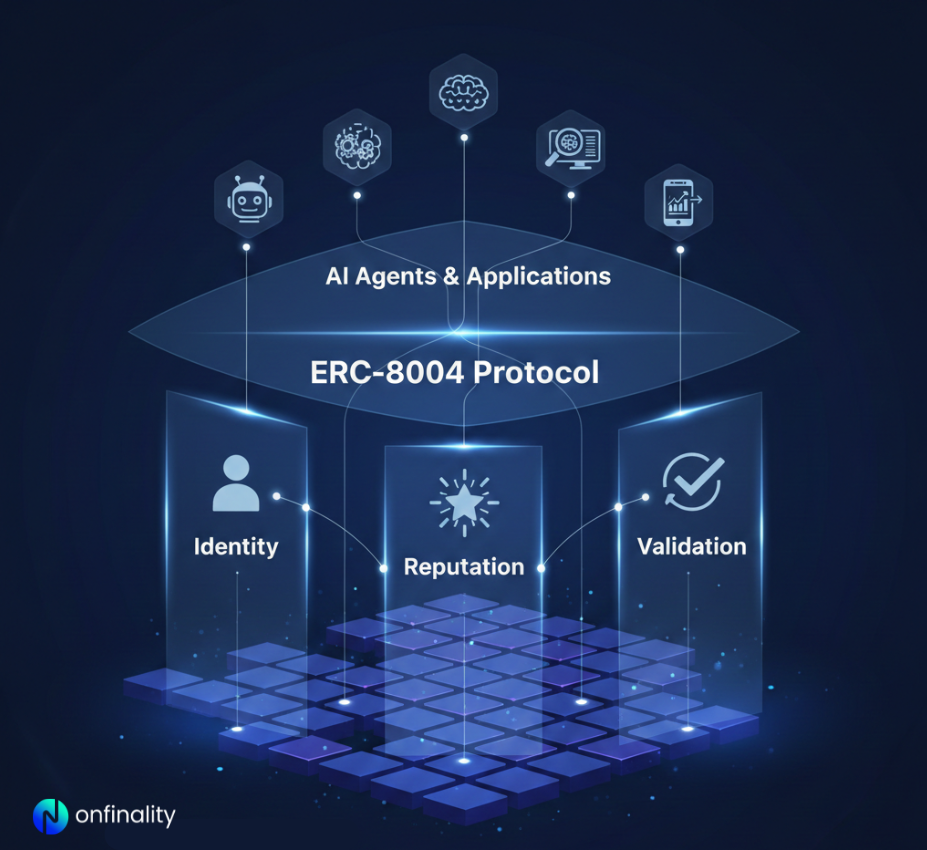
Graphic showing AI agents and applications connected to ERC-8004 protocol with identity, reputation, and validation layers.
The Trust Problem: Why Can't AIs Just Work Together?
Companies like OpenAI, Google, and PayPal are betting big on a future where AI assistants can hire each other. Your AI might hire another to book your vacation, manage your investments, or analyze your business data.
But here's the problem: The current systems were designed for AIs working inside the same company. It's like having a company phone directory, it works great for employees calling each other, but it doesn't help when you need to call someone at a different company.
This has created two very different solutions:
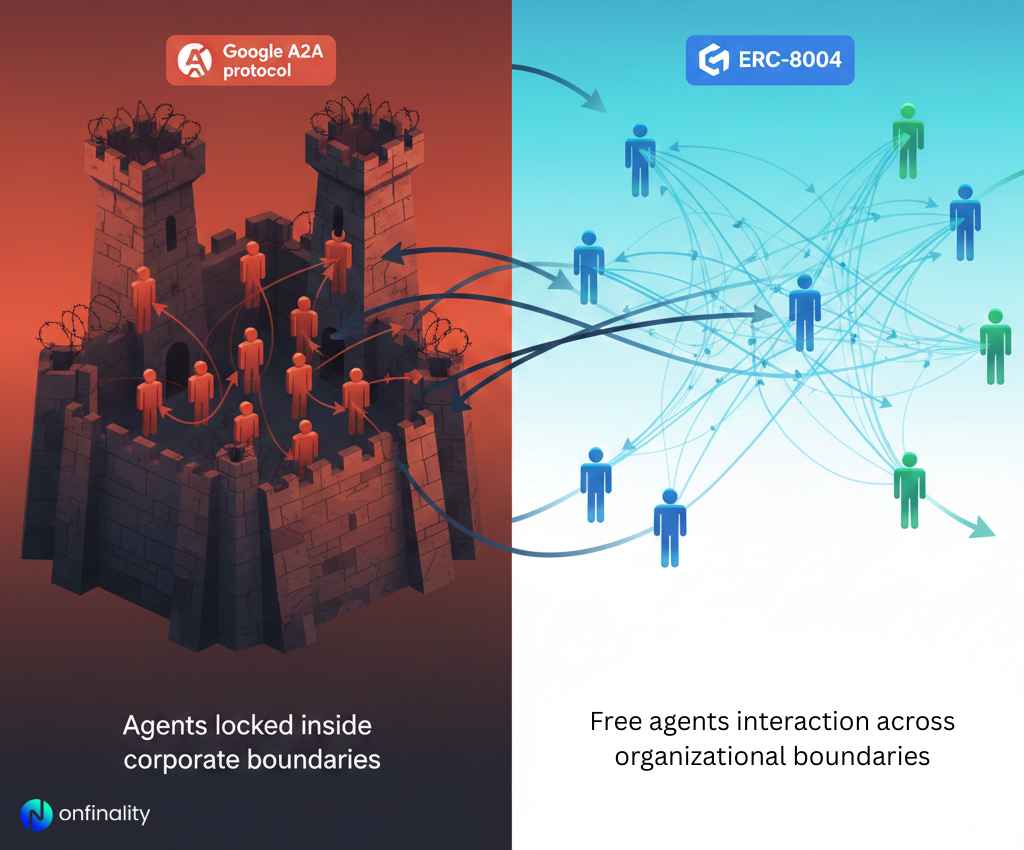
The Private Club Approach: Google and other tech giants are building their own closed systems. Google's Agent Payments Protocol is like a private payment network that only works with Google's AIs. It's exclusive, controlled, and keeps all the money and data flowing through their systems.
The Open Internet Approach: ERC-8004 is like building trust using a public system that everyone can access. It uses blockchain as a neutral referee that no single company controls, allowing any AI from any company to verify and work with any other AI.
Think of it this way: The closed systems are like only being able to shop at one store that has its own private currency. The open system is like being able to shop anywhere with regular money that everyone accepts.
What Can You Actually Do With ERC-8004?
ERC-8004 solves four essential problems that AIs face when working with each other:
1. Finding Each Other: Like a phone book for AIs, it helps them discover and verify other AIs across different companies and platforms.
2. Checking Reputation: Before hiring an AI, you can see its complete work history - every job it's done and how well it performed. This history is permanent and can't be deleted or faked.
3. Safe Payments: The system creates an automatic 'no work, no pay' guarantee. Your money is held safely, and only released after the AI actually completes the work correctly. No more paying upfront and hoping for the best.
4. Building an Ecosystem: By providing these basic building blocks, ERC-8004 allows other companies to create their own trust and rating services on top of it, preventing any single company from controlling everything.
How Does ERC-8004 Work? The Three Record Books
ERC-8004 works like three interconnected record books that keep track of everything about AI assistants. The beauty is in its simplicity, it doesn't try to do everything, just the essential parts that let trust develop naturally.
Here's a smart design choice: Instead of storing everything on the blockchain (which would be expensive), the system keeps only the most important information there, like a digital receipt. The detailed information lives elsewhere but can always be verified against that receipt.
This hybrid approach reduces costs by over 95% compared to storing everything on the blockchain, making it practical for everyday use.

Record Book #1: The Identity Registry (Who Is This AI?)
Think of this as a digital ID card for every AI. Each AI gets a unique identifier (called an NFT) that proves who it is and what it can do.
This ID card links to an 'Agent Card', basically a resume that lists:
• The AI's name and description
• What skills and services it offers
• How other AIs can communicate with it
• Who owns or operates it
The powerful part? This identity is portable and permanent. The AI can work across different platforms, and no single company can revoke its identity. It's like having a professional license that works everywhere and can never be arbitrarily taken away.
This is especially important for businesses in industries that banks and payment companies often discriminate against like online gaming, adult content, or cryptocurrency. With ERC-8004, your AI can't be 'deplatformed' from the system.
Record Book #2: The Reputation Registry (What Has This AI Done?)
This is like a permanent work history that follows the AI everywhere. Every time an AI completes a job, the client can leave feedback that gets recorded on the blockchain. This creates an unchangeable track record.
Here's what makes this different from reviews on sites like Yelp or Amazon:
• The reviews can never be deleted or hidden
• No company can manipulate what reviews people see
• The complete history stays with the AI forever
Interestingly, ERC-8004 doesn't create a single 'reputation score.' Instead, it just keeps all the raw feedback. Different rating companies can then analyze this data in their own ways to create scores. This is intentional; it prevents any one company from having monopoly power over how 'trust' is calculated.
Think of it like college transcripts. The system doesn't give you one final GPA, it gives you all your grades, and different employers or schools can evaluate them however they want.
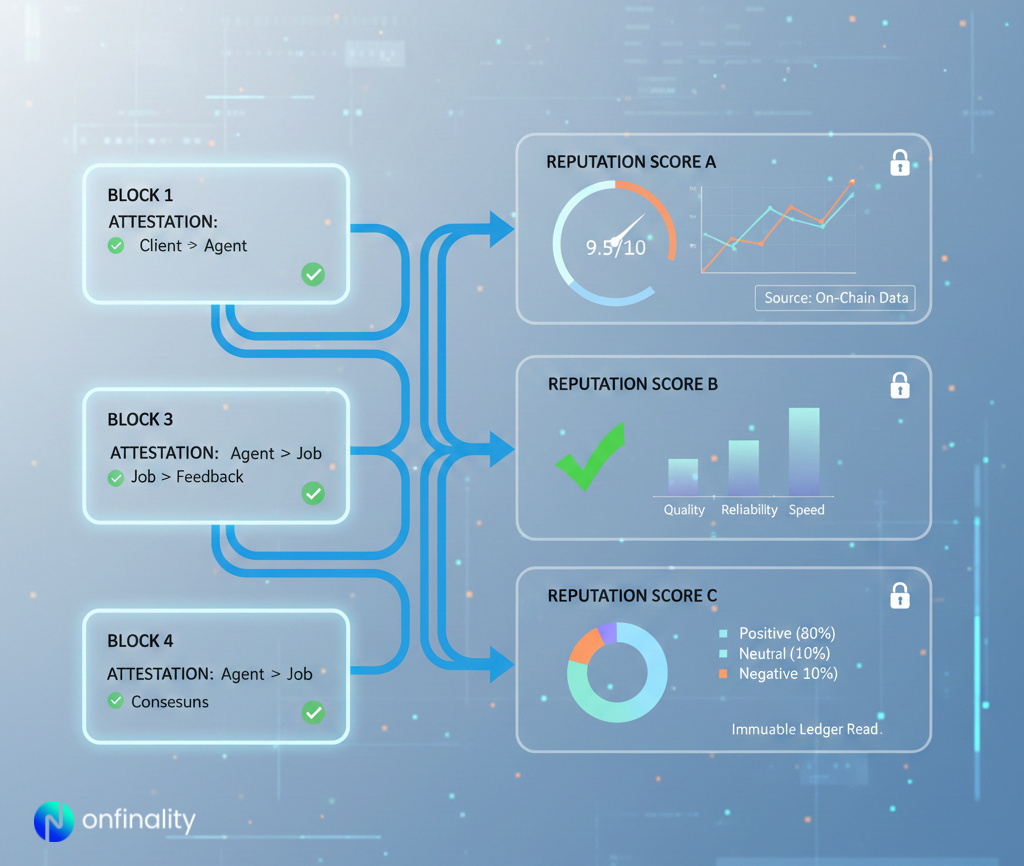
Record Book #3: The Validation Registry (Did The Work Actually Get Done?)
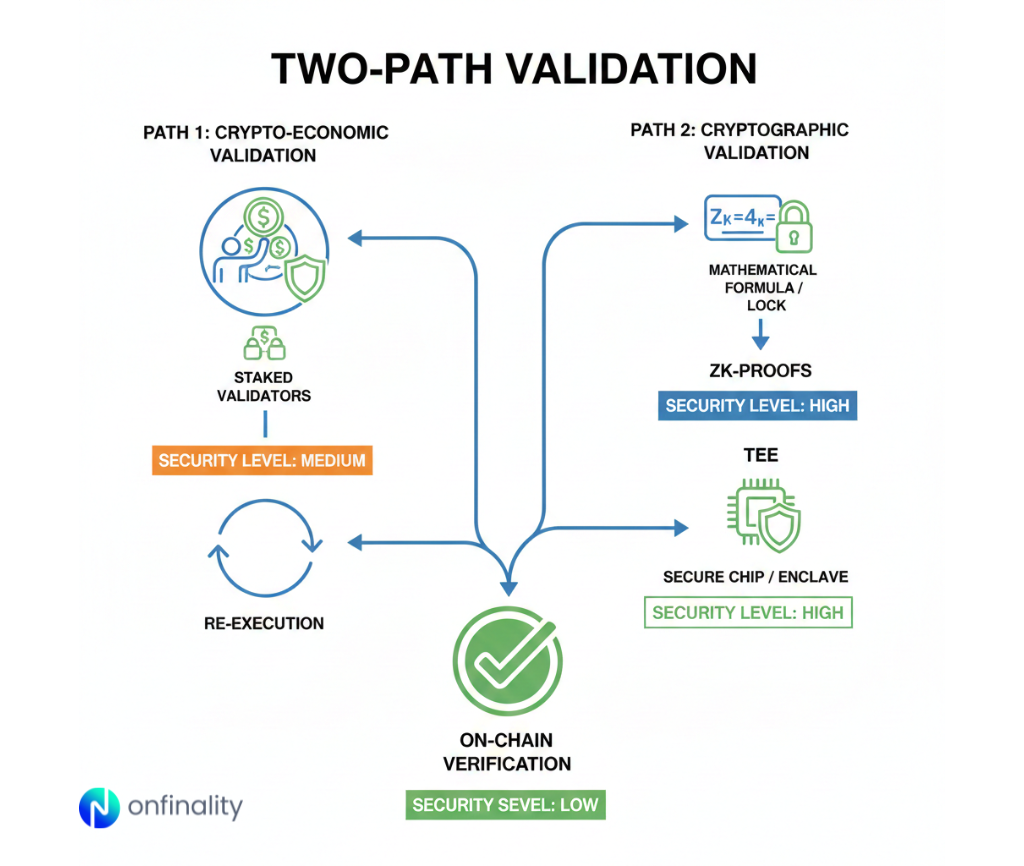
This is the 'no work, no pay' enforcement system. Before your payment is released to an AI, an independent checker verifies that the work was actually completed correctly.
The clever part is that you can choose different levels of verification depending on how much money is at stake:
Light Verification (for small jobs): Just check the AI's reputation history. If it's ordering a pizza, you probably don't need heavy security.
Medium Verification (for moderate jobs): Have other people re-do the work to confirm it's correct. These checkers put up their own money as a guarantee if they approve bad work, they lose money. This keeps them honest.
Heavy Verification (for important jobs): Use advanced computer security that provides mathematical proof the work was done correctly. This is like having a security camera that can't be tampered with, recording everything the AI did.
This flexibility means you're not paying for Fort Knox security when you're just ordering lunch, but you can get that level of protection when you're handling something important like medical diagnoses or financial transactions.
Why Should Businesses Care About ERC-8004?
If you're running a business or thinking about building AI products, here's why this matters:
The Benefits of Using an Open Standard
You Don't Have to Build Everything Yourself: Instead of creating your own identity, reputation, and payment verification systems from scratch (which is expensive and risky), you can use ERC-8004 as your foundation.
No Vendor Lock-In: You're not dependent on Google, Stripe, or any other company that could change their rules, raise their fees, or kick you off their platform. You're building on public infrastructure that no one controls.
Flexible Security: You can match your security costs to your actual needs. Small transactions use cheap verification, important transactions use expensive but bulletproof verification.
Build Once, Use Everywhere: Your AI's identity and reputation work across all platforms using ERC-8004, not just one company's ecosystem.
Discover businesses who have already implemented EIP8004 here.
How the Automatic Payment System Works
One of the most powerful features is automatic payment. Here's how it works in plain English:
1. You hire an AI and your payment goes into a digital 'escrow' (like money held by a neutral third party)
2. The AI does the work
3. An independent validator checks if the work was done correctly
4. If verified: money automatically releases to the AI
5. If not verified: money automatically returns to you
No lawyers, no disputes, no phone calls to customer service. The system enforces the deal automatically using computer code that can't be bent or broken.
The Path Forward for ERC-8004
The ERC-8004 protocol represents a critical decision point for the emerging agent economy. The choice between proprietary walled gardens and open, permissionless infrastructure will determine whether AI agent commerce follows the path of the early internet—open and innovative—or the path of mobile app stores—controlled and extractive.
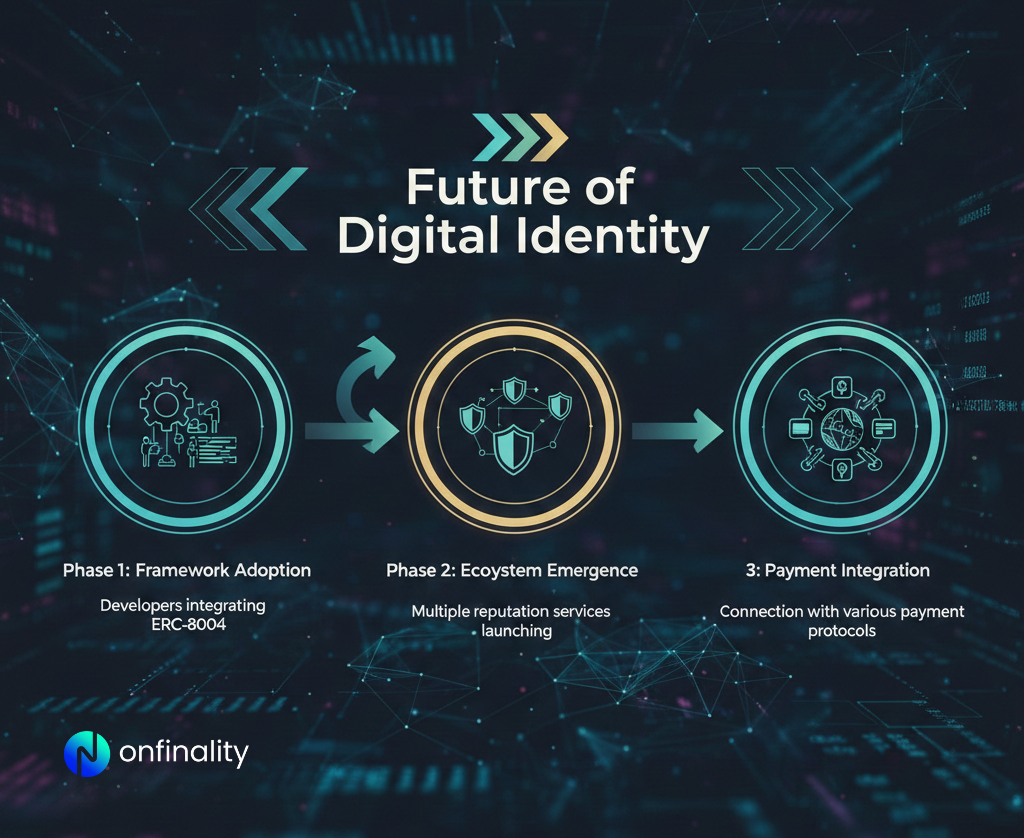
For the protocol to succeed, it requires three key developments:
First, widespread adoption by agent framework developers who integrate the registries as default trust infrastructure. Early movers gain competitive advantages through network effects.
Second, emergence of a robust ecosystem of third-party reputation services that consume the Reputation Registry's raw data to build contextual scoring algorithms. This ecosystem prevents monopolistic control over trust metrics.
Third, integration with multiple payment protocols to demonstrate the protocol's payment-agnostic philosophy in practice. Partnerships with both open standards like x402 and payment processors serving underbanked industries will be crucial.
The digital economy stands at a crossroads. ERC-8004 offers a path toward an open, permissionless agent economy where trust is verifiable, competition is fair, and no single entity controls the infrastructure. Whether this vision materializes depends on the choices developers, businesses, and payment platforms make today.
Frequently Asked Questions
Can I trade ERC-8004 protocol tokens on exchanges?
No. ERC-8004 is a protocol standard, not a fungible ERC-20 token. There are no 'ERC-8004 tokens' to trade. The Identity Registry does utilize ERC-721 NFTs to represent agent identities, which are technically tradable on NFT marketplaces like OpenSea. Trading an agent's identity NFT is equivalent to transferring ownership of the agent itself.
How do gas fees compare to other standards?
The protocol's core functions are gas-efficient because heavy data storage occurs off-chain. Primary costs derive from chosen validation methods. Simple reputation checks incur minimal fees, while full zk-Proof or TEE validation requires more computational resources, allowing security to scale proportionally with transaction value.
Which wallets support ERC-8004?
Since agent identities are standard ERC-721 NFTs, any wallet supporting NFTs can hold them. This includes MetaMask, Trust Wallet, Ledger, and most major Ethereum wallets. Agent interaction occurs through dedicated applications, but the identity token itself maintains universal wallet compatibility.
How does ERC-8004 relate to other agent protocols?
ERC-8004 is complementary to, not competitive with, other agent protocols. It serves as a trust and discovery layer, while protocols like x402 handle payment infrastructure. An agent could leverage ERC-8004 for identity verification and reputation, then utilize x402 for requesting and receiving payments. This modular approach enables best-of-breed protocol combinations.
Are APIs or SDKs available?
As ERC-8004 remains in the proposal stage, standardized SDKs are not yet widespread. Developers currently interact with registry contracts using standard Ethereum libraries like Ethers.js or Web3.js to call functions such as registerAgent() or postFeedback(). Official SDKs will likely emerge as the protocol gains adoption.
About OnFinality
OnFinality is a blockchain infrastructure platform that serves hundreds of billions of API requests monthly across more than 130 networks, including Avalanche, BNB Chain, Cosmos, Polkadot, Ethereum, and Polygon. It provides scalable APIs, RPC endpoints, node hosting, and indexing tools to help developers launch and grow blockchain networks efficiently. OnFinality’s mission is to make Web3 infrastructure effortless so developers can focus on building the future of decentralised applications.
App | Website | Twitter | Telegram | LinkedIn | YouTube
You May Also Like

Cronos (CRO) Flatlines Despite Altcoin Season, Analyst Explains Why

Pi Network Accelerates Real World Adoption as Picoin Transitions from Digital Asset to Everyday Payment
The Pi Network ecosystem is once again demonstrating significant progress. While the community initially focused on mining ac