

Bitcoin Author Saifedean Exposes Milei’s ‘Economic Miracle’ As Fiat Fraud
Saifedean Ammous—best known in the Bitcoin community as the author of The Bitcoin Standard—has attacked Argentine President Javier Milei’s stabilization program as a bond-fueled “fiat fraud,” arguing that the policy mix flatters official statistics while deepening the country’s dependence on multilateral lenders and peso-denominated carry trades.
In a lengthy X post on August 20, Ammous framed last week’s bond rollover as a reality check: “Argentina’s Javier Milei regime tried to roll over bonds by offering investors an insane 69% interest rate, and only succeeded in rolling over 61% of them. Even a 69% annual interest rate isn’t enough to tempt investors to risk lending to the Milei ponzi.” He punctuated the thread with a line he says Milei himself used after a memecoin debacle: “No Crying in the Casino!”
Bitcoin Vs. Fiat: Milei Picks His Side
Ammous’ critique is explicitly Bitcoin-versus-fiat. He claims the administration “reneged on [its] campaign promise to shut down the central bank,” chose to expand money-supply measures instead of “stop[ping] creating money,” and raised taxes while seeking an IMF rescue—moves he calls “the same old fiat banksterism.” The Bitcoin author’s monetary prescription is unambiguous: “After almost two years in office, it would have been absolutely trivial for Milei to bring price inflation down to close to zero with the one simple trick… stop creating money.” In Ammous’ telling, anything short of extinguishing discretionary money creation cannot be sold to Bitcoiners as sound policy.
On debt and multilateral financing, Ammous alleges that the latest arrangements amount to record-breaking exposure to official creditors and a mortgaging of future fiscal space. “With this new $20b in IMF loans, Argentina now has the highest outstanding debt to the IMF in IMF history… borrowing is now at 1,352% of its IMF quota,” he writes, adding that the World Bank and Inter-American Development Bank “also” committed roughly $12 billion and $10 billion, respectively, bringing “a total of $42 billion borrowed from international institutions.” He characterizes the show of support, celebrated by local officials, as a pyrrhic victory for fiat: “Point 5 is not a win, it is an L.”
The Bitcoin-versus-fiat framing extends to prices, exchange rates, and data quality. Ammous argues that government statistics understate the erosion of purchasing power, but says even the official numbers are damning. “After year-on-year price inflation rates rose to almost 300% in the first few months of his presidency, it has declined to the 30–40% range in recent months, and the cumulative price inflation since Milei has taken office is 155%,” he writes. He underscores pressure on the peso by citing both the black-market and official rates: “The black market peso exchange rate has dropped 30% against the dollar in just 21 months… The official rate… has dropped by around 70%, from 400 pesos per dollar to 1,300 pesos per dollar. Just in the last month of July, both rates dropped around 13%.”
Bitcoin Doesn’t Default—Fiat Always Does
Ammous, speaking from a hard-money and Bitcoin perspective, insists that free markets cannot coexist with monetary discretion: “All talk of a free market is empty rhetoric as long as the government manipulates the money.” He links this to the high-yield peso bond complex—what he dubs a “shitcoin casino”—arguing that “the central bank is imposing an interest rate of 65%, making speculation on the government’s bonds the only possibly profitable industry.” In Bitcoin circles, that argument resonates with a longstanding critique: fiat incentives manufacture yield-chasing behavior that collapses when confidence wobbles, while Bitcoin’s fixed issuance schedule avoids that cycle by design.
His post also alleges problematic asset management and bank risk. “Milei shipped off the little that remained of Argentina’s once significant gold reserves to London in search for a quick yield buck,” Ammous claims, before warning that new regulations could again funnel household savings into sovereign risk: “Milei and Caputo are currently trying to force the banks to buy more government bonds, yet again using the savings of Argentinians to prop up the government’s unsustainable debt… bringing back painful memories of the Corralón of 2001.” The Bitcoin author’s broader contention is that fiat systems externalize crisis risk onto depositors and domestic savers, while Bitcoin self-custody avoids those channels.
The administration’s supporters—some of them Bitcoiners—push back. Fernando Nikolić, founder of Perception responded point-by-point that “inflation has dramatically declined,” “GDP growth is projected at 5.5%,” “currency controls were successfully eliminated without crisis,” and “the budget achieved [a] historic surplus.” He framed the outcome as proof that markets and institutions “rewarded Milei’s more gradual approach,” even if it falls short of an immediate central-bank shutdown favored by Austrian economists and many Bitcoin advocates. Ammous dismissed the rebuttal: “You either didn’t read what I wrote or you’re incapable of comprehending what you read… Point 5 is not a win, it is an L. Muted for wasting my time with stupidity.”
Beyond the clash of tone, the substantive disagreement is philosophical and monetary. Ammous’ benchmark is Bitcoin-standard discipline: close the central bank, anchor money supply, let relative prices reset, and rebuild on hard money—painful initially, in his view, but durable.
The government’s approach is classic fiat stabilization: disinflate with tight policy, widen financing buffers with IMF/WB/IDB lines, normalize the FX regime, and nurse domestic markets back to depth—politically survivable if growth returns, but reliant on confidence, rollover capacity, and high local-currency rates that Bitcoiners see as the hallmark of fiat fragility.
For now, both narratives point to the same hinge variables: peso rollover capacity at “insane” yields, the pace of disinflation, the behavior of parallel exchange rates, and whether multilateral support remains politically and financially sustainable. If those levers tighten simultaneously, Bitcoin’s critique will look prescient; if they hold, the case for a fiat stabilization hardens. In Ammous’ words, however, Bitcoin is the only durable exit: “It would have been absolutely trivial… stop creating money.”
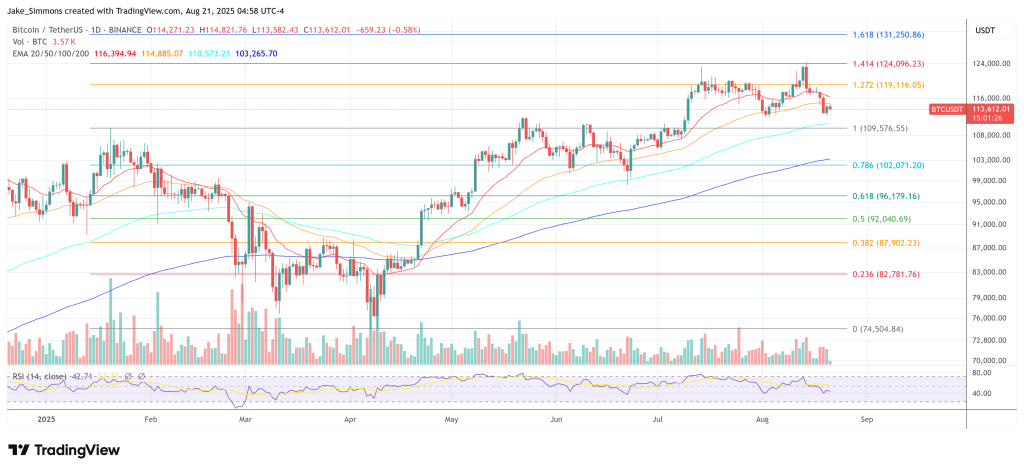
At press time, Bitcoin traded at $113,612.
You May Also Like

Recovery extends to $88.20, momentum improves

Fed Decides On Interest Rates Today—Here’s What To Watch For
