• Walmart becomes the first retailer to reach $1 trillion market capitalization, joining an elite club dominated by tech giants.
• Palantir surges over 10% after delivering blockbuster fourth-quarter results and raising 2026 revenue guidance well above Wall Street expectations.
• PayPal plunges 18% following disappointing earnings and CEO Alex Chriss’s immediate departure, with HP’s Enrique Lores named as replacement.
• Gold and Silver stage sharp rebounds after historic selloffs, with analysts maintaining bullish long-term outlooks despite recent volatility.
The Dow Jones Industrial Average (DJIA) traded in mixed territory on Tuesday, down around 175 points or 0.35% as investors digested a deluge of corporate earnings and economic data stutters. The S&P 500 rose 0.3% in early trading, hovering near record highs, while the Nasdaq Composite gained 0.5% on strength in AI-related stocks. The Dow fluctuated near the flatline, weighed down by weakness in healthcare names following Medicare Advantage rate proposals, but supported by gains in consumer staples and industrials.
The Bureau of Labor Statistics (BLS) confirmed that the December 2025 JOLTS Job Openings report, originally scheduled for Tuesday morning, will be delayed due to the ongoing partial government shutdown. The Labor Department is among the agencies affected by the funding lapse that began January 31. The most recent data from November showed job openings fell by 303K to 7.146 million, the lowest level since September 2024 and well below market expectations of 7.60 million. Openings declined notably in accommodation and food services, transportation, warehousing and utilities, and wholesale trade. The January employment situation report, including the latest Nonfarm Payrolls (NFP) net job additions figures, initially scheduled for Friday, has also been postponed. A House vote on a funding package is expected later Tuesday, though analysts note the delay adds uncertainty as markets assess the health of the labor market ahead of the Federal Reserve’s (Fed) next policy meeting.
AI software powers Palantir to blowout quarter
Palantir Technologies Inc. (PLTR) surged more than 10% after reporting fourth-quarter results that crushed analyst expectations across the board. The Denver-based software company posted adjusted earnings of 25 cents per share on revenue of $1.41 billion, handily beating estimates of 23 cents and $1.33 billion, respectively. Revenue surged 70% year-over-year, with US commercial revenue jumping 137% as demand for AI-powered data analytics tools accelerated. CEO Alex Karp called the results “indisputably the best in tech in the last decade.” The company’s fiscal 2026 revenue guidance of $7.18 billion to $7.20 billion came in well above Wall Street’s $6.22 billion estimate, implying 61% growth and underscoring the company’s dominant position in enterprise AI software.
Walmart joins the trillion-dollar club
Walmart Inc. (WMT) became the first retailer in history to reach a $1 trillion market capitalization on Tuesday, rising as much as 1.6% to hit an intraday record of $126 per share. The milestone vaults the Bentonville, Arkansas-based company into an elite group typically dominated by technology giants, including Nvidia Corporation (NVDA), Alphabet Inc. (GOOG), and Apple Inc. (AAPL). Walmart shares have climbed more than 24% over the past year, driven by robust e-commerce growth, expansion of its Walmart+ membership program to 28.4 million members, and market-share gains as budget-conscious consumers continue to seek value. The achievement came during the first week under new CEO John Furner, who succeeded Doug McMillon after more than a decade at the helm.
PayPal shares crater on CEO departure, weak outlook
PayPal Holdings Inc. (PYPL) tumbled nearly 18% after the payments company reported fourth-quarter earnings and revenue that missed expectations, while simultaneously announcing that CEO Alex Chriss would be replaced by HP Inc. (HPQ) CEO Enrique Lores effective March 1. PayPal posted adjusted earnings of $1.23 per share on revenue of $8.68 billion, falling short of estimates for $1.29 and $8.80 billion. The board stated that “the pace of change and execution did not meet expectations” under Chriss, who had been tasked with steering the fintech giant through intensifying competition from Apple Pay, Google Pay, and newer rivals. HP shares fell roughly 6% on the news of Lores’s departure. PayPal’s weak 2026 profit outlook, projecting flat to slightly declining earnings, further rattled investors already concerned about market share losses in branded checkout.
Teradyne soars on AI-driven test equipment demand
Teradyne Inc. (TER) rocketed more than 20% higher after the semiconductor test equipment maker delivered a blowout fourth quarter and issued first-quarter guidance that stunned analysts. The company reported revenue of $1.08 billion, up 44% year-over-year, with adjusted earnings of $1.80 per share, crushing the $1.38 consensus. First-quarter revenue guidance of $1.15 billion to $1.25 billion came in well above the $933 million expected, while adjusted EPS guidance of $1.89 to $2.25 demolished estimates of $1.26. CEO Greg Smith attributed the strength to “AI-related demand in compute, networking, and memory within our Semi Test business,” highlighting how the company has positioned itself as a critical enabler of AI infrastructure buildout.
Gold and Silver rebound after historic selloff
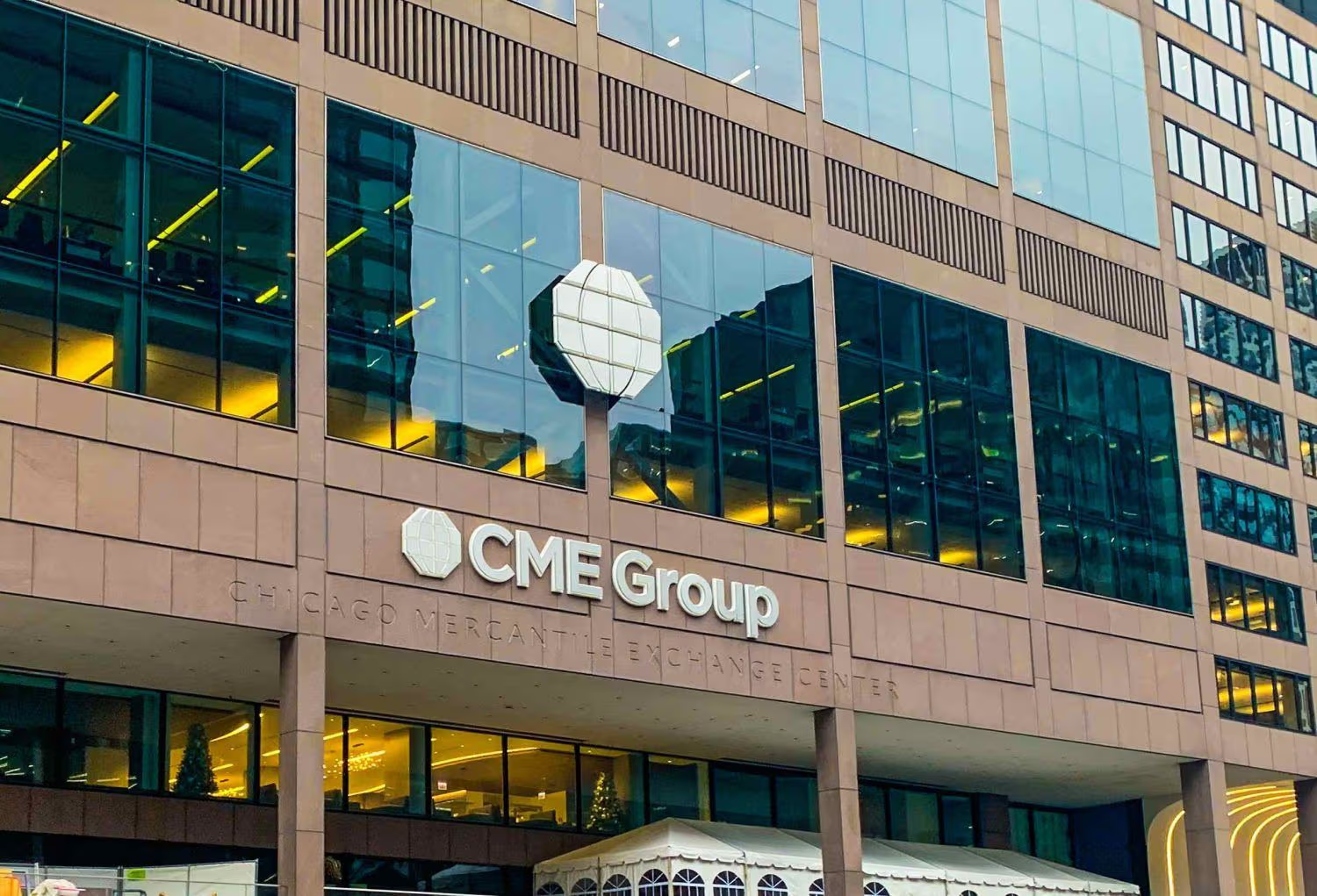
Gold and Silver prices staged a sharp recovery on Tuesday following last week’s brutal selloff that saw Silver post its worst single-day decline since 1980. Spot Gold climbed more than 5% to around $4,900 per ounce, while Silver surged roughly 10% to approximately $87 per ounce. The preceding collapse was triggered by a stronger US Dollar following President Trump’s nomination of Kevin Warsh as the next Federal Reserve chair, combined with marginrequirement increases at the CME. Analysts at Deutsche Bank and JPMorgan maintained bullish outlooks, with Deutsche Bank reiterating its $6,000 Gold price target and noting that “Gold’s thematic drivers remain positive.” Mining stocks rallied in sympathy, with the ProShares Ultra Silver ETF gaining more than 15% in premarket trading.
Dow Jones daily chart
Dow Jones FAQs
The Dow Jones Industrial Average, one of the oldest stock market indices in the world, is compiled of the 30 most traded stocks in the US. The index is price-weighted rather than weighted by capitalization. It is calculated by summing the prices of the constituent stocks and dividing them by a factor, currently 0.152. The index was founded by Charles Dow, who also founded the Wall Street Journal. In later years it has been criticized for not being broadly representative enough because it only tracks 30 conglomerates, unlike broader indices such as the S&P 500.
Many different factors drive the Dow Jones Industrial Average (DJIA). The aggregate performance of the component companies revealed in quarterly company earnings reports is the main one. US and global macroeconomic data also contributes as it impacts on investor sentiment. The level of interest rates, set by the Federal Reserve (Fed), also influences the DJIA as it affects the cost of credit, on which many corporations are heavily reliant. Therefore, inflation can be a major driver as well as other metrics which impact the Fed decisions.
Dow Theory is a method for identifying the primary trend of the stock market developed by Charles Dow. A key step is to compare the direction of the Dow Jones Industrial Average (DJIA) and the Dow Jones Transportation Average (DJTA) and only follow trends where both are moving in the same direction. Volume is a confirmatory criteria. The theory uses elements of peak and trough analysis. Dow’s theory posits three trend phases: accumulation, when smart money starts buying or selling; public participation, when the wider public joins in; and distribution, when the smart money exits.
There are a number of ways to trade the DJIA. One is to use ETFs which allow investors to trade the DJIA as a single security, rather than having to buy shares in all 30 constituent companies. A leading example is the SPDR Dow Jones Industrial Average ETF (DIA). DJIA futures contracts enable traders to speculate on the future value of the index and Options provide the right, but not the obligation, to buy or sell the index at a predetermined price in the future. Mutual funds enable investors to buy a share of a diversified portfolio of DJIA stocks thus providing exposure to the overall index.
Source: https://www.fxstreet.com/news/dow-jones-industrial-average-mixed-as-palantir-soars-paypal-plunges-on-earnings-flood-202602031742