The post Bitcoin holds below $80,000 as January prediction contracts miss liquidation-driven slide: Asia Morning Briefing appeared on BitcoinEthereumNews.com. GoodThe post Bitcoin holds below $80,000 as January prediction contracts miss liquidation-driven slide: Asia Morning Briefing appeared on BitcoinEthereumNews.com. Good

Bitcoin holds below $80,000 as January prediction contracts miss liquidation-driven slide: Asia Morning Briefing

Good Morning, Asia. Here’s what’s making news in the markets:

Welcome to Asia Morning Briefing, a daily summary of top stories during U.S. hours and an overview of market moves and analysis. For a detailed overview of U.S. markets, see CoinDesk’s Crypto Daybook Americas.

Bitcoin’s latest slide exposed a familiar pattern in crypto markets: probability gauges drifted lower while derivatives traders scrambled for protection. As options open interest in $75,000 puts surged and hundreds of millions in long bets were liquidated, prediction markets registered only a slow erosion of upside conviction.

Throughout January, Polymarket contracts tied to higher bitcoin price targets softened gradually through late January, yet they never implied the kind of abrupt volatility that ultimately erased hundreds of millions of dollars in leveraged long positions in a single day.

The miss is rooted more in structure than in oversight. Prediction markets are built around end states. A contract asking whether bitcoin will finish the month above a certain level does not reward traders for correctly anticipating a two-day leverage flush if they still believe a rebound is possible before expiry. The payoff depends on the final destination, not the speed or violence of the path. In that setup, short-term volatility can be rationally ignored.

Research from Galaxy Digital has argued that directional prediction markets inherently compress complex beliefs into binary outcomes, often overstating consensus and obscuring magnitude and tail risk.

Derivatives desks operate under the opposite incentives. Data from Deribit showed open interest in $75,000 put options swelling rapidly, as CoinDesk previously reported, nearly matching the once dominant $100,000 call strike within days.

That shift did not necessarily signal a long-term bearish turn. It reflected traders buying insurance as downside distributions widened and volatility expectations jumped. Options markets are forced to react early because capital is immediately exposed to tail risk.

Liquidation data explains why the divergence became visible so quickly. More than $500 Million in leveraged long positions were forcibly closed over 24 hours – a weekend when liquidity was thin, and TradFi traders weren’t at their desks – with the bulk of selling concentrated on perpetual futures venues where margin dynamics accelerate moves.

For a leveraged fund, that is an urgent event. For a month-end probability contract, it is decisive only if it changes the belief about the final outcome.

In its 2025 year-end review, research firm QCP has described crypto as operating at two speeds, where structural optimism coexists with sudden leverage-driven drawdowns.

Bitcoin didn’t crash below $75,000, but it didn’t recover to the levels prediction markets suggested were likely, either. The final outcome split the difference and in doing so, revealed how differently these markets measure the same underlying risk.

Market Movement

BTC: Bitcoin traded just under $80,000 after a week of sharp volatility that flushed leveraged long positions and pushed traders toward downside protection rather than fresh upside bets.

ETH: Ether hovered near $2,300, extending its multi-week slide as risk appetite stayed muted and traders showed little urgency to rotate back into large-cap altcoins.

Gold: Gold was trading around $4,750 per ounce, pulling back sharply after testing the $5,300 level earlier in the week.

Nikkei 225: Japan’s Nikkei 225 inched higher Monday as Asia Pacific markets traded mixed, with investors weighing private data showing China’s January factory activity expanding at its fastest pace since October, while South Korean and Hong Kong equities fell and gold extended its recent losses.

Elsewhere in Crypto

  • Crypto exchanges sanctioned alongside Iranian officials in Trump administration’s Iran crackdown (The Block)
  • Quantum threat gets real: Ethereum Foundation prioritizes security with leanVM and PQ signatures (CoinDesk)

Source: https://www.coindesk.com/markets/2026/02/02/bitcoin-holds-below-usd80-000-as-january-prediction-contracts-miss-liquidation-driven-slide-asia-morning-briefing

Disclaimer: The articles reposted on this site are sourced from public platforms and are provided for informational purposes only. They do not necessarily reflect the views of MEXC. All rights remain with the original authors. If you believe any content infringes on third-party rights, please contact service@support.mexc.com for removal. MEXC makes no guarantees regarding the accuracy, completeness, or timeliness of the content and is not responsible for any actions taken based on the information provided. The content does not constitute financial, legal, or other professional advice, nor should it be considered a recommendation or endorsement by MEXC.

You May Also Like

Young Republicans were more proud to be American under Obama than under Trump: data analyst

Young Republicans were more proud to be American under Obama than under Trump: data analyst

CNN data analyst Harry Enten sorts through revealing polls and surveys of American attitudes, looking for shifts, and his latest finding is an indictment of President
Share
Alternet2026/02/10 22:18
Vitalik Buterin Outlines Ethereum’s AI Framework, Pushes Back Against Solana’s Acceleration Thesis

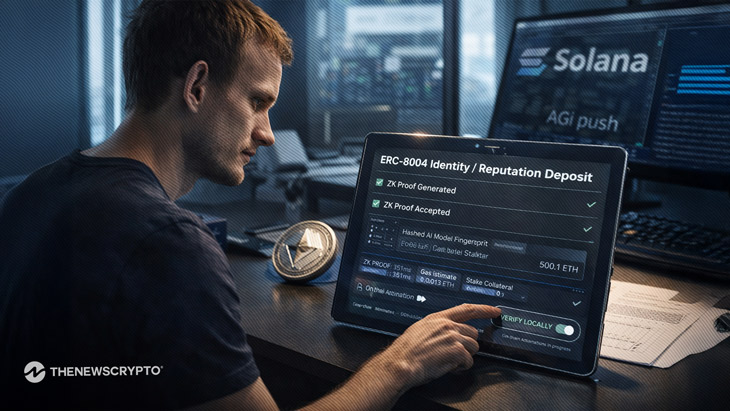
Vitalik Buterin Outlines Ethereum’s AI Framework, Pushes Back Against Solana’s Acceleration Thesis

Ethereum co-founder Vitalik Buterin has reacted to Solana’s artificial general intelligence acceleration initiative. He did this through the establishment of his
Share
Thenewscrypto2026/02/10 18:40
Vitalik Buterin Reveals Ethereum’s Bold Plan to Stay Quantum-Secure and Simple!

Vitalik Buterin Reveals Ethereum’s Bold Plan to Stay Quantum-Secure and Simple!

Buterin unveils Ethereum’s strategy to tackle quantum security challenges ahead. Ethereum focuses on simplifying architecture while boosting security for users. Ethereum’s market stability grows as Buterin’s roadmap gains investor confidence. Ethereum founder Vitalik Buterin has unveiled his long-term vision for the blockchain, focusing on making Ethereum quantum-secure while maintaining its simplicity for users. Buterin presented his roadmap at the Japanese Developer Conference, and splits the future of Ethereum into three phases: short-term, mid-term, and long-term. Buterin’s most ambitious goal for Ethereum is to safeguard the blockchain against the threats posed by quantum computing.  The danger of such future developments is that the future may call into question the cryptographic security of most blockchain systems, and Ethereum will be able to remain ahead thanks to more sophisticated mathematical techniques to ensure the safety and integrity of its protocols. Buterin is committed to ensuring that Ethereum evolves in a way that not only meets today’s security challenges but also prepares for the unknowns of tomorrow. Also Read: Ethereum Giant The Ether Machine Takes Major Step Toward Going Public! However, in spite of such high ambitions, Buterin insisted that Ethereum also needed to simplify its architecture. An important aspect of this vision is to remove unnecessary complexity and make Ethereum more accessible and maintainable without losing its strong security capabilities. Security and simplicity form the core of Buterin’s strategy, as they guarantee that the users of Ethereum experience both security and smooth processes. Focus on Speed and Efficiency in the Short-Term In the short term, Buterin aims to enhance Ethereum’s transaction efficiency, a crucial step toward improving scalability and reducing transaction costs. These advantages are attributed to the fact that, within the mid-term, Ethereum is planning to enhance the speed of transactions in layer-2 networks. According to Butterin, this is part of Ethereum’s expansion, particularly because there is still more need to use blockchain technology to date. The other important aspect of Ethereum’s development is the layer-2 solutions. Buterin supports an approach in which the layer-2 networks are dependent on layer-1 to perform some essential tasks like data security, proof, and censorship resistance. This will enable the layer-2 systems of Ethereum to be concerned with verifying and sequencing transactions, which will improve the overall speed and efficiency of the network. Ethereum’s Market Stability Reflects Confidence in Long-Term Strategy Ethereum’s market performance has remained solid, with the cryptocurrency holding steady above $4,000. Currently priced at $4,492.15, Ethereum has experienced a slight 0.93% increase over the last 24 hours, while its trading volume surged by 8.72%, reaching $34.14 billion. These figures point to growing investor confidence in Ethereum’s long-term vision. The crypto community remains optimistic about Ethereum’s future, with many predicting the price could rise to $5,500 by mid-October. Buterin’s clear, forward-thinking strategy continues to build trust in Ethereum as one of the most secure and scalable blockchain platforms in the market. Also Read: Whales Dump 200 Million XRP in Just 2 Weeks – Is XRP’s Price on the Verge of Collapse? The post Vitalik Buterin Reveals Ethereum’s Bold Plan to Stay Quantum-Secure and Simple! appeared first on 36Crypto.
Share
Coinstats2025/09/18 01:22