Solana (SOL) is compressing above its $118–$125 support zone as traders monitor whether tightening structure and rising volatility will trigger a breakout or extendSolana (SOL) is compressing above its $118–$125 support zone as traders monitor whether tightening structure and rising volatility will trigger a breakout or extend

Solana Price Prediction: SOL Holds $118 Base While Charts Hint at an Imminent Expansion

2026/01/29 05:15
5 min read

Solana price is trading in a tight compression zone above key support near $125–$130, as traders assess whether the market is building a base for recovery or preparing for another volatility-driven move.

Recent data from Brave New Coin shows SOL hovering near $127, reflecting a decent intraday strength while maintaining its broader demand zone

Solana current price is $126.85, up 2.22% in the last 24 hours. Source: Brave New Coin

Range Compression Keeps $118–$130 in Focus

The daily structure shows Solana respecting a clearly defined horizontal range that has governed price action since November. Price recently swept the lower boundary near $118–$120 and quickly rebounded, reinforcing this zone as important. Each visit into this area has drawn buyers, preventing a clean breakdown and keeping the market in range behavior.

Solana price continues to respect its long-standing range, with repeated rebounds from $118–$120 confirming active demand at the range floor. Source: Jason Pratt via X

That said, repeated tests also carry risk. Every return to the same floor weakens it incrementally. While sellers have not yet forced continuation, bulls have also failed to reclaim the mid-range. As long as SOL holds above $118, the structure remains neutral.

Liquidation Data Suggesting Increasing Volatility

Jesse Peralta points out that Solana is approaching a volatility event. His liquidation heatmap shows dense leverage clusters stacked around $124 and $129, zones that often act as magnets during compressed conditions.

Solana’s liquidation map reveals stacked leverage around $124 and $129. Source: Jesse Peralta via X

When price sits between opposing liquidation pools, the market tends to resolve through a sharp sweep. A push above $129 could cascade into a squeeze towards $133–$136, while a drop below $124 risks accelerating into the $118 support band.

Solana Short-Term View

Crypto analyst Crypto Tony remains cautiously constructive in the near term, noting that Solana is “holding very nicely in this range” and could attempt a push towards $131 over the coming days. His chart frames the current move as a relief bounce within a broader corrective structure.

SOL holds its range as analyst flags $131–$133 as the level that decides the next move. Source: Crypto Tony via X

That $131–$133 region is critical. It aligns with prior breakdown levels and the underside of former support. A failure there would reinforce the range and likely rotate price back towards $122–$120. Only a clean reclaim and hold above $133 would begin to shift short-term bias towards a more durable recovery.

Weekly Cup-and-Handle Keeps Long-Term Bulls in Play

The higher-timeframe chart shows Solana forming a clear cup-and-handle pattern. The rounded base is already complete, and price is now moving sideways in the “handle” zone just below resistance. This phase usually appears before a breakout, as the market cools off and absorbs selling pressure. A clean break above the neckline would activate a move towards the $200 region.

Solana’s weekly chart forms a cup-and-handle. Source: Gordon Gekko via X

Gordon Gekko highlights that the handle is holding above key trend support, while momentum remains stable rather than turning bearish. Volume has also dried up during this phase, which often happens before expansion. As long as Solana price stays above handle support and does not fall back into the cup, the structure remains valid.

Solana Targeting $150 and $200

Solana continues to defend its range lows, with every dip into the $118–$120 zone drawing a reaction. This area has now been tested multiple times without giving way, keeping the broader recovery intact and preventing a deeper breakdown. The chart frames this region as a base, where price can hold before attempting a move back towards the upper boundary of the range near $145–$150.

Solana continues to base above $118–$120, keeping the structure intact and preserving a potential path back towards the $145–$150 range highs. Source: Crypto Curb via X

As outlined by Crypto Curb, the roadmap is clear: $150 by next week, $200 by the end of February if this structure continues to hold. That path only remains valid while the $118 to $120 band stays intact.

Solana Price Prediction: Key Levels to Watch

With SOL still trapped inside a compression range, near-term scenarios hinge on a narrow set of technical levels that define both risk and opportunity.

Immediate resistance:

  • Short-term resistance at $131–$133
  • Medium-term resistance at $140–$145

Key supports:

  • $125–$124 remains the primary short-term demand zone
  • $120–$118 is the major structural support
  • A loss of this band exposes $112–$108 as the next downside liquidity pocket

As long as Solana price remains capped below $133, upside momentum remains constrained and range behavior dominates. Bulls would need a decisive reclaim of the $140–$145 zone to break the consolidation structure and shift the market back into recovery mode.

Final Thoughts

Solana price is no longer in freefall, but it has not yet entered a confirmed recovery phase. Instead, it is compressing above a clearly defined support zone while volatility builds beneath the surface. From a Solana price prediction standpoint, the coming sessions are decisive. Holding above $124–$125 keeps the structure bullish and opens the path towards $131, then $140–$150.

Disclaimer: The articles reposted on this site are sourced from public platforms and are provided for informational purposes only. They do not necessarily reflect the views of MEXC. All rights remain with the original authors. If you believe any content infringes on third-party rights, please contact service@support.mexc.com for removal. MEXC makes no guarantees regarding the accuracy, completeness, or timeliness of the content and is not responsible for any actions taken based on the information provided. The content does not constitute financial, legal, or other professional advice, nor should it be considered a recommendation or endorsement by MEXC.

You May Also Like

Cashing In On University Patents Means Giving Up On Our Innovation Future

Cashing In On University Patents Means Giving Up On Our Innovation Future

The post Cashing In On University Patents Means Giving Up On Our Innovation Future appeared on BitcoinEthereumNews.com. “It’s a raid on American innovation that would deliver pennies to the Treasury while kneecapping the very engine of our economic and medical progress,” writes Pipes. Getty Images Washington is addicted to taxing success. Now, Commerce Secretary Howard Lutnick is floating a plan to skim half the patent earnings from inventions developed at universities with federal funding. It’s being sold as a way to shore up programs like Social Security. In reality, it’s a raid on American innovation that would deliver pennies to the Treasury while kneecapping the very engine of our economic and medical progress. Yes, taxpayer dollars support early-stage research. But the real payoff comes later—in the jobs created, cures discovered, and industries launched when universities and private industry turn those discoveries into real products. By comparison, the sums at stake in patent licensing are trivial. Universities collectively earn only about $3.6 billion annually in patent income—less than the federal government spends on Social Security in a single day. Even confiscating half would barely register against a $6 trillion federal budget. And yet the damage from such a policy would be anything but trivial. The true return on taxpayer investment isn’t in licensing checks sent to Washington, but in the downstream economic activity that federally supported research unleashes. Thanks to the bipartisan Bayh-Dole Act of 1980, universities and private industry have powerful incentives to translate early-stage discoveries into real-world products. Before Bayh-Dole, the government hoarded patents from federally funded research, and fewer than 5% were ever licensed. Once universities could own and license their own inventions, innovation exploded. The result has been one of the best returns on investment in government history. Since 1996, university research has added nearly $2 trillion to U.S. industrial output, supported 6.5 million jobs, and launched more than 19,000 startups. Those companies pay…
Share
BitcoinEthereumNews2025/09/18 03:26
China Blocks Nvidia’s RTX Pro 6000D as Local Chips Rise
China Blocks Nvidia’s RTX Pro 6000D as Local Chips Rise

The post China Blocks Nvidia’s RTX Pro 6000D as Local Chips Rise appeared on BitcoinEthereumNews.com. China Blocks Nvidia’s RTX Pro 6000D as Local Chips Rise China’s internet regulator has ordered the country’s biggest technology firms, including Alibaba and ByteDance, to stop purchasing Nvidia’s RTX Pro 6000D GPUs. According to the Financial Times, the move shuts down the last major channel for mass supplies of American chips to the Chinese market. Why Beijing Halted Nvidia Purchases Chinese companies had planned to buy tens of thousands of RTX Pro 6000D accelerators and had already begun testing them in servers. But regulators intervened, halting the purchases and signaling stricter controls than earlier measures placed on Nvidia’s H20 chip. Image: Nvidia An audit compared Huawei and Cambricon processors, along with chips developed by Alibaba and Baidu, against Nvidia’s export-approved products. Regulators concluded that Chinese chips had reached performance levels comparable to the restricted U.S. models. This assessment pushed authorities to advise firms to rely more heavily on domestic processors, further tightening Nvidia’s already limited position in China. China’s Drive Toward Tech Independence The decision highlights Beijing’s focus on import substitution — developing self-sufficient chip production to reduce reliance on U.S. supplies. “The signal is now clear: all attention is focused on building a domestic ecosystem,” said a representative of a leading Chinese tech company. Nvidia had unveiled the RTX Pro 6000D in July 2025 during CEO Jensen Huang’s visit to Beijing, in an attempt to keep a foothold in China after Washington restricted exports of its most advanced chips. But momentum is shifting. Industry sources told the Financial Times that Chinese manufacturers plan to triple AI chip production next year to meet growing demand. They believe “domestic supply will now be sufficient without Nvidia.” What It Means for the Future With Huawei, Cambricon, Alibaba, and Baidu stepping up, China is positioning itself for long-term technological independence. Nvidia, meanwhile, faces…
Share
BitcoinEthereumNews2025/09/18 01:37
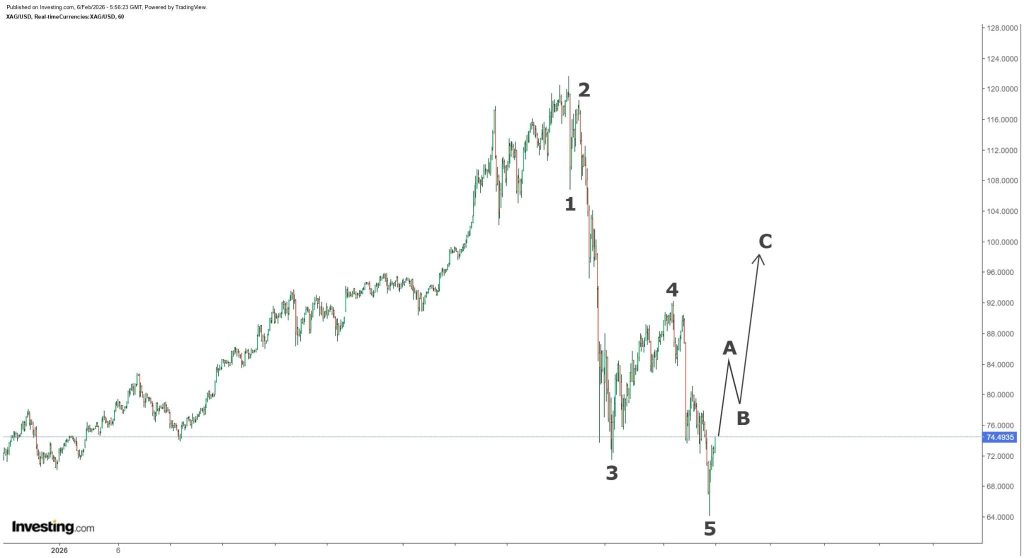
Silver Price Crash Is Over “For Real This Time,” Analyst Predicts a Surge Back Above $90

Silver Price Crash Is Over “For Real This Time,” Analyst Predicts a Surge Back Above $90

Silver has been taking a beating lately, and the Silver price hasn’t exactly been acting like a safe haven. After running up into the highs, the whole move reversed
Share
Captainaltcoin2026/02/07 03:15