Bitcoin is trading around $90,000 at the time of writing, following a period of elevated realized losses that initially appeared to signal renewed short-term holderBitcoin is trading around $90,000 at the time of writing, following a period of elevated realized losses that initially appeared to signal renewed short-term holder

Bitcoin Realized Loss Spike Proves False as Market Activity Remains Thin

2026/01/28 22:42

Bitcoin is trading around $90,000 at the time of writing, following a period of elevated realized losses that initially appeared to signal renewed short-term holder (STH) capitulation.

However, on-chain data shows that the recent spike in realized losses was not driven by distribution, but by internal UTXO consolidation, distorting several commonly used STH indicators.

According to CryptoQuant, the market reaction around January 23 reflects a technical artifact rather than a genuine shift in investor behavior. Once this anomaly is isolated, overall on-chain activity appears muted, suggesting the market remains in a consolidation phase rather than entering a new sell-driven regime.

This distinction is critical, as misreading these signals could lead to incorrect conclusions about trend strength and investor conviction.

Short-Term Price Context and Realized Loss Activity

Bitcoin price remained relatively stable through late January, holding above the $85,000–$87,000 zone while realized losses briefly surged. The realized profit and loss chart shows a sharp negative spike approaching -$6 billion, visually similar to prior stress events such as the late-November Coinbase-related movement.
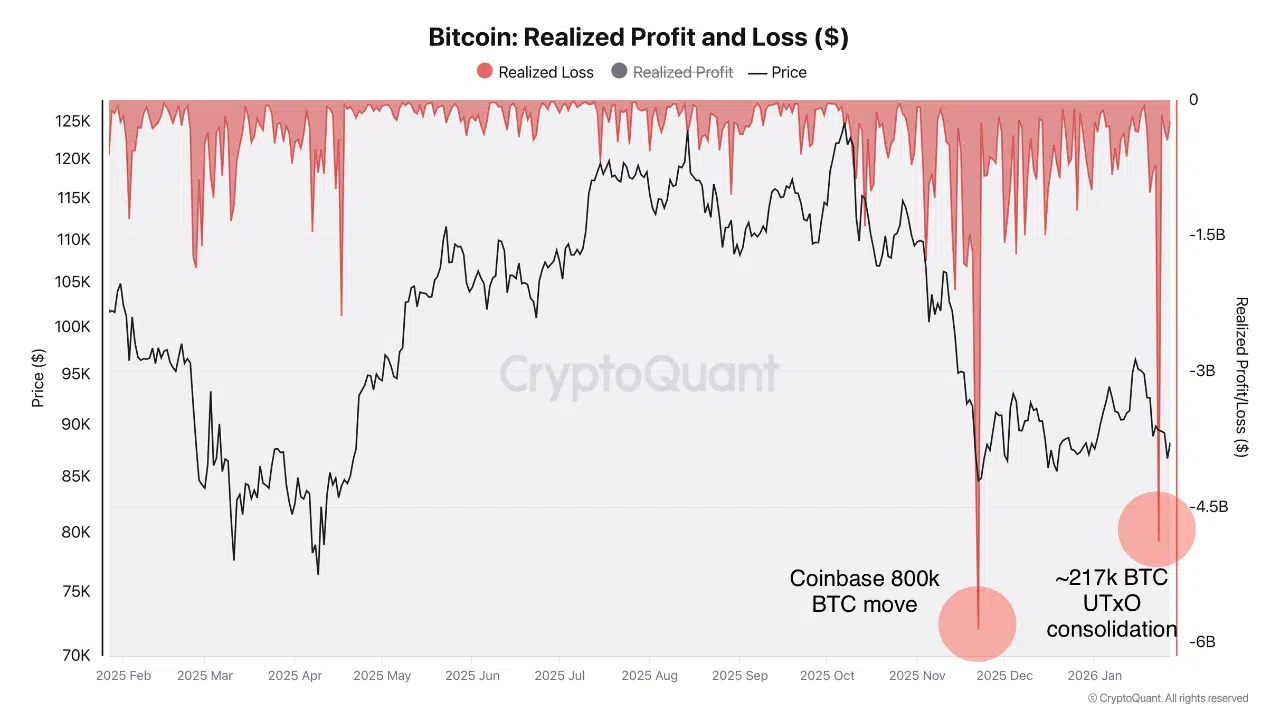
At first glance, this suggested aggressive STH selling. Historically, such spikes often coincide with emotional exits and trend exhaustion. However, price did not follow through to the downside, nor did volatility expand meaningfully, creating an early inconsistency between price behavior and on-chain stress signals.

This divergence prompted a deeper inspection of the underlying UTXO activity.

UTXO Consolidation Triggered a False STH Signal

On January 23, a single block (933,503) included multiple UTXO consolidation transactions that collectively moved approximately 217,000 BTC.

Importantly, these coins were not sold. They were transferred from an address back to the same address, purely to aggregate fragmented UTXOs.

The breakdown of the moved supply shows:

  • ~188,000 BTC from the 3m–6m age band
  • ~30,900 BTC from the 1m–3m band
  • ~31,700 BTC from the 1w–1m band

All BTC in the 3m–6m cohort were likely acquired during the October 10 drawdown, at prices between $102,000 and $126,000. When these UTXOs were destroyed and recreated through consolidation, they were recorded as realized losses because Bitcoin was trading significantly lower on January 23.

This mechanically inflated realized loss metrics without reflecting actual selling pressure.

Why Multiple Indicators Were Distorted

Because realized price is embedded across several on-chain metrics, this consolidation event impacted:

  • STH MVRV
  • STH SOPR
  • Short-term cost basis
  • Aggregate realized loss readings

The effect mirrors a similar false signal observed during the Coinbase-related movement in late November, where internal wallet restructuring briefly produced outsized realized losses without corresponding market exits.

Once these extraordinary events are excluded, the data shows very little genuine on-chain activity, reinforcing the view that neither panic nor aggressive distribution is currently underway.

OKX Launches Stablecoin Card in Europe as MiCA Takes Effect

Market Interpretation and Risk Context

This episode highlights an important limitation of surface-level on-chain analysis. Not all realized losses represent selling, and not all STH signals reflect behavioral stress. In this case, the market absorbed a large technical adjustment without price breakdown, suggesting resilience rather than weakness.

With Bitcoin holding above $85,000 and realized loss pressure largely attributable to accounting mechanics, the broader structure remains one of low participation and consolidation, not capitulation.

Until genuine spending activity increases across multiple age bands, realized loss spikes should be treated cautiously, especially when price action fails to confirm the signal.

Conclusion

The January 23 realized loss spike was not a sell-off, but a UTXO consolidation event that temporarily distorted short-term holder metrics. Once adjusted for this anomaly, on-chain data points to a market with minimal activity and reduced directional conviction.

For now, Bitcoin remains in a holding pattern. Confirmation will require either sustained distribution accompanied by price acceptance below support, or renewed demand that expands both volume and realized profits. Until then, the market appears structurally quiet rather than stressed.

The post Bitcoin Realized Loss Spike Proves False as Market Activity Remains Thin appeared first on ETHNews.

Disclaimer: The articles reposted on this site are sourced from public platforms and are provided for informational purposes only. They do not necessarily reflect the views of MEXC. All rights remain with the original authors. If you believe any content infringes on third-party rights, please contact service@support.mexc.com for removal. MEXC makes no guarantees regarding the accuracy, completeness, or timeliness of the content and is not responsible for any actions taken based on the information provided. The content does not constitute financial, legal, or other professional advice, nor should it be considered a recommendation or endorsement by MEXC.

You May Also Like

Botanix launches stBTC to deliver Bitcoin-native yield

Botanix launches stBTC to deliver Bitcoin-native yield

The post Botanix launches stBTC to deliver Bitcoin-native yield appeared on BitcoinEthereumNews.com. Botanix Labs has launched stBTC, a liquid staking token designed to turn Bitcoin into a yield-bearing asset by redistributing network gas fees directly to users. The protocol will begin yield accrual later this week, with its Genesis Vault scheduled to open on Sept. 25, capped at 50 BTC. The initiative marks one of the first attempts to generate Bitcoin-native yield without relying on inflationary token models or centralized custodians. stBTC works by allowing users to deposit Bitcoin into Botanix’s permissionless smart contract, receiving stBTC tokens that represent their share of the staking vault. As transactions occur, 50% of Botanix network gas fees, paid in BTC, flow back to stBTC holders. Over time, the value of stBTC increases relative to BTC, enabling users to redeem their original deposit plus yield. Botanix estimates early returns could reach 20–50% annually before stabilizing around 6–8%, a level similar to Ethereum staking but fully denominated in Bitcoin. Botanix says that security audits have been completed by Spearbit and Sigma Prime, and the protocol is built on the EIP-4626 vault standard, which also underpins Ethereum-based staking products. The company’s Spiderchain architecture, operated by 16 independent entities including Galaxy, Alchemy, and Fireblocks, secures the network. If adoption grows, Botanix argues the system could make Bitcoin a productive, composable asset for decentralized finance, while reinforcing network consensus. This is a developing story. This article was generated with the assistance of AI and reviewed by editor Jeffrey Albus before publication. Get the news in your inbox. Explore Blockworks newsletters: Source: https://blockworks.co/news/botanix-launches-stbtc
Share
BitcoinEthereumNews2025/09/18 02:37
3 Paradoxes of Altcoin Season in September

3 Paradoxes of Altcoin Season in September

The post 3 Paradoxes of Altcoin Season in September appeared on BitcoinEthereumNews.com. Analyses and data indicate that the crypto market is experiencing its most active altcoin season since early 2025, with many altcoins outperforming Bitcoin. However, behind this excitement lies a paradox. Most retail investors remain uneasy as their portfolios show little to no profit. This article outlines the main reasons behind this situation. Altcoin Market Cap Rises but Dominance Shrinks Sponsored TradingView data shows that the TOTAL3 market cap (excluding BTC and ETH) reached a new high of over $1.1 trillion in September. Yet the share of OTHERS (excluding the top 10) has declined since 2022, now standing at just 8%. OTHERS Dominance And TOTAL3 Capitalization. Source: TradingView. In past cycles, such as 2017 and 2021, TOTAL3 and OTHERS.D rose together. That trend reflected capital flowing not only into large-cap altcoins but also into mid-cap and low-cap ones. The current divergence shows that capital is concentrated in stablecoins and a handful of top-10 altcoins such as SOL, XRP, BNB, DOG, HYPE, and LINK. Smaller altcoins receive far less liquidity, making it hard for their prices to return to levels where investors previously bought. This creates a situation where only a few win while most face losses. Retail investors also tend to diversify across many coins instead of adding size to top altcoins. That explains why many portfolios remain stagnant despite a broader market rally. Sponsored “Position sizing is everything. Many people hold 25–30 tokens at once. A 100x on a token that makes up only 1% of your portfolio won’t meaningfully change your life. It’s better to make a few high-conviction bets than to overdiversify,” analyst The DeFi Investor said. Altcoin Index Surges but Investor Sentiment Remains Cautious The Altcoin Season Index from Blockchain Center now stands at 80 points. This indicates that over 80% of the top 50 altcoins outperformed…
Share
BitcoinEthereumNews2025/09/18 01:43
The three whale addresses have spent a total of $1,414 in recent days to purchase gold tokens.

The three whale addresses have spent a total of $1,414 in recent days to purchase gold tokens.

PANews reported on January 29 that, according to Onchain Lens monitoring, as whales continue to accumulate gold, its price has broken through $5,500, setting a
Share
PANews2026/01/29 08:11