Chainlink acquired FastLane’s Atlas to expand its SVR system across five networks. The move helps DeFi protocols recover liquidation value and boost revenues. TheChainlink acquired FastLane’s Atlas to expand its SVR system across five networks. The move helps DeFi protocols recover liquidation value and boost revenues. The

Chainlink Acquires FastLane’s Atlas to Expand Liquidation Value Recovery

3 min read

Chainlink LINK $12.23 24h volatility: 2.3% Market cap: $8.67 B Vol. 24h: $436.13 M acquired Atlas intellectual property and key personnel from FastLane, bringing order-processing technology under its control and expanding its Smart Value Recapture (SVR) system to Arbitrum ARB $0.18 24h volatility: 1.0% Market cap: $1.04 B Vol. 24h: $107.06 M , Base, BNB Chain BNB $883.8 24h volatility: 2.0% Market cap: $120.49 B Vol. 24h: $1.49 B , Ethereum ETH $2 938 24h volatility: 2.1% Market cap: $354.63 B Vol. 24h: $28.57 B , and Hyperliquid’s HyperEVM.

Atlas now exclusively supports Chainlink SVR, according to the joint announcement.

SVR helps decentralized finance (DeFi) lending platforms recover profits that would otherwise go to third parties when borrowers’ crypto-backed loans are liquidated.

The system has processed more than $460 million in liquidations and recovered over $10 million for integrated protocols, according to Chainlink.

The recovered value is split between DeFi protocols and the Chainlink Network.

How the Technology Works

When borrowers fail to maintain sufficient collateral, their loans are automatically sold off. Chainlink SVR captures profit opportunities that arise during these liquidations and returns a portion to the lending protocol instead of letting outside traders take it.

Maximal extractable value represents the profits third parties can extract by reordering blockchain transactions.
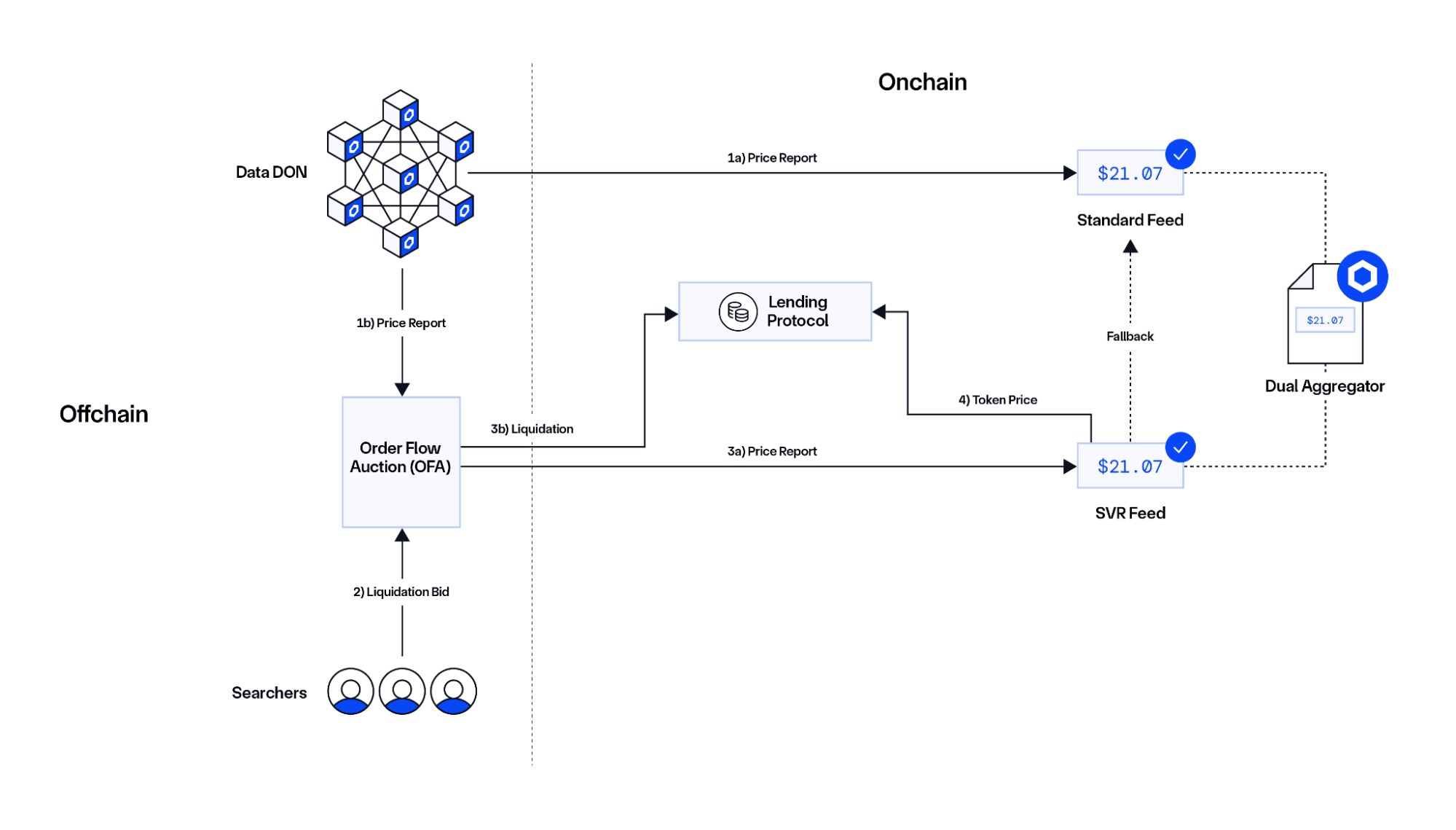
Chainlink SVR uses a dual-path system where price updates flow through both a standard feed and an order flow auction, allowing searchers to bid for liquidation rights while the lending protocol receives verified pricing. | Source: Chainlink

Chainlink SVR uses a dual-path system where price updates flow through both a standard feed and an order flow auction, allowing searchers to bid for liquidation rights while the lending protocol receives verified pricing. | Source: Chainlink

Johann Eid, Chief Business Officer at Chainlink Labs, said the acquisition creates an effective value recovery system that increases revenue for DeFi through expansion to new blockchain networks.

FastLane will continue to operate independently as a strategic partner.

Protocol Adoption

Major DeFi lending platforms including Aave AAVE $157.1 24h volatility: 2.9% Market cap: $2.39 B Vol. 24h: $361.28 M , which helps facilitate billions in crypto-backed loans, and Compound COMP $24.07 24h volatility: 1.0% Market cap: $232.96 M Vol. 24h: $13.22 M have adopted SVR.

Chainlink secures approximately 70% of the DeFi ecosystem by value and has enabled over $27 trillion in transaction value, according to DefiLlama data and company metrics.

The acquisition accelerates SVR deployment across networks where lending protocols operate.

Alex Watts, CEO of FastLane, said Chainlink is positioned to lead the oracle value recovery market, where it competes with API3 and Pyth Network.

Meanwhile, LINK has seen steady whale accumulation despite a recent pullback, with analysts pointing to a long-term support zone and projecting higher upside as market conditions stabilize.

next

The post Chainlink Acquires FastLane’s Atlas to Expand Liquidation Value Recovery appeared first on Coinspeaker.

Disclaimer: The articles reposted on this site are sourced from public platforms and are provided for informational purposes only. They do not necessarily reflect the views of MEXC. All rights remain with the original authors. If you believe any content infringes on third-party rights, please contact service@support.mexc.com for removal. MEXC makes no guarantees regarding the accuracy, completeness, or timeliness of the content and is not responsible for any actions taken based on the information provided. The content does not constitute financial, legal, or other professional advice, nor should it be considered a recommendation or endorsement by MEXC.

You May Also Like

Tom Lee’s BitMine Hits 7-Month Stock Low as Ethereum Paper Losses Reach $8 Billion

Tom Lee’s BitMine Hits 7-Month Stock Low as Ethereum Paper Losses Reach $8 Billion

The post Tom Lee’s BitMine Hits 7-Month Stock Low as Ethereum Paper Losses Reach $8 Billion appeared on BitcoinEthereumNews.com. In brief Shares of BitMine Immersion
Share
BitcoinEthereumNews2026/02/06 04:47
MYX Finance price surges again as funding rate points to a crash

MYX Finance price surges again as funding rate points to a crash

MYX Finance price went parabolic again as the recent short-squeeze resumed. However, the formation of a double-top pattern and the funding rate point to an eventual crash in the coming days. MYX Finance (MYX) came in the spotlight earlier this…
Share
Crypto.news2025/09/18 02:57
How The ByteDance App Survived Trump And A US Ban

How The ByteDance App Survived Trump And A US Ban

The post How The ByteDance App Survived Trump And A US Ban appeared on BitcoinEthereumNews.com. WASHINGTON, DC – MARCH 13: Participants hold signs in support of TikTok outside the U.S. Capitol Building on March 13, 2024 in Washington, DC. (Photo by Anna Moneymaker/Getty Images) Getty Images From President Trump’s first ban attempt to a near-blackout earlier this year, TikTok’s five-year roller coaster ride looks like it’s finally slowing down now that Trump has unveiled a deal framework to keep the ByteDance app alive in the U.S. A look back at the saga around TikTok starting in 2020, however, shows just how close the app came to being shut out of the US – how it narrowly averted a ban and forced sale that found rare bipartisan backing in Washington. Recapping TikTok’s dramatic five-year battle When I interviewed Brendan Carr back in 2022, for example, the future FCC chairman was already certain at that point that TikTok’s days were numbered. For a litany of perceived sins — everything from the too-cozy relationship of the app’s parent company with China’s ruling regime to the app’s repeated floating of user privacy — Carr was already convinced, at least during his conversation with me, that: “The tide is going out on TikTok.” It was, in fact, one of the few issues that Washington lawmakers seemed to agree on. Even then-President Biden was on board, having resurrected Trump’s aborted TikTok ban from his first term and signed it into law. “It feels different now than it did two years ago at the end of the Trump administration, when concerns were first raised,” Carr told me then, in August of 2022. “I think, like a lot of things in the Trump era, people sort of picked sides on the issue based on the fact that it was Trump.” One thing led to another, though, and it looked like Carr was probably…
Share
BitcoinEthereumNews2025/09/18 07:29