Threshold Network Introduces Stake-Based Fee Waivers to Strengthen tBTC
[PRESS RELEASE – New York, United States, January 22nd, 2026]
Threshold Network today announced the launch of fee waivers for $T stakers, a mechanism intended to enhance the Threshold token’s utility and improve onchain performance and capital efficiency for tBTC, its decentralized Bitcoin bridge.
By staking (locking) $T tokens, participants become eligible for reduced or fully waived tBTC bridge fees on eligible mint and redeem activity. The update lowers execution costs for active users, improves arbitrage efficiency between tBTC and BTC, and creates a clearer, more direct link between governance participation and real protocol usage.
Lower Costs, Better Outcomes for Active BTC Users
For participants who regularly bridge Bitcoin, execution costs can compound over time. Minting BTC into tBTC remains free, in line with existing governance decisions. However, redemption carries a fee of up to 20 basis points, reflecting the cost of maintaining secure, decentralized bridge infrastructure. The new fee waivers for $T stakers are designed to reduce this friction by minimizing or fully offsetting redemption costs based on the amount of $T staked.
Staking larger amounts of $T increases waiver capacity, resulting in significant reductions in redemption and other eligible protocol fees.
For participants, this means:
- Lower effective execution costs over time
- Improved arbitrage efficiency between BTC and tBTC
- Tighter pricing and more reliable liquidity
- No changes to custody, settlement, or operational workflows
For long-term $T holders, staking now extends beyond governance participation or security contribution, becoming a practical tool to improve execution outcomes while reinforcing the infrastructure they rely on.
Supporting Tighter BTC–tBTC Pricing
tBTC is designed to track Bitcoin as closely as possible. Even small sources of friction can matter at scale. The 20-basis-point BTC redemption fee, implemented to support protocol sustainability, introduced a modest drag that could manifest as a proportional discount to BTC in secondary markets
Fee waivers change the economics of that interaction. By reducing redemption costs for active participants, $T staking improves arbitrage efficiency between tBTC and BTC, supporting tighter pricing, more reliable liquidity, and smoother BTC flows across DeFi, benefiting both users and the protocol.
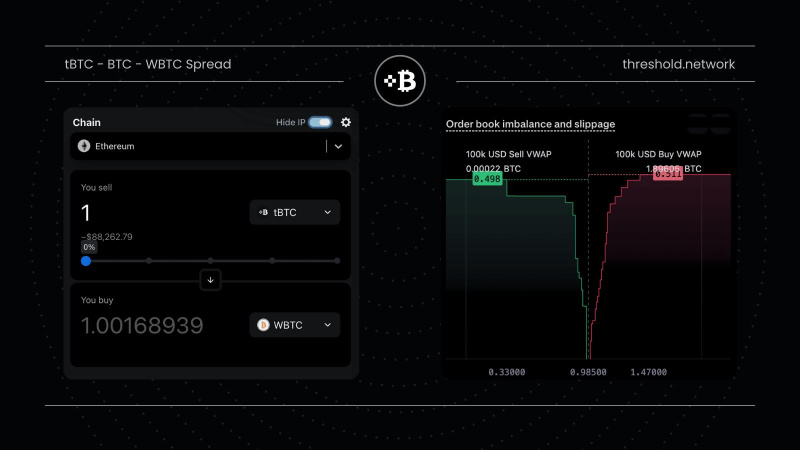 Early data indicate the mechanism is functioning as intended, reinforcing pricing reliability while maintaining the protocol’s conservative security assumptions.
Understanding Key Benefits and Limitations
When T is staked, it unlocks waiver capacity for tBTC minting and redemption over a rolling 30-day window. For every 100,000 T staked, users can offset 0.001 tBTC in bridge fees. tBTC fees can be completely waived if a user stakes a proportional amount of T.
A few key parameters:
- Waiver capacity applies over a rolling 30-day window
- Every 100,000 $T staked offsets up to 0.001 tBTC in eligible fees
- Minting remains free; redemption fees are offset via waivers
- Unstaking requires a 30-day period
- Governance participation is unaffected
Over recent periods, tBTC has demonstrated consistent, steady growth and strong onchain performance relative to other Bitcoin wrappers, supported by transparent design and sustained market usage. The introduction of fee waivers for $T stakers reflects Threshold Network’s continued focus on refining the economic and operational framework for bringing Bitcoin onchain in a manner that supports efficiency, reliability, and market integrity.
The update is relevant to participants who regularly interact with Bitcoin infrastructure, including frequent bridgers, market makers, arbitrageurs, long-term $T holders, and institutions seeking transparent, capital-efficient access to Bitcoin. Even users who do not stake may benefit indirectly from improved liquidity, tighter pricing, and increased reliability across tBTC markets.
Staking $T is optional. Eligible participants may access available fee waivers in accordance with applicable protocol parameters. $T token is available on most decentralized exchanges and major CEX’s
Where users can find $T: https://coingecko.com/en/coins/threshold-network-token
To start taking $T tokens, users can visit https://app.threshold.network/stake
About Threshold Network
Threshold Network powers tBTC, the Bitcoin standard in finance, enabling Bitcoin liquidity to move across chains without compromising settlement finality. Secured by threshold cryptography, tBTC is trust-minimized and censorship-resistant, while maintaining a direct settlement path back to native Bitcoin.
The post Threshold Network Introduces Stake-Based Fee Waivers to Strengthen tBTC appeared first on CryptoPotato.
You May Also Like

Once Upon a Farm Announces Pricing of Initial Public Offering

Forward Industries Bets Big on Solana With $4B Capital Plan