Senate Agriculture Committee Chairman John Boozman postponed a planned markup of bipartisan crypto legislation to late January, citing the need for additional timeSenate Agriculture Committee Chairman John Boozman postponed a planned markup of bipartisan crypto legislation to late January, citing the need for additional time

Senate Delays Crypto Market Structure Bill to Secure Bipartisan Support

2026/01/13 23:05
4 min read

Senate Agriculture Committee Chairman John Boozman postponed a planned markup of bipartisan crypto legislation to late January, citing the need for additional time to finalize remaining policy details and ensure broad congressional support.

The delay follows weekend negotiations with Democratic lead Senator Cory Booker on the Digital Asset Market Clarity Act, which divides regulatory authority between the SEC and CFTC while establishing frameworks for stablecoin yields, DeFi protections, and digital asset classifications.

The postponement adds uncertainty to legislation already facing political headwinds as the 2026 midterm elections approach, with some analysts warning passage could slip to 2027 despite strong backing from the Trump administration and newly appointed SEC Chair Paul Atkins, who called this “a big week for crypto” while urging Congress to bring digital asset markets “out of the regulatory gray zone.

Banks Challenge Stablecoin Yield Provisions in Final Negotiations

Traditional banking groups intensified lobbying efforts to restrict stablecoin rewards beyond the GENIUS Act’s framework, which permits third-party platforms to offer incentives while barring direct interest payments from issuers.

The latest Senate Banking Committee draft, released late Monday after what sources described as a “doozy” of a day, prohibits companies from paying interest solely for holding balances but allows rewards tied to account opening, transaction activity, staking, liquidity provision, collateral deposits, or governance participation.

The American Bankers Association warned in a recent letter that “if billions are displaced from community bank lending, small businesses, farmers, students, and home buyers in towns like ours will suffer,” arguing that crypto exchanges cannot replicate FDIC-insured products or fill lending gaps from deposit outflows.

As a result, Coinbase threatened to withdraw support if Senate negotiators insert restrictions beyond enhanced disclosure requirements, with Chief Policy Officer Faryar Shirzad contending that “undermining the supremacy of the USD has been a longstanding goal of the PRC—the Senate banning rewards would be a big assist to China’s efforts,” noting Beijing announced plans to pay interest on its digital yuan starting January 1, 2026.

Stablecoin rewards represent critical revenue for Coinbase, which shares interest income from USDC reserves with Circle Internet Group and offers 3.5% yields on Coinbase One balances, with Bloomberg projecting the exchange’s total stablecoin revenue reached $1.3 billion in 2025.

Jake Chervinsky of Variant Fund questioned the yield restrictions, stating, “there are a few things left that could blow up the market structure bill, and stablecoin yield is one of them,” adding, “what does stablecoin yield have to do with market structure, you ask? Good question! NOTHING. Except the banks have influence and they want their regulatory moat back.

Legislative Timeline Faces Midterm Election Pressure

Three Democratic senators, Chris Van Hollen, Tina Smith, and Jack Reed, sent a letter to Banking Committee leadership demanding a full hearing before Thursday’s markup, criticizing the lack of text “just two days before the markup, calling the timeline inadequate for voting on ‘the most significant law considered by the committee this century.’

The lawmakers noted that neither the full committee nor the public had seen any text resembling the legislation affecting 68 million American crypto owners and the $3 trillion digital asset market by 6 p.m. Monday, ahead of the 10 a.m. Thursday vote.

Due to growing bipartisan opposition and pressure from bankers, TD Cowen warned that the 2026 midterms could delay passage until 2027, with Senate Democrats potentially withholding support as lawmakers position for the next cycle.

Bloomberg Intelligence analyst Nathan Dean even suggested the markup’s lack of bipartisan support may push odds of first-half passage below 70%, while full implementation could extend to 2029 depending on election outcomes that reshape congressional control.

Notably, the new legislation includes an “ETF safe harbor” automatically classifying tokens as non-securities if they were principal assets of exchange-traded products listed on national securities exchanges as of January 1, treating major altcoins identically to BTC and ETH from day one.

Bill Hughes of Consensys also noted the bill “really does protect non-custodial trading interfaces” by creating regulatory perimeters based on custody and control rather than interface popularity, stating “if users trade through their own keys, you’re software” versus “if users trade through their own keys, you’re software.

SEC Chair Paul Atkins expressed full support for congressional action, writing, “passing bipartisan market structure legislation will help us future-proof against rogue regulators, ensuring that we achieve President Trump’s goal to make the U.S. the crypto capital of the world,” while anticipating the president would sign legislation “in the coming months.

Disclaimer: The articles reposted on this site are sourced from public platforms and are provided for informational purposes only. They do not necessarily reflect the views of MEXC. All rights remain with the original authors. If you believe any content infringes on third-party rights, please contact service@support.mexc.com for removal. MEXC makes no guarantees regarding the accuracy, completeness, or timeliness of the content and is not responsible for any actions taken based on the information provided. The content does not constitute financial, legal, or other professional advice, nor should it be considered a recommendation or endorsement by MEXC.

You May Also Like

Ethereum Price Prediction: ETH Targets $10,000 In 2026 But Layer Brett Could Reach $1 From $0.0058

Ethereum Price Prediction: ETH Targets $10,000 In 2026 But Layer Brett Could Reach $1 From $0.0058

Ethereum price predictions are turning heads, with analysts suggesting ETH could climb to $10,000 by 2026 as institutional demand and network upgrades drive growth. While Ethereum remains a blue-chip asset, investors looking for sharper multiples are eyeing Layer Brett (LBRETT). Currently in presale at just $0.0058, the Ethereum Layer 2 meme coin is drawing huge [...] The post Ethereum Price Prediction: ETH Targets $10,000 In 2026 But Layer Brett Could Reach $1 From $0.0058 appeared first on Blockonomi.
Share
Blockonomi2025/09/17 23:45
Will XRP Price Increase In September 2025?

Will XRP Price Increase In September 2025?

Ripple XRP is a cryptocurrency that primarily focuses on building a decentralised payments network to facilitate low-cost and cross-border transactions. It’s a native digital currency of the Ripple network, which works as a blockchain called the XRP Ledger (XRPL). It utilised a shared, distributed ledger to track account balances and transactions. What Do XRP Charts Reveal? […]
Share
Tronweekly2025/09/18 00:00
Vitalik Buterin Reveals Ethereum’s Bold Plan to Stay Quantum-Secure and Simple!

Vitalik Buterin Reveals Ethereum’s Bold Plan to Stay Quantum-Secure and Simple!

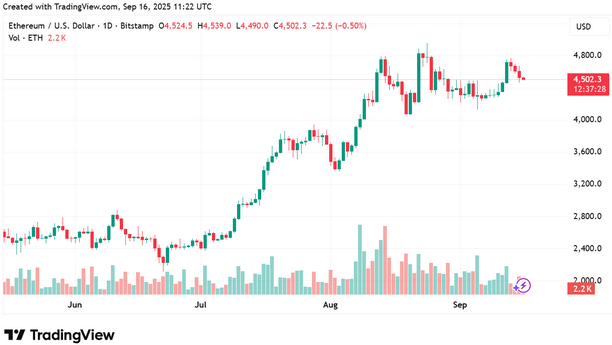
Buterin unveils Ethereum’s strategy to tackle quantum security challenges ahead. Ethereum focuses on simplifying architecture while boosting security for users. Ethereum’s market stability grows as Buterin’s roadmap gains investor confidence. Ethereum founder Vitalik Buterin has unveiled his long-term vision for the blockchain, focusing on making Ethereum quantum-secure while maintaining its simplicity for users. Buterin presented his roadmap at the Japanese Developer Conference, and splits the future of Ethereum into three phases: short-term, mid-term, and long-term. Buterin’s most ambitious goal for Ethereum is to safeguard the blockchain against the threats posed by quantum computing.  The danger of such future developments is that the future may call into question the cryptographic security of most blockchain systems, and Ethereum will be able to remain ahead thanks to more sophisticated mathematical techniques to ensure the safety and integrity of its protocols. Buterin is committed to ensuring that Ethereum evolves in a way that not only meets today’s security challenges but also prepares for the unknowns of tomorrow. Also Read: Ethereum Giant The Ether Machine Takes Major Step Toward Going Public! However, in spite of such high ambitions, Buterin insisted that Ethereum also needed to simplify its architecture. An important aspect of this vision is to remove unnecessary complexity and make Ethereum more accessible and maintainable without losing its strong security capabilities. Security and simplicity form the core of Buterin’s strategy, as they guarantee that the users of Ethereum experience both security and smooth processes. Focus on Speed and Efficiency in the Short-Term In the short term, Buterin aims to enhance Ethereum’s transaction efficiency, a crucial step toward improving scalability and reducing transaction costs. These advantages are attributed to the fact that, within the mid-term, Ethereum is planning to enhance the speed of transactions in layer-2 networks. According to Butterin, this is part of Ethereum’s expansion, particularly because there is still more need to use blockchain technology to date. The other important aspect of Ethereum’s development is the layer-2 solutions. Buterin supports an approach in which the layer-2 networks are dependent on layer-1 to perform some essential tasks like data security, proof, and censorship resistance. This will enable the layer-2 systems of Ethereum to be concerned with verifying and sequencing transactions, which will improve the overall speed and efficiency of the network. Ethereum’s Market Stability Reflects Confidence in Long-Term Strategy Ethereum’s market performance has remained solid, with the cryptocurrency holding steady above $4,000. Currently priced at $4,492.15, Ethereum has experienced a slight 0.93% increase over the last 24 hours, while its trading volume surged by 8.72%, reaching $34.14 billion. These figures point to growing investor confidence in Ethereum’s long-term vision. The crypto community remains optimistic about Ethereum’s future, with many predicting the price could rise to $5,500 by mid-October. Buterin’s clear, forward-thinking strategy continues to build trust in Ethereum as one of the most secure and scalable blockchain platforms in the market. Also Read: Whales Dump 200 Million XRP in Just 2 Weeks – Is XRP’s Price on the Verge of Collapse? The post Vitalik Buterin Reveals Ethereum’s Bold Plan to Stay Quantum-Secure and Simple! appeared first on 36Crypto.
Share
Coinstats2025/09/18 01:22