VanEck has declared 2026 a “risk-on” year for investors despite Bitcoin breaking its traditional four-year cycle, with CEO Jan van Eck positioning artificial intelligenceVanEck has declared 2026 a “risk-on” year for investors despite Bitcoin breaking its traditional four-year cycle, with CEO Jan van Eck positioning artificial intelligence

VanEck Says 2026 Will Be Risk-On Quarter Despite Bitcoin Cycle Break

2026/01/13 16:25
4 min read

VanEck has declared 2026 a “risk-on” year for investors despite Bitcoin breaking its traditional four-year cycle, with CEO Jan van Eck positioning artificial intelligence, private credit, and gold as compelling opportunities following late-2025 corrections.

The asset manager’s Q1 2026 outlook emphasizes unprecedented visibility into fiscal and monetary policy, marking a sharp departure from recent years, when economic uncertainty dominated markets, and contrasting with Goldman Sachs’ forecast of 11% global stock returns driven primarily by equities over alternative assets.
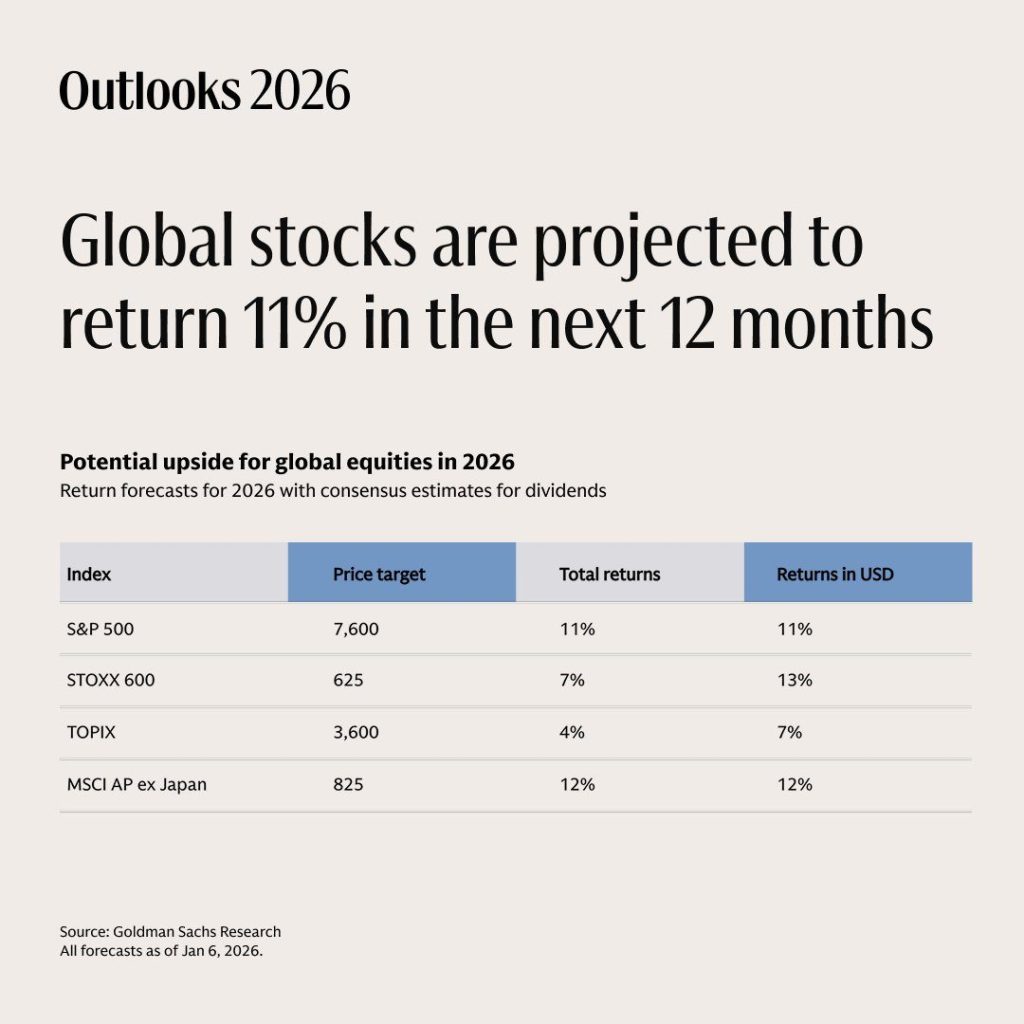
VanEck Bitcoin Risk-On Quarter - Goldman Sachs Projection TableSource: Goldman Sachs Research

Van Eck attributes the improved clarity to Treasury Secretary Scott Bessent’s influence on Federal Reserve policy direction.

Scott Bessent snuck in an interview, a podcast interview the last week of 2025 that is so profound. I actually listened to it three times,” van Eck stated, highlighting Bessent’s articulation that current interest rates represent “normal levels” rather than requiring aggressive cuts.

The secretary’s framework suggests the Fed will maintain a restrained monetary policy, with market expectations of just 25 to 50 basis points in rate adjustments through 2026.

Van Eck emphasized that Bessent specifically criticized excessive quantitative easing following COVID, which he blamed for 10% inflation that continues to anger Americans.

Fiscal Stability and AI Opportunities Drive Optimism

The US fiscal picture shows meaningful improvement, with deficits declining as a percentage of GDP from COVID-era peaks, helping anchor long-term interest rates.

VanEck projects the fiscal 2026 deficit at 5.5% of GDP or less, contradicting more pessimistic Wall Street forecasts.

Van Eck emphasized that GDP growth could exceed consensus estimates significantly, noting that Bessent suggested analysts are “an order of magnitude wrong” with predictions barely above 2% when fourth-quarter 2025 growth reached 4%.

The fear out there is that we are selecting a new Fed chair as we do every four years in May of 2026 and that Donald Trump is exerting too much control over the Fed,” van Eck explained in his quarterly video presentation, before arguing Bessent’s groundwork makes smooth confirmation likely.

AI valuations have reset to attractive levels following late-2025 corrections, according to VanEck’s analysis.

I hope to show you that the bubble has popped and it’s time to reload your AI allocations,” van Eck declared in his video presentation, noting companies reliant on debt for data center buildouts experienced stock price declines exceeding 50% from summer peaks.

Oracle, a diversified technology company that announced major compute deals, saw its stock correct substantially from levels van Eck termed “nosebleed,” despite strong underlying demand for tokens and compute capacity.

Nuclear power stocks tied to AI electricity demand also repriced meaningfully, improving risk-reward profiles for medium-term investors.

VanEck Bitcoin Risk-On Quarter - MVIS Glabal Uranium & Nuclear Energy IndexSource: VanEck

Private Credit and Gold Position as Alternative Opportunities

Business development companies now offer compelling value after a difficult 2025, with yields reaching 9% amid concerns about floating-rate debt exposure and isolated fraud cases in private markets.

Van Eck noted management companies like Ares Capital have seen valuations compress from 50 times forward earnings to approximately 35 times, bringing them back within historical ranges.

A famous Wall Street CEO said there was a cockroach in the private credit markets. And I think that those fears are overdone but well priced and again an opportunity,” van Eck stated, acknowledging previous caution while now seeing attractive entry points.

Gold continues its structural re-emergence as a global monetary asset, driven by central bank demand and a declining dollar-centricity worldwide.

Source: VanEck

VanEck characterizes recent developments in Venezuela as reinforcing geopolitical uncertainty that supports precious metals demand, as governments worldwide recognize the US’s willingness to seize assets or intervene militarily.

While gold appears technically extended in short-term charts, van Eck frames pullbacks as buying opportunities within a multi-year trend he expects to persist through 2028 and beyond, calling it a “paradigm change” akin to the 1971 transition off the gold standard.

Bitcoin Cycle Break Complicates Near-Term Outlook

Bitcoin’s traditional four-year cycle broke in 2025, creating uncertainty for the typically strong first half of post-halving years.

Van Eck expressed caution about the next three to six months, noting Bitcoin was the worst-performing asset in 2025 despite not experiencing its characteristic three-year peak period.

Bitcoin’s traditional four-year cycle broke in 2025, complicating short-term signals,” the outlook stated, with VanEck colleagues Matthew Sigel and David Schassler maintaining more constructive immediate-term views.

This cautious stance aligns with CryptoQuant CEO Ki Young Ju’s warning that capital inflows into Bitcoin have “completely dried up,” as rotation toward stocks and precious metals creates sideways trading expectations through Q1 2026.

Disclaimer: The articles reposted on this site are sourced from public platforms and are provided for informational purposes only. They do not necessarily reflect the views of MEXC. All rights remain with the original authors. If you believe any content infringes on third-party rights, please contact service@support.mexc.com for removal. MEXC makes no guarantees regarding the accuracy, completeness, or timeliness of the content and is not responsible for any actions taken based on the information provided. The content does not constitute financial, legal, or other professional advice, nor should it be considered a recommendation or endorsement by MEXC.

You May Also Like

The Channel Factories We’ve Been Waiting For

The Channel Factories We’ve Been Waiting For

The post The Channel Factories We’ve Been Waiting For appeared on BitcoinEthereumNews.com. Visions of future technology are often prescient about the broad strokes while flubbing the details. The tablets in “2001: A Space Odyssey” do indeed look like iPads, but you never see the astronauts paying for subscriptions or wasting hours on Candy Crush.  Channel factories are one vision that arose early in the history of the Lightning Network to address some challenges that Lightning has faced from the beginning. Despite having grown to become Bitcoin’s most successful layer-2 scaling solution, with instant and low-fee payments, Lightning’s scale is limited by its reliance on payment channels. Although Lightning shifts most transactions off-chain, each payment channel still requires an on-chain transaction to open and (usually) another to close. As adoption grows, pressure on the blockchain grows with it. The need for a more scalable approach to managing channels is clear. Channel factories were supposed to meet this need, but where are they? In 2025, subnetworks are emerging that revive the impetus of channel factories with some new details that vastly increase their potential. They are natively interoperable with Lightning and achieve greater scale by allowing a group of participants to open a shared multisig UTXO and create multiple bilateral channels, which reduces the number of on-chain transactions and improves capital efficiency. Achieving greater scale by reducing complexity, Ark and Spark perform the same function as traditional channel factories with new designs and additional capabilities based on shared UTXOs.  Channel Factories 101 Channel factories have been around since the inception of Lightning. A factory is a multiparty contract where multiple users (not just two, as in a Dryja-Poon channel) cooperatively lock funds in a single multisig UTXO. They can open, close and update channels off-chain without updating the blockchain for each operation. Only when participants leave or the factory dissolves is an on-chain transaction…
Share
BitcoinEthereumNews2025/09/18 00:09
Polygon Tops RWA Rankings With $1.1B in Tokenized Assets

Polygon Tops RWA Rankings With $1.1B in Tokenized Assets

The post Polygon Tops RWA Rankings With $1.1B in Tokenized Assets appeared on BitcoinEthereumNews.com. Key Notes A new report from Dune and RWA.xyz highlights Polygon’s role in the growing RWA sector. Polygon PoS currently holds $1.13 billion in RWA Total Value Locked (TVL) across 269 assets. The network holds a 62% market share of tokenized global bonds, driven by European money market funds. The Polygon POL $0.25 24h volatility: 1.4% Market cap: $2.64 B Vol. 24h: $106.17 M network is securing a significant position in the rapidly growing tokenization space, now holding over $1.13 billion in total value locked (TVL) from Real World Assets (RWAs). This development comes as the network continues to evolve, recently deploying its major “Rio” upgrade on the Amoy testnet to enhance future scaling capabilities. This information comes from a new joint report on the state of the RWA market published on Sept. 17 by blockchain analytics firm Dune and data platform RWA.xyz. The focus on RWAs is intensifying across the industry, coinciding with events like the ongoing Real-World Asset Summit in New York. Sandeep Nailwal, CEO of the Polygon Foundation, highlighted the findings via a post on X, noting that the TVL is spread across 269 assets and 2,900 holders on the Polygon PoS chain. The Dune and https://t.co/W6WSFlHoQF report on RWA is out and it shows that RWA is happening on Polygon. Here are a few highlights: – Leading in Global Bonds: Polygon holds 62% share of tokenized global bonds (driven by Spiko’s euro MMF and Cashlink euro issues) – Spiko U.S.… — Sandeep | CEO, Polygon Foundation (※,※) (@sandeepnailwal) September 17, 2025 Key Trends From the 2025 RWA Report The joint publication, titled “RWA REPORT 2025,” offers a comprehensive look into the tokenized asset landscape, which it states has grown 224% since the start of 2024. The report identifies several key trends driving this expansion. According to…
Share
BitcoinEthereumNews2025/09/18 00:40
Explosive 25% Penalty On Nations Trading With Tehran

Explosive 25% Penalty On Nations Trading With Tehran

The post Explosive 25% Penalty On Nations Trading With Tehran appeared on BitcoinEthereumNews.com. Trump Iran Tariffs: Explosive 25% Penalty On Nations Trading
Share
BitcoinEthereumNews2026/02/07 08:10