Crypto Market Turmoil: October Crash Shakes Market Makers and Liquidity The substantial crypto market decline in October has profoundly impacted market makers, Crypto Market Turmoil: October Crash Shakes Market Makers and Liquidity The substantial crypto market decline in October has profoundly impacted market makers,

Crypto’s ‘Easy Yield’ Era Ends After October Crash
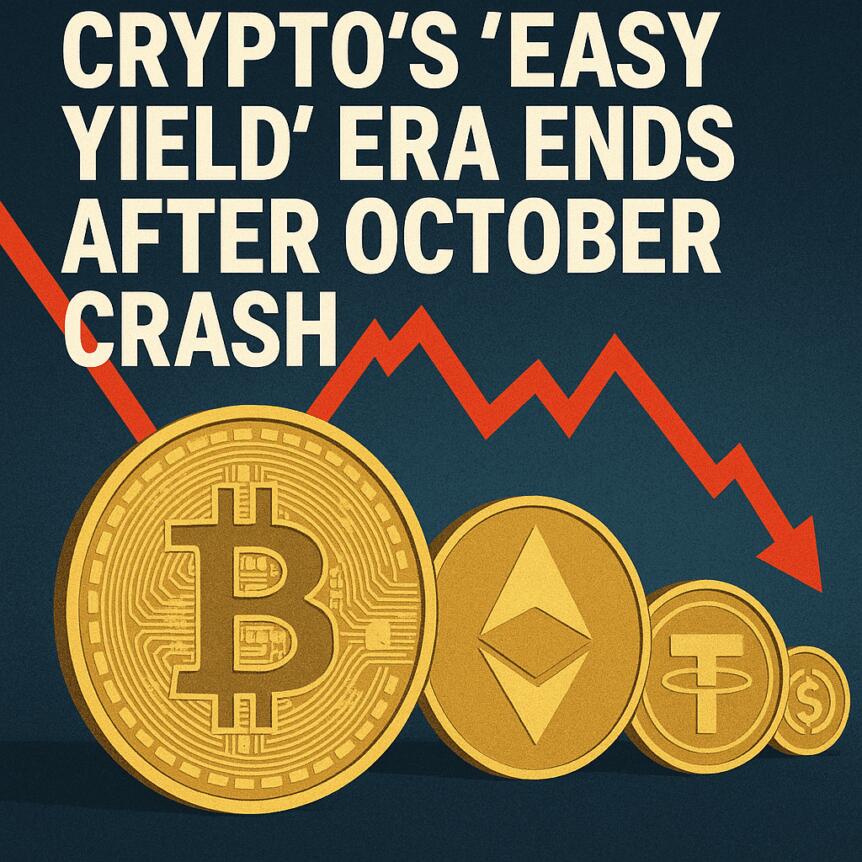
Crypto’s ‘easy Yield’ Era Ends After October Crash

Crypto Market Turmoil: October Crash Shakes Market Makers and Liquidity

The substantial crypto market decline in October has profoundly impacted market makers, marking a pivotal shift in the crypto trading landscape. According to BitMEX, this event wiped out approximately $20 billion and shattered years of perceived stability in crypto derivatives trading, highlighting the vulnerabilities of leveraged trading strategies amid extreme volatility.

Key Takeaways

  • October’s crash led to a historic $20 billion loss, severely damaging market maker positions.
  • Auto-deleveraging triggered by liquidations caused liquidity withdrawals and the deepest order books since 2022.
  • Market participants report a shift from traditional platforms to decentralized perpetual swaps, though concerns about manipulation persist.
  • The incident exposed flaws in on-chain transparency and emphasized the resilience of trusted exchanges.

Tickers mentioned: None

Sentiment: Bearish

Price impact: Negative. The event underscores systemic risks and reduced liquidity, potentially leading to more volatile markets.

Trading idea (Not Financial Advice): Hold — Caution advised amid ongoing volatility and liquidity concerns.

Market context: The crash reflects broader fragility in crypto markets, prompting reevaluation of leverage and risk management strategies.

Market Breakdown and Industry Implications

The October crash, characterized as the most destructive event for sophisticated market makers, resulted from a feedback loop of auto-deleveraging. During the systemic selloff, exchanges liquidated profitable leveraged positions to prevent further losses, forcing market makers to exit their delta-neutral strategies. As a consequence, liquidity dried up, leaving order books at their lowest levels since 2022, thereby reducing market depth and increasing volatility.

Market makers traditionally contribute to liquidity by shorting and holding crypto assets to hedge risks. However, when these hedge positions were forcibly closed in the aftermath of the crash, they were left holding unhedged, “naked” positions—a situation that contributed to the thinning order books and heightened trading risks.

The report from BitMEX further notes that the arbitrage strategies between spot and futures markets have become overcrowded, with negative funding rates diminishing profitability. This trend demonstrates a significant shift in trading dynamics, as the once-reliable alpha-generating strategies struggle in the current environment.

Meanwhile, the industry has observed a split between ‘fair matchers’ and ‘predatory B-Book exchanges.’ The latter engage in practices such as claiming to be market makers while employing ‘abnormal trading’ clauses to void profitable trades and refusing payouts during adverse conditions. These revelations have driven traders toward decentralized perpetual swap exchanges like Hyperliquid, although concerns about manipulation and platform security remain.

Additionally, the recent launch of the Plasma token in September exposed vulnerabilities, with attackers leveraging its liquidations map to manipulate pre-launch tokens lacking reliable price oracles. BitMEX warns that high transparency on-chain may not always safeguard traders, especially when platforms operate without proven security and robustness.

Despite the turmoil, the report emphasizes that such failures are paving the way for more resilient, tested exchanges and innovative trading protocols to emerge, potentially stabilizing the market long-term.

This article was originally published as Crypto’s ‘Easy Yield’ Era Ends After October Crash on Crypto Breaking News – your trusted source for crypto news, Bitcoin news, and blockchain updates.

Market Opportunity
ERA Logo
ERA Price(ERA)
$0.156
$0.156$0.156
+1.43%
USD
ERA (ERA) Live Price Chart
Disclaimer: The articles reposted on this site are sourced from public platforms and are provided for informational purposes only. They do not necessarily reflect the views of MEXC. All rights remain with the original authors. If you believe any content infringes on third-party rights, please contact service@support.mexc.com for removal. MEXC makes no guarantees regarding the accuracy, completeness, or timeliness of the content and is not responsible for any actions taken based on the information provided. The content does not constitute financial, legal, or other professional advice, nor should it be considered a recommendation or endorsement by MEXC.

You May Also Like

The Future of Metalworking: Advancements and Innovations

The Future of Metalworking: Advancements and Innovations

The demand for precision and efficiency in manufacturing processes continues to rise, leading to groundbreaking advancements in metalworking. This sector constantly
Share
Techbullion2026/02/07 19:24
Crypto whale loses $6M to sneaky phishing scheme targeting staked Ethereum

Crypto whale loses $6M to sneaky phishing scheme targeting staked Ethereum

The post Crypto whale loses $6M to sneaky phishing scheme targeting staked Ethereum appeared on BitcoinEthereumNews.com. A crypto whale lost more than $6 million in staked Ethereum (stETH) and Aave-wrapped Bitcoin (aEthWBTC) after approving malicious signatures in a phishing scheme on Sept. 18, according to blockchain security firm Scam Sniffer. According to the firm, the attackers disguised their move as a routine wallet confirmation through “Permit” signatures, which tricked the victim into authorizing fund transfers without triggering obvious red flags. Yu Xian, founder of blockchain security company SlowMist, noted that the victim did not recognize the danger because the transaction required no gas fees. He wrote: “From the victim’s perspective, he just clicked a few times to confirm the wallet’s pop-up signature requests, didn’t spend a single penny of gas, and $6.28 million was gone.” How Permit exploits work Permit approvals were originally designed to simplify token transfers. Instead of submitting an on-chain approval and paying fees, a user can sign an off-chain message authorizing a spender. That efficiency, however, has created a new attack surface for malicious players. Once a user signs such a permit, attackers can combine two functions—Permit and TransferFrom—to drain assets directly. Because the authorization takes place off-chain, wallet dashboards show no unusual activity until the funds move. As a result, the assets are gone when the approval executes on-chain, and tokens are redirected to the attacker’s wallet. This loophole has made permit exploits increasingly attractive for malicious actors, who can siphon millions without needing complex hacks or high-cost gas wars. Phishing losses The latest theft highlights a wider trend of escalating phishing campaigns. Scam Sniffer reported that in August alone, attackers stole $12.17 million from more than 15,200 victims. That figure represented a 72% jump in losses compared with July. According to the firm, the most significant share of August’s damages came from three large accounts that accounted for nearly half…
Share
BitcoinEthereumNews2025/09/19 02:31
WHALE ALERT: $351 MILLION Bitcoin Dump Incoming

WHALE ALERT: $351 MILLION Bitcoin Dump Incoming

One crypto whale transferred 5,000 Bitcoin, which is worth about 351 million, to Binance. Ash Crypto reported this transfer. It happened only several days after
Share
Coinfomania2026/02/07 19:36