TLDR Hyperliquid (HYPE) has dropped over 56.5% in less than 90 days, falling from $58 to under $25 Whale wallets have deposited over $37 million USDC to accumulateTLDR Hyperliquid (HYPE) has dropped over 56.5% in less than 90 days, falling from $58 to under $25 Whale wallets have deposited over $37 million USDC to accumulate

Hyperliquid (HYPE) Price: Large Investors Buy the Dip as Token Drops 56%

TLDR

  • Hyperliquid (HYPE) has dropped over 56.5% in less than 90 days, falling from $58 to under $25
  • Whale wallets have deposited over $37 million USDC to accumulate HYPE tokens at various price levels
  • The platform’s DEX revenue reached highs in October and November despite the price decline
  • HYPE needs to break above $30 resistance to confirm a bullish shift, while a drop below $22.5 could push it toward $20
  • The token is trading near $23.55 in an accumulation zone with RSI around 33, approaching oversold levels

Hyperliquid (HYPE) has experienced a sharp decline over the past three months. The token has fallen more than 56.5% from $58 to under $25 in less than 90 days.

Hyperliquid (HYPE) PriceHyperliquid (HYPE) Price

The price drop comes despite strong fundamentals for the platform. Hyperliquid’s decentralized exchange revenue hit record levels during October and November. These months are typically considered difficult periods for the crypto market.
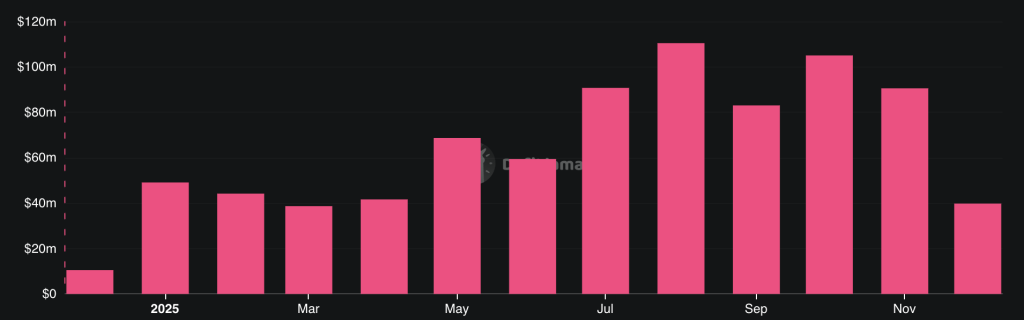
Source: DefiLlama

The decline has sparked debate about the effectiveness of token buybacks. Vlad Svitanko, CEO of Cryptorsy Ventures, compared buybacks to paying people to stand in line at a restaurant to create false demand. He called it one of the worst strategies in crypto.

Svitanko noted that Hyperliquid generates more profit than many banks. Yet the token remains down on the yearly chart. He suggested the money spent on buybacks could be better used to generate more revenue.

Large Investors Continue Buying

Despite the price drop, whale wallets are accumulating HYPE tokens. Data from Lookonchain shows over $37 million in USDC has flowed into Hyperliquid recently.

One wallet identified as 0x5Ae4 deposited $20 million USDC. The wallet set a limit buy order at $15. Another wallet, 0xE867, deposited $10 million USDC and now holds 926,488 tokens worth approximately $22.4 million.

A third whale wallet, 0x23Af, spent $7.1 million USDC to purchase 277,420 tokens. The average purchase price was $25.6 per token.

The accumulation across different price ranges suggests institutional investors see value at current levels. These buying patterns indicate confidence in the token’s long-term prospects.

Technical Analysis Points to Key Levels

HYPE price currently needs to break above $30 to confirm any bullish reversal. This level represents a psychological resistance point for traders.

The token is trading around $23.55, which sits in what analysts call an accumulation zone. The RSI indicator hovers around 33, close to oversold territory. This could signal a short-term bounce.

However, if the bounce fails to create a sustained rally, the downtrend would remain intact. A break below $22.5 could push the price toward $20. Some analysts see $16 as a possible downside target if selling pressure continues.

Market Structure Remains Weak

The broader crypto market conditions are contributing to HYPE’s struggles. Futures trading volume reached record highs in 2025. Hyperliquid’s position as a leader in this sector makes some investors view the current dip as a buying opportunity.

Crypto analyst Hyper_Up noted that the token still faces strong selling pressure. The overall market structure continues to show downward movement.

A break below $23 could expose the token to further losses. The market needs to establish a weekly fractal before confirming a long-term bottom. Until then, buying remains speculative.

Once a confirmed low appears on weekly charts, a new range could form. Analysts suggest the $33 to $34 region could serve as a correction target. The previous swing high of $50.15 remains a distant goal.

The token remains one of the top 10 largest cryptocurrencies by market cap. As long as platform fundamentals continue improving, HYPE could return to previous highs when the broader market recovers. The current price action shows accumulation by large investors at $23 to $25 levels.

The post Hyperliquid (HYPE) Price: Large Investors Buy the Dip as Token Drops 56% appeared first on CoinCentral.

Market Opportunity
Hyperliquid Logo
Hyperliquid Price(HYPE)
$24.74
$24.74$24.74
+3.68%
USD
Hyperliquid (HYPE) Live Price Chart
Disclaimer: The articles reposted on this site are sourced from public platforms and are provided for informational purposes only. They do not necessarily reflect the views of MEXC. All rights remain with the original authors. If you believe any content infringes on third-party rights, please contact service@support.mexc.com for removal. MEXC makes no guarantees regarding the accuracy, completeness, or timeliness of the content and is not responsible for any actions taken based on the information provided. The content does not constitute financial, legal, or other professional advice, nor should it be considered a recommendation or endorsement by MEXC.

You May Also Like

Whales keep selling XRP despite ETF success — Data signals deeper weakness

Whales keep selling XRP despite ETF success — Data signals deeper weakness

The post Whales keep selling XRP despite ETF success — Data signals deeper weakness appeared on BitcoinEthereumNews.com. XRP ETFs have crossed $1 billion in assets
Share
BitcoinEthereumNews2025/12/20 02:55
Foreigner’s Lou Gramm Revisits The Band’s Classic ‘4’ Album, Now Reissued

Foreigner’s Lou Gramm Revisits The Band’s Classic ‘4’ Album, Now Reissued

The post Foreigner’s Lou Gramm Revisits The Band’s Classic ‘4’ Album, Now Reissued appeared on BitcoinEthereumNews.com. American-based rock band Foreigner performs onstage at the Rosemont Horizon, Rosemont, Illinois, November 8, 1981. Pictured are, from left, Mick Jones, on guitar, and vocalist Lou Gramm. (Photo by Paul Natkin/Getty Images) Getty Images Singer Lou Gramm has a vivid memory of recording the ballad “Waiting for a Girl Like You” at New York City’s Electric Lady Studio for his band Foreigner more than 40 years ago. Gramm was adding his vocals for the track in the control room on the other side of the glass when he noticed a beautiful woman walking through the door. “She sits on the sofa in front of the board,” he says. “She looked at me while I was singing. And every now and then, she had a little smile on her face. I’m not sure what that was, but it was driving me crazy. “And at the end of the song, when I’m singing the ad-libs and stuff like that, she gets up,” he continues. “She gives me a little smile and walks out of the room. And when the song ended, I would look up every now and then to see where Mick [Jones] and Mutt [Lange] were, and they were pushing buttons and turning knobs. They were not aware that she was even in the room. So when the song ended, I said, ‘Guys, who was that woman who walked in? She was beautiful.’ And they looked at each other, and they went, ‘What are you talking about? We didn’t see anything.’ But you know what? I think they put her up to it. Doesn’t that sound more like them?” “Waiting for a Girl Like You” became a massive hit in 1981 for Foreigner off their album 4, which peaked at number one on the Billboard chart for 10 weeks and…
Share
BitcoinEthereumNews2025/09/18 01:26
New York Regulators Push Banks to Adopt Blockchain Analytics

New York Regulators Push Banks to Adopt Blockchain Analytics

New York’s top financial regulator urged banks to adopt blockchain analytics, signaling tighter oversight of crypto-linked risks. The move reflects regulators’ concern that traditional institutions face rising exposure to digital assets. While crypto-native firms already rely on monitoring tools, the Department of Financial Services now expects banks to use them to detect illicit activity. NYDFS Outlines Compliance Expectations The notice, issued on Wednesday by Superintendent Adrienne Harris, applies to all state-chartered banks and foreign branches. In its industry letter, the New York State Department of Financial Services (NYDFS) emphasized that blockchain analytics should be integrated into compliance programs according to each bank’s size, operations, and risk appetite. The regulator cautioned that crypto markets evolve quickly, requiring institutions to update frameworks regularly. “Emerging technologies introduce evolving threats that require enhanced monitoring tools,” the notice stated. It stressed the need for banks to prevent money laundering, sanctions violations, and other illicit finance linked to virtual currency transactions. To that end, the Department listed specific areas where blockchain analytics can be applied: Screening customer wallets with crypto exposure to assess risks. Verifying the origin of funds from virtual asset service providers (VASPs). Monitoring the ecosystem holistically to detect money laundering or sanctions exposure. Identifying and assessing counterparties, such as third-party VASPs. Evaluating expected versus actual transaction activity, including dollar thresholds. Weighing risks tied to new digital asset products before rollout. These examples highlight how institutions can tailor monitoring tools to strengthen their risk management frameworks. The guidance expands on NYDFS’s Virtual Currency-Related Activities (VCRA) framework, which has governed crypto oversight in the state since 2022. Regulators Signal Broader Impact Market observers say the notice is less about new rules and more about clarifying expectations. By formalizing the role of blockchain analytics in traditional finance, New York is reinforcing the idea that banks cannot treat crypto exposure as a niche concern. Analysts also believe the approach could ripple beyond New York. Federal agencies and regulators in other states may view the guidance as a blueprint for aligning banking oversight with the realities of digital asset adoption. For institutions, failure to adopt blockchain intelligence tools may invite regulatory scrutiny and undermine their ability to safeguard customer trust. With crypto now firmly embedded in global finance, New York’s stance suggests that blockchain analytics are no longer optional for banks — they are essential to protecting the financial system’s integrity.
Share
Coinstats2025/09/18 08:49