

Must Read
AWARD. Budget Secretary Amenah Pangandaman and PS-DBM Executive Director Genmaries Entredicho-Caong accept the Philippine government's awards at the Open Gov ChallengeAWARD. Budget Secretary Amenah Pangandaman and PS-DBM Executive Director Genmaries Entredicho-Caong accept the Philippine government's awards at the Open Gov Challenge
REPORTER’S NOTES: At UN summit, we ask how to keep up with borderless corruption
This week, over 2,000 delegates from 192 states around the world, along with representatives from civil society, the private sector, and the media, are in Doha, Qatar for what a veteran colleague aptly described as the “Coachella of anti-corruption advocates.”
Every two years, the United Nations Convention against Corruption (UNCAC) convenes the Conference of the States Parties (COSP), a gathering where member states discuss, negotiate, and pass resolutions that governments can use as a guide in implementing anti-graft policies back home.
Mounting a weeklong, high-level gathering to approve documents that do not compel governments to immediately enact policies might sound underwhelming on paper (and that may actually be the case). Still, any treaty language or resolution agreed upon here in Doha gives anti-corruption advocates ammunition to pressure their respective governments to step up and do better.
The COSP also provides neutral, UN-approved language that bilateral and multilateral donors use to justify their funding to a certain country. So yes, it’s also about money.
So far, I have seen more than 10 delegates from the Philippine delegation, led by Ombudsman Boying Remulla. Other top officials include anti-graft court Sandiganbayan Presiding Chief Geraldine Econg, new Chief Presidential Legal Counsel Anna Liza Logan, Procurement Service-Department of Budget and Management (PS-DBM) chief Genmaries Entredicho-Caong.
The Philippines is no longer the international pariah that it used to be when Rodrigo Duterte was the president, as the country under Ferdinand Marcos Jr.’s rule has become more open to dialogue with international bodies. So it’s no surprise that Philippine officials were met with attention rather than skepticism.
PS-DBM chief Entredicho-Caong touted ongoing procurement reforms in the Philippines, even though back home, journalists still struggle navigating the PhilGeps portal to aid in their investigations into the public works corruption scandal, which has taken the country by storm this year.
Remulla didn’t shy away from the controversy in the panels he was part of, calling the scale of flood control corruption — which involves executive agencies and the legislative — “unimaginable.” He also mentioned what his office has been doing, including the filing of cases against the officials involved.
Of course, a nuance lost on many foreign delegates is that the corruption scandal has been linked to Marcos himself and his associates. Remulla was appointed by the President but is constitutionally mandated to serve as an independent watchdog against government corruption. It makes one wonder how Malacañang officials like Logan frame the scandal in conversations with their foreign peers.
Play Video 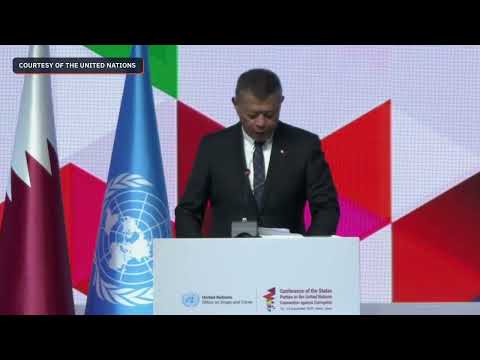
Cross-country collaborations
Remulla is honest about his intentions here: he wants to use the COSP as an opportunity to tighten the net on fugitives from justice, like Zaldy Co, the resigned congressman accused of being behind the national budget mess. Co is hiding abroad and refusing to come home to face the charges against him.
Remulla is referring not only to alleged masterminds of public works corruption who have fled — or may flee — the country, but also to bad actors involved in other crimes, such as illegal gambling. Before flood control irregularities dominated the national conversation, Filipinos were focused on scam hubs run by Philippine offshore gaming operators.
“The Office of the Ombudsman views robust regional and cross-regional cooperation not just as an option but a strategic necessity for the success in this modern age of fighting corruption,” Remulla said in one panel.
“We can start creating a network of countries that do not allow the people to run away and hide in one corner, and just live a happy life of anonymity in a foreign country,” he added in a separate panel.
Corruption being borderless is a recurring talking point in these panels, including in one that I was a part of. I am here upon the invitation United Nations Office and Drugs and Crime to represent Journalists Against Corruption (JAC), a network of Southeast Asian media practitioners.
My co-panelist Torplus “Nick” Yomnak made an interesting point: when corruption is treated solely as a domestic issue, civil society coalitions face structural barriers that are difficult to overcome.
While cross-border collaborations have increased in recent years, he pointed out that much of these collaborations remain ad hoc.
“It takes the form of meetings, workshops, and conferences — important and valuable, but often short-term. There is limited systematic facilitation, limited continuity, and limited long-term support. Once the event ends, the momentum often fades,” he said.
Nick added that a more structural response has begun to emerge. With support from UNODC and the Swedish government, they have established the Southeast Asian Anti-Corruption Network for Civil Society Organisations.
The same holds true for my organization JAC, which — as I pointed out in my panel — provided funding that enabled us to pursue our investigative stories on Zaldy Co. This Southeast Asian network has also provided a venue for data-sharing among like-minded journalists investigating corruption in their own countries.
Meanwhile, my fellow Filipino in the panel, Dexter Yang from the YouthLED board in Southeast Asia, stressed that corruption impacts young people most acutely, and underscored the need to include them in decision-making. (Dexter also attended the COSP in Atlanta, after which he wrote for Rappler about the lack of youth representation in the high-level summit).
Need for proactive delegation
Negotiations on numerous resolutions forwarded by other countries are still ongoing, though none is being sponsored or co-sponsored by the Philippines. Many of these resolutions are expected to be tabled before the summit closes on December 19.
Civil society delegates here have been ramping up efforts to convince state delegates from their own countries to attend the informal negotiations and support the resolutions.
So far, the Philippines has only attended negotiations on two resolutions, namely:
- the future of the UNCAC review mechanism, a key tool because what gets reviewed is what governments are ultimately pushed to fix;
- and one resolution that seeks to recognize corruption as a major cause of environmental crimes, urging signatories to develop strong domestic frameworks on transparency, open government participation, and access to information
It is important for the Philippine government to be more proactive in these negotiations. Sources here say there has been strong pushback from the United States on the political finance resolution, which encourages states to adopt stronger rules on campaign donations, beneficial ownership, and foreign interference.
Remulla has said the Philippines will support that resolution, but the delegation needs to walk the talk — attend the discussions and offer vocal support to sway holdouts — because there is strength in numbers. – Rappler.com
Market Opportunity
SUMMIT Price(SUMMIT)
$0.0000176
$0.0000176$0.0000176
USD
SUMMIT (SUMMIT) Live Price Chart
Disclaimer: The articles reposted on this site are sourced from public platforms and are provided for informational purposes only. They do not necessarily reflect the views of MEXC. All rights remain with the original authors. If you believe any content infringes on third-party rights, please contact service@support.mexc.com for removal. MEXC makes no guarantees regarding the accuracy, completeness, or timeliness of the content and is not responsible for any actions taken based on the information provided. The content does not constitute financial, legal, or other professional advice, nor should it be considered a recommendation or endorsement by MEXC.
You May Also Like

Is Doge Losing Steam As Traders Choose Pepeto For The Best Crypto Investment?
The post Is Doge Losing Steam As Traders Choose Pepeto For The Best Crypto Investment? appeared on BitcoinEthereumNews.com. Crypto News 17 September 2025 | 17:39 Is dogecoin really fading? As traders hunt the best crypto to buy now and weigh 2025 picks, Dogecoin (DOGE) still owns the meme coin spotlight, yet upside looks capped, today’s Dogecoin price prediction says as much. Attention is shifting to projects that blend culture with real on-chain tools. Buyers searching “best crypto to buy now” want shipped products, audits, and transparent tokenomics. That frames the true matchup: dogecoin vs. Pepeto. Enter Pepeto (PEPETO), an Ethereum-based memecoin with working rails: PepetoSwap, a zero-fee DEX, plus Pepeto Bridge for smooth cross-chain moves. By fusing story with tools people can use now, and speaking directly to crypto presale 2025 demand, Pepeto puts utility, clarity, and distribution in front. In a market where legacy meme coin leaders risk drifting on sentiment, Pepeto’s execution gives it a real seat in the “best crypto to buy now” debate. First, a quick look at why dogecoin may be losing altitude. Dogecoin Price Prediction: Is Doge Really Fading? Remember when dogecoin made crypto feel simple? In 2013, DOGE turned a meme into money and a loose forum into a movement. A decade on, the nonstop momentum has cooled; the backdrop is different, and the market is far more selective. With DOGE circling ~$0.268, the tape reads bearish-to-neutral for the next few weeks: hold the $0.26 shelf on daily closes and expect choppy range-trading toward $0.29–$0.30 where rallies keep stalling; lose $0.26 decisively and momentum often bleeds into $0.245 with risk of a deeper probe toward $0.22–$0.21; reclaim $0.30 on a clean daily close and the downside bias is likely neutralized, opening room for a squeeze into the low-$0.30s. Source: CoinMarketcap / TradingView Beyond the dogecoin price prediction, DOGE still centers on payments and lacks native smart contracts; ZK-proof verification is proposed,…
Share
BitcoinEthereumNews2025/09/18 00:14

ServicePower Closes Transformative Year with AI-Driven Growth and Market Expansion
Double-digit growth, 50% team expansion, and accelerated innovation define 2025 momentum MCLEAN, Va., Dec. 18, 2025 /PRNewswire/ — ServicePower, a leading provider
Share
AI Journal2025/12/18 23:32

Franklin Templeton CEO Dismisses 50bps Rate Cut Ahead FOMC
The post Franklin Templeton CEO Dismisses 50bps Rate Cut Ahead FOMC appeared on BitcoinEthereumNews.com. Franklin Templeton CEO Jenny Johnson has weighed in on whether the Federal Reserve should make a 25 basis points (bps) Fed rate cut or 50 bps cut. This comes ahead of the Fed decision today at today’s FOMC meeting, with the market pricing in a 25 bps cut. Bitcoin and the broader crypto market are currently trading flat ahead of the rate cut decision. Franklin Templeton CEO Weighs In On Potential FOMC Decision In a CNBC interview, Jenny Johnson said that she expects the Fed to make a 25 bps cut today instead of a 50 bps cut. She acknowledged the jobs data, which suggested that the labor market is weakening. However, she noted that this data is backward-looking, indicating that it doesn’t show the current state of the economy. She alluded to the wage growth, which she remarked is an indication of a robust labor market. She added that retail sales are up and that consumers are still spending, despite inflation being sticky at 3%, which makes a case for why the FOMC should opt against a 50-basis-point Fed rate cut. In line with this, the Franklin Templeton CEO said that she would go with a 25 bps rate cut if she were Jerome Powell. She remarked that the Fed still has the October and December FOMC meetings to make further cuts if the incoming data warrants it. Johnson also asserted that the data show a robust economy. However, she noted that there can’t be an argument for no Fed rate cut since Powell already signaled at Jackson Hole that they were likely to lower interest rates at this meeting due to concerns over a weakening labor market. Notably, her comment comes as experts argue for both sides on why the Fed should make a 25 bps cut or…
Share
BitcoinEthereumNews2025/09/18 00:36