Pi coin price is showing signs of an impending crash as it hovers near a potential breakdown zone. According to data from crypto.news, Pi Network (PI) was tradingPi coin price is showing signs of an impending crash as it hovers near a potential breakdown zone. According to data from crypto.news, Pi Network (PI) was trading

Pi coin price forms bearish setup as it approaches key support level, will it crash?

Pi coin price is showing signs of an impending crash as it hovers near a potential breakdown zone.

Summary
  • Pi coin price is down over 26% since its November high.
  • The lack of buyer interest and a looming token unlock are keeping price action capped.
  • A bearish double-top pattern has formed on the 4-hour chart.

According to data from crypto.news, Pi Network (PI) was trading at $0.20 on Wednesday, afternoon Asian time, down 26% from its November high and 93.2% from its year-to-date high of $2.99 reached in February.

Pi coin price has been in a strong downtrend as whale buying has continued to diminish, accompanied by a significant drop in trading activity on the Pi network over the past few months. Data from CoinGecko shows that trading volume for the token stood at around $22 million, down from over $2.5 billion seen earlier in February.

Waning whale interest and shrinking volume, when taken together, signal a clear lack of investor confidence, which has most likely led many market participants to rotate away from the token.

Pi coin is also under pressure as more tokens are being unlocked periodically, increasing the circulating supply and diluting existing holdings. Data from Piscan shows that the network is set to unlock nearly 105 million tokens by the end of December and over 1.22 billion tokens throughout 2026.

Such a surge in the amount of circulating tokens, occurring alongside a decline in trading volume and market demand, risks significant dilution. If buying interest remains weak, this imbalance may continue to push prices downwards.

Pi coin price analysis

On the 4-hour chart, Pi coin price has dropped below the neckline of a double top pattern that had been forming since late October this year. In technical analysis, this pattern is considered highly bearish and often serves as a precursor to further downside, at least in the short term.
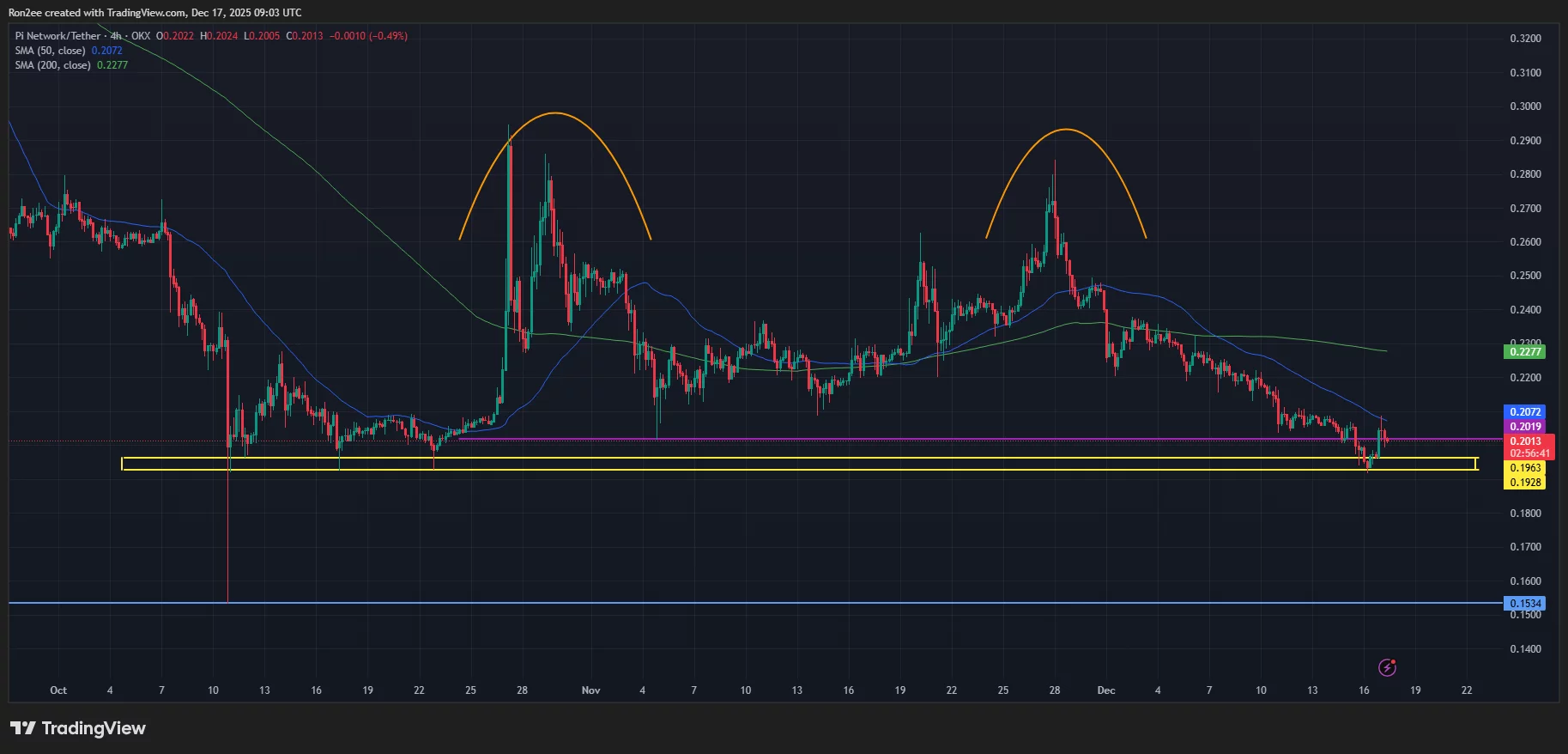
PI price forms a double-top pattern on the 4-hour chart.

Subsequently, the 50-day simple moving average has crossed below the 200-day one, forming what is known as a death cross on the chart, a telltale sign that bears have largely taken control over the market.

For now, the $0.192-$0.196 levels act as the most important support zone to watch. It has been a key zone where buyers have stepped in multiple times over the past few months to defend against further losses.
If this support fails to hold, it could potentially open doors for a drop towards the $0.15 low, a level last seen during the October selloff. At press time, that level stands roughly 25% below the current price level.

Disclosure: This article does not represent investment advice. The content and materials featured on this page are for educational purposes only.

Market Opportunity
Pi Network Logo
Pi Network Price(PI)
$0.20222
$0.20222$0.20222
-0.13%
USD
Pi Network (PI) Live Price Chart
Disclaimer: The articles reposted on this site are sourced from public platforms and are provided for informational purposes only. They do not necessarily reflect the views of MEXC. All rights remain with the original authors. If you believe any content infringes on third-party rights, please contact service@support.mexc.com for removal. MEXC makes no guarantees regarding the accuracy, completeness, or timeliness of the content and is not responsible for any actions taken based on the information provided. The content does not constitute financial, legal, or other professional advice, nor should it be considered a recommendation or endorsement by MEXC.

You May Also Like

The Channel Factories We’ve Been Waiting For

The Channel Factories We’ve Been Waiting For

The post The Channel Factories We’ve Been Waiting For appeared on BitcoinEthereumNews.com. Visions of future technology are often prescient about the broad strokes while flubbing the details. The tablets in “2001: A Space Odyssey” do indeed look like iPads, but you never see the astronauts paying for subscriptions or wasting hours on Candy Crush.  Channel factories are one vision that arose early in the history of the Lightning Network to address some challenges that Lightning has faced from the beginning. Despite having grown to become Bitcoin’s most successful layer-2 scaling solution, with instant and low-fee payments, Lightning’s scale is limited by its reliance on payment channels. Although Lightning shifts most transactions off-chain, each payment channel still requires an on-chain transaction to open and (usually) another to close. As adoption grows, pressure on the blockchain grows with it. The need for a more scalable approach to managing channels is clear. Channel factories were supposed to meet this need, but where are they? In 2025, subnetworks are emerging that revive the impetus of channel factories with some new details that vastly increase their potential. They are natively interoperable with Lightning and achieve greater scale by allowing a group of participants to open a shared multisig UTXO and create multiple bilateral channels, which reduces the number of on-chain transactions and improves capital efficiency. Achieving greater scale by reducing complexity, Ark and Spark perform the same function as traditional channel factories with new designs and additional capabilities based on shared UTXOs.  Channel Factories 101 Channel factories have been around since the inception of Lightning. A factory is a multiparty contract where multiple users (not just two, as in a Dryja-Poon channel) cooperatively lock funds in a single multisig UTXO. They can open, close and update channels off-chain without updating the blockchain for each operation. Only when participants leave or the factory dissolves is an on-chain transaction…
Share
BitcoinEthereumNews2025/09/18 00:09
Why Is the Bitcoin Price Constantly Falling? Analysis Firm Says “The Selling Process Has Reached Saturation,” Shares Its Expectations

Why Is the Bitcoin Price Constantly Falling? Analysis Firm Says “The Selling Process Has Reached Saturation,” Shares Its Expectations

Cryptocurrency analytics company K33 Research has evaluated the recent price movements of Bitcoin. Here are the details. Continue Reading: Why Is the Bitcoin Price
Share
Coinstats2025/12/18 03:53
Gold continues to hit new highs. How to invest in gold in the crypto market?

Gold continues to hit new highs. How to invest in gold in the crypto market?

As Bitcoin encounters a "value winter", real-world gold is recasting the iron curtain of value on the blockchain.
Share
PANews2025/04/14 17:12