Bitcoin’s “death cross” is back in the group chat. And yes, the emails too. Matthew Sigel, head of digital assets research at VanEck, said he’s been “getting questionsBitcoin’s “death cross” is back in the group chat. And yes, the emails too. Matthew Sigel, head of digital assets research at VanEck, said he’s been “getting questions

Bitcoin ‘Death Cross’ Panic Returns: History Says It’s A Late Signal

2025/12/17 19:00

Bitcoin’s “death cross” is back in the group chat. And yes, the emails too. Matthew Sigel, head of digital assets research at VanEck, said he’s been “getting questions from clients” about the latest death cross print — the 50-day moving average slipping under the 200-day — and answered with the kind of data dump that tends to calm people down.

“Lagging indicator,” Sigel wrote on X, alongside a table of every Bitcoin death cross going back to 2011. The summary stats are clean: the 6-month median return after a death cross is +30%, the 12-month median is +89%, and the “positive hit rate” is 64%.

Another Bitcoin Death Cross, Another Missed Bottom?

But the interesting bit isn’t just the returns. It’s Sigel’s market regime column — basically a hint that the same technical signal can mean wildly different things depending on where you are in the cycle.
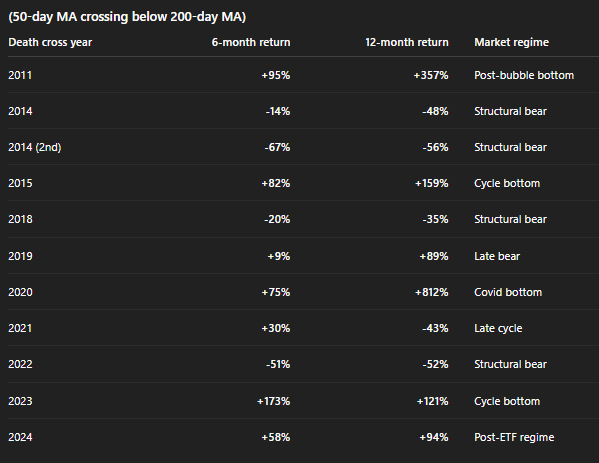
Bitcoin death cross history

Take the ones tagged as some version of “bottom.” In 2011 (“post-bubble bottom”), the death cross showed up around the wreckage of an early-cycle blow-off, and the next 12 months were +357%. In 2015 (“cycle bottom”), it was +82% at six months and +159% at 12 months — classic post-capitulation behavior where trend indicators catch up late, after price has already stabilized and started to turn.

2020 (“Covid bottom”) is the extreme example: forced liquidation, policy response, then a monster rebound (+812% over 12 months). And 2023 is also tagged “cycle bottom,” with +173% at six months and +121% at 12 months — the kind of “this is awful until it isn’t” regime crypto does better than any asset class.

Now look at “structural bear.” That label shows up in 2014 (twice), 2018, and 2022 — and the forward returns are mostly ugly: 2014 prints -48% and -56% over 12 months, 2018 is -35%, and 2022 is -52%. Different environment. Less “washout and bounce,” more “trend is down because the system is deleveraging,” whether that’s miners, credit, exchanges, or macro liquidity tightening. In those regimes, a death cross isn’t a late alarm — it’s the moving averages confirming that the downtrend is real and persistent.

The in-between tags matter too. 2019 is marked “late bear,” with +9% at six months and +89% at 12 — choppy, uneven, but improving as the cycle turns. 2021 is “late cycle”: +30% at six months, then -43% at 12, which fits a regime where trend signals can whipsaw while distribution and macro tightening creep in.

And then there’s 2024: “post-ETF regime,” with +58% at six months and +94% at 12. That tag is doing a lot of work. It suggests the backdrop isn’t just “price vs. moving averages,” but structural demand (ETFs), different liquidity plumbing, and a market that may behave less like pure reflexive leverage and more like a hybrid of trad-fi flows plus crypto-native positioning.

So the takeaway isn’t “death crosses are bullish.” That’s not true. It’s that the signal is mostly a trailing mirror — and the regime you’re actually in (bottoming, late bear, structural deleveraging, late cycle, post-ETF flow market) is what decides whether it’s a fake-out, a confirmation, or just noise with a scary name.

At press time, Bitcoin traded at $86,631.
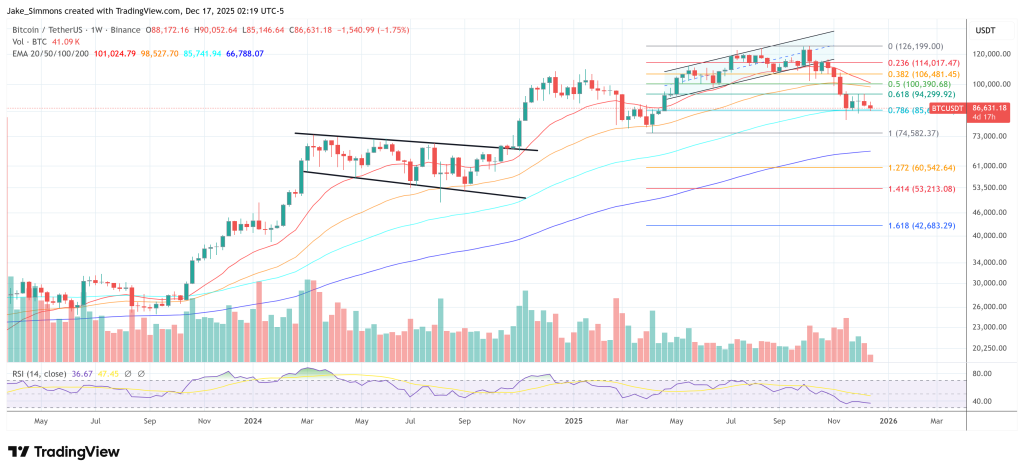
Bitcoin price
Market Opportunity
CROSS Logo
CROSS Price(CROSS)
$0.1275
$0.1275$0.1275
-0.56%
USD
CROSS (CROSS) Live Price Chart
Disclaimer: The articles reposted on this site are sourced from public platforms and are provided for informational purposes only. They do not necessarily reflect the views of MEXC. All rights remain with the original authors. If you believe any content infringes on third-party rights, please contact service@support.mexc.com for removal. MEXC makes no guarantees regarding the accuracy, completeness, or timeliness of the content and is not responsible for any actions taken based on the information provided. The content does not constitute financial, legal, or other professional advice, nor should it be considered a recommendation or endorsement by MEXC.

You May Also Like

Xsolla Expands MTN Mobile Money Support to Congo-Brazzaville and Zambia, Enhancing Access in Fast-Growing Markets

Xsolla Expands MTN Mobile Money Support to Congo-Brazzaville and Zambia, Enhancing Access in Fast-Growing Markets

New Expansion Delivers Instant, Secure Transactions, And A Familiar Local Payment Experience, Helping Developers Reach Millions Of Players And Boost Conversions
Share
AI Journal2025/12/17 23:50
iGMS Introduces AI-Driven Pro+ Plan, Cutting Host Workloads by Up to 85%

iGMS Introduces AI-Driven Pro+ Plan, Cutting Host Workloads by Up to 85%

VANCOUVER, British Columbia–(BUSINESS WIRE)–#STRSoftware—iGMS, an award-winning short-term rental platform and official Airbnb Partner, today announced the launch
Share
AI Journal2025/12/18 00:18
Fed Decides On Interest Rates Today—Here’s What To Watch For

Fed Decides On Interest Rates Today—Here’s What To Watch For

The post Fed Decides On Interest Rates Today—Here’s What To Watch For appeared on BitcoinEthereumNews.com. Topline The Federal Reserve on Wednesday will conclude a two-day policymaking meeting and release a decision on whether to lower interest rates—following months of pressure and criticism from President Donald Trump—and potentially signal whether additional cuts are on the way. President Donald Trump has urged the central bank to “CUT INTEREST RATES, NOW, AND BIGGER” than they might plan to. Getty Images Key Facts The central bank is poised to cut interest rates by at least a quarter-point, down from the 4.25% to 4.5% range where they have been held since December to between 4% and 4.25%, as Wall Street has placed 100% odds of a rate cut, according to CME’s FedWatch, with higher odds (94%) on a quarter-point cut than a half-point (6%) reduction. Fed governors Christopher Waller and Michelle Bowman, both Trump appointees, voted in July for a quarter-point reduction to rates, and they may dissent again in favor of a large cut alongside Stephen Miran, Trump’s Council of Economic Advisers’ chair, who was sworn in at the meeting’s start on Tuesday. It’s unclear whether other policymakers, including Kansas City Fed President Jeffrey Schmid and St. Louis Fed President Alberto Musalem, will favor larger cuts or opt for no reduction. Fed Chair Jerome Powell said in his Jackson Hole, Wyoming, address last month the central bank would likely consider a looser monetary policy, noting the “shifting balance of risks” on the U.S. economy “may warrant adjusting our policy stance.” David Mericle, an economist for Goldman Sachs, wrote in a note the “key question” for the Fed’s meeting is whether policymakers signal “this is likely the first in a series of consecutive cuts” as the central bank is anticipated to “acknowledge the softening in the labor market,” though they may not “nod to an October cut.” Mericle said he…
Share
BitcoinEthereumNews2025/09/18 00:23
