BitcoinWorld Bitcoin Short-Term Holders Capitulating: What This Critical Signal Means for BTC Price Bitcoin’s recent price decline has triggered a critical marketBitcoinWorld Bitcoin Short-Term Holders Capitulating: What This Critical Signal Means for BTC Price Bitcoin’s recent price decline has triggered a critical market

Bitcoin Short-Term Holders Capitulating: What This Critical Signal Means for BTC Price
2025/12/15 17:10
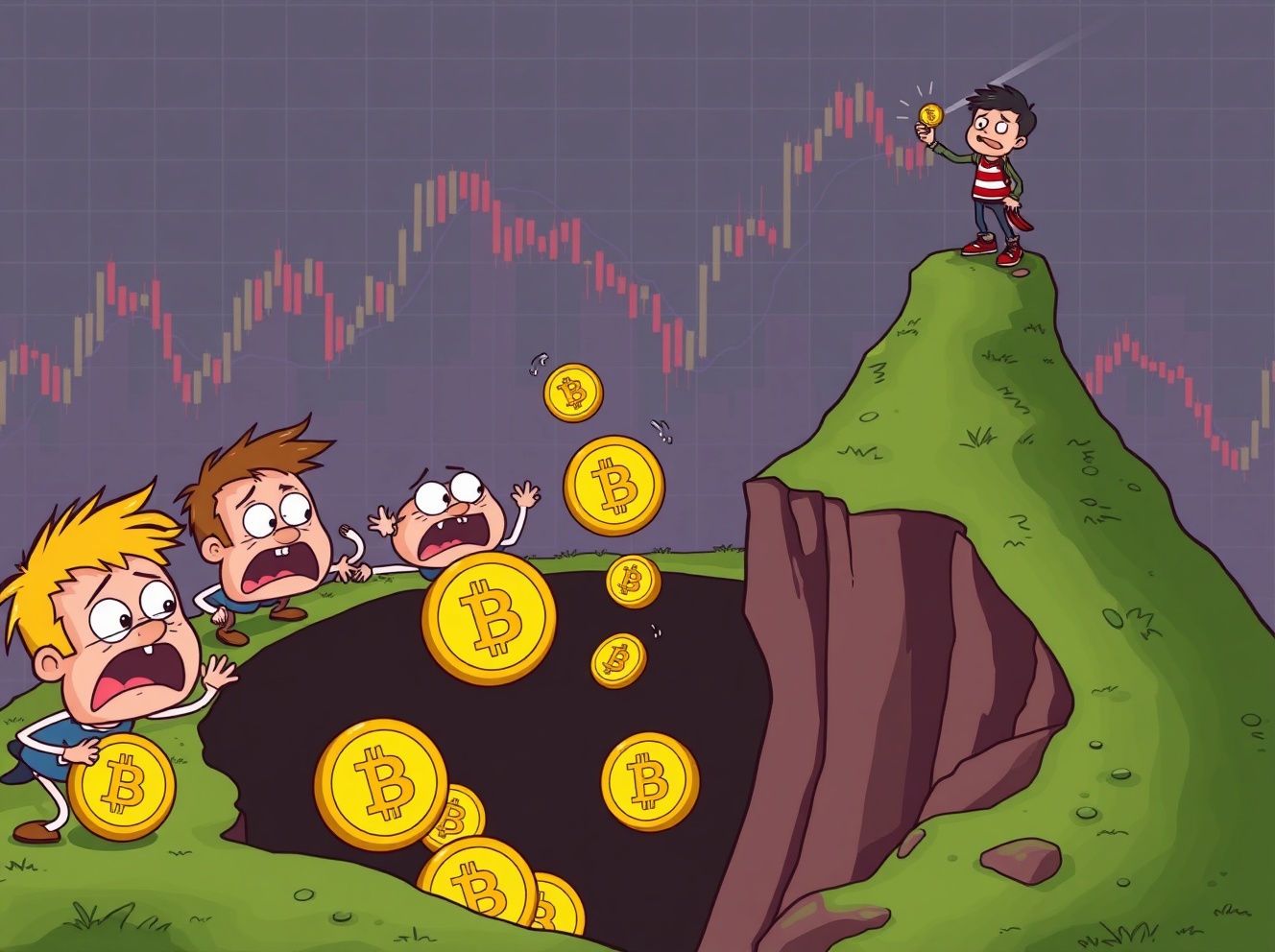
Cartoon illustration showing Bitcoin short-term holders capitulating by selling coins during market decline

BitcoinWorld

Bitcoin Short-Term Holders Capitulating: What This Critical Signal Means for BTC Price

Bitcoin’s recent price decline has triggered a critical market phase that every investor should understand. According to crypto analyst Axel Adler Jr., Bitcoin short-term holders are capitulating right now. This pattern often signals important turning points in cryptocurrency markets. But what does this capitulation actually mean, and how might it affect your Bitcoin investments?

What Does Bitcoin Short-Term Holder Capitulation Mean?

When we say Bitcoin short-term holders are capitulating, we’re describing a specific market psychology. Short-term holders (STHs) are investors who purchased Bitcoin within approximately the last 155 days. Capitulation occurs when these investors sell their holdings at a loss, typically driven by fear or panic during price declines.

This behavior creates important market dynamics. First, it transfers Bitcoin from weak hands to potentially stronger ones. Second, it often precedes market bottoms. However, capitulation doesn’t guarantee an immediate recovery. The market needs sufficient buying demand to absorb this selling pressure.

How Do We Know Capitulation Is Happening?

Analysts don’t guess about capitulation—they measure it using on-chain data. Axel Adler Jr. points to two key indicators confirming that Bitcoin short-term holders are capitulating:

  • STH Spent Output Profit Ratio (SOPR): This seven-day average has fallen below one, meaning short-term holders are selling at an overall loss
  • Profit/Loss Block Indicator: Currently at -3, signaling extremely negative market sentiment among recent buyers

These metrics provide objective evidence beyond price charts. They show actual investor behavior through blockchain transactions. When both indicators point downward simultaneously, they create a strong signal of market stress.

Why Should Bitcoin Investors Care About This Signal?

Understanding that Bitcoin short-term holders are capitulating matters for several reasons. First, capitulation often creates buying opportunities for long-term investors. Second, it indicates potential market exhaustion—when the weakest sellers have exited, fewer remain to push prices lower.

However, Adler cautions that capitulation alone doesn’t guarantee recovery. The market needs sufficient demand to absorb this selling. If buying interest remains weak, prices could continue declining despite the capitulation signal.

When Will the Bitcoin Market Recover?

According to Adler’s analysis, recovery requires specific conditions. The SOPR must rise above one again, indicating that short-term holders are selling at a profit. Simultaneously, the P/L Block indicator needs to return to positive territory.

These changes would signal several important developments:

  • Reduced selling pressure from panicked investors
  • Increased confidence among market participants
  • Potential accumulation by long-term holders
  • Improved overall market sentiment

Until these indicators reverse, the Bitcoin short-term holders capitulating phase may continue. Investors should watch for these on-chain signals alongside price action.

What Should Bitcoin Investors Do Now?

Recognizing that Bitcoin short-term holders are capitulating provides context for investment decisions. However, it shouldn’t dictate panic selling or reckless buying. Consider these balanced approaches:

  • For long-term holders: This may represent a potential accumulation zone, though timing bottoms remains challenging
  • For short-term traders: Exercise caution until on-chain indicators show clear improvement
  • For new investors: Consider dollar-cost averaging rather than timing exact market bottoms

Remember that capitulation phases test investor psychology. The emotional urge to sell often peaks just before potential recoveries. Having a clear investment strategy matters more than reacting to every market signal.

Frequently Asked Questions

What are Bitcoin short-term holders?
Short-term holders (STHs) are investors who purchased Bitcoin within approximately the last 155 days. They typically show more price sensitivity than long-term holders.

How long does capitulation typically last?
Capitulation phases vary in duration. They can last from days to weeks, depending on market conditions and overall sentiment. There’s no fixed timeline.

Does capitulation always lead to a price bottom?
Not always. While capitulation often precedes market bottoms, it doesn’t guarantee them. Sufficient buying demand must emerge to reverse the trend.

How can I track these on-chain indicators myself?
Several cryptocurrency analytics platforms provide on-chain data, including Glassnode, CryptoQuant, and LookIntoBitcoin. These sites offer both free and paid access to metrics like SOPR.

Should I sell my Bitcoin during capitulation?
This depends on your investment strategy and time horizon. Capitulation often creates potential buying opportunities, but selling during fear-driven markets can lock in losses. Consult your financial advisor for personalized advice.

What’s the difference between STH and LTH capitulation?
Short-term holder capitulation is more common during corrections, while long-term holder capitulation typically occurs during deeper bear markets. LTH capitulation often signals more severe market stress.

Share This Analysis

Did this explanation of why Bitcoin short-term holders are capitulating help your understanding? Share this article with fellow investors who might benefit from understanding these critical market signals. Knowledge helps build stronger cryptocurrency communities.

To learn more about the latest Bitcoin market trends, explore our article on key developments shaping Bitcoin price action and institutional adoption.

This post Bitcoin Short-Term Holders Capitulating: What This Critical Signal Means for BTC Price first appeared on BitcoinWorld.

Market Opportunity
Bitcoin Logo
Bitcoin Price(BTC)
$87,013.89
$87,013.89$87,013.89
-0.01%
USD
Bitcoin (BTC) Live Price Chart
Disclaimer: The articles reposted on this site are sourced from public platforms and are provided for informational purposes only. They do not necessarily reflect the views of MEXC. All rights remain with the original authors. If you believe any content infringes on third-party rights, please contact service@support.mexc.com for removal. MEXC makes no guarantees regarding the accuracy, completeness, or timeliness of the content and is not responsible for any actions taken based on the information provided. The content does not constitute financial, legal, or other professional advice, nor should it be considered a recommendation or endorsement by MEXC.

You May Also Like

Volante Technologies Customers Successfully Navigate Critical Regulatory Deadlines for EU SEPA Instant and Global SWIFT Cross-Border Payments

Volante Technologies Customers Successfully Navigate Critical Regulatory Deadlines for EU SEPA Instant and Global SWIFT Cross-Border Payments

PaaS leader ensures seamless migrations and uninterrupted payment operations LONDON–(BUSINESS WIRE)–Volante Technologies, the global leader in Payments as a Service
Share
AI Journal2025/12/16 17:16
Fed Acts on Economic Signals with Rate Cut

Fed Acts on Economic Signals with Rate Cut

In a significant pivot, the Federal Reserve reduced its benchmark interest rate following a prolonged ten-month hiatus. This decision, reflecting a strategic response to the current economic climate, has captured attention across financial sectors, with both market participants and policymakers keenly evaluating its potential impact.Continue Reading:Fed Acts on Economic Signals with Rate Cut
Share
Coinstats2025/09/18 02:28
Google's AP2 protocol has been released. Does encrypted AI still have a chance?

Google's AP2 protocol has been released. Does encrypted AI still have a chance?

Following the MCP and A2A protocols, the AI Agent market has seen another blockbuster arrival: the Agent Payments Protocol (AP2), developed by Google. This will clearly further enhance AI Agents' autonomous multi-tasking capabilities, but the unfortunate reality is that it has little to do with web3AI. Let's take a closer look: What problem does AP2 solve? Simply put, the MCP protocol is like a universal hook, enabling AI agents to connect to various external tools and data sources; A2A is a team collaboration communication protocol that allows multiple AI agents to cooperate with each other to complete complex tasks; AP2 completes the last piece of the puzzle - payment capability. In other words, MCP opens up connectivity, A2A promotes collaboration efficiency, and AP2 achieves value exchange. The arrival of AP2 truly injects "soul" into the autonomous collaboration and task execution of Multi-Agents. Imagine AI Agents connecting Qunar, Meituan, and Didi to complete the booking of flights, hotels, and car rentals, but then getting stuck at the point of "self-payment." What's the point of all that multitasking? So, remember this: AP2 is an extension of MCP+A2A, solving the last mile problem of AI Agent automated execution. What are the technical highlights of AP2? The core innovation of AP2 is the Mandates mechanism, which is divided into real-time authorization mode and delegated authorization mode. Real-time authorization is easy to understand. The AI Agent finds the product and shows it to you. The operation can only be performed after the user signs. Delegated authorization requires the user to set rules in advance, such as only buying the iPhone 17 when the price drops to 5,000. The AI Agent monitors the trigger conditions and executes automatically. The implementation logic is cryptographically signed using Verifiable Credentials (VCs). Users can set complex commission conditions, including price ranges, time limits, and payment method priorities, forming a tamper-proof digital contract. Once signed, the AI Agent executes according to the conditions, with VCs ensuring auditability and security at every step. Of particular note is the "A2A x402" extension, a technical component developed by Google specifically for crypto payments, developed in collaboration with Coinbase and the Ethereum Foundation. This extension enables AI Agents to seamlessly process stablecoins, ETH, and other blockchain assets, supporting native payment scenarios within the Web3 ecosystem. What kind of imagination space can AP2 bring? After analyzing the technical principles, do you think that's it? Yes, in fact, the AP2 is boring when it is disassembled alone. Its real charm lies in connecting and opening up the "MCP+A2A+AP2" technology stack, completely opening up the complete link of AI Agent's autonomous analysis+execution+payment. From now on, AI Agents can open up many application scenarios. For example, AI Agents for stock investment and financial management can help us monitor the market 24/7 and conduct independent transactions. Enterprise procurement AI Agents can automatically replenish and renew without human intervention. AP2's complementary payment capabilities will further expand the penetration of the Agent-to-Agent economy into more scenarios. Google obviously understands that after the technical framework is established, the ecological implementation must be relied upon, so it has brought in more than 60 partners to develop it, almost covering the entire payment and business ecosystem. Interestingly, it also involves major Crypto players such as Ethereum, Coinbase, MetaMask, and Sui. Combined with the current trend of currency and stock integration, the imagination space has been doubled. Is web3 AI really dead? Not entirely. Google's AP2 looks complete, but it only achieves technical compatibility with Crypto payments. It can only be regarded as an extension of the traditional authorization framework and belongs to the category of automated execution. There is a "paradigm" difference between it and the autonomous asset management pursued by pure Crypto native solutions. The Crypto-native solutions under exploration are taking the "decentralized custody + on-chain verification" route, including AI Agent autonomous asset management, AI Agent autonomous transactions (DeFAI), AI Agent digital identity and on-chain reputation system (ERC-8004...), AI Agent on-chain governance DAO framework, AI Agent NPC and digital avatars, and many other interesting and fun directions. Ultimately, once users get used to AI Agent payments in traditional fields, their acceptance of AI Agents autonomously owning digital assets will also increase. And for those scenarios that AP2 cannot reach, such as anonymous transactions, censorship-resistant payments, and decentralized asset management, there will always be a time for crypto-native solutions to show their strength? The two are more likely to be complementary rather than competitive, but to be honest, the key technological advancements behind AI Agents currently all come from web2AI, and web3AI still needs to keep up the good work!
Share
PANews2025/09/18 07:00