Ex-Terra Insider Calls Do Kwon Case ‘Backwards’ In Explosive X Thread
Former Terraform Labs developer Will Chen argued in a Dec. 13 X thread that the fraud case against Do Kwon was built on a “backwards” theory, days after a court sentenced Kwon to 15 years in prison on Friday, Dec. 15.
Chen framed his post as a critique of the legal mechanics, not a character defense. “I wanted Do to fail. I wanted him punished. I thought he was arrogant and reckless and I told him so to his face multiple times,” he wrote. “I’m not here to defend Do Kwon the person. But the legal case is broken.”
Do Kwon Conviction Misframed Terra’s Collapse
He described Judge Engelmayer as “sympathetic” and “extremely methodical,” but argued the guilty plea boxed Kwon into the government’s framing: “Do taking the guilty plea means admitting to the government’s charges as is. There’s no debating afterward.” Chen said he found it “incredibly ironic” that Do Kwon didn’t contest the case.
At the center of Chen’s critique is prosecutors’ theory around Terra’s May 2021 depeg. As Chen summarized it, the government argued that Kwon claimed the algorithm “self-healed” while failing to disclose that Jump Trading stepped in to buy UST and help restore the peg, making his public statements deceptive and therefore fraudulent.
Chen’s rebuttal is that this logic runs in the wrong direction. “Fraud is when you claim your system has safety mechanisms it doesn’t have, and people invest trusting that fake safety, and then they lose money when the danger you hid materializes,” he wrote, contrasting it with the allegation here: “But what the government is alleging is the inverse. Do said ‘no reserves, the algorithm alone handles it’ when he actually did have Jump as a backstop.”
In Chen’s view, that means Do Kwon was “claiming less safety than he actually had,” adding: “If he’d disclosed Jump, investors would have been more confident, not less.” He distilled his conclusion bluntly: “You don’t defraud someone by hiding additional safety mechanisms. The direction is backwards.”
Chen also disputed how prosecutors interpreted a reported private remark attributed to Do Kwon — that Terra “might’ve been fucked without Jump” — as proof Kwon knew the mechanism was broken. “Might’ve been fucked is uncertainty about an unknowable counterfactual,” Chen wrote. “Knew it would have failed is a claim of definite knowledge.”
He argued the only way to truly know the algorithm would not have recovered is to not intervene and watch it die, which he suggests is inconsistent with operating a live financial system. “The algorithm was working during that period,” Chen wrote. “Arbitrage was happening. UST was being burned for LUNA. Jump was also buying. Both things were true.”
Even the non-disclosure itself, Chen argued, could be framed as strategic rather than deceptive. “Algorithmic stablecoins operate in adversarial conditions,” he wrote, suggesting that publicizing the size and nature of defenses can make an attack easier to price. “If attackers know your exact defense capabilities, they can calculate whether an attack is profitable,” Chen said, arguing that “uncertainty about defense resources is itself a defense.”
He compared the idea to “strategic ambiguity” used by central banks and warned that public transparency around reserves can become a tactical disadvantage: “Would disclosing Jump have made Terra more or less secure? Attackers could have calculated exactly how much force was needed to overwhelm the defense.”
Chen then challenged whether the case established investor reliance and causation in a market saturated with information. “Do’s statements were one signal in an incredibly noisy channel,” he wrote, pointing to years of public debate around Terra’s risks, open-source code, and prominent critics. “The risk was described in the original white paper. The code was open source. The potential failure mode was publicly debated for years,” Chen wrote, arguing prosecutors “never established direct causation between Do’s specific statements and investor decisions.”
He also drew a sharp line between the May 2021 episode and the May 2022 collapse, arguing the information environment changed materially in between. “By May 2022, investors knew about backstops,” he wrote, pointing to Luna Foundation Guard’s public launch in January 2022 and the visibility of reserves on-chain. In Chen’s view, that breaks the causal chain: “The May 2021 non-disclosure about Jump is causally disconnected from May 2022 losses because the information environment had completely changed by then.”
One of Chen’s most forceful objections was the scope of losses attributed to Do Kwon. “One thing I can’t get over is the fact that Do signed off on pleading guilty to causing $40 billion in loss,” he wrote. “Market cap decline is not fraud loss.” He offered a simple example to illustrate what he sees as a category error: “If I buy LUNA at $1 and it goes to $100 and then back to zero, my loss is $1. The $99 was paper gains I never realized.” Treating peak-to-trough market cap evaporation as damages, he argued, “sets a terrible legal precedent for the industry.”
While disputing the overarching fraud theory, Chen did not claim Terraform Labs’ messaging was clean across the board. He said “the Chai stuff has more merit as an actual fraud claim,” while arguing the government’s portrayal was still overstated. “That’s not entirely accurate,” he wrote of claims Chai didn’t use Terra, adding that Chai “did use Terra for accounting,” that “Terra wallet was integrated into the app,” and “you could top up Chai with KRT,” while conceding Do Kwon “probably stretched the truth early on” about on-chain payment settlement.
Anchor, Chen wrote, was “harder to defend.” Promoting the roughly 20% yield as sustainable while reserves depleted was “reckless,” and he said Do Kwon knew “the 20% couldn’t last forever without a plan.” Still, Chen argued that even if yield marketing was misleading, the catastrophic losses were driven by the depeg: “If UST had held, people would’ve just earned less interest. They wouldn’t have lost their principal.”
The ex-Terra developer also contrasts Do Kwon to Sam Bankman-Fried: “SBF literally stole customer deposits and used them for other purposes. That’s why SBF victims are being repaid. The money was taken and still exists somewhere. Terra victims can’t be repaid because the value was destroyed in a crash, not stolen and moved to a different account. Treating these situations as equivalent is wrong.”
Chen closed with a broader warning about precedent and builder behavior. “If founder confidence plus project failure equals fraud, we’ve criminalized entrepreneurship,” he wrote, arguing it exposes founders who publicly express optimism about products that later fail. His final framing returned to process: whatever one thinks of Do Kwon personally, Chen argues the plea locked in prosecutors’ narrative without the kind of contested defense that might have narrowed both the theory and the scope of damages.
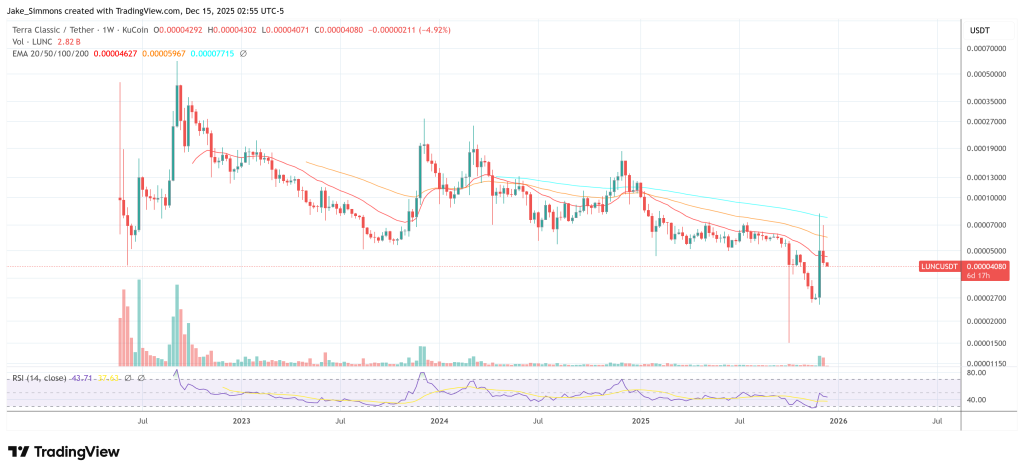
At press time, LUNC traded at $0.00004080.
You May Also Like

‘One Battle After Another’ Becomes One Of This Decade’s Best-Reviewed Movies
XRP Price Prediction: Can Ripple Rally Past $2 Before the End of 2025?