Most projects we see here are *totally useless* and won't exist for more than a few months. Most will be abandoned in 3 weeks when the founder realizes nobody wants to pay for their "revolutionary" todo app with AI. "AI-Powered" means nothing anymore.Most projects we see here are *totally useless* and won't exist for more than a few months. Most will be abandoned in 3 weeks when the founder realizes nobody wants to pay for their "revolutionary" todo app with AI. "AI-Powered" means nothing anymore.

Stop Building "AI-Powered" Sh*t. The SaaS Gold Rush is a Trap

2025/12/09 20:19
8 min read

"Check out my SaaS directory list" - nobody cares

"I Hit 10k MRR in 30 Days: Here's How" - stop lying

"I created an AI-powered chatbot" - no, you wrapped OpenAI's API

"Built my MVP in 48 hours with Cursor" - congrats, so did 50,000 other people this week

Most projects we see here are totally useless and won't exist for more than a few months. Actually, scratch that and most will be abandoned in 3 weeks when the founder realizes nobody wants to pay for their "revolutionary" todo app with AI.

And the culprit is you

Yes, you, who thought you'd get rich by:

  • Watching a 47-minute YouTube video titled "I Built a $10k/month SaaS with AI (You Can Too!)"
  • Spending 6 hours "coding" in Cursor (you mean prompting)
  • Slapping together NextJS + Supabase + PostgreSQL + Vercel
  • Adding "AI-Powered" to your landing page (it's literally just a ChatGPT wrapper)
  • Posting on 47 Reddit communities asking for "feedback" (begging for users)
  • Getting 3 signups (your mom, your best friend, and a bot)
  • Wondering why you're not a millionaire yet

Just because AI tools like Cursor, v0, and ChatGPT can help you code faster doesn't mean every AI-generated SaaS needs to exist.

We've seen this movie before

Remember when everyone was:

  • Launching crypto tokens → "This will revolutionize payments!" (Rugpulled in 6 months)
  • Minting NFTs → "Digital art is the future!" (Floor price: $0)
  • Dropshipping fidget spinners → "Passive income!" (Banned by Shopify)
  • Creating courses → "Share your expertise!" (12 sales, all refunded)
  • Starting agencies → "I'll manage your social media!" (Client ghosted after 2 weeks)

And now: Building AI SaaS → "Cursor will make me rich!" (0 MRR after 4 months)

Different costumes, same empty promises.

The harsh truth nobody tells you

1. Your SaaS isn't special

There are 47,000+ SaaS products launched every year. Most die within 12 months.

Why? Because you didn't solve a problem but you created a solution looking for a problem.

Nobody wakes up thinking: "Man, I really wish there was an AI-powered calendar that summarizes my meetings and sends me a haiku about my productivity."

2. "AI-Powered" means nothing anymore

Every SaaS now has "AI" slapped on it:

  • AI project management (it's Trello with GPT)
  • AI email assistant (Gmail + OpenAI API)
  • AI note-taking (Notion clone with embeddings)
  • AI analytics (charts + ChatGPT summaries)

Customers don't care about AI. They care about solving their problem faster, cheaper, or better.

If your only differentiator is "we added AI," you have no differentiator.

3. Tech stack doesn't matter (yet you obsess over it)

You spend 40 hours debating:

  • "Should I use NextJS or Remix?"
  • "Supabase or Firebase?"
  • "TailwindCSS or Chakra UI?"
  • "Vercel or Netlify?"

Nobody gives a shit.

Your customers don't care if you built it in NextJS, PHP, or hand-coded assembly. They care if it solves their problem.

Dropbox's MVP was a video. Airbnb's MVP was Craigslist + a camera. Stripe's first version couldn't even handle edge cases.

Stop optimizing your tech stack. Start talking to customers.

4. You're not a founder. You're a code monkey with delusions

Real founders:

  • Spend 80% of time talking to customers
  • Understand sales, marketing, distribution
  • Obsess over problem-solution fit
  • Build in public and iterate based on feedback
  • Know their numbers (CAC, LTV, churn, MRR)

Fake founders:

  • Spend 80% of time "perfecting" the product
  • Think "if I build it, they will come"
  • Launch on Product Hunt and wonder why nobody cares
  • Have zero customers but "plan to monetize later"
  • Refuse to do sales because "I'm technical, not a salesperson"

If you can't sell, you can't build a business. Period.

5. The only people making money are selling you the dream

That YouTuber with "How I Built a $50k/month SaaS"?

  • Their SaaS makes $2k/month
  • Their course about building SaaS makes $48k/month

That "indie hacker" with a Twitter following?

  • Their product makes $5k/month
  • Their paid community/newsletter makes $30k/month

That "AI automation agency" guy?

  • His agency has 2 clients
  • His "agency blueprint" course has 847 students at $297 each

They're not experts. They're salespeople. And they're good at one thing: making you believe you're just one AI prompt, one tech stack, one "secret framework" away from financial freedom.

You're not.

What we actually need to do (the uncomfortable truth):

1. Stop building. Start validating

Before you write a single line of code:

  • Talk to 50 potential customers
  • Ask: "What's your biggest pain point with [X]?"
  • Ask: "How do you currently solve this?"
  • Ask: "Would you pay $[price] to solve this?"
  • If 30+ say "yes," you might have something

If you can't find 50 people to talk to, you don't understand your market.

2. Solve problems you've personally experienced

The best SaaS founders build solutions to their own problems:

  • Notion → Frustrated with clunky wikis
  • Superhuman → Email was too slow
  • Linear → Jira was a nightmare
  • Figma → Design tools were desktop-only

What problem are you so frustrated with that you'd build a solution even if nobody paid you?

If your answer is "I saw a gap in the market," you're already wrong.

3. Build expertise, not MVPs

Stop launching half-baked products every month. Start building deep expertise in one domain.

Spend 6-12 months:

  • Learning everything about a specific industry
  • Talking to practitioners daily
  • Understanding workflows, pain points, budgets
  • Building a reputation as someone who "gets it"

Then build a solution.

4. Learn sales first, code second

Controversial take: You don't need to code to build a SaaS.

You need to:

  • Identify a painful problem
  • Sell the solution before it exists
  • Hire developers to build it
  • Sell more, iterate, scale

If you're "technical" but can't sell, you're not a founder then you're an engineer looking for a co-founder who'll do the hard part.

Learn sales. Learn copywriting. Learn positioning. Then worry about your tech stack.

5. Build for purpose, not profit (initially)

If your only goal is "make money," you'll quit the moment it gets hard.

The best founders are obsessed with the problem:

  • They'd work on it even without pay
  • They can talk about it for hours
  • They have strong opinions about the industry
  • They've been thinking about this for years

If you're just chasing "passive income," go buy index funds.

Take a breath and ask yourself:

  • What am I genuinely world-class at? (Not "pretty good"—world-class)
  • What problems do I understand better than 99% of people?
  • What could I talk about for 3 hours without notes?
  • What industry do I have insider knowledge about?
  • What would I build even if I knew it would never make money?

If you can't answer these, you're not ready to build a SaaS. You're ready to learn, research, and gain experience.

Let's stop the madness

Stop building:

  • Another AI chatbot
  • Another project management tool "with AI"
  • Another no-code directory
  • Another "Notion alternative"
  • Another Chrome extension that "boosts productivity"

Start building:

  • Deep expertise in a specific domain
  • Relationships with potential customers
  • Sales and marketing skills
  • Financial literacy (understand unit economics)
  • Resilience (because 99% of startups fail)

A brutal reality check

🔴 95% of SaaS products fail

🔴 Only 1% reach $1M ARR

🔴 40% of startups fail due to no market need

🔴 Average time to profitability: 3-5 years(not 30 days)

🔴Most "successful" indie hackers have 5+ failed products behind them

Still want to build a SaaS? Good.

But do it for the right reasons:

  • Because you're obsessed with solving a specific problem
  • Because you have unique insights others don't
  • Because you're willing to spend years learning and iterating
  • Because you understand that coding is 10% of the work

Not because some YouTuber said you could get rich quick with Cursor and NextJS.

Final thoughts:

I'm not saying don't use AI tools. I'm not saying don't build products.

I'm saying: Stop building thoughtless garbage that adds zero value to the world.

If your elevator pitch is "It's like [successful product] but with AI," you don't have a business. You have a copycat with a ChatGPT API key.

If you can't explain why your product needs to exist in one sentence without mentioning "AI," "ML," or "automation," you haven't found product-market fit.

And if your go-to-market strategy is "post on Reddit and hope," you're not serious about building a business.

Build less. Think more. Sell first. Code last.

That's the formula. Everything else is noise.

TL;DR:

  • Stop building AI-powered clones with Cursor
  • Tech stack doesn't matter if you have no customers
  • The only people making money are selling courses
  • Learn sales before you learn to code
  • Solve problems you deeply understand
  • Build expertise, not MVPs
  • 95% of SaaS products fail so don't be a statistic

Now go delete your "revolutionary AI SaaS" and start talking to real humans about real problems.

Or don't. Your choice. Just don't complain when your "10k MRR in 30 days" turns into "$0 MRR after 6 months."

\

Market Opportunity
LETSTOP Logo
LETSTOP Price(STOP)
$0.02331
$0.02331$0.02331
+0.64%
USD
LETSTOP (STOP) Live Price Chart
Disclaimer: The articles reposted on this site are sourced from public platforms and are provided for informational purposes only. They do not necessarily reflect the views of MEXC. All rights remain with the original authors. If you believe any content infringes on third-party rights, please contact service@support.mexc.com for removal. MEXC makes no guarantees regarding the accuracy, completeness, or timeliness of the content and is not responsible for any actions taken based on the information provided. The content does not constitute financial, legal, or other professional advice, nor should it be considered a recommendation or endorsement by MEXC.

You May Also Like

Why Smart Whales Abandon Cardano And Solana, Choosing Pepeto Presale For 100x Potential
Why Smart Whales Abandon Cardano And Solana, Choosing Pepeto Presale For 100x Potential

But a new player is emerging quickly: Pepeto (PEPETO), still in presale at just $0.000000153, already garnering over $6.7 million. […] The post Why Smart Whales Abandon Cardano And Solana, Choosing Pepeto Presale For 100x Potential appeared first on Coindoo.
Share
Coindoo2025/09/20 01:35
US Crypto Legislation: Unlocking a New Era for the Market Cycle

US Crypto Legislation: Unlocking a New Era for the Market Cycle

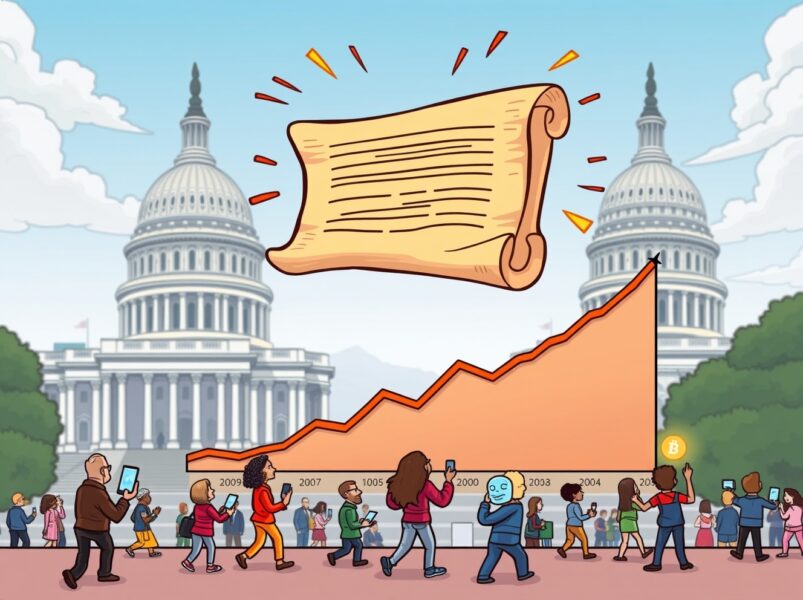
BitcoinWorld US Crypto Legislation: Unlocking a New Era for the Market Cycle Get ready for a potentially monumental shift in the crypto world! Galaxy Digital CEO Mike Novogratz has shared a fascinating prediction: significant US crypto legislation could fundamentally reshape the market’s traditional four-year cycle. This isn’t just speculation; it points to a future where crypto’s trajectory might look very different from what we’ve seen before. How is US Crypto Legislation Changing the Game? In a recent interview with Bloomberg, Novogratz highlighted two key pieces of legislation: the Genius Act and the CLARITY Act. These aren’t just bureaucratic terms; they represent a concerted effort to bring clarity and regulation to the cryptocurrency space. The Genius Act, enacted in July, focuses on stablecoin regulation. This is crucial because stablecoins, which are cryptocurrencies pegged to a stable asset like the US dollar, are becoming central to many digital transactions. The CLARITY Act aims to provide a clearer market structure. This means establishing defined rules for how cryptocurrencies are traded and regulated, making the market more transparent and accessible. Novogratz believes these legislative developments will act as a powerful magnet, drawing a massive influx of new investors into the market. Imagine millions of new participants feeling confident enough to engage with digital assets thanks to clear guidelines. Will We See a Different Crypto Market Cycle This Time? One of Novogratz’s most intriguing predictions challenges the historical pattern of crypto. He suggests that this current cycle might not conclude with the kind of large-scale sell-off that characterized previous Bitcoin (BTC) peaks. Historically, after major bull runs, investors often sold off their holdings, leading to significant market corrections. Consider the cycles of 2017 and 2021. Both saw incredible highs followed by substantial downturns as investors took profits. However, Novogratz argues that the investment environment has undergone a significant transformation. The presence of robust US crypto legislation is a key factor here, fostering a more mature market. The Power of Legitimized Stablecoins and Wider Adoption What exactly is different now? A major part of Novogratz’s argument centers on legalized stablecoins. These digital assets are poised to become seamlessly integrated into our daily lives. Think about using them directly within apps on your iPhone or across various social media platforms. This widespread usability has profound implications: Reduced Volatility Concerns: For everyday transactions, stablecoins offer the speed and efficiency of crypto without the wild price swings often associated with assets like Bitcoin or Ethereum. Easier Onboarding for New Users: When stablecoins are integrated into familiar platforms, the barrier to entry for new users dramatically decreases. People can engage with digital assets without needing to navigate complex exchanges immediately. Mainstream Acceptance: This level of integration pushes cryptocurrency further into the mainstream, moving it beyond niche trading circles and into everyday commerce. The clarity provided by US crypto legislation around these assets builds trust and encourages broader adoption. Navigating the Future: Opportunities and Potential Hurdles While the outlook is overwhelmingly positive, it’s also wise to consider the evolving landscape. The introduction of comprehensive US crypto legislation presents both immense opportunities and potential hurdles. Opportunities: A clearer regulatory framework can attract institutional investors, foster innovation within the blockchain space, and provide consumer protection, all contributing to a more robust and sustainable market. Potential Hurdles: Crafting effective legislation is complex. There might be ongoing debates, adjustments, and unforeseen impacts that could influence market dynamics. The industry will need to adapt to new compliance requirements. Ultimately, a regulated environment aims to create a more predictable and secure space for growth, benefiting both seasoned investors and newcomers alike. A New Dawn for Crypto Market Cycles Mike Novogratz’s vision paints an exciting picture for the future of cryptocurrency. The advent of clear US crypto legislation, particularly the Genius and CLARITY Acts, appears set to usher in a new era. This could mean a departure from the dramatic boom-and-bust cycles of the past, paving the way for more sustained growth and widespread adoption. As stablecoins become integral to our digital interactions, the crypto market is evolving into a more mature, integrated, and accessible financial ecosystem. The potential for a less volatile, more inclusive market is truly transformative. Frequently Asked Questions About Crypto Legislation Q1: What is the significance of the Genius Act and CLARITY Act? A1: The Genius Act focuses on regulating stablecoins, providing a clear framework for their issuance and use. The CLARITY Act aims to establish a clear market structure for cryptocurrencies, defining how they are traded and regulated. Together, they bring much-needed legal certainty to the crypto space. Q2: How could new US crypto legislation prevent large-scale sell-offs? A2: Novogratz suggests that with increased regulatory clarity and the widespread integration of stablecoins into daily apps, the market will attract a broader base of long-term investors. This could lead to more stable growth and reduce the likelihood of the rapid, panic-driven sell-offs seen after previous market peaks. Q3: How will legalized stablecoins change everyday use? A3: Legitimized stablecoins are expected to be integrated into common applications on devices like iPhones and social media platforms. This will make them easier to use for everyday transactions, payments, and remittances, much like traditional digital currency, but with the benefits of blockchain technology. Q4: What are the main benefits of clearer US crypto legislation for investors? A4: Clear legislation provides several benefits: it reduces regulatory uncertainty, which can attract more institutional and retail investors; it offers better consumer protection; and it fosters a more predictable and stable environment for innovation and growth within the crypto market. Q5: Are there any potential challenges with new crypto legislation? A5: While largely positive, challenges could include the complexity of implementing and enforcing new regulations, the need for continuous adaptation as technology evolves, and potential disagreements within the industry or among regulators on specific rules. However, these are part of any maturing market. If you found this article insightful, consider sharing it with your network! Help us spread the word about the exciting future of cryptocurrency and how US crypto legislation is shaping it. Your shares help inform and educate others about these pivotal market changes. To learn more about the latest crypto market trends, explore our article on key developments shaping Bitcoin and Ethereum institutional adoption. This post US Crypto Legislation: Unlocking a New Era for the Market Cycle first appeared on BitcoinWorld.
Share
Coinstats2025/09/24 12:25
XRP Price Prediction February 2026: Senator Warren Warns Fed as Pepeto’s 100x Presale Steals the Spotlight From Ripple

XRP Price Prediction February 2026: Senator Warren Warns Fed as Pepeto’s 100x Presale Steals the Spotlight From Ripple

Senator Elizabeth Warren reportedly sent a letter to Fed Chair Jerome Powell and Treasury Secretary Scott Bessent demanding they not […] The post XRP Price Prediction
Share
Coindoo2026/02/22 05:55