Shiba Inu’s effort to grow beyond being a meme coin is struggling. Its blockchain network, Shibarium, was created to bring real use and value to the project, but it has not gained much attention or activity. Developer interest and user engagement are very low, and the network’s overall growth has slowed down sharply. Recent network issues, including technical troubles and security problems, have made things worse. Many users have left, and new projects are not joining. As a result, Shibarium now shows very little activity, leading many in the crypto community to call it a “ghost chain.”  Shiba Inu’s Struggle To Evolve Beyond A Meme Coin Shiba Inu tried to change its image from a simple meme coin into a real blockchain project capable of competing with other networks. The team launched Shibarium, a layer-2 blockchain, in 2023 to help make this move. However, this plan has not worked as expected, with Shibarium failing to attract developers, projects, or users and gaining no market share. Related Reading: XRP At $1,000 Is Peanuts If Used To Clear US National Debt; Pundit Explains According to data from DeFi Llama, Shibarium has only 18 developers since it began. It is a much lower number than on other blockchains, which have hundreds or even thousands of active developers. The total value locked (TVL) on the network, which shows how much money people have invested in it, has fallen to just $878,000.  Shibarium has also failed to attract any stablecoins, which are among the most widely used tokens in decentralized finance. Not a single stablecoin project has deployed on the network, reflecting Shibarium’s lack of presence in one of the most critical areas of the crypto world. Other newer and more active layer-2 networks like Base, Arbitrum, Plasma, and Linea have already moved far ahead, leaving Shibarium behind. Hacks And The Decline Of Shibarium Network Activity Things got worse for the network when ShibaSwap, the most popular decentralized app (dApp) on the Shibarium network, was recently compromised. The attack eroded user confidence and forced developers to pause a key bridge connecting Shibarium to other networks. Even with the bridge now active, most of the network’s activity stopped. Many users could not move their tokens or use apps, making the network almost entirely silent. Related Reading: Here’s Why The XRP Price Still Isn’t Bearish Despite The 50% Flash Crash Because of this drop in network activity, Shibarium is no longer helping burn SHIB tokens. Typically, a portion of network transaction fees goes toward buying and burning Shiba Inu tokens, helping reduce supply and support the token’s price. But now, with very few transactions, the burn process has slowed down significantly. The decline in users, developers, and activity are indicators that Shibarium’s dream of becoming a strong, useful blockchain has not come to fruition. Instead of growing into a central crypto platform, it has become what some would call the real ghost chain.  Featured image created with Dall.E, chart from Tradingview.comShiba Inu’s effort to grow beyond being a meme coin is struggling. Its blockchain network, Shibarium, was created to bring real use and value to the project, but it has not gained much attention or activity. Developer interest and user engagement are very low, and the network’s overall growth has slowed down sharply. Recent network issues, including technical troubles and security problems, have made things worse. Many users have left, and new projects are not joining. As a result, Shibarium now shows very little activity, leading many in the crypto community to call it a “ghost chain.”  Shiba Inu’s Struggle To Evolve Beyond A Meme Coin Shiba Inu tried to change its image from a simple meme coin into a real blockchain project capable of competing with other networks. The team launched Shibarium, a layer-2 blockchain, in 2023 to help make this move. However, this plan has not worked as expected, with Shibarium failing to attract developers, projects, or users and gaining no market share. Related Reading: XRP At $1,000 Is Peanuts If Used To Clear US National Debt; Pundit Explains According to data from DeFi Llama, Shibarium has only 18 developers since it began. It is a much lower number than on other blockchains, which have hundreds or even thousands of active developers. The total value locked (TVL) on the network, which shows how much money people have invested in it, has fallen to just $878,000.  Shibarium has also failed to attract any stablecoins, which are among the most widely used tokens in decentralized finance. Not a single stablecoin project has deployed on the network, reflecting Shibarium’s lack of presence in one of the most critical areas of the crypto world. Other newer and more active layer-2 networks like Base, Arbitrum, Plasma, and Linea have already moved far ahead, leaving Shibarium behind. Hacks And The Decline Of Shibarium Network Activity Things got worse for the network when ShibaSwap, the most popular decentralized app (dApp) on the Shibarium network, was recently compromised. The attack eroded user confidence and forced developers to pause a key bridge connecting Shibarium to other networks. Even with the bridge now active, most of the network’s activity stopped. Many users could not move their tokens or use apps, making the network almost entirely silent. Related Reading: Here’s Why The XRP Price Still Isn’t Bearish Despite The 50% Flash Crash Because of this drop in network activity, Shibarium is no longer helping burn SHIB tokens. Typically, a portion of network transaction fees goes toward buying and burning Shiba Inu tokens, helping reduce supply and support the token’s price. But now, with very few transactions, the burn process has slowed down significantly. The decline in users, developers, and activity are indicators that Shibarium’s dream of becoming a strong, useful blockchain has not come to fruition. Instead of growing into a central crypto platform, it has become what some would call the real ghost chain.  Featured image created with Dall.E, chart from Tradingview.com
Forget Cardano, Why Shiba Inu’s Shibarium Is The Real Ghost Chain

2025/10/31 03:00
3 min read

Shiba Inu’s effort to grow beyond being a meme coin is struggling. Its blockchain network, Shibarium, was created to bring real use and value to the project, but it has not gained much attention or activity. Developer interest and user engagement are very low, and the network’s overall growth has slowed down sharply.

Recent network issues, including technical troubles and security problems, have made things worse. Many users have left, and new projects are not joining. As a result, Shibarium now shows very little activity, leading many in the crypto community to call it a “ghost chain.” 

Shiba Inu’s Struggle To Evolve Beyond A Meme Coin

Shiba Inu tried to change its image from a simple meme coin into a real blockchain project capable of competing with other networks. The team launched Shibarium, a layer-2 blockchain, in 2023 to help make this move. However, this plan has not worked as expected, with Shibarium failing to attract developers, projects, or users and gaining no market share.

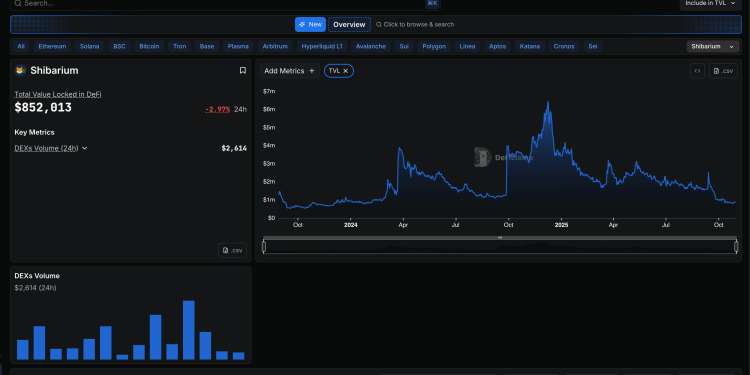
According to data from DeFi Llama, Shibarium has only 18 developers since it began. It is a much lower number than on other blockchains, which have hundreds or even thousands of active developers. The total value locked (TVL) on the network, which shows how much money people have invested in it, has fallen to just $878,000. 

Shiba Inu Shibarium

Shibarium has also failed to attract any stablecoins, which are among the most widely used tokens in decentralized finance. Not a single stablecoin project has deployed on the network, reflecting Shibarium’s lack of presence in one of the most critical areas of the crypto world. Other newer and more active layer-2 networks like Base, Arbitrum, Plasma, and Linea have already moved far ahead, leaving Shibarium behind.

Hacks And The Decline Of Shibarium Network Activity

Things got worse for the network when ShibaSwap, the most popular decentralized app (dApp) on the Shibarium network, was recently compromised. The attack eroded user confidence and forced developers to pause a key bridge connecting Shibarium to other networks. Even with the bridge now active, most of the network’s activity stopped. Many users could not move their tokens or use apps, making the network almost entirely silent.

Because of this drop in network activity, Shibarium is no longer helping burn SHIB tokens. Typically, a portion of network transaction fees goes toward buying and burning Shiba Inu tokens, helping reduce supply and support the token’s price. But now, with very few transactions, the burn process has slowed down significantly.

The decline in users, developers, and activity are indicators that Shibarium’s dream of becoming a strong, useful blockchain has not come to fruition. Instead of growing into a central crypto platform, it has become what some would call the real ghost chain. 

Shiba Inu price chart from Tradingview.com (Shibarium)
Market Opportunity
RealLink Logo
RealLink Price(REAL)
$0,0541
$0,0541$0,0541
-0,27%
USD
RealLink (REAL) Live Price Chart
Disclaimer: The articles reposted on this site are sourced from public platforms and are provided for informational purposes only. They do not necessarily reflect the views of MEXC. All rights remain with the original authors. If you believe any content infringes on third-party rights, please contact service@support.mexc.com for removal. MEXC makes no guarantees regarding the accuracy, completeness, or timeliness of the content and is not responsible for any actions taken based on the information provided. The content does not constitute financial, legal, or other professional advice, nor should it be considered a recommendation or endorsement by MEXC.

You May Also Like

Microsoft Corp. $MSFT blue box area offers a buying opportunity

Microsoft Corp. $MSFT blue box area offers a buying opportunity

The post Microsoft Corp. $MSFT blue box area offers a buying opportunity appeared on BitcoinEthereumNews.com. In today’s article, we’ll examine the recent performance of Microsoft Corp. ($MSFT) through the lens of Elliott Wave Theory. We’ll review how the rally from the April 07, 2025 low unfolded as a 5-wave impulse followed by a 3-swing correction (ABC) and discuss our forecast for the next move. Let’s dive into the structure and expectations for this stock. Five wave impulse structure + ABC + WXY correction $MSFT 8H Elliott Wave chart 9.04.2025 In the 8-hour Elliott Wave count from Sep 04, 2025, we saw that $MSFT completed a 5-wave impulsive cycle at red III. As expected, this initial wave prompted a pullback. We anticipated this pullback to unfold in 3 swings and find buyers in the equal legs area between $497.02 and $471.06 This setup aligns with a typical Elliott Wave correction pattern (ABC), in which the market pauses briefly before resuming its primary trend. $MSFT 8H Elliott Wave chart 7.14.2025 The update, 10 days later, shows the stock finding support from the equal legs area as predicted allowing traders to get risk free. The stock is expected to bounce towards 525 – 532 before deciding if the bounce is a connector or the next leg higher. A break into new ATHs will confirm the latter and can see it trade higher towards 570 – 593 area. Until then, traders should get risk free and protect their capital in case of a WXY double correction. Conclusion In conclusion, our Elliott Wave analysis of Microsoft Corp. ($MSFT) suggested that it remains supported against April 07, 2025 lows and bounce from the blue box area. In the meantime, keep an eye out for any corrective pullbacks that may offer entry opportunities. By applying Elliott Wave Theory, traders can better anticipate the structure of upcoming moves and enhance risk management in volatile markets. Source: https://www.fxstreet.com/news/microsoft-corp-msft-blue-box-area-offers-a-buying-opportunity-202509171323
Share
BitcoinEthereumNews2025/09/18 03:50
Nomura Alters Fed Rate Cut Prediction for 2025

Nomura Alters Fed Rate Cut Prediction for 2025

Detail: https://coincu.com/markets/nomura-fed-rate-cut-forecast-2025/
Share
Coinstats2025/09/18 12:39
Crypto Executives Advocate for U.S. Strategic Bitcoin Reserve Legislation

Crypto Executives Advocate for U.S. Strategic Bitcoin Reserve Legislation

Crypto execs, led by Michael Saylor, push for the U.S. to acquire 1 million BTC, establishing a Strategic Bitcoin Reserve.   Crypto executives, led by Strategy co-founder Michael Saylor, have gathered in Washington to advocate for a new piece of legislation. This bill, known as the BITCOIN Act, proposes the establishment of a U.S. Strategic […] The post Crypto Executives Advocate for U.S. Strategic Bitcoin Reserve Legislation appeared first on Live Bitcoin News.
Share
LiveBitcoinNews2025/09/18 05:00