TLDR Ethereum transactions and active addresses are at all-time highs in October 2025. Average Ethereum gas fees remain low despite record mainnet usage. Layer-2 networks like Arbitrum and Optimism help keep Ethereum fees low. Rollups and EIP-4844 upgrades are improving Ethereum’s efficiency at scale. Ethereum has recorded its highest-ever on-chain activity, with transaction volumes and [...] The post Ethereum Activity Hits Record High While Gas Fees Remain Near All-time lows appeared first on CoinCentral.TLDR Ethereum transactions and active addresses are at all-time highs in October 2025. Average Ethereum gas fees remain low despite record mainnet usage. Layer-2 networks like Arbitrum and Optimism help keep Ethereum fees low. Rollups and EIP-4844 upgrades are improving Ethereum’s efficiency at scale. Ethereum has recorded its highest-ever on-chain activity, with transaction volumes and [...] The post Ethereum Activity Hits Record High While Gas Fees Remain Near All-time lows appeared first on CoinCentral.

Ethereum Activity Hits Record High While Gas Fees Remain Near All-time lows

2025/10/30 18:14
4 min read

TLDR

  • Ethereum transactions and active addresses are at all-time highs in October 2025.
  • Average Ethereum gas fees remain low despite record mainnet usage.
  • Layer-2 networks like Arbitrum and Optimism help keep Ethereum fees low.
  • Rollups and EIP-4844 upgrades are improving Ethereum’s efficiency at scale.

Ethereum has recorded its highest-ever on-chain activity, with transaction volumes and unique active addresses reaching new peaks. According to Token Terminal, these records were set without the typical rise in gas fees. Despite the surge in demand, transaction costs on Ethereum have remained close to historic lows. This development has captured attention across the blockchain industry, especially among users, developers, and long-term participants.

Record Activity on Ethereum Mainnet

Recent data from Token Terminal shows that ETH Layer 1 (L1) has reached record numbers in daily transactions and unique active addresses. The network is currently processing millions of transactions each day, surpassing past monthly averages.

Analytics platforms confirm that usage across decentralized finance (DeFi), NFT platforms, and other on-chain applications is increasing. This activity is helping to push Ethereum usage to its highest levels to date. Developers have also reported that the network is handling the increased load without notable congestion issues.
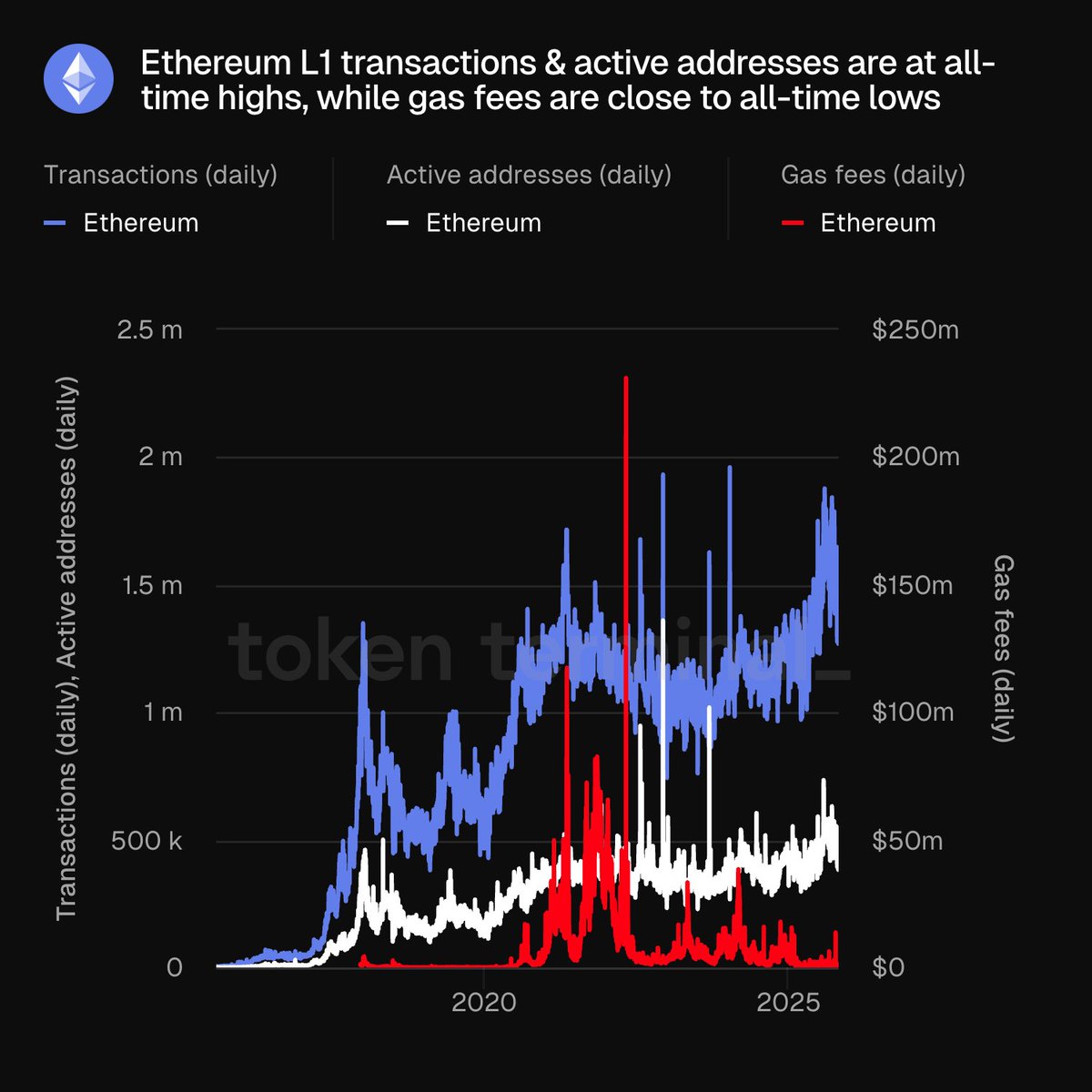
Line charts display Ethereum L1 daily transactions in blue peaking at 2 million, active addresses in black reaching 1.5 million, and gas fees in red dropping to around 50 dollars, all at all-time highs or lows from 2020 to 2025 with Token Terminal watermark.Source: Token Terminal

Much of this growth is tied to higher engagement with decentralized applications and improved user experiences. Ethereum’s throughput on the mainnet has expanded in both volume and scale, further showing the rising demand for on-chain services. This activity suggests that more users are interacting directly with Ethereum or through connected applications.

Gas Fees Remain Low Despite Heavy Network Usage

Gas fees have remained low even as activity on Ethereum has climbed to new highs. Historically, any rise in transactions on Ethereum would lead to higher gas costs due to congestion. This time, however, that pattern has not occurred.

Ethereum’s current average gas fees are near historic lows. Market observers suggest this shift is due to the growing use of Layer-2 (L2) networks such as Arbitrum, Optimism, and Base. These L2 chains bundle transactions off-chain and settle them on the mainnet in batches.

By offloading traffic from the base layer, L2s reduce the number of direct transactions on Ethereum L1. This system allows for high throughput while keeping user transaction fees lower. Developers also note that new smart contract designs and protocol upgrades are improving how efficiently Ethereum handles load.

Technology Upgrades Help Support High Activity

The Ethereum network has benefited from a series of infrastructure upgrades that improve its ability to scale. One such upgrade, known as EIP-4844 or proto-danksharding, is expected to further reduce costs and boost data availability on L2 networks.

Since Ethereum transitioned from proof-of-work to proof-of-stake, it has become more energy-efficient and structurally flexible. These changes have laid the foundation for handling increased activity without slowing the network or raising fees.

Rollups, which are a key part of ETH roadmap, are being adopted at a growing pace. These scaling solutions process transactions efficiently and help maintain a balanced load on the mainnet. Together with protocol upgrades, they are creating better conditions for both users and developers.

Outlook for Ethereum Network Scalability

Maintaining strong performance while keeping transaction costs low will be a key challenge going forward. ETH developers continue to focus on expanding its capacity while protecting decentralization and security.

The rise in Layer-2 adoption is expected to continue, which may help Ethereum scale more sustainably. As user activity increases across Web3 services, Ethereum will need to keep pace with demand without returning to high gas fee conditions.

For now, Ethereum’s infrastructure appears to be handling the increased pressure well. If these trends continue, Ethereum could remain a central hub for blockchain activity without the high transaction costs that once limited its usability.

The post Ethereum Activity Hits Record High While Gas Fees Remain Near All-time lows appeared first on CoinCentral.

Market Opportunity
NEAR Logo
NEAR Price(NEAR)
$1.0129
$1.0129$1.0129
-0.28%
USD
NEAR (NEAR) Live Price Chart
Disclaimer: The articles reposted on this site are sourced from public platforms and are provided for informational purposes only. They do not necessarily reflect the views of MEXC. All rights remain with the original authors. If you believe any content infringes on third-party rights, please contact service@support.mexc.com for removal. MEXC makes no guarantees regarding the accuracy, completeness, or timeliness of the content and is not responsible for any actions taken based on the information provided. The content does not constitute financial, legal, or other professional advice, nor should it be considered a recommendation or endorsement by MEXC.

You May Also Like

Understanding the Parts of a Check: A Complete Guide for Beginners

Understanding the Parts of a Check: A Complete Guide for Beginners

Checks remain a reliable payment method for personal and business transactions. Even in a digital-first world, understanding the Parts of a Check is essential for
Share
Techbullion2026/02/22 23:50
Trendline Tests Meet Corrective Bounce

Trendline Tests Meet Corrective Bounce

The post Trendline Tests Meet Corrective Bounce appeared on BitcoinEthereumNews.com. Ethereum’s higher time frame charts now show two competing reads of the same
Share
BitcoinEthereumNews2026/02/23 00:23
Taiko Makes Chainlink Data Streams Its Official Oracle

Taiko Makes Chainlink Data Streams Its Official Oracle

The post Taiko Makes Chainlink Data Streams Its Official Oracle appeared on BitcoinEthereumNews.com. Key Notes Taiko has officially integrated Chainlink Data Streams for its Layer 2 network. The integration provides developers with high-speed market data to build advanced DeFi applications. The move aims to improve security and attract institutional adoption by using Chainlink’s established infrastructure. Taiko, an Ethereum-based ETH $4 514 24h volatility: 0.4% Market cap: $545.57 B Vol. 24h: $28.23 B Layer 2 rollup, has announced the integration of Chainlink LINK $23.26 24h volatility: 1.7% Market cap: $15.75 B Vol. 24h: $787.15 M Data Streams. The development comes as the underlying Ethereum network continues to see significant on-chain activity, including large sales from ETH whales. The partnership establishes Chainlink as the official oracle infrastructure for the network. It is designed to provide developers on the Taiko platform with reliable and high-speed market data, essential for building a wide range of decentralized finance (DeFi) applications, from complex derivatives platforms to more niche projects involving unique token governance models. According to the project’s official announcement on Sept. 17, the integration enables the creation of more advanced on-chain products that require high-quality, tamper-proof data to function securely. Taiko operates as a “based rollup,” which means it leverages Ethereum validators for transaction sequencing for strong decentralization. Boosting DeFi and Institutional Interest Oracles are fundamental services in the blockchain industry. They act as secure bridges that feed external, off-chain information to on-chain smart contracts. DeFi protocols, in particular, rely on oracles for accurate, real-time price feeds. Taiko leadership stated that using Chainlink’s infrastructure aligns with its goals. The team hopes the partnership will help attract institutional crypto investment and support the development of real-world applications, a goal that aligns with Chainlink’s broader mission to bring global data on-chain. Integrating real-world economic information is part of a broader industry trend. Just last week, Chainlink partnered with the Sei…
Share
BitcoinEthereumNews2025/09/18 03:34