Author: Virtuals Protocol Compiled by: TechFlow Why change? We believe that in the future agents will surpass humans, and global productivity will shift from human GDP to agent GDP (aGDP). Every part of Virtuals plays a role in this mission: Butler connects people with AI agents, making interaction and coordination seamless. ACP (Agentic Core Protocol) provides an economic foundation for agents, a permissionless transaction, trade, and collaboration layer. The creation of Virtuals Launchpad addresses the most critical aspect: co-ownership of agents. The original intention of Virtuals Launchpad was to enable anyone to co-own intelligent entities that shape the future AI economy. However, our first launch model, Genesis, failed to achieve this vision. Genesis starts with fairness. Every Virgen (Virtuals Protocol participant) can participate through points. The participation threshold is equal, the contribution threshold is high, and every project has visibility. Genesis pursues fairness, but like Icarus, it flies too high and eventually falls. Deep Tide Note: "Icarus" is a figure in Greek mythology who, along with his father, Daedalus, escaped Crete by crafting wings from wax and feathers. Daedalus warned Icarus not to fly too high (towards the sun) or too low (towards the sea). However, Icarus, overwhelmed by the thrill of flight, flew too high, and the sun's heat melted the wax on his wings, causing him to fall into the sea and drown. But fairness has turned into scoring. The entire system has become about collecting points, not faith. Virgens rotate from one platform to another, racking up points, staking, selling, and leaving. The cycle repeats. High-quality founders are unable to raise meaningful funding. The system lacks a built-in fundraising mechanism, with only small transaction fees, which has led talented developers to avoid the platform entirely. The result: Virgens' returns have dwindled, project quality has declined, and user confidence has been eroded. While fairness exists, it's unsustainable. We realized that if we wanted people to truly co-own the AI agents that define the future, we needed a new model—one that made ownership meaningful again, rewarded early conviction, attracted high-quality founders, and created a home for agents worth living. That’s why we built Unicorn, a launchpad system to nurture the next billion-dollar agency. What has changed? Unicorn is designed around belief, not convenience. It gives Virgens the freedom to take authentic positions and rewards them for good judgment. It provides founders with the capital to build long-term structures and grow based on results. What the she-wolf was to ancient Rome, the Unicorn is to the new era of AI ownership. How it works Unicorn is built for true faith, for Virgens who can discover faith early, and for founders who can prove faith. Every project starts small, allowing anyone to trade, and eventually scales to hundreds of billions of dollars. Early confidence will bring huge rewards. Founders are protected, held accountable, and only receive funding when they achieve real growth. That’s how we make winning meaningful again. i. Creation phase Founders need to pay a one-time creation fee of $100 VIRTUAL to start the project. Once created, a dedicated proxy launch page will be published on the Virtuals Protocol platform, displaying all core project details, token supply, founding team, and launch parameters. There is a minimum 24-hour evaluation window between page creation and public trading. This allows the community time to review, discuss, and evaluate each project before liquidity is released. Trading will then begin. ii. Start-up and Early-stage Transactions Transactions start at lower initial valuations, providing early-stage Virgens with asymmetric, often extraordinary upside to discover conviction before others. Anyone can participate directly through the Virtuals Protocol interface, with no pre-sales, whitelists, or allocation restrictions required. To maintain fairness, the Anti-Sniper Tax will be enabled at startup. Anti-Sniper Tax: The initial tax rate is 99% and decays linearly to 1% over time. All collected taxes will be used to repurchase proxy tokens to strengthen the market and reward genuine participants. The system prevents bot takeover and transforms volatility into constructive liquidity growth. iii. Team Distribution and Fundraising Mechanism 50% of the total supply is reserved for the founding team. 25% is distributed linearly through limited price sale fundraising, starting only when the project reaches 2 million FDV and continuing until 160 million FDV. These sales will be executed automatically and transparently as the project grows. Founders only receive benefits when they gain traction in the actual market, and funding is tied to performance, not promises. The remaining 25% will be unlocked one year after the TGE on a six-month linear vesting schedule, or when the project reaches 160 million FDV, whichever comes first. This dual team allocation structure ensures that founders receive both financial support and accountability, preventing them from selling out early and instead securing growth funding by building value over the long term. iv. Ecological Airdrop Each Unicorn release allocates 5% of the total supply to real Virgens: 2% allocated to $VIRTUAL stakers 3% allocated to active Virtuals ecosystem participants Airdrops are distributed weekly, and snapshots are linked to $VIRTUAL staking and Virtuals ecosystem activities. This means that every proxy launch will directly reward $VIRTUAL stakers and active Virtuals Protocol ecosystem participants. Transition from a points system As we transition from Genesis to Unicorn, airdrops will gradually shift from the old points system to the new $VIRTUAL staking and Virtuals ecosystem activity model. During the transition period, all existing points will still generate airdrops based on the number of points held, and will also receive rewards based on $VIRTUAL staking and Virtuals ecosystem activities. Prior to the launch of Unicorn, a snapshot of all existing points balances will be taken. Airdrop distribution will then follow a three-week transition plan until full migration to the new model is complete. Token Allocation Key The road ahead Genesis was an experiment, a bold attempt to ensure a fair and transparent product launch. It succeeded to a certain extent, but fairness alone is not enough. Small victories don't build a lasting market. Fire is the first spark of humanity, and agency ownership is the next. Unicorn rewards belief, provides funding for real developers, and makes ownership meaningful again - ownership that drives the rise of Agentic GDP and real problem solving. This is how we'll move forward: helping Virgens co-own the AI agents that define the next economy and attract founders who can build for the long term. When Virgens win, Virtuals win. This is the only way forward. Unicorn, stay tuned!Author: Virtuals Protocol Compiled by: TechFlow Why change? We believe that in the future agents will surpass humans, and global productivity will shift from human GDP to agent GDP (aGDP). Every part of Virtuals plays a role in this mission: Butler connects people with AI agents, making interaction and coordination seamless. ACP (Agentic Core Protocol) provides an economic foundation for agents, a permissionless transaction, trade, and collaboration layer. The creation of Virtuals Launchpad addresses the most critical aspect: co-ownership of agents. The original intention of Virtuals Launchpad was to enable anyone to co-own intelligent entities that shape the future AI economy. However, our first launch model, Genesis, failed to achieve this vision. Genesis starts with fairness. Every Virgen (Virtuals Protocol participant) can participate through points. The participation threshold is equal, the contribution threshold is high, and every project has visibility. Genesis pursues fairness, but like Icarus, it flies too high and eventually falls. Deep Tide Note: "Icarus" is a figure in Greek mythology who, along with his father, Daedalus, escaped Crete by crafting wings from wax and feathers. Daedalus warned Icarus not to fly too high (towards the sun) or too low (towards the sea). However, Icarus, overwhelmed by the thrill of flight, flew too high, and the sun's heat melted the wax on his wings, causing him to fall into the sea and drown. But fairness has turned into scoring. The entire system has become about collecting points, not faith. Virgens rotate from one platform to another, racking up points, staking, selling, and leaving. The cycle repeats. High-quality founders are unable to raise meaningful funding. The system lacks a built-in fundraising mechanism, with only small transaction fees, which has led talented developers to avoid the platform entirely. The result: Virgens' returns have dwindled, project quality has declined, and user confidence has been eroded. While fairness exists, it's unsustainable. We realized that if we wanted people to truly co-own the AI agents that define the future, we needed a new model—one that made ownership meaningful again, rewarded early conviction, attracted high-quality founders, and created a home for agents worth living. That’s why we built Unicorn, a launchpad system to nurture the next billion-dollar agency. What has changed? Unicorn is designed around belief, not convenience. It gives Virgens the freedom to take authentic positions and rewards them for good judgment. It provides founders with the capital to build long-term structures and grow based on results. What the she-wolf was to ancient Rome, the Unicorn is to the new era of AI ownership. How it works Unicorn is built for true faith, for Virgens who can discover faith early, and for founders who can prove faith. Every project starts small, allowing anyone to trade, and eventually scales to hundreds of billions of dollars. Early confidence will bring huge rewards. Founders are protected, held accountable, and only receive funding when they achieve real growth. That’s how we make winning meaningful again. i. Creation phase Founders need to pay a one-time creation fee of $100 VIRTUAL to start the project. Once created, a dedicated proxy launch page will be published on the Virtuals Protocol platform, displaying all core project details, token supply, founding team, and launch parameters. There is a minimum 24-hour evaluation window between page creation and public trading. This allows the community time to review, discuss, and evaluate each project before liquidity is released. Trading will then begin. ii. Start-up and Early-stage Transactions Transactions start at lower initial valuations, providing early-stage Virgens with asymmetric, often extraordinary upside to discover conviction before others. Anyone can participate directly through the Virtuals Protocol interface, with no pre-sales, whitelists, or allocation restrictions required. To maintain fairness, the Anti-Sniper Tax will be enabled at startup. Anti-Sniper Tax: The initial tax rate is 99% and decays linearly to 1% over time. All collected taxes will be used to repurchase proxy tokens to strengthen the market and reward genuine participants. The system prevents bot takeover and transforms volatility into constructive liquidity growth. iii. Team Distribution and Fundraising Mechanism 50% of the total supply is reserved for the founding team. 25% is distributed linearly through limited price sale fundraising, starting only when the project reaches 2 million FDV and continuing until 160 million FDV. These sales will be executed automatically and transparently as the project grows. Founders only receive benefits when they gain traction in the actual market, and funding is tied to performance, not promises. The remaining 25% will be unlocked one year after the TGE on a six-month linear vesting schedule, or when the project reaches 160 million FDV, whichever comes first. This dual team allocation structure ensures that founders receive both financial support and accountability, preventing them from selling out early and instead securing growth funding by building value over the long term. iv. Ecological Airdrop Each Unicorn release allocates 5% of the total supply to real Virgens: 2% allocated to $VIRTUAL stakers 3% allocated to active Virtuals ecosystem participants Airdrops are distributed weekly, and snapshots are linked to $VIRTUAL staking and Virtuals ecosystem activities. This means that every proxy launch will directly reward $VIRTUAL stakers and active Virtuals Protocol ecosystem participants. Transition from a points system As we transition from Genesis to Unicorn, airdrops will gradually shift from the old points system to the new $VIRTUAL staking and Virtuals ecosystem activity model. During the transition period, all existing points will still generate airdrops based on the number of points held, and will also receive rewards based on $VIRTUAL staking and Virtuals ecosystem activities. Prior to the launch of Unicorn, a snapshot of all existing points balances will be taken. Airdrop distribution will then follow a three-week transition plan until full migration to the new model is complete. Token Allocation Key The road ahead Genesis was an experiment, a bold attempt to ensure a fair and transparent product launch. It succeeded to a certain extent, but fairness alone is not enough. Small victories don't build a lasting market. Fire is the first spark of humanity, and agency ownership is the next. Unicorn rewards belief, provides funding for real developers, and makes ownership meaningful again - ownership that drives the rise of Agentic GDP and real problem solving. This is how we'll move forward: helping Virgens co-own the AI agents that define the next economy and attract founders who can build for the long term. When Virgens win, Virtuals win. This is the only way forward. Unicorn, stay tuned!

Virtuals Protocol: Why are we launching Unicorn, our new launch pad?

2025/10/10 16:00
6 min read

Author: Virtuals Protocol

Compiled by: TechFlow

Why change?

We believe that in the future agents will surpass humans, and global productivity will shift from human GDP to agent GDP (aGDP).

Every part of Virtuals plays a role in this mission:

  • Butler connects people with AI agents, making interaction and coordination seamless.
  • ACP (Agentic Core Protocol) provides an economic foundation for agents, a permissionless transaction, trade, and collaboration layer.
  • The creation of Virtuals Launchpad addresses the most critical aspect: co-ownership of agents.

The original intention of Virtuals Launchpad was to enable anyone to co-own intelligent entities that shape the future AI economy. However, our first launch model, Genesis, failed to achieve this vision.

Genesis starts with fairness. Every Virgen (Virtuals Protocol participant) can participate through points. The participation threshold is equal, the contribution threshold is high, and every project has visibility.
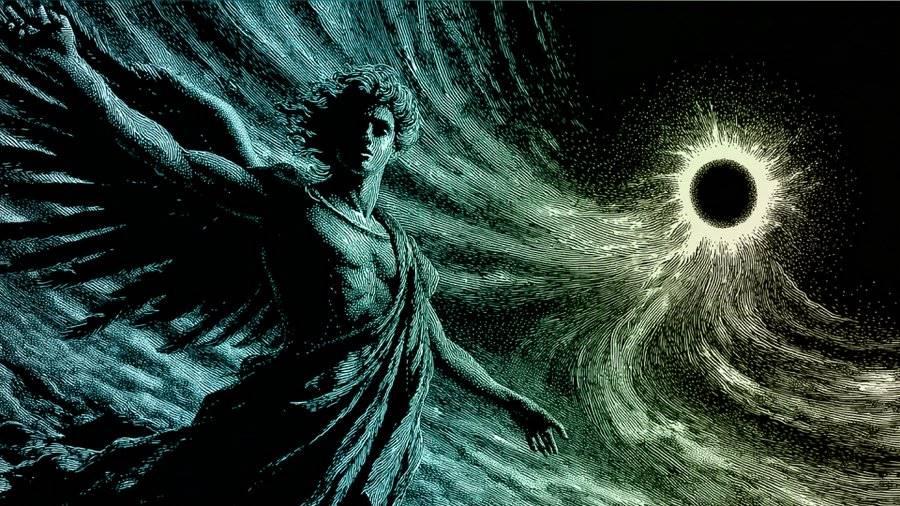
Genesis pursues fairness, but like Icarus, it flies too high and eventually falls.

Deep Tide Note: "Icarus" is a figure in Greek mythology who, along with his father, Daedalus, escaped Crete by crafting wings from wax and feathers. Daedalus warned Icarus not to fly too high (towards the sun) or too low (towards the sea). However, Icarus, overwhelmed by the thrill of flight, flew too high, and the sun's heat melted the wax on his wings, causing him to fall into the sea and drown.

But fairness has turned into scoring.

The entire system has become about collecting points, not faith. Virgens rotate from one platform to another, racking up points, staking, selling, and leaving. The cycle repeats.

High-quality founders are unable to raise meaningful funding.

The system lacks a built-in fundraising mechanism, with only small transaction fees, which has led talented developers to avoid the platform entirely. The result: Virgens' returns have dwindled, project quality has declined, and user confidence has been eroded. While fairness exists, it's unsustainable.

We realized that if we wanted people to truly co-own the AI agents that define the future, we needed a new model—one that made ownership meaningful again, rewarded early conviction, attracted high-quality founders, and created a home for agents worth living.

That’s why we built Unicorn, a launchpad system to nurture the next billion-dollar agency.

What has changed?
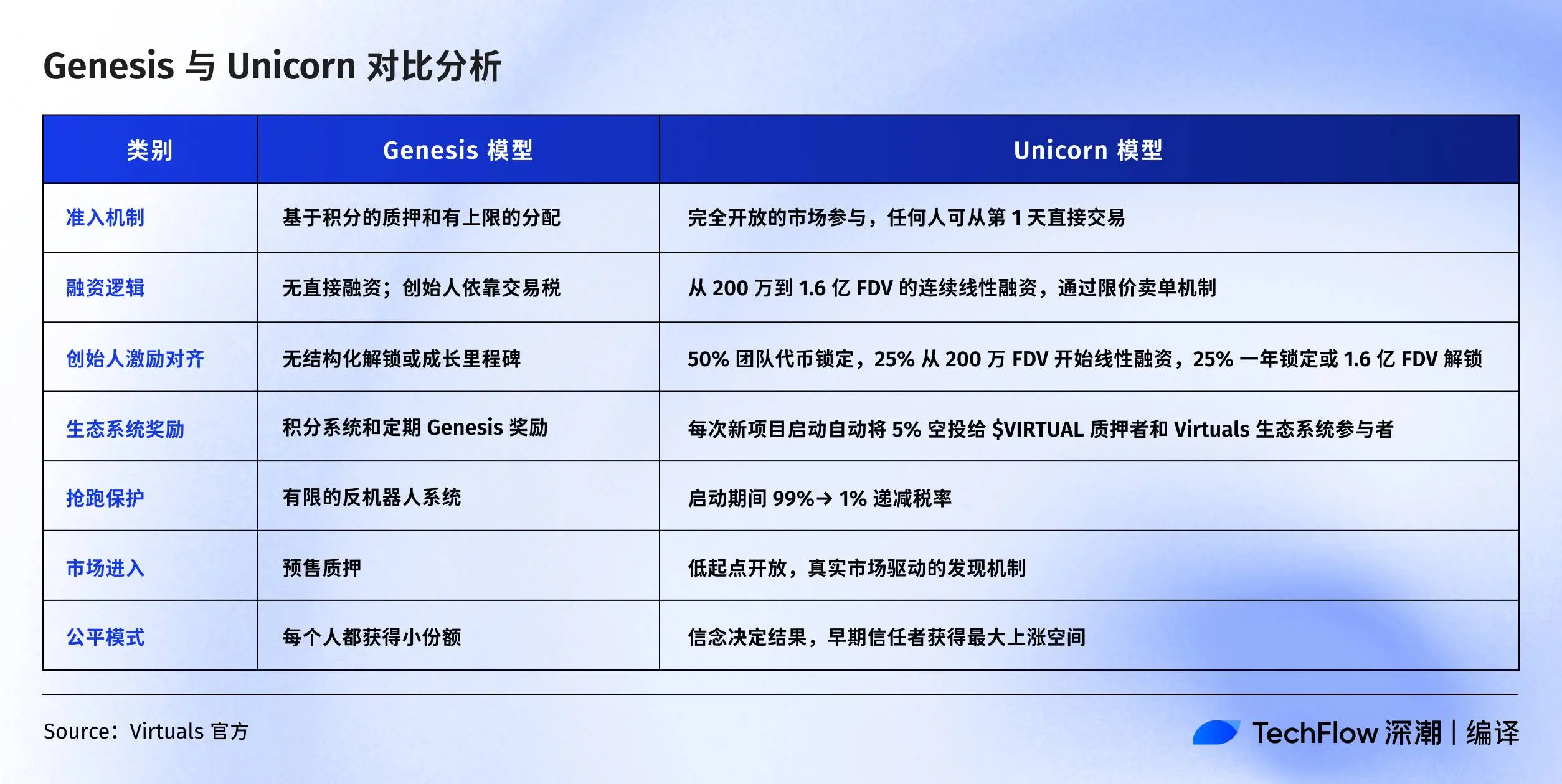
Unicorn is designed around belief, not convenience.

  • It gives Virgens the freedom to take authentic positions and rewards them for good judgment.
  • It provides founders with the capital to build long-term structures and grow based on results.

What the she-wolf was to ancient Rome, the Unicorn is to the new era of AI ownership.

How it works

Unicorn is built for true faith, for Virgens who can discover faith early, and for founders who can prove faith.

Every project starts small, allowing anyone to trade, and eventually scales to hundreds of billions of dollars. Early confidence will bring huge rewards.

Founders are protected, held accountable, and only receive funding when they achieve real growth.

That’s how we make winning meaningful again.

i. Creation phase

  • Founders need to pay a one-time creation fee of $100 VIRTUAL to start the project.
  • Once created, a dedicated proxy launch page will be published on the Virtuals Protocol platform, displaying all core project details, token supply, founding team, and launch parameters.
  • There is a minimum 24-hour evaluation window between page creation and public trading. This allows the community time to review, discuss, and evaluate each project before liquidity is released. Trading will then begin.

ii. Start-up and Early-stage Transactions

  • Transactions start at lower initial valuations, providing early-stage Virgens with asymmetric, often extraordinary upside to discover conviction before others.
  • Anyone can participate directly through the Virtuals Protocol interface, with no pre-sales, whitelists, or allocation restrictions required.
  • To maintain fairness, the Anti-Sniper Tax will be enabled at startup.

Anti-Sniper Tax: The initial tax rate is 99% and decays linearly to 1% over time. All collected taxes will be used to repurchase proxy tokens to strengthen the market and reward genuine participants.

The system prevents bot takeover and transforms volatility into constructive liquidity growth.

iii. Team Distribution and Fundraising Mechanism

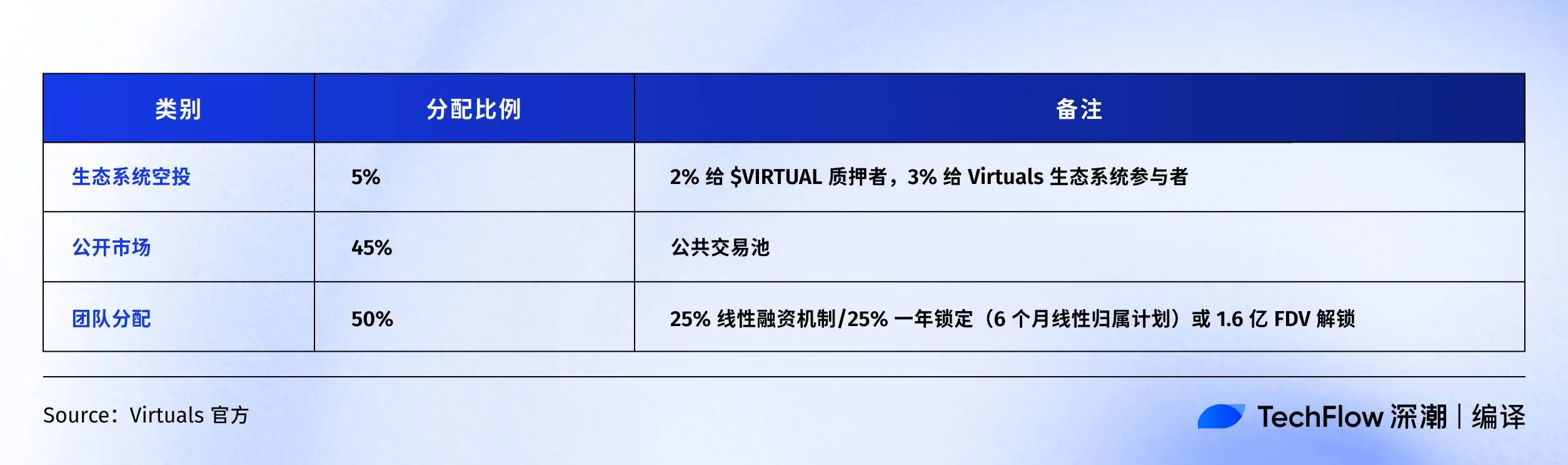
  • 50% of the total supply is reserved for the founding team.
  • 25% is distributed linearly through limited price sale fundraising, starting only when the project reaches 2 million FDV and continuing until 160 million FDV.
  • These sales will be executed automatically and transparently as the project grows.
  • Founders only receive benefits when they gain traction in the actual market, and funding is tied to performance, not promises.
  • The remaining 25% will be unlocked one year after the TGE on a six-month linear vesting schedule, or when the project reaches 160 million FDV, whichever comes first.

This dual team allocation structure ensures that founders receive both financial support and accountability, preventing them from selling out early and instead securing growth funding by building value over the long term.

iv. Ecological Airdrop

Each Unicorn release allocates 5% of the total supply to real Virgens:

  • 2% allocated to $VIRTUAL stakers
  • 3% allocated to active Virtuals ecosystem participants

Airdrops are distributed weekly, and snapshots are linked to $VIRTUAL staking and Virtuals ecosystem activities.

This means that every proxy launch will directly reward $VIRTUAL stakers and active Virtuals Protocol ecosystem participants.

Transition from a points system

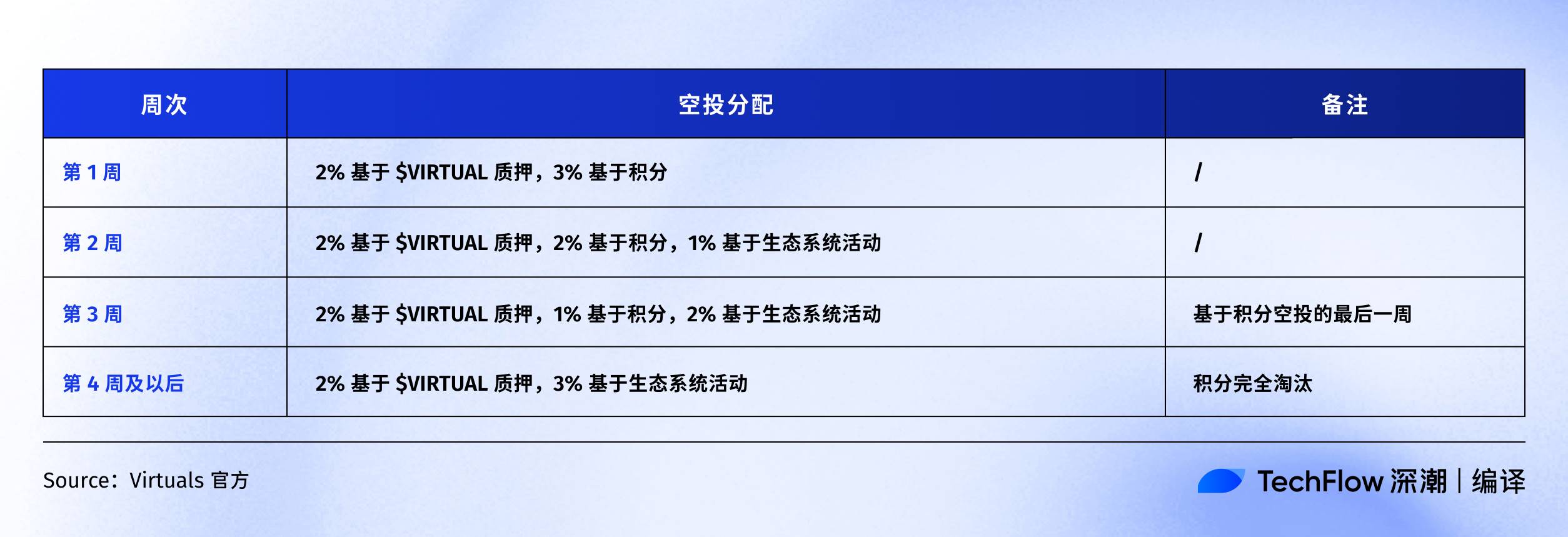
As we transition from Genesis to Unicorn, airdrops will gradually shift from the old points system to the new $VIRTUAL staking and Virtuals ecosystem activity model.

During the transition period, all existing points will still generate airdrops based on the number of points held, and will also receive rewards based on $VIRTUAL staking and Virtuals ecosystem activities.

Prior to the launch of Unicorn, a snapshot of all existing points balances will be taken. Airdrop distribution will then follow a three-week transition plan until full migration to the new model is complete.
Token Allocation Key
The road ahead

Genesis was an experiment, a bold attempt to ensure a fair and transparent product launch. It succeeded to a certain extent, but fairness alone is not enough. Small victories don't build a lasting market.

Fire is the first spark of humanity, and agency ownership is the next.

Unicorn rewards belief, provides funding for real developers, and makes ownership meaningful again - ownership that drives the rise of Agentic GDP and real problem solving.

This is how we'll move forward: helping Virgens co-own the AI agents that define the next economy and attract founders who can build for the long term. When Virgens win, Virtuals win. This is the only way forward.

Unicorn, stay tuned!

Market Opportunity
ChangeX Logo
ChangeX Price(CHANGE)
$0.00030733
$0.00030733$0.00030733
0.00%
USD
ChangeX (CHANGE) Live Price Chart
Disclaimer: The articles reposted on this site are sourced from public platforms and are provided for informational purposes only. They do not necessarily reflect the views of MEXC. All rights remain with the original authors. If you believe any content infringes on third-party rights, please contact service@support.mexc.com for removal. MEXC makes no guarantees regarding the accuracy, completeness, or timeliness of the content and is not responsible for any actions taken based on the information provided. The content does not constitute financial, legal, or other professional advice, nor should it be considered a recommendation or endorsement by MEXC.

You May Also Like

Ethereum unveils roadmap focusing on scaling, interoperability, and security at Japan Dev Conference

Ethereum unveils roadmap focusing on scaling, interoperability, and security at Japan Dev Conference

The post Ethereum unveils roadmap focusing on scaling, interoperability, and security at Japan Dev Conference appeared on BitcoinEthereumNews.com. Key Takeaways Ethereum’s new roadmap was presented by Vitalik Buterin at the Japan Dev Conference. Short-term priorities include Layer 1 scaling and raising gas limits to enhance transaction throughput. Vitalik Buterin presented Ethereum’s development roadmap at the Japan Dev Conference today, outlining the blockchain platform’s priorities across multiple timeframes. The short-term goals focus on scaling solutions and increasing Layer 1 gas limits to improve transaction capacity. Mid-term objectives target enhanced cross-Layer 2 interoperability and faster network responsiveness to create a more seamless user experience across different scaling solutions. The long-term vision emphasizes building a secure, simple, quantum-resistant, and formally verified minimalist Ethereum network. This approach aims to future-proof the platform against emerging technological threats while maintaining its core functionality. The roadmap presentation comes as Ethereum continues to compete with other blockchain platforms for market share in the smart contract and decentralized application space. Source: https://cryptobriefing.com/ethereum-roadmap-scaling-interoperability-security-japan/
Share
BitcoinEthereumNews2025/09/18 00:25
CEO Sandeep Nailwal Shared Highlights About RWA on Polygon

CEO Sandeep Nailwal Shared Highlights About RWA on Polygon

The post CEO Sandeep Nailwal Shared Highlights About RWA on Polygon appeared on BitcoinEthereumNews.com. Polygon CEO Sandeep Nailwal highlighted Polygon’s lead in global bonds, Spiko US T-Bill, and Spiko Euro T-Bill. Polygon published an X post to share that its roadmap to GigaGas was still scaling. Sentiments around POL price were last seen to be bearish. Polygon CEO Sandeep Nailwal shared key pointers from the Dune and RWA.xyz report. These pertain to highlights about RWA on Polygon. Simultaneously, Polygon underlined its roadmap towards GigaGas. Sentiments around POL price were last seen fumbling under bearish emotions. Polygon CEO Sandeep Nailwal on Polygon RWA CEO Sandeep Nailwal highlighted three key points from the Dune and RWA.xyz report. The Chief Executive of Polygon maintained that Polygon PoS was hosting RWA TVL worth $1.13 billion across 269 assets plus 2,900 holders. Nailwal confirmed from the report that RWA was happening on Polygon. The Dune and https://t.co/W6WSFlHoQF report on RWA is out and it shows that RWA is happening on Polygon. Here are a few highlights: – Leading in Global Bonds: Polygon holds 62% share of tokenized global bonds (driven by Spiko’s euro MMF and Cashlink euro issues) – Spiko U.S.… — Sandeep | CEO, Polygon Foundation (※,※) (@sandeepnailwal) September 17, 2025 The X post published by Polygon CEO Sandeep Nailwal underlined that the ecosystem was leading in global bonds by holding a 62% share of tokenized global bonds. He further highlighted that Polygon was leading with Spiko US T-Bill at approximately 29% share of TVL along with Ethereum, adding that the ecosystem had more than 50% share in the number of holders. Finally, Sandeep highlighted from the report that there was a strong adoption for Spiko Euro T-Bill with 38% share of TVL. He added that 68% of returns were on Polygon across all the chains. Polygon Roadmap to GigaGas In a different update from Polygon, the community…
Share
BitcoinEthereumNews2025/09/18 01:10
Kalshi debuts ecosystem hub with Solana and Base

Kalshi debuts ecosystem hub with Solana and Base

The post Kalshi debuts ecosystem hub with Solana and Base appeared on BitcoinEthereumNews.com. Kalshi, the US-regulated prediction market exchange, rolled out a new program on Wednesday called KalshiEco Hub. The initiative, developed in partnership with Solana and Coinbase-backed Base, is designed to attract builders, traders, and content creators to a growing ecosystem around prediction markets. By combining its regulatory footing with crypto-native infrastructure, Kalshi said it is aiming to become a bridge between traditional finance and onchain innovation. The hub offers grants, technical assistance, and marketing support to selected projects. Kalshi also announced that it will support native deposits of Solana’s SOL token and USDC stablecoin, making it easier for users already active in crypto to participate directly. Early collaborators include Kalshinomics, a dashboard for market analytics, and Verso, which is building professional-grade tools for market discovery and execution. Other partners, such as Caddy, are exploring ways to expand retail-facing trading experiences. Kalshi’s move to embrace blockchain partnerships comes at a time when prediction markets are drawing fresh attention for their ability to capture sentiment around elections, economic policy, and cultural events. Competitor Polymarket recently acquired QCEX — a derivatives exchange with a CFTC license — to pave its way back into US operations under regulatory compliance. At the same time, platforms like PredictIt continue to push for a clearer regulatory footing. The legal terrain remains complex, with some states issuing cease-and-desist orders over whether these event contracts count as gambling, not finance. This is a developing story. This article was generated with the assistance of AI and reviewed by editor Jeffrey Albus before publication. Get the news in your inbox. Explore Blockworks newsletters: Source: https://blockworks.co/news/kalshi-ecosystem-hub-solana-base
Share
BitcoinEthereumNews2025/09/18 04:40