Stablecoin Adoption: Why Bank-Level Protection Matters
Overview
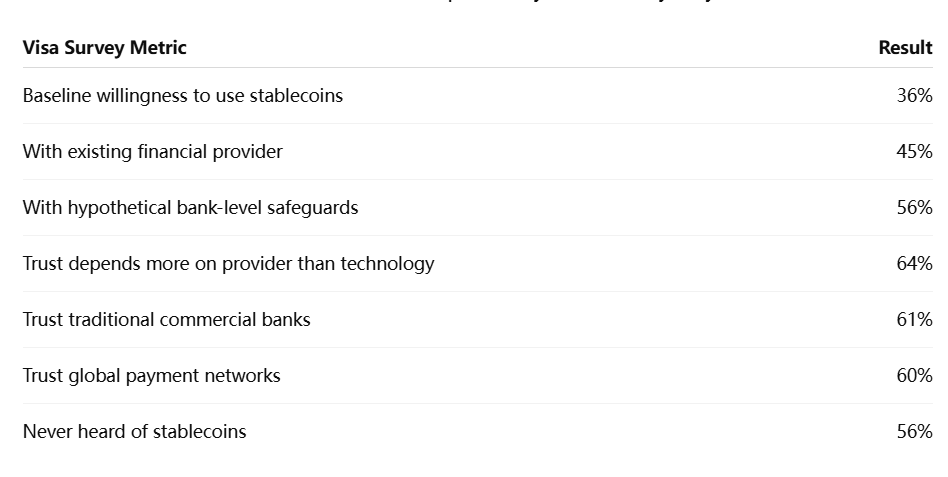
Stablecoin adoption may depend less on blockchain technology than on whether consumers receive protections they already associate with banks and card networks. Visa’s Money Travels 2026 research found that 36% of surveyed U.S. adults said they would be willing to use stablecoins under a baseline scenario, while that figure rose to 56% when respondents were asked to imagine stablecoins with bank-level fraud protection and deposit insurance. The increase measures stated willingness under a hypothetical protection framework, not actual stablecoin usage or a forecast that 56% of Americans will adopt stablecoins.
The same survey points to a broader trust gap. Willingness rose from 36% to 45% when stablecoins were offered by an existing financial provider, while 64% of respondents said their trust in a payment method depends more on the provider than on the underlying technology. Traditional commercial banks were trusted by 61% of respondents to provide digital-currency services, while global payment networks were trusted by 60%.
These results suggest that mainstream stablecoin adoption may increasingly depend on familiar financial protections, credible distribution and consumer confidence rather than technical advantages alone. Stablecoins can already offer fast, programmable and potentially 24/7 value transfer, but those benefits may matter less to ordinary consumers if they remain uncertain about fraud recovery, insurance or who is responsible when something goes wrong.
Key Takeaways
- Visa found baseline willingness to use stablecoins at 36% among surveyed U.S. adults.
- In a hypothetical scenario with bank-level fraud protection and deposit insurance, willingness rose to 56%.
- Offering stablecoins through an existing financial provider increased willingness to 45%.
- 64% said trust depends more on the provider than on the technology.
- The survey measures stated intent, not current stablecoin adoption or guaranteed future behavior.
What Did Visa Actually Find About Stablecoin Adoption?
The 56% Figure Measures Willingness, Not Actual Usage
The most important point is methodological. Visa’s survey does not show that 56% of Americans currently use stablecoins, nor does it predict that adoption will automatically reach that level. Respondents were presented with hypothetical conditions and asked how willing they would be to use the technology if certain protections were available.
Under the baseline scenario, 36% expressed willingness to use stablecoins. When the survey added hypothetical bank-level fraud protection and deposit insurance, that share increased to 56%, a 20-percentage-point rise. The magnitude of the change is useful because it isolates one possible barrier to adoption: consumers appear substantially more interested when digital dollars are presented with familiar protections.
The survey also tested distribution trust. If stablecoins were offered through an existing financial provider, willingness increased from 36% to 45%. This suggests that consumers may evaluate a stablecoin partly through the institution standing behind the experience rather than only through the token’s technology, issuer or blockchain.
Why Does the Survey Methodology Matter?
Visa’s U.S. research covered 2,192 adults and was conducted from February 24 to March 2, 2026. Respondents were given information about stablecoins before answering questions, which means the results should not be treated as a pure test of unaided consumer awareness.
That is important because awareness remains low. Visa reported that 56% of U.S. respondents had never heard of stablecoins before. If more than half of the surveyed population starts without basic familiarity, opinions can change materially depending on how the technology is described.
The results are therefore best understood as evidence about consumer preferences under defined scenarios. They show which product characteristics may increase willingness, but they do not measure actual transaction behavior, retention or long-term usage.
Why Do Bank-Level Protections Matter So Much?
Consumers Are Used to Recoverability, Not Irreversible Transfers
Traditional financial products have conditioned users to expect layers of protection when payments go wrong. Unauthorized card transactions can often be disputed, bank accounts have established recovery procedures and consumers generally know which institution to contact when fraud occurs. Many blockchain transactions operate differently: once assets are sent to the wrong address or transferred after a wallet compromise, reversing the transaction may be difficult or impossible.
This gap can matter more than transaction speed. A stablecoin may move globally within minutes and operate around the clock, but a consumer evaluating whether to hold or spend it may first ask what happens if the account is hacked. If the answer is unclear, faster settlement offers limited psychological value.
Visa’s results therefore suggest that consumer adoption requires a protection layer as much as a payments layer. Mainstream users may not judge stablecoins primarily by block time, gas fees or network architecture. They may instead compare them with the safety expectations already established by cards and bank deposits.
Deposit Insurance Changes How Consumers Perceive Risk
Deposit insurance is particularly important because it is a familiar signal of financial safety. Consumers generally understand that eligible bank deposits operate within a regulated framework that includes protections unavailable to many other financial assets.
Stablecoins should not automatically be described as insured bank deposits. Even a stablecoin designed to maintain a $1 value can involve issuer, reserve, redemption and operational risk, and legal protections depend on the specific product and jurisdiction.
The Visa survey is therefore useful precisely because the insurance element is hypothetical. It demonstrates that consumers respond strongly to the idea of protection without establishing that current stablecoin products universally provide it.
For issuers and payment companies, the implication is clear: reducing technical friction may not be enough. The next stage of adoption may require products that provide clearer legal claims, recovery mechanisms and consumer protections.
Trust May Matter More Than Technology
Provider Reputation Changes Adoption Intent
Visa found that 64% of U.S. respondents said their trust in a payment method depends more on the provider than on the technology. That result changes how stablecoin competition should be viewed. Crypto markets often compare networks based on throughput, fees or decentralization, but consumer financial adoption may be driven by very different factors.
Banks and global payment networks score relatively strongly because users already associate them with customer service, fraud controls and regulated financial obligations. A technically sophisticated stablecoin issued by an unfamiliar entity may therefore face a trust disadvantage even if its blockchain infrastructure performs better.
This helps explain why stablecoins are increasingly being integrated into familiar brands and payment networks. The consumer does not necessarily need to know which blockchain processes the transfer if a trusted financial provider manages the experience.
Stablecoin Competition Could Become a Distribution Competition
If provider trust materially affects adoption, distribution becomes as important as token design. Banks, fintechs, exchanges, card networks and wallets already own relationships with different user groups, and those relationships can lower the cost of introducing a new digital-dollar product.
A bank could embed stablecoin settlement into an existing account. A payment company could use stablecoins for cross-border transfers without changing the consumer interface. An exchange could make stablecoins available inside an environment where users already understand digital assets.
The likely result is not one universal distribution model. Different providers may dominate different use cases. What the Visa data indicates is that technology alone may be insufficient to drive mass adoption if users do not trust the institution surrounding it.
Why Is Stablecoin Awareness Still a Problem?
More Than Half of Respondents Had Never Heard of Stablecoins
The 56% awareness gap is one of the most important numbers in the survey because it shows how far stablecoins remain from mainstream consumer understanding. Crypto-market participants may view USDT, USDC and other digital dollars as established infrastructure, but that familiarity does not necessarily extend to the general public.
Low awareness creates several problems. Consumers may confuse stablecoins with volatile cryptocurrencies such as Bitcoin, misunderstand how reserves work or assume a $1 peg is guaranteed under all market conditions. These misconceptions can reduce adoption even when the underlying product performs reliably.
Education therefore remains part of the infrastructure challenge. Issuers need to explain what backs the asset, how redemption works, which protections are available and how the product differs from both bank deposits and volatile crypto tokens.
Better Education Could Increase Adoption, but Trust Comes First
Education can improve understanding, but information alone does not create confidence. A consumer may fully understand how a stablecoin works and still prefer a bank transfer if they believe the traditional option offers stronger protection.
This is where provider reputation and product safeguards reinforce each other. A trusted financial institution can explain a new technology within a familiar relationship, while recognizable protections make the product feel less experimental.
The broader lesson is that adoption is not simply a technical literacy problem. It is a trust-design problem.
Could Banks Become the Main Distribution Channel for Stablecoins?
Banks Have a Trust Advantage, but Not a Guaranteed Victory
Visa’s data suggests banks are well positioned because 61% of respondents trust traditional commercial banks to provide digital-currency services. That gives banks a potential distribution advantage, particularly among consumers who want digital-dollar functionality without managing crypto-native wallets.
Bank-issued or bank-distributed stablecoins could combine blockchain settlement with familiar account access, customer-service channels and compliance systems. This may be particularly attractive for payments and savings-like use cases where consumers prioritize security over permissionless composability.
However, this does not mean banks will necessarily dominate stablecoins. Crypto exchanges and fintechs already serve users who value faster innovation, global access and direct interaction with blockchain networks. Different user groups may prefer different trade-offs.
The more likely outcome is a layered market in which banks, fintechs, payment networks and crypto platforms all distribute stablecoins for different purposes.
Payment Networks Could Become the Bridge
Global payment networks also scored strongly in the Visa survey, with 60% of respondents expressing trust in them as digital-currency providers. This is important because card networks sit between banks, merchants and consumers and can integrate stablecoins into familiar payment experiences.
Recent stablecoin settlement initiatives already point in this direction. The consumer may continue using a card while the settlement asset used between financial institutions changes behind the scenes.
This model could be particularly powerful because it minimizes behavioral change. Stablecoins can gain transaction volume without requiring every user to consciously adopt a new financial product.
What Are the Limits of the Visa Survey?
Stated Preference Is Not Real Financial Behavior
Survey respondents frequently express intentions that differ from actual behavior. A consumer may say they would use a protected stablecoin but never open an account, fund a wallet or complete a transaction once fees, onboarding and competing products are introduced.
The 56% figure should therefore be interpreted as an indication of potential demand under a hypothetical scenario rather than a forecast of future adoption.
The survey is also specific to U.S. adults. Stablecoin use cases differ considerably across markets. Consumers in countries with unstable currencies, expensive remittances or restricted dollar access may evaluate stablecoins differently from U.S. users with broad access to bank deposits and payment cards.
The research remains valuable because it identifies the variables that appear to matter. It should not be treated as a precise estimate of future market penetration.
Hypothetical Safeguards May Be Hard to Replicate Exactly
The phrase “bank-level protection” combines several concepts that can be difficult to reproduce in a decentralized financial environment. Fraud reimbursement, account recovery and deposit insurance depend on legal and operational systems that may not map cleanly onto self-custodied blockchain assets.
A stablecoin stored in a regulated custodial account can potentially receive different protections from the same stablecoin held in a self-custody wallet. Product structure therefore matters as much as the token itself.
This means future stablecoin adoption could depend on creating different service layers around the same asset rather than changing the asset’s core technology.
MEXC View: Stablecoin Competition Is Becoming a Trust Competition
The next stage of stablecoin adoption may be determined less by which blockchain offers the highest throughput and more by which products can combine digital-dollar utility with protections consumers already understand. Visa’s survey suggests that trust, recovery and institutional reputation have meaningful influence over willingness to use stablecoins.
For the crypto industry, this changes the competitive framework. Stablecoins have historically differentiated themselves through liquidity, reserves, chain support and DeFi integrations. As they move deeper into mainstream payments, consumer protection and distribution could become equally important competitive advantages.
The strongest products may therefore be those that preserve blockchain functionality while making the underlying complexity invisible. Users may care less about the network processing the transaction than whether they know who is responsible if something fails.
Stablecoin Adoption May Depend More on Trust Than Technology
Visa’s Money Travels 2026 survey does not prove that stablecoin adoption will reach 56% in the United States. It shows something more useful: consumer willingness changes materially when digital dollars are paired with familiar financial protections. Baseline interest of 36% rose to 56% under a hypothetical scenario combining bank-level fraud protection and deposit insurance, while simply offering the product through an existing financial provider increased willingness to 45%.
Those results suggest that stablecoins face a trust gap as much as an awareness gap. More than half of U.S. respondents had never heard of stablecoins, and consumers continue to rely heavily on provider reputation when evaluating financial products. Faster settlement and lower transaction costs may therefore have limited mainstream impact unless users also understand who protects them and what happens when something goes wrong.
The industry’s next challenge is likely to be institutional rather than purely technical. Stablecoins need clearer consumer protections, credible distribution and simpler explanations of reserve and redemption structures. Banks and payment networks may play a growing role because they already possess relationships and trust that new crypto products must otherwise build from scratch.
Stablecoin adoption can still grow through crypto-native use cases, but the path to mainstream payments may look different. The winning infrastructure may be the one that makes blockchain nearly invisible while preserving the safeguards consumers already expect from traditional finance.
Sources
Risk Disclaimer: This article is for reference only and does not constitute investment advice. The cryptocurrency market is highly volatile. Please make decisions cautiously based on your individual circumstances.
You May Also Like

Robinhood Stock Tokens Hit $10.4B: Is DeFi Repricing Equities?
What Is Polymarket? POLYMARKET Pre-IPO Futures Launch on MEXC