

ApeMars Price Prediction: Is 85% Locked Supply Delaying $APRZ Listing?
Why does a token trading on live decentralized markets still feel like it's waiting on something bigger?
That's the tension running through every current ApeMars price prediction discussion, especially as talk of the next ApeMars launch phase continues to circulate.
APRZ has completed its presale; tokens are already changing hands on-chain, and yet a broader exchange rollout remains unconfirmed, leaving the community to debate whether the supply structure itself is the real holdup.
Before assuming any specific lock-up figure explains the wait, it's worth separating what Ape-Mars has actually published about its tokenomics from what's circulating as a community assumption, since the two aren't always the same thing.
ApeMars Tokenomics: What's Actually Confirmed on Supply
Here's where it's important to separate confirmed details from assumptions.
ApeMar’s published tokenomics describe a total supply of 70 billion APRZ, with 50% allocated to the presale itself and the remaining 50% split across staking rewards, ecosystem development, liquidity, and a team allocation.
Staking rewards specifically remain locked for two months following launch through the project's Yield Station program, which is a documented, time-based lock rather than a fixed percentage of total supply held indefinitely.
Based on everything publicly available from the project's own materials, there is no confirmed figure showing 85% of total supply locked; that specific number does not appear in ApeMar’s published tokenomics breakdown and should be treated as unverified community speculation rather than an official project figure.
| Confirmed | Unconfirmed / Speculative |
|---|---|
| 70B total supply with 50% allocated to the presale. | The claimed "85% locked supply" figure is not present in official tokenomics. |
| Staking rewards remain locked for two months after launch. | Whether any single wallet or allocation controls a majority of supply. |
| Four scheduled token burns at Stages 6, 12, 18, and 23. | Timing of any broader centralized exchange (CEX) listing. |
ApeMars Listing: Separating Confirmed Status From Speculation
The actual ApeMars listing situation is more straightforward than the locked-supply theory suggests.
APRZ is already live and trading on decentralized venues, meaning the token isn't waiting on a first listing in the strictest sense; it's waiting on a potential centralized exchange debut, which is a separate and larger milestone.
No CEX listing has been officially confirmed by the project as of now.
Given that the presale itself concluded and claiming has already opened, the more likely explanation for slow price momentum is standard post-presale dynamics: early buyers who entered at fractions of a cent evaluating exit points.
Combined with thin volume typical of DEX-only trading, rather than any specific supply-lock mechanism holding back a listing that hasn't been scheduled to begin with.
ApeMars Price Prediction: What the Current Chart Shows
The current APRZ/SOL chart on Orca, viewed on the 4-hour timeframe, shows the token trading at $0.0003086, up 1.38% in the period, with an open of $0.0003044 and a high and low both printing around $0.0003087.
The 20-period EMA sits at $0.0003102, just above the current price, meaning short-term momentum remains just below its own moving average despite the recent green candle.
The chart maps out a clear structure: Resistance-2 near $0.0003400, a Resistance-1 zone spanning roughly $0.0003000 to just above it, Support-1 near $0.0002600, and Support-2 near $0.0002400.
Price is currently pulling back after testing the upper end of the Resistance-1 zone, the same area that has repeatedly capped recent rally attempts.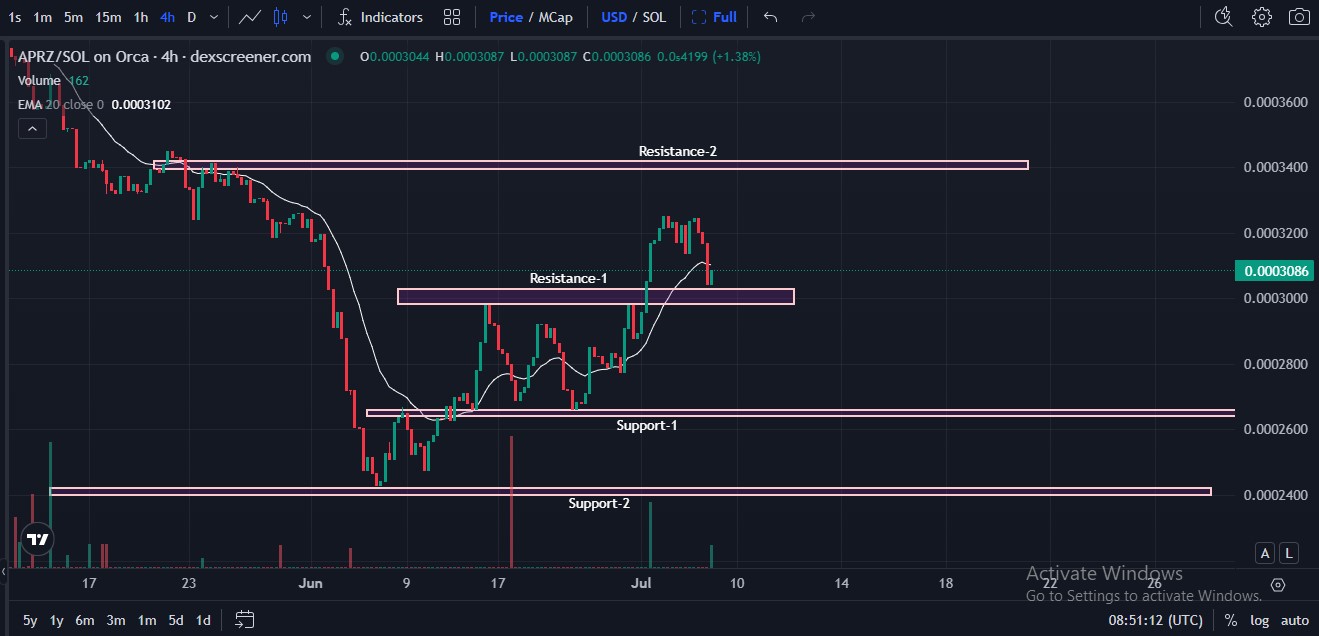
Source: Chart by Dexscreener
| APRZ Chart Snapshot | Value |
|---|---|
| Current Price | $0.0003086 |
| Period Change | +1.38% |
| Open / High / Low | $0.0003044 / $0.0003087 / $0.0003087 |
| EMA 20 (Close) | $0.0003102 |
| Resistance-2 | ~$0.0003400 |
| Resistance-1 Zone | ~$0.0003000–$0.0003080 |
| Support-1 | ~$0.0002600 |
| Support-2 | ~$0.0002400 |
ApeMars Price Prediction: Weighing Supply against Demand
Every serious ApeMars price prediction has to weigh real tokenomics against real trading behavior rather than unverified lock-up theories.
A cautious $APRZ price prediction notes that with 50% of supply tied to the presale and already partially in circulation, the bigger near-term risk is presale-era sellers testing resistance zones like the current $0.0003000–$0.0003080 range, not a mysterious majority-supply lock.
A more constructive APRZ price prediction points to the scheduled burns at stages 6, 12, 18, and 23 as a genuine deflationary mechanism that reduces float over time regardless of listing timing.
The most balanced ApeMars price prediction treats current chart resistance as the real near-term battleground while treating any CEX listing as a longer-term catalyst still awaiting official confirmation.
Expert View: ApeMars Price Prediction and the Supply Question
Analysts reviewing ApeMars note that mixing up confirmed staking lock periods with unverified total-supply lock claims is a common source of confusion in meme coin communities generally, and this appears to be one of those cases.
The documented 50/50 presale-to-ecosystem split and two-month staking lock are real, structured mechanics, but an 85% supply-lock figure isn't traceable to anything the project has published.
Analysts suggest tracking actual on-chain circulating supply and CEX-listing announcements directly, rather than assuming supply-lock speculation explains price behavior that DEX-only liquidity and post-presale selling can already account for.
Disclaimer
This article is for informational purposes only and does not constitute financial or investment advice. All ApeMars price prediction figures, resistance and support levels, and tokenomics discussions mentioned are based on publicly available chart data and project statements and are not guaranteed outcomes. No official CEX listing has been confirmed at the time of writing. and the "85% locked supply" figure referenced in some community discussion could not be verified against ApeMars' published tokenomics. Cryptocurrency investments carry significant risk, including potential loss of capital. Always do your own research and verify information through official channels.


You May Also Like

Trump family’s fortunes tumble by $600m as company faces 'deep downturn'

Filipinos still cautious over financial institutions — study

US naval commander dies as Trump declares ceasefire 'over'



