

Market Watch: Equities Advance While Bitcoin (BTC) Maintains $62K Amid US-Iran Tensions
Key Takeaways
- Equity futures showed gains Thursday following a second wave of US military operations targeting Iran
- Bitcoin maintained support above $62,000, posting a 1.2% daily decline but gaining 1.6% weekly
- Gold continued its downward trend for the fourth consecutive session as Brent crude advanced 1% to $78.80 per barrel
- Rate markets adjusted Federal Reserve hike expectations, moving the timeline from December to October
- The Fear and Greed index for Bitcoin rose to 27, breaking a 40-day streak in extreme fear levels
Equity futures climbed Thursday morning as military tensions escalated with the United States executing another wave of strikes targeting Iranian positions.
Contracts tied to the Dow Jones Industrial Average and S&P 500 both advanced 0.1%. Nasdaq-100 futures posted a 0.3% increase.
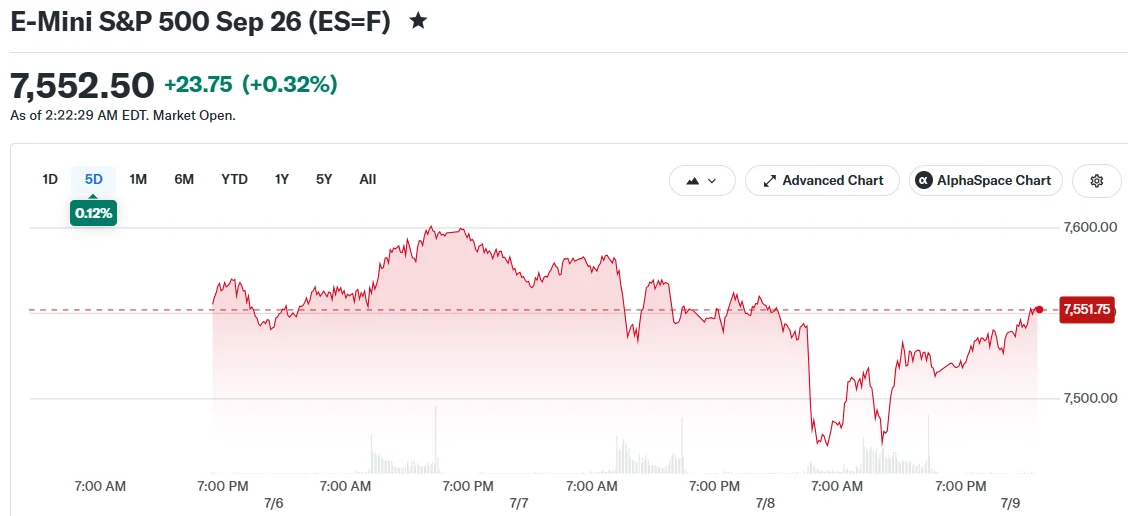 E-Mini S&P 500 Sep 26 (ES=F)
Late Wednesday, US military officials confirmed they had “initiated further strikes targeting Iran to continue degrading their capacity to threaten maritime freedom in the Strait of Hormuz.”
President Trump announced Wednesday that the ceasefire between the nations was “over.” He additionally suggested the possibility of implementing a blockade of the Strait of Hormuz.
Equity markets ended Wednesday’s session with mixed results after surrendering earlier advances. Crude prices surged in response to Trump’s statements.
Crude Advances, Precious Metals Retreat
Brent crude rose 1% to reach $78.80 per barrel, marking its third consecutive daily gain.
Gold extended its losing streak to four sessions, hovering around $4,060 per ounce. Rising rate forecasts are pressuring the precious metal, as it becomes less attractive when interest-bearing assets offer higher returns.
Money markets recalibrated their forecast for the Federal Reserve’s next rate increase to October from the previous December estimate.
Digital Assets Demonstrate Stability
Bitcoin was changing hands at $62,009, reflecting a 1.2% 24-hour decline while maintaining a 1.6% weekly gain.
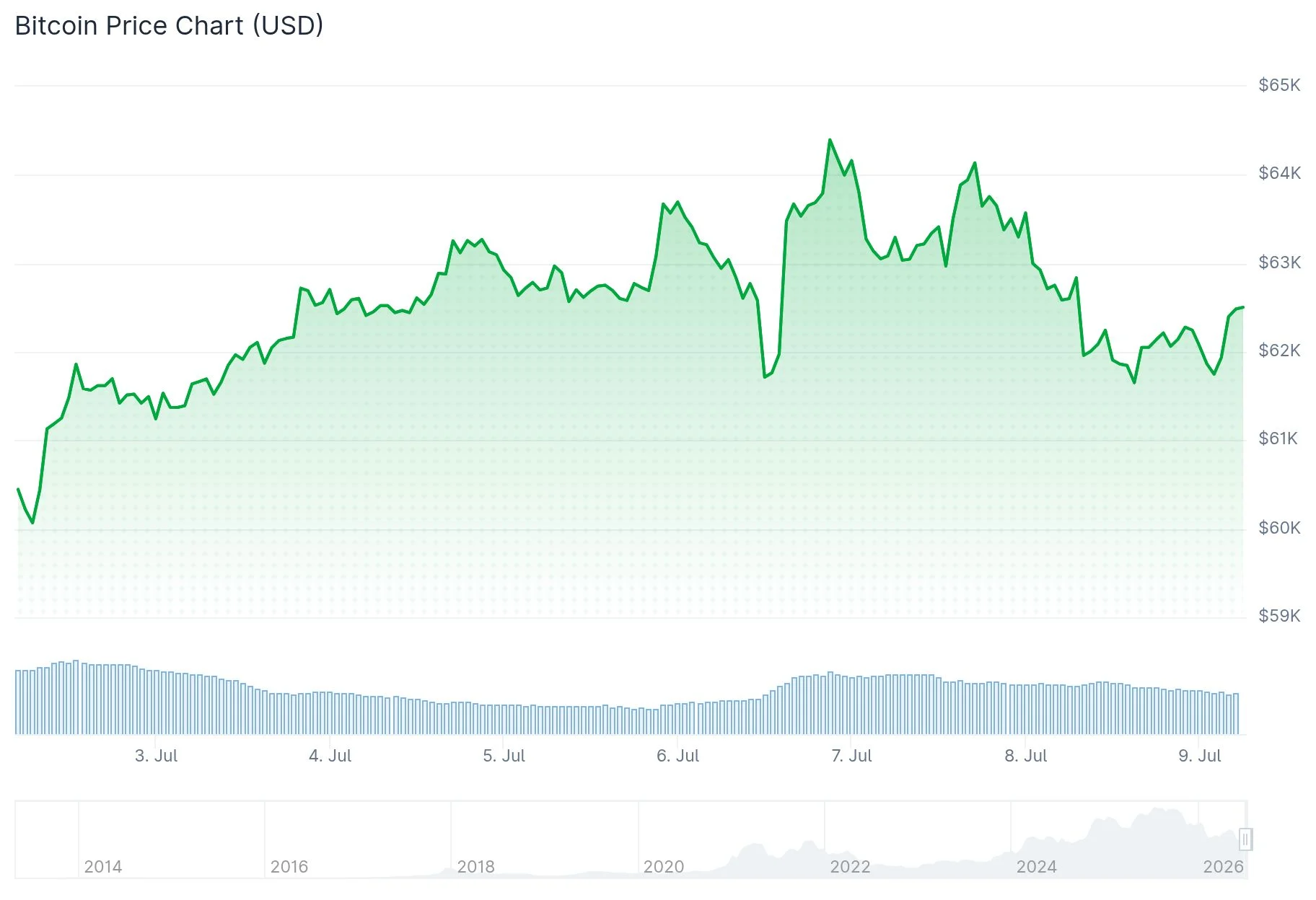 Bitcoin (BTC) Price
Ether stood at $1,730, down 1.2% daily but posting a 5.7% gain across seven trading sessions.
Solana emerged as the session’s laggard, quoted at $77.25 with a 1.8% daily decrease and 1.7% weekly decline. XRP edged down 0.7% to $1.09.
Bitcoin’s response to geopolitical turbulence has been remarkably subdued. Historically, Strait of Hormuz-related news could trigger 5% single-day declines in Bitcoin. This week’s movement registered just 1.2%.
This behavioral shift has persisted since February. Each successive escalation has generated diminishing price reactions from Bitcoin.
Market participants are increasingly viewing these events through an interest rate lens rather than crypto-specific risk factors. Bitcoin is demonstrating stronger correlation with rate expectations than petroleum prices.
The critical support zone remains at $60,000. Bitcoin has defended this level throughout a simultaneous rate repricing, oil shock, and bond market selloff.
The Fear and Greed index advanced to 27 Thursday, concluding a 40-session stretch in extreme fear territory. The index hasn’t sustained levels above 50 since November.
Government debt instruments in Japan, Australia, and New Zealand also declined Thursday, continuing Wednesday’s worldwide selloff. Two-year Treasury yields approached their 2026 peak.
Market observers are also monitoring developments in the AI semiconductor space. SK Hynix is scheduled to launch its IPO Friday, providing fresh insights into chip demand following June’s sector correction.
Should Bitcoin preserve support above $60,000 amid continued escalations while gold extends its decline, it would reinforce the market’s treatment of cryptocurrency as a rate-sensitive instrument rather than a traditional risk hedge.
The post Market Watch: Equities Advance While Bitcoin (BTC) Maintains $62K Amid US-Iran Tensions appeared first on Blockonomi.


You May Also Like

Dogecoin Eyes $0.12 As Traders Look For A Cleaner Breakout Signal

Kraken Leads MiCA-Licensed Crypto Exchanges With $400 Million in Spot Liquidity

Google to Ban Real-Money Prediction Market Extensions From Chrome



