

Why Agnes Aistleitner trusts founders’ discipline more than genius
The first thing you notice about Agnes Aistleitner, a partner at Africa-focused venture capital firm First Circle Capital, is that she answers questions as though she has been thinking about them for years. Her opinions are tempered by the time she has spent listening to founders, watching businesses succeed and fail, and learning which assumptions hold up in reality.
We meet at Artcaffé in Village Market, inside Nairobi’s diplomatic zone, where aid workers, diplomats, founders, and investors walk in and out of meetings that may, or may not, change the future.
Aistleitner speaks directly, laughs easily, and answers questions without the fog that clouds VC. An Austrian by birth, she now divides her life between Nairobi and Kampala, searching for founders worth backing and convincing investors to place bigger bets on Africa.
Before we begin the interview proper, we spend several minutes catching up on the sluggish investment climate, the difficulty of raising money in today’s market, why elections always make capital nervous, and whether Kenya’s politics this time will once again freeze decisions.
She orders hibiscus tea with samosas. I settle for hot chocolate and a croissant. Then she glances at her watch.
“I try not to eat after four,” she says, before breaking into a laugh that suggests the rule is occasionally negotiable. The coincidence catches me off guard. It is a discipline I have also been trying to cultivate—sometimes successfully, often not.
For someone who spends her days deciding which founders deserve funding, Aistleitner speaks remarkably little about money. She talks about discipline, learning, persistence, and showing up when companies are failing rather than disappearing.
Our conversation begins where all interesting journeys do, not her career, but with home.
This interview has been edited for length and clarity.
You grew up in Austria and built a career that eventually brought you to East Africa. What part of the world did you discover in Nairobi and Kampala that you couldn’t find back home?
I’ve been in many countries—Jordan, Ukraine, Japan— and I felt like I wanted to spend some time here and see what’s going on on the continent. What I found in Kampala and Nairobi was a kind of rawness and possibility that is harder to find in Austria. Austria is great. It is beautiful, stable, organised, with a very high quality of life. But because so many systems already work, there is less space to feel that you can build something from scratch and have it matter. In East Africa, the gaps are visible. That can be frustrating, but it is also energising. You see problems everywhere, but you also see people building around them, through them, despite them. I guess you can ascribe this to youthful curiosity; Uganda and Kenya are great, and Austria is great.
When you visit Austria now, what feels foreign to you? And when you return to East Africa, what reminds you that you are still an outsider?
When I go back to Austria, what feels foreign is how structured and predictable everything is. I appreciate it more now than I did when I was younger, but it also feels a bit strange. There is a certain order to life, to careers, to institutions, to expectations.
Culturally, I’m so direct that people find me abrasive at times. East African culture reminds me a lot of Japan in weird ways. Communication is very indirect. And then, of course, I am a Muzungu (caucasian). That reminder follows you around whether you like it or not. It does not matter how long you have lived somewhere or how much you care about the place. You are still seen through a certain lens. I think the mature thing is not to be offended by that, but to understand it, keep learning, and not assume belonging is something you can simply declare for yourself.
What did your parents imagine you would become when you were young, and how different is that life from the one you ended up living?
Well, I come from a very simple background, grew up on a farm, my father is a roofer and mechanic, and I didn’t really meet my parents’ expectations for life. I’d be sitting as a hairdresser, admin, or office worker somewhere near my hometown. But it’s okay. What I did get from that background was very valuable. I learned how to work hard early. I learned that nobody is coming to save you. I learned that if something needs to get done, you do it. And I learned not to look too much for validation from other people, because when you come from a background where your ambitions do not make sense to the people around you, you either stop or you build the internal muscle to keep going.
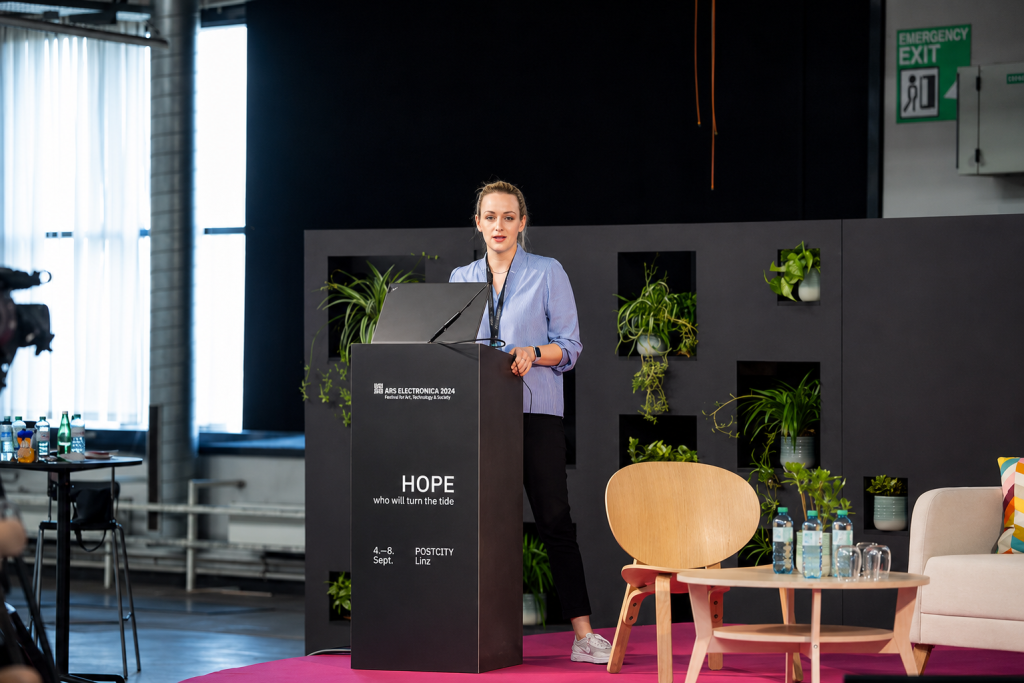 Agnes Aistleitner speaking at Ars Electronica Festival 2024. Image source: First Circle Capital
You spend your days evaluating founders. What is the most important quality you’ve seen in great entrepreneurs that never appears in a pitch deck?
It’s always about the ability to grow as a person, persistence, and that drive to learn and improve. Great entrepreneurs are learning machines, but they put in the work; you’ve got to put in the work. A lot of founders are smart. Many are charismatic. Some are very good at fundraising. But the ones who become truly great are the ones who keep improving. They become better managers, better sellers, better capital allocators, better communicators. They grow into the company before the company outgrows them.
And then there is persistence. Not motivational-poster persistence. Actual persistence. The kind where you wake up after something went badly, and you still do the next thing that needs doing.
Venture capital is often described as a business of conviction. Tell me about a moment when your conviction cost you something—money, reputation, or sleep.
I actually think “conviction” is sometimes the wrong way to frame venture capital. VC is a probability distribution business. You are looking for enough shots on target where the upside is large enough to carry the losses. The job is to find exceptional teams with strong execution ability, building something audacious enough that it could become very big and, yes, also fail.
If nothing ever costs you anything, you are probably not taking enough risk. But that does not mean you should romanticise suffering or bad outcomes.
When companies do not go well, it is painful. It is painful for the founders, and it is painful for us as investors. It creates more work, more difficult conversations, more sleepless nights, and sometimes you are trying everything to save something that cannot be saved. That is sad because there are real people involved, and everyone went in hoping for a good outcome.
The best you can do is handle it with effort, honesty, and clear communication. You show up. You try to help. You do not disappear when things become uncomfortable.
And sometimes things do turn around. Sometimes, being proactive, helping with a pivot, opening the right door, or pushing for a hard decision changes a company’s trajectory. Those moments teach you that conviction is not just believing. It is staying useful when the probability distribution becomes messy—and that is probably more important in the African context.
You’ve lived and worked across very different cultures. What belief about success did you have at 25 that you no longer believe today?
At 25, I probably thought that success was mostly about being smart, ambitious, and willing to work harder than other people. Those things matter, but they are not enough. I think when you are young, you also believe you know much more than you do. You have strong opinions, and that confidence can be useful because it gets you moving. But over time, you realise how much you do not know, and more importantly, you realise that not knowing is not a weakness if you are honest about it and willing to learn.
Now I think success is much more about consistency, self-confidence, self-control, and the ability to keep questioning your own assumptions. You have to ask, ask, ask. You have to be willing to look stupid for five minutes so you do not stay stupid for five years. And there are no shortcuts. You build confidence through repeated effort, not through people telling you that you are good. You build self-trust by doing hard things, keeping promises to yourself, and not collapsing every time something gets uncomfortable.
What has Africa taught you about business that Europe still struggles to understand?
Relationships matter much more than people admit. In Europe, we like to talk about systems, meritocracy, process, and fairness. And I believe meritocracy is something we should aspire to as a society. But the real world is not purely meritocratic. Access matters. Trust matters. Who knows you matters. Who is willing to take your call matters.
Africa makes that very obvious. Business often moves through relationships because institutions are weaker, markets are more fragmented, and information is less evenly distributed. That can be frustrating, but it is also honest. People do business with people they trust because trust reduces risk.
Europe sometimes pretends that networks are secondary to merit. I think that is naive. Merit is important, of course. But a strong network compounds merit. A good relationship can open a door, accelerate a deal, prevent a mistake, or help you understand what is really going on.
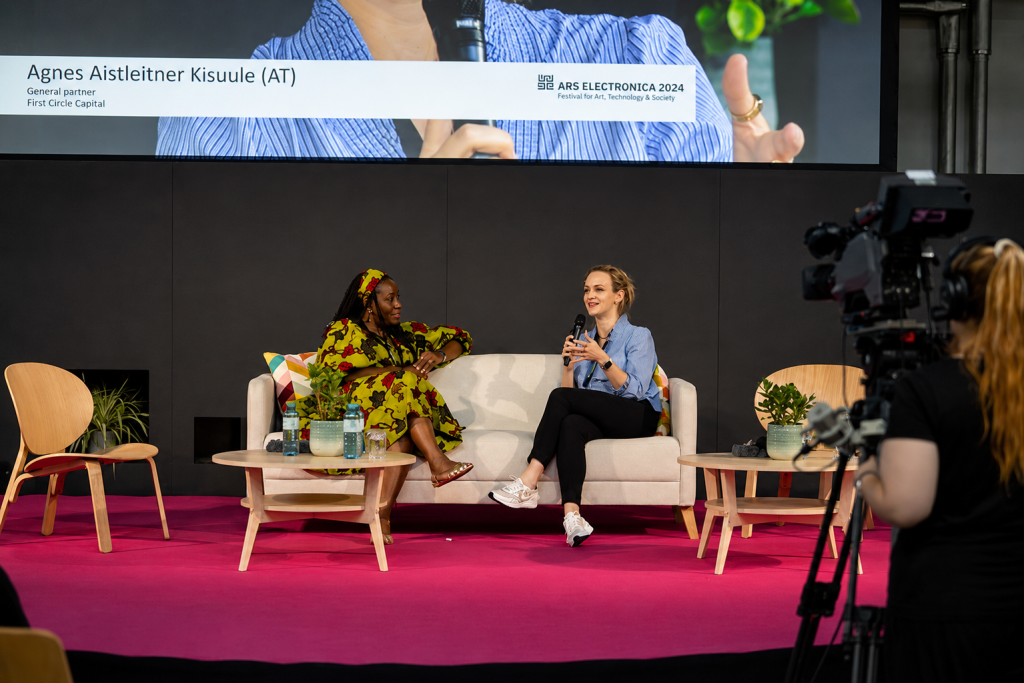 Agnes Aistleitner speaking at Ars Electronica Festival 2024. Image source: First Circle Capital
Many investors spend their lives looking for exceptional founders. Have you ever met a founder who changed the way you think about life itself?
A lot of them change how I think. In this business, you meet people who are obsessed enough, brave enough, and sometimes crazy enough to build something out of almost nothing. That does something to you. You see people operating under pressure, uncertainty, limited capital, difficult markets, family expectations, regulatory issues, and still, they keep going. Great reminders to keep up the good fight.
What is the most expensive mistake you’ve made in your career, and what did it teach you about yourself?
Difficult question. The most expensive mistakes in my life were probably not strictly career mistakes. They were personal mistakes, especially around my failed marriage. That was expensive emotionally, financially, and in terms of what it forced me to rebuild. But it also taught me some of the most important lessons: know your self-worth, trust yourself, and do not outsource your sense of reality to someone else. In business, we talk a lot about judgment, risk, and pattern recognition. But your personal life teaches you judgment too, sometimes more brutally. You learn where you ignored signals. You learn where you were too hopeful, too accommodating, too disconnected from your own instincts.
What is something about venture capital that young professionals admire but would probably dislike if they experienced it firsthand?
Venture capital sounds glamorous from the outside. You meet founders, talk about the future, sit in interesting rooms, and look at exciting companies. And yes, those parts are real. But they are a very small part of the job. The reality is a lot of work: research, sourcing, diligence, portfolio support, fundraising, limited partner (LP) communication, market mapping, writing, network building, follow-ups, internal discussions, legal documents, and reporting.
To be effective, you have to put in the hours. You have to read. You have to think. You have to speak to a lot of people. You have to be responsive. You have to develop judgment in markets where data is often incomplete.
I think young professionals sometimes admire the access and the status. They may dislike how much of the job is actually discipline, repetition, and invisible work.
You see hundreds of companies every year. Does that abundance of opportunity make you more optimistic about Africa’s future or more realistic about its limitations?
Seeing hundreds of companies gives you a very clear view of the limitations. You see infrastructure gaps, regulatory friction, currency risk, fragmented markets, weak purchasing power, limited exit paths, talent constraints, and capital scarcity. You cannot ignore those things if you are doing the work properly. But you also see the drive of entrepreneurs. You see people building around constraints that would stop others completely. You see founders who are forced to be incredibly creative because the easy version of the market does not exist.
That makes me optimistic. Not in a naive way. I do not think everything will magically work out. It will take time. There will be failures. There will be cycles. There will be capital shortages and painful corrections. But the potential is there. The demographic story is real, and digitisation is happening. The gaps are there and need to be filled.
If all the titles disappeared tomorrow—partner, investor, board member—what would remain of Agnes Aistleitner?
A relentless, competitive nerd who does not get tired of learning. I have to learn every day. It is almost a compulsion. I get restless if I am not learning, reading, building, improving, or trying to understand something new. That is probably the core of me more than any title. Recently, I have also gotten very into working out, and that makes me happy in a very simple way. There is something grounding about physical discipline. You do the work, your body responds slowly. It is honest. No shortcuts.
And of course, my kids. I have two little children, they are three and five, and I am a very proud mother.
What is the loneliest part of being successful that people rarely talk about?
I think you’ll have to get comfortable with doing stuff by yourself, and trusting yourself and the process without outside validation. Success is hard; be ready for it. The thought of success is more glamorous than the actual action to get there.
Imagine you’re 90 years old. What would have to be true about your life for you to say, “That was a life well lived”?
Doing the things that feel scary, growing as a person, doing the hard things, being consistent and true to myself, and continuously learning.


You May Also Like

Grant Cardone Is Buying the Bitcoin Dip With Real Estate Cash Flow

Boy, 5, dies in fall from 24th floor apartment

Australia Gives Crypto Firms More Time to Secure Licences



