

Dogecoin (DOGE) vs Kaspa (KAS): Which Could Deliver Bigger Gains by 2027?
Dogecoin and Kaspa are completely different cryptocurrencies, but they share one important trait. Both have loyal communities, and both have shown they can produce explosive rallies when the right catalyst appears. That makes an interesting question worth exploring. Which of these two assets could offer the bigger upside by 2027?
Dogecoin remains one of the biggest names in crypto. Kaspa, on the other hand, has a market capitalization below $800 million compared to Dogecoin’s roughly $13 billion valuation. That huge gap changes the investment discussion.
Dogecoin benefits from popularity and liquidity, whereas Kaspa has much more room to grow from its current size. Both arguments have merit, which is why the comparison deserves a closer look.
Dogecoin Could Benefit From Stronger Institutional Access And Retail Recognition
Dogecoin may have several advantages over Kaspa despite its much larger valuation. One of the biggest is institutional accessibility. DOGE has already received digital commodity treatment from both the SEC and the CFTC. Spot Dogecoin ETF products have also entered the market, including 21Shares’ TDOG listing on Nasdaq. Kaspa currently lacks comparable products in the United States, which limits its exposure to traditional investment capital.
Another potential catalyst continues to attract attention. Elon Musk’s long-discussed X Money payment system still leaves room for Dogecoin integration. Nothing has been confirmed, although DOGE supporters continue to watch every update closely. A successful integration would place Dogecoin before hundreds of millions of X users almost overnight.
Retail recognition also works in Dogecoin’s favor. Crypto market history shows that meme coins often become early beneficiaries whenever speculative money returns during bull markets. Dogecoin usually leads that category because it has existed longer than most competitors and remains available on every major exchange, including Coinbase, Binance, Kraken, and Robinhood. Easy access allows new investors to enter quickly whenever interest returns.
Development could also improve Dogecoin’s outlook. The DogeOS project aims to introduce layer 2 functionality that supports decentralized applications. Transaction fees could eventually burn DOGE tokens if adoption becomes meaningful. Such a mechanism would reduce the impact of Dogecoin’s annual issuance of roughly 5 billion new coins.
Kaspa’s supply schedule presents another interesting discussion point. More than 90% of KAS could already be circulating by 2027 because of its aggressive emission schedule. Scarcity often sounds positive, although miner incentives could weaken if transaction fees fail to replace declining block rewards. Strong ecosystem growth would likely solve that issue. Slower adoption could encourage capital to rotate toward larger and more liquid assets like Dogecoin.
Kaspa’s Smaller Market Capitalization Creates A Different Opportunity
Kaspa may still deliver much higher percentage gains than Dogecoin despite Dogecoin’s structural advantages.
Market capitalization explains much of that argument. Dogecoin already ranks among crypto’s largest assets, which means pushing its valuation substantially higher requires billions of dollars of new investment. Kaspa starts from a much smaller base. The same amount of fresh capital could have a dramatically larger impact on the KAS price.
Supply dynamics also favor Kaspa. More than 95% of all KAS has already been mined. Newly issued supply continues to decline because of Kaspa’s aggressive emission schedule. That leaves far fewer newly created coins entering exchanges every day.
Dogecoin follows a very different model. Roughly 5 billion new DOGE enter circulation every year. Strong demand can easily absorb that supply during bull markets, although steady issuance creates continuous selling pressure over time.
Technology gives Kaspa another possible edge. The Toccata upgrade introduced smart contract functionality and native KRC20 assets to Kaspa’s BlockDAG network. Developers now have the foundation to build decentralized finance applications, stablecoins, and other blockchain services. Strong ecosystem growth could create steady transactional demand instead of relying mainly on market sentiment.
Exchange availability also leaves room for improvement. Dogecoin already trades almost everywhere. Kaspa still lacks several major regulated spot listings. Additional tier 1 exchange support between now and 2027 could introduce millions of potential buyers and become a meaningful catalyst for the KAS price.
Dogecoin Price Outlook Shows Buyers Defending Major Support
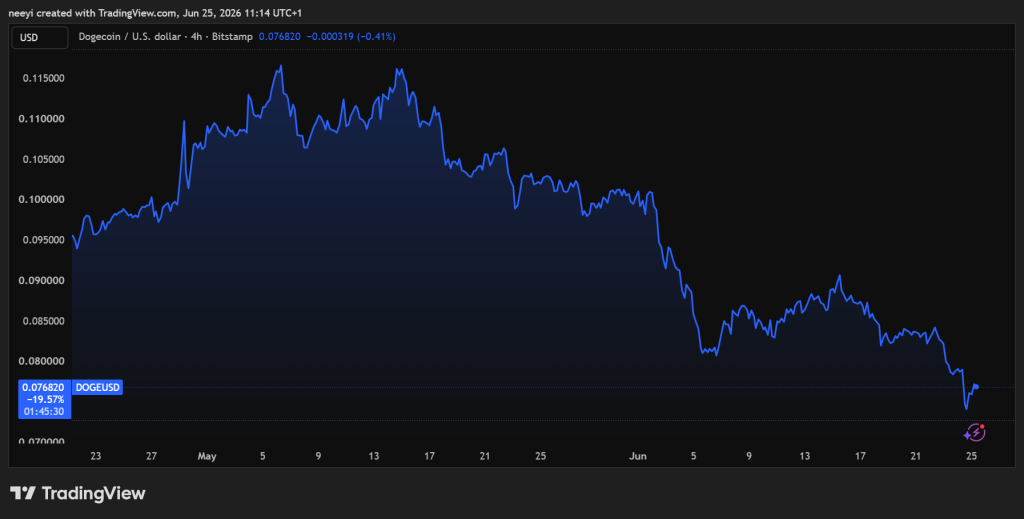
A look at the Dogecoin chart shows the market sitting inside a corrective phase after its strong advance earlier this year. DOGE currently trades near $0.08 after reaching roughly $0.11 to $0.12 in May. That places the coin about 25% below its recent high.
 DOGE Price Chart / TradingView.com
Support remains concentrated around $0.075 to $0.08. Holding that region could allow buyers to rebuild confidence over time. Failure to defend that level could expose the next downside area near $0.07 and possibly the middle of the $0.06 region.
Resistance begins around $0.09 before extending toward the important $0.10 to $0.115 zone where sellers previously returned.
The remainder of 2026 could keep DOGE inside a broad $0.06 to $0.10 range if overall crypto sentiment stays mixed. Strong Bitcoin performance together with renewed meme coin enthusiasm could eventually push price back above $0.115. Additional weakness across the broader market could send DOGE back toward its yearly lows.
ChatGPT Predicts Dogecoin Price Scenarios For 2027
We asked ChatGPT to evaluate several possible paths for the DOGE price through 2027 based on historical market cycles, current fundamentals, and potential catalysts.
Conservative Scenario
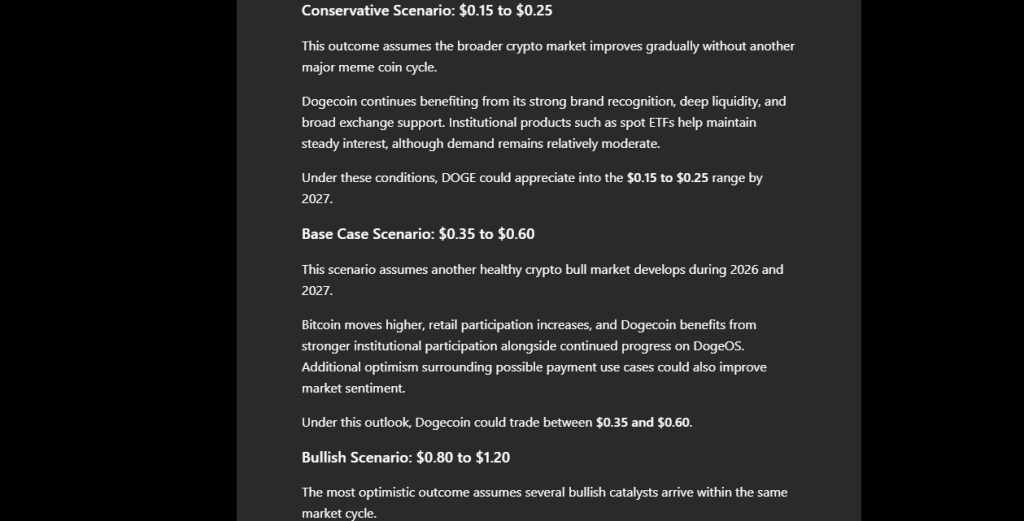
This scenario assumes crypto markets recover slowly without another major meme coin boom. Dogecoin continues benefiting from broad exchange support and its large community, although demand remains moderate. Under those conditions, DOGE could trade between $0.15 and $0.25 by 2027.
 ChatGPT’s Response
Base Case Scenario
This outcome assumes Bitcoin enters another healthy bull market and retail participation returns across major altcoins. Continued DogeOS development together with growing institutional access could support a move toward $0.35 to $0.60.
Bullish Scenario
This scenario assumes several major catalysts arrive together. Strong crypto markets, widespread retail participation, possible X platform integration, successful DogeOS adoption, and ETF driven inflows could combine to push DOGE toward $0.80 to $1.20 during an exceptionally strong market cycle.
Kaspa Price Outlook Shows Recovery Depends On Reclaiming Key Resistance
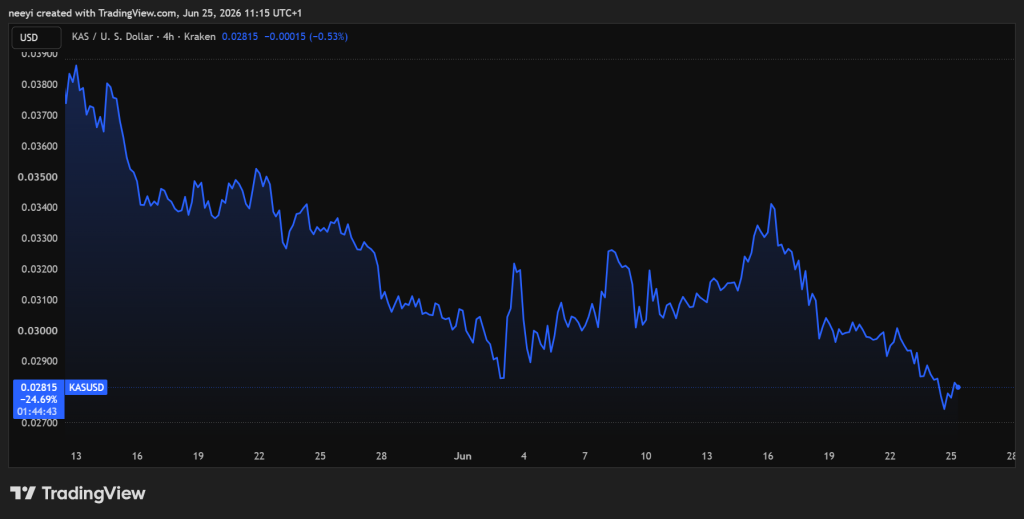
Kaspa also remains inside a corrective trend after reaching about $0.038 during May. KAS now changes hands near $0.028. That leaves the token roughly one third below its recent peak.
 KAS Price Chart / TradingView.com
Support currently sits around $0.028 to $0.029. Losing that area would expose $0.027 before opening the possibility of another decline into the lower $0.02 region.
Resistance appears around $0.031 to $0.033. Stronger selling pressure could emerge again near $0.035 to $0.038 because many buyers entered around those levels earlier this year.
Current market conditions could keep Kaspa trading between roughly $0.022 and $0.035 during the rest of 2026 unless a major catalyst appears. Breaking above $0.038 with strong buying activity would improve the technical picture considerably. Continued weakness below $0.027 would increase downside risks.
ChatGPT Predicts Kaspa Price Scenarios For 2027
We also asked ChatGPT to examine possible KAS price outcomes by 2027 using Kaspa’s supply model, market capitalization, technology roadmap, and adoption potential.
Conservative Scenario
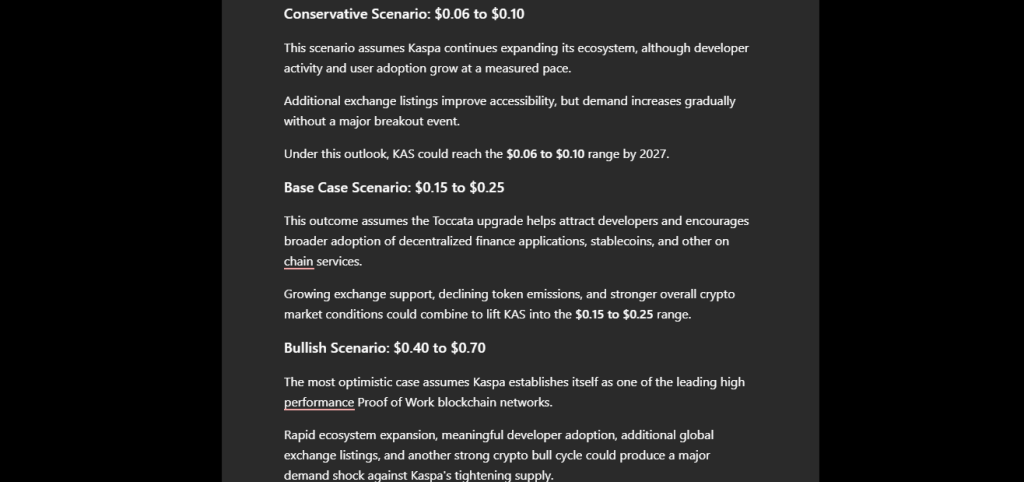
This scenario assumes blockchain adoption grows steadily without major developer expansion on Kaspa. Exchange listings improve gradually, although demand remains moderate. Under those conditions, KAS could trade between $0.06 and $0.10 by 2027. That would still represent meaningful gains because of Kaspa’s relatively small starting valuation.
 ChatGPT’s Response
Base Case Scenario
This outcome assumes Toccata attracts developers, decentralized finance activity expands, additional tier 1 exchange listings arrive, and crypto markets remain healthy. Reduced token emissions combine with stronger demand under this outlook. KAS could reach $0.15 to $0.25 by 2027.
Bullish Scenario
This scenario assumes Kaspa becomes one of the leading high-performance proof-of-work networks. Broad developer adoption, meaningful decentralized finance activity, global exchange expansion, and another strong crypto cycle could drive KAS toward $0.40 to $0.70 during 2027. Such a move would represent much larger percentage gains than Dogecoin, although it would also require several optimistic assumptions to materialize.
Read Also: Peter Schiff Slams Bitcoin Again: “Cheap” Means Nothing Without Earnings or Yield
Which Could Deliver Bigger Gains By 2027?
The answer depends largely on which narrative dominates the crypto market over the next 2 years.
Dogecoin holds clear advantages through liquidity, institutional products, exchange availability, and unmatched brand recognition. Those qualities may make DOGE the safer choice if investors want exposure to a well-established digital asset.
Kaspa presents a different opportunity. Its much smaller market capitalization, declining supply growth, expanding technology, and room for additional exchange listings give it greater potential for percentage gains if adoption continues.
Both cryptocurrencies have delivered remarkable rallies during previous market cycles. Dogecoin could benefit more if retail speculation becomes the dominant theme again. Kaspa may outperform if investors place greater value on utility-driven blockchain networks with smaller valuations.
FAQs
Subscribe to our YouTube channel for daily crypto updates, market insights, and expert analysis.
The post Dogecoin (DOGE) vs Kaspa (KAS): Which Could Deliver Bigger Gains by 2027? appeared first on CaptainAltcoin.


You May Also Like

Top U.S. economist says Gold reversal is imminent

MEV Extraction and What It Means for Price Discovery in DeFi

Xbox Hits Gamers With Price-Hike As Major Retailer Warns Console Shortage Looms Ahead Of GTA VI Launch



