

SK Hynix (000660.KS) Stock Claims Top Spot as South Korea’s Largest Company by Market Cap
Key Highlights
- SK Hynix has eclipsed Samsung Electronics to claim the position of South Korea’s highest-valued publicly traded firm, reaching a market valuation of $1.35 trillion
- Shares have skyrocketed over 340% throughout the current year, propelled by explosive growth in demand for high-bandwidth memory (HBM) chips powering artificial intelligence infrastructure
- The company commands a dominant 61% share of the worldwide HBM market, significantly outpacing Samsung’s 17% and Micron’s 21%
- Samsung maintained the leading market position for more than two decades since 2000, and contends its total valuation including preferred shares stands at approximately 2,252 trillion won
- Reports indicate SK Hynix is preparing for a Nasdaq listing in the United States to expand its investor reach
SK Hynix shares climbed 5.7% during Monday’s trading session, elevating its total market value to 2,082.5 trillion won ($1.35 trillion) and narrowly surpassing Samsung Electronics — which posted a modest 0.4% gain — marking a historic first.
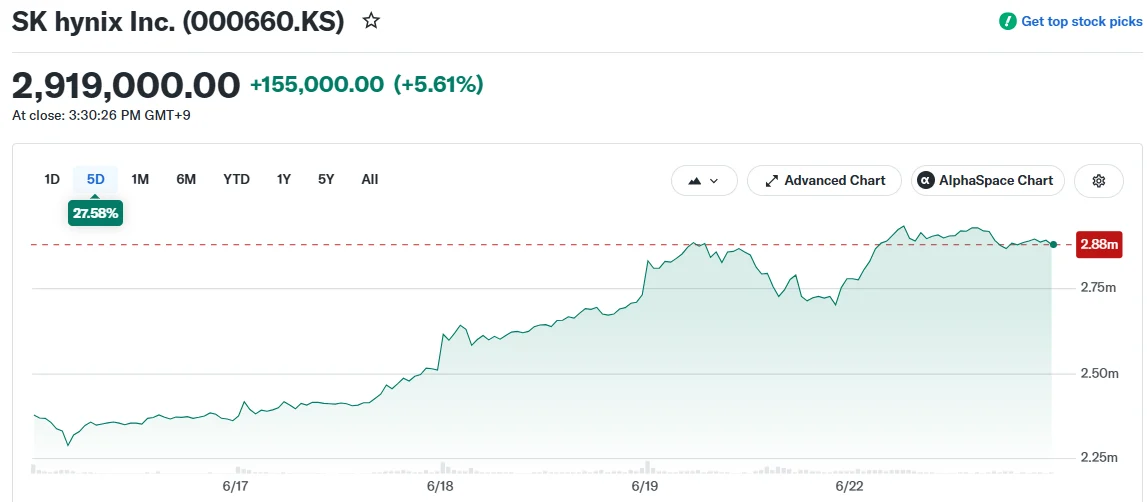 SK hynix Inc. (000660.KS)
Samsung has occupied the premier position since the turn of the millennium. The margin separating these tech giants remains extremely narrow, and Samsung maintains that incorporating its preferred shares would place its complete market capitalization near 2,252 trillion won.
This achievement crowns an extraordinary performance for SK Hynix, with shares climbing more than 340% year-to-date.
The driving force behind this meteoric rise is HBM technology — specialized high-bandwidth memory modules arranged in vertical stacks to enable enhanced processing speeds while reducing energy consumption. These advanced chips serve as critical building blocks within AI accelerators manufactured by Nvidia and deployed by tech giants including Alphabet’s Google.
Different from conventional DRAM products, HBM technology is deeply integrated with artificial intelligence hardware. This creates substantial market entry challenges and provides manufacturers with pricing advantages that commodity memory products have never enjoyed. SK Hynix controls 61% of the worldwide HBM marketplace. Samsung holds 17%, while Micron captures 21%.
Remarkable Recovery: From Near-Bankruptcy to $1.35 Trillion
The corporate resurrection narrative is nothing short of extraordinary. Back in 2002, the company then known as Hynix Semiconductor teetered on the edge of collapse, nearly acquired by Micron after drowning in massive debt obligations. When that transaction collapsed, the business remained under creditor oversight for close to ten years. By 2003, shares had plummeted to just 135 won — essentially penny stock territory.
During 2023, a severe memory market contraction dealt a crushing blow. SK Hynix reported an annual operating deficit of 7.73 trillion won during that difficult period.
Despite the challenging environment, the company maintained its HBM technology investments throughout the slump — a strategic gamble that delivered spectacular results. By 2024, it achieved a record-breaking operating profit of 23.5 trillion won as artificial intelligence infrastructure spending from Microsoft, Google, and Meta intensified.
SK Group Chairman Chey Tae-won, who championed the controversial Hynix acquisition despite fierce internal resistance, outlined his strategic vision in a book released this January.
Samsung Faces Mounting Pressure in DRAM Production Race
The competitive shift extends beyond simple market capitalization metrics. Samsung’s long-standing leadership in DRAM manufacturing faces increasing challenges.
Bank of America projects SK Hynix’s monthly DRAM production capacity will hit approximately 589,000 wafers during the current year, compared with roughly 691,000 for Samsung. However, SK Hynix plans to boost output by 38% from 2025 through 2028, substantially outpacing Samsung’s anticipated 17.5% expansion.
By 2028, this aggressive growth trajectory would shrink the production differential to less than 10%, down dramatically from 23% in 2025.
SK Hynix is also reportedly advancing plans for a Nasdaq listing in the United States, a move expected to significantly enhance its visibility among international institutional investors.
The post SK Hynix (000660.KS) Stock Claims Top Spot as South Korea’s Largest Company by Market Cap appeared first on Blockonomi.


You May Also Like

Japan’s Yen Crisis Deepens After $73 Billion Currency Intervention

Polymarket Paid Creators To Film Fake Trades In Covert Social Media Campaign, Investigation Finds

Current price of oil as of June 22, 2026



