

Quake-stricken GenSan farmers mourn lost homes, buried crops
GENERAL SANTOS CITY, Philippines – Widowed farmer Jasmine Dimasuhid had been looking forward to a good harvest season.
Before a magnitude 7.8 earthquake struck parts of Mindanao on June 8, Dimasuhid and her family had been hard at work tilling their land in General Santos City, growing cassava and taro, and making copra out of coconuts.
If the season is good, they can make up to P20 per kilogram of copra, which they would bring from their uphill community in Sitio Datal Salvan, Barangay San Jose, to the markets in General Santos City — about a 20-kilometer drive.
That all changed when landslides triggered by the powerful quake and aftershocks buried parts of their land, Dimasuhid told Rappler.
“Dili na mi kabalik sa among harvest kay hadlok na mi (We can no longer return to our harvest because we are afraid),” the farmer said.
More than 400 residents of Sitio Datal Salvan have been displaced by the tremor. Dimasuhid and her fellow evacuees are temporarily sheltered in their evacuation center at the community drier, an open-spaced, cemented area designed for drying crops.
Unable to return home due to the danger of landslides, Dimasuhid thought that things could not get worse until she learned that her younger brother had been missing since the June 8 quake.
“Nahulog siya kay nagtrabaho siya sa construction sa dalan…. Hangtud karon, wala pa nakit-an iyahang lawas (He fell when he was working; construction on a road…. Until now, they still haven’t found his body),” Dimasuhid said.
Trauma and stress
For almost two weeks since the quake, residents of Sitio Datal Salvan, mostly farmers, remained at the evacuation center.
Given the drier’s design, the evacuees are forced to endure intense heat and humid living conditions. According to Barangay Health Worker Juanita Pandian, recent blood pressure checks of the evacuees averaged 140/100 or near hypertensive levels.
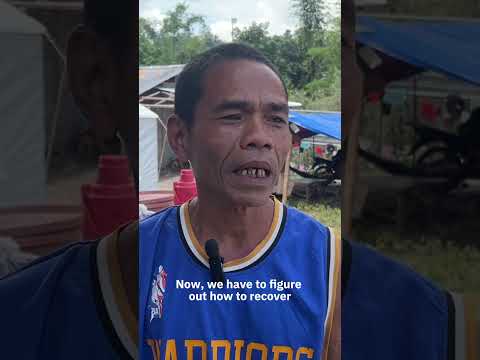
Farmer Renato Mendel told Rappler that their current living situation is aggravated by the fact that most of the residents lost all of their harvest due to the landslides.
“Maninkamot mi unsaon namo pagrecover nga makatanom pa mi og ginagmay nga tanom aron naa tawn mi madaganan (We are figuring out how to recover in a way that we can plant small plants at least that we can use),” Mendel said.
Senior citizens, mothers, and children make most of the population at the Sitio Datal Salvan evacuation center.
“Sakit akong ulo, kaning ubo nako… Kung mukaon, wala ko gana dahil sa situation (My head hurts, I have this cough…. When eating, I don’t have any appetite due to the situation),” senior citizen Cecilia Canol lamented.
Anya Samal, a 21-year-old moother, worried about the health of her three sons. She was with her 5-year-old son, her eldest, at the Datal Salvan Elementary School when the earthquake struck. They had minor injuries due to the tremor.
“Kailangan jud mi og diaper ug gatas kay magsige ug hilak akong anak kay wala koy mahatag kung [breastfeed] (We really need diapers and milk because my child keeps crying since I can’t breastfeed),” Canol told Rappler.
 FAMILY. Anya Samal (in red) sits with her family at the Datal Salvan evacuation center as they wait for more assistance and food packs to arrive on Wednesday, June 17, 2026.
Government response
Barangay Captain Abdul Rahim Paidumama told Rappler that they have coordinated with social workers and health officers from the General Santos City Government to conduct psychosocial first-aid for affected residents.
“Our challenge is where to place the evacuation centers because we have four that are in puroks that are near danger zones,” Paidumama said.
At present, the local government and representatives from the Department of Social Welfare and Development (DSWD) and Department of Health (DOH) among others have been providing food packs and hygiene kits to affected barangays in General Santos City.
General Santos City Mayor Lorelie Pacquiao told Rappler that 1,300 beneficiaries, whose households were totally damaged by the earthquake, would receive P30,000 cash aid from the National Housing Authority. – Rappler.com


You May Also Like

Critical USDT0 Response to Drift Hack Exposes Stark Contrast in Stablecoin Security Protocols

Fed Governor Calls For Strong Stablecoin Oversight As CLARITY Act’s Final Text Gets Delayed

Why Sui Just Processed Over $65 Billion in Stablecoin Transfers



