The post 2 million users and 10k agents on the AI blockchain appeared on BitcoinEthereumNews.com. Over 2 million registered users and 10,000 agents already published. ChainOpera brings decentralized AI from the experimental phase to a concrete implementation on blockchain, with incentives, traceability, and integrated verifications, as described in the official ChainOpera whitepaper and in industry analyses published on The Block. The project, described by co-founder Salman Avestimehr – professor at USC and recipient of the U.S. Presidential Early Career Award for Scientists and Engineers (PECASE), as well as IEEE Fellow – combines decentralized federated learning and distributed ledgers to build an operational and interoperable ecosystem. In this context, the stated goal is to return ownership and control to communities of developers, computing providers, and end users. According to the public data available in the whitepaper and official communications, updated as of September 30, 2025, the platform reports over 2 million registered users and approximately 10,000 published agents. Industry analysts note that the completion of the $17 million seed round in December 2024 accelerated the development of the L1 and OS components. Cross-checks of the technical pages reveal metrics on PoI functionalities and the layered structure that confirm the approach described in the project document. Origins, team, and vision ChainOpera was born from the experience gained with FedML, an open-source library launched in 2019 for decentralized federated learning. The project was co-founded by Salman Avestimehr and Chaoyang Aiden He, who initiated FedML during his PhD FedML ChainOpera. The team includes academic profiles and engineers from UC Berkeley, Stanford, USC, MIT, and companies like Amazon, Google, and Microsoft. The long-term vision converges towards a community-owned and governed “Crypto AGI,” a topic addressed in interviews and debates within the sector The Block. The $17M seed round was announced in December 2024 and saw the participation of institutional investors supporting the development of the L1 infrastructure. What does “decentralized… The post 2 million users and 10k agents on the AI blockchain appeared on BitcoinEthereumNews.com. Over 2 million registered users and 10,000 agents already published. ChainOpera brings decentralized AI from the experimental phase to a concrete implementation on blockchain, with incentives, traceability, and integrated verifications, as described in the official ChainOpera whitepaper and in industry analyses published on The Block. The project, described by co-founder Salman Avestimehr – professor at USC and recipient of the U.S. Presidential Early Career Award for Scientists and Engineers (PECASE), as well as IEEE Fellow – combines decentralized federated learning and distributed ledgers to build an operational and interoperable ecosystem. In this context, the stated goal is to return ownership and control to communities of developers, computing providers, and end users. According to the public data available in the whitepaper and official communications, updated as of September 30, 2025, the platform reports over 2 million registered users and approximately 10,000 published agents. Industry analysts note that the completion of the $17 million seed round in December 2024 accelerated the development of the L1 and OS components. Cross-checks of the technical pages reveal metrics on PoI functionalities and the layered structure that confirm the approach described in the project document. Origins, team, and vision ChainOpera was born from the experience gained with FedML, an open-source library launched in 2019 for decentralized federated learning. The project was co-founded by Salman Avestimehr and Chaoyang Aiden He, who initiated FedML during his PhD FedML ChainOpera. The team includes academic profiles and engineers from UC Berkeley, Stanford, USC, MIT, and companies like Amazon, Google, and Microsoft. The long-term vision converges towards a community-owned and governed “Crypto AGI,” a topic addressed in interviews and debates within the sector The Block. The $17M seed round was announced in December 2024 and saw the participation of institutional investors supporting the development of the L1 infrastructure. What does “decentralized…

2 million users and 10k agents on the AI blockchain

Over 2 million registered users and 10,000 agents already published. ChainOpera brings decentralized AI from the experimental phase to a concrete implementation on blockchain, with incentives, traceability, and integrated verifications, as described in the official ChainOpera whitepaper and in industry analyses published on The Block.

The project, described by co-founder Salman Avestimehr – professor at USC and recipient of the U.S. Presidential Early Career Award for Scientists and Engineers (PECASE), as well as IEEE Fellow – combines decentralized federated learning and distributed ledgers to build an operational and interoperable ecosystem.

In this context, the stated goal is to return ownership and control to communities of developers, computing providers, and end users.

According to the public data available in the whitepaper and official communications, updated as of September 30, 2025, the platform reports over 2 million registered users and approximately 10,000 published agents.

Industry analysts note that the completion of the $17 million seed round in December 2024 accelerated the development of the L1 and OS components. Cross-checks of the technical pages reveal metrics on PoI functionalities and the layered structure that confirm the approach described in the project document.

Origins, team, and vision

ChainOpera was born from the experience gained with FedML, an open-source library launched in 2019 for decentralized federated learning. The project was co-founded by Salman Avestimehr and Chaoyang Aiden He, who initiated FedML during his PhD FedML ChainOpera.

The team includes academic profiles and engineers from UC Berkeley, Stanford, USC, MIT, and companies like Amazon, Google, and Microsoft.

The long-term vision converges towards a community-owned and governed “Crypto AGI,” a topic addressed in interviews and debates within the sector The Block. The $17M seed round was announced in December 2024 and saw the participation of institutional investors supporting the development of the L1 infrastructure.

What does “decentralized AI” on blockchain mean

A decentralized AI distributes training, execution, and verification of agents across a network of nodes without central control.

The blockchain, in this context, records contributions, certifies results, and manages rewards according to transparent rules, as explained in the protocol specifications and the official whitepaper.

In practice, each actor – whether it be data, models, GPUs, or agents – obtains a verifiable trace of their activities. The result is an increase in transparency, improved auditability, and incentives aligned with quality.

Stack and numbers: the platform in four levels

According to ChainOpera, the ecosystem, structured into four interoperable layers, is already operational:

  • AI Terminal (Super App): a ChatGPT-style dApp, deployed on the BNB Smart Chain (BNB Chain), with over 2 million registered users and hundreds of thousands of DAU (daily active users, metric not yet publicly disclosed) (data reported in 2025 and verified as of September 30, 2025) BNB Chain: over 2 million users.
  • Agent Developer Platform: a marketplace where over 10,000 agents have been published, reusable in different compositions, as reported by industry outlets The Block.
  • Model & GPU Platform: an infrastructure designed for model providers, data, and computing capacity, integrating Web2 and Web3 solutions ChainOpera.
  • AI‑Native Blockchain Protocol: the Proof of Intelligence (PoI) protocol to measure, validate, and remunerate contributions, making the entire system verifiable and auditable. The technical specifications are described in the research sections of the whitepaper.

Proof of Intelligence: how performance and contributions are measured

The PoI is a verifiability protocol designed to attribute value to the efforts of agents and providers. It is based on three pillars:

  • Measure: evaluation through standardized tasks (for example, accuracy, success rate, latency, cost per task, and resistance to adversarial inputs).
  • Verification: use of on‑chain attestations, peer checks, and sample re‑executions to mitigate fraud and sybil attacks.
  • Liquidation: distribution of rewards proportional to the value produced, with penalty mechanisms (slashing) in case of discrepancies.

In essence, an agent deposits the outcome of a task; independent verifiers check it with shared benchmarks and the blockchain records both the result and the related payout. This way, a quality economy is incentivized, not just the consumption of resources.

Impact: a cooperative and onboarding-oriented AI

The cooperative nature of the network allows agents and models to improve as data availability and computational capacity increase.

Each new contribution integrates into the system, enabling chains of specialized agents, as described in the whitepaper and public project communications ChainOpera.

The conversational interface facilitates access to DeFi and other on‑chain tools, making AI a natural bridge for non-expert users and generating a virtuous circle between usage, development, and interoperability.

Competition to Centralized Models: Where It Can Win and Where It Cannot

Decentralized systems focus on specialization and composition of agents, contrasting with large centralized models. Among the advantages are:

  • Transparency and the possibility of auditing on executions and costs;
  • Resilience against single points of failure and censorship;
  • Incentives that reward high-quality contributions (data, models, or computational capacity).

That said, significant challenges remain related to the adoption of effective governance, the control of agent quality, and compliance with privacy and intellectual property regulations, as well as potential limitations due to latency and verification costs in real-time applications.

Context: how it positions itself compared to other projects

In the global landscape, Bittensor, SingularityNET, and Fetch.ai follow different paths: Bittensor incentivizes the provision of intelligence through network and model mining; SingularityNET offers a marketplace for AI services; Fetch.ai focuses on an economy of autonomous agents.

Yet, these differences highlight the positioning of ChainOpera, which stands out for an already active user terminal, an agent marketplace, and a native verification protocol (PoI), aiming to bridge the gap between development and adoption.

Roadmap: priorities and contribution opportunities

  • Agent Social Network: development of multi-agent experiences and smoother interactions between humans and AI, to foster group collaborations.
  • Verifiability: refinement of the PoI protocol through public benchmarks and even more robust attestations, to ensure transparency. A topic addressed in detail in AI Benchmark: complete guide to evaluating AI model performance.
  • Developer platform: enhancing the scalability of agents, with applications in sectors such as market intelligence, automation, and on‑chain execution.

The roadmap highlights the areas where communities and partners can experiment and contribute to the validation of key components, maintaining an application‑led approach that aligns research and adoption in the long term.

In Summary

ChainOpera combines a blockchain-based AI platform, collaborative agents, and a Proof of Intelligence mechanism designed to measure and reward contributions.

With 2 million registered users, 10,000 agents published, and a product already live, the project offers a concrete path to decentralization of AI, while facing significant challenges in governance and quality control, as confirmed by recent industry analyses Cryptocurrencies and emerging projects: ChainOpera among the leaders.

Source: https://en.cryptonomist.ch/2025/09/30/chainopera-2-million-users-and-10k-agents-on-the-ai-blockchain/

Market Opportunity
null Logo
null Price(null)
--
----
USD
null (null) Live Price Chart
Disclaimer: The articles reposted on this site are sourced from public platforms and are provided for informational purposes only. They do not necessarily reflect the views of MEXC. All rights remain with the original authors. If you believe any content infringes on third-party rights, please contact service@support.mexc.com for removal. MEXC makes no guarantees regarding the accuracy, completeness, or timeliness of the content and is not responsible for any actions taken based on the information provided. The content does not constitute financial, legal, or other professional advice, nor should it be considered a recommendation or endorsement by MEXC.

You May Also Like

CME Group to Launch Solana and XRP Futures Options

CME Group to Launch Solana and XRP Futures Options

The post CME Group to Launch Solana and XRP Futures Options appeared on BitcoinEthereumNews.com. An announcement was made by CME Group, the largest derivatives exchanger worldwide, revealed that it would introduce options for Solana and XRP futures. It is the latest addition to CME crypto derivatives as institutions and retail investors increase their demand for Solana and XRP. CME Expands Crypto Offerings With Solana and XRP Options Launch According to a press release, the launch is scheduled for October 13, 2025, pending regulatory approval. The new products will allow traders to access options on Solana, Micro Solana, XRP, and Micro XRP futures. Expiries will be offered on business days on a monthly, and quarterly basis to provide more flexibility to market players. CME Group said the contracts are designed to meet demand from institutions, hedge funds, and active retail traders. According to Giovanni Vicioso, the launch reflects high liquidity in Solana and XRP futures. Vicioso is the Global Head of Cryptocurrency Products for the CME Group. He noted that the new contracts will provide additional tools for risk management and exposure strategies. Recently, CME XRP futures registered record open interest amid ETF approval optimism, reinforcing confidence in contract demand. Cumberland, one of the leading liquidity providers, welcomed the development and said it highlights the shift beyond Bitcoin and Ethereum. FalconX, another trading firm, added that rising digital asset treasuries are increasing the need for hedging tools on alternative tokens like Solana and XRP. High Record Trading Volumes Demand Solana and XRP Futures Solana futures and XRP continue to gain popularity since their launch earlier this year. According to CME official records, many have bought and sold more than 540,000 Solana futures contracts since March. A value that amounts to over $22 billion dollars. Solana contracts hit a record 9,000 contracts in August, worth $437 million. Open interest also set a record at 12,500 contracts.…
Share
BitcoinEthereumNews2025/09/18 01:39
China Blocks Nvidia’s RTX Pro 6000D as Local Chips Rise

China Blocks Nvidia’s RTX Pro 6000D as Local Chips Rise

The post China Blocks Nvidia’s RTX Pro 6000D as Local Chips Rise appeared on BitcoinEthereumNews.com. China Blocks Nvidia’s RTX Pro 6000D as Local Chips Rise China’s internet regulator has ordered the country’s biggest technology firms, including Alibaba and ByteDance, to stop purchasing Nvidia’s RTX Pro 6000D GPUs. According to the Financial Times, the move shuts down the last major channel for mass supplies of American chips to the Chinese market. Why Beijing Halted Nvidia Purchases Chinese companies had planned to buy tens of thousands of RTX Pro 6000D accelerators and had already begun testing them in servers. But regulators intervened, halting the purchases and signaling stricter controls than earlier measures placed on Nvidia’s H20 chip. Image: Nvidia An audit compared Huawei and Cambricon processors, along with chips developed by Alibaba and Baidu, against Nvidia’s export-approved products. Regulators concluded that Chinese chips had reached performance levels comparable to the restricted U.S. models. This assessment pushed authorities to advise firms to rely more heavily on domestic processors, further tightening Nvidia’s already limited position in China. China’s Drive Toward Tech Independence The decision highlights Beijing’s focus on import substitution — developing self-sufficient chip production to reduce reliance on U.S. supplies. “The signal is now clear: all attention is focused on building a domestic ecosystem,” said a representative of a leading Chinese tech company. Nvidia had unveiled the RTX Pro 6000D in July 2025 during CEO Jensen Huang’s visit to Beijing, in an attempt to keep a foothold in China after Washington restricted exports of its most advanced chips. But momentum is shifting. Industry sources told the Financial Times that Chinese manufacturers plan to triple AI chip production next year to meet growing demand. They believe “domestic supply will now be sufficient without Nvidia.” What It Means for the Future With Huawei, Cambricon, Alibaba, and Baidu stepping up, China is positioning itself for long-term technological independence. Nvidia, meanwhile, faces…
Share
BitcoinEthereumNews2025/09/18 01:37
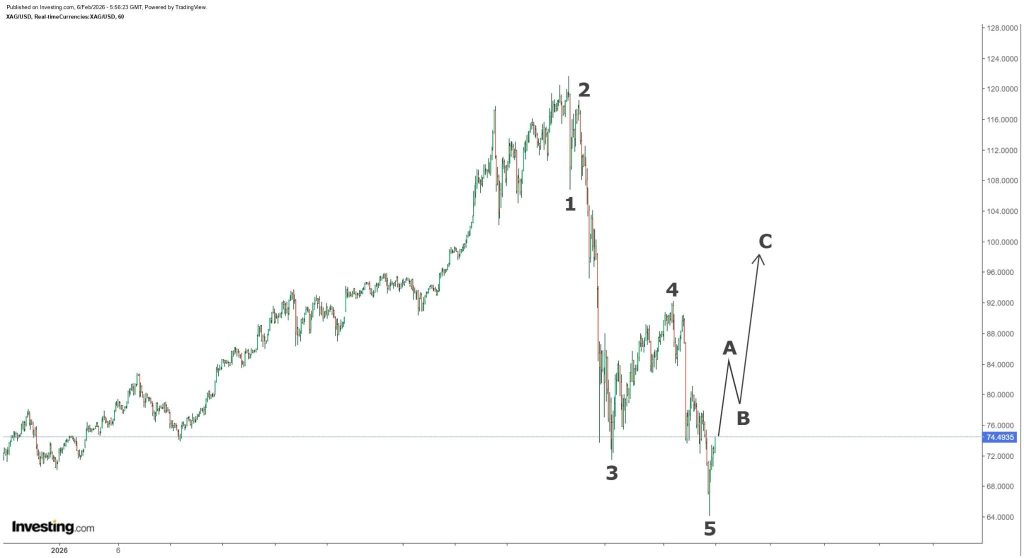
Silver Price Crash Is Over “For Real This Time,” Analyst Predicts a Surge Back Above $90

Silver Price Crash Is Over “For Real This Time,” Analyst Predicts a Surge Back Above $90

Silver has been taking a beating lately, and the Silver price hasn’t exactly been acting like a safe haven. After running up into the highs, the whole move reversed
Share
Captainaltcoin2026/02/07 03:15