Ripple’s Chief Technology Officer David Schwartz argued that large internet companies will inevitably adopt blockchain-based finance, contending that decentralized infrastructure is arriving “at the right place at the right time” to meet needs that legacy rails struggle to serve. The remarks came in Episode 1 of Ripple’s new Onchain Economy video series, published on September […]Ripple’s Chief Technology Officer David Schwartz argued that large internet companies will inevitably adopt blockchain-based finance, contending that decentralized infrastructure is arriving “at the right place at the right time” to meet needs that legacy rails struggle to serve. The remarks came in Episode 1 of Ripple’s new Onchain Economy video series, published on September […]

Amazon, Uber And Beyond—Ripple CTO Predicts Big Tech’s Blockchain Migration

2025/09/26 21:00
3 min read

Ripple’s Chief Technology Officer David Schwartz argued that large internet companies will inevitably adopt blockchain-based finance, contending that decentralized infrastructure is arriving “at the right place at the right time” to meet needs that legacy rails struggle to serve. The remarks came in Episode 1 of Ripple’s new Onchain Economy video series, published on September 25. In the segment, Schwartz frames decentralized finance as a practical response to unmet enterprise demand rather than a speculative detour.

Ripple CTO Foresees DeFi Eating Into TradFi

“Tech is coming for finance with or without blockchain. It was what was going to happen,” Schwartz says, singling out hyperscalers and platform companies: “New corporations, companies like Amazon and Uber need more financial services than the current system is able to provide them. And the blockchain technologies are in the right place at the right time.” He presents the thesis bluntly: this is less about converting traditional banks to crypto orthodoxy and more about meeting the operational realities of software-driven businesses that require programmable money, continuous settlement, and composable workflows.

Schwartz also distances his argument from the narrower, speculative corners of crypto. “It can’t just be collectibles and it can’t just be… seeking very high reward at very high risk,” he cautions, before asserting that DeFi—broadly defined to include smart contracts and the infrastructure around them—will “take a huge bite out of TradFi over the next couple of years.” The condition, in his telling, is straightforward: the blockchain sector must ship services people actually want from a financial system, and do so with institutional-grade guardrails.

That bridge between decentralization and compliance is the crux of the episode. “I don’t think there’s a tension between institutional adoption and decentralization,” Schwartz says. What institutions want from a base layer, he argues, is the very thing public chains offer: neutrality. “Ecosystems are interested in layer-1 blockchains because of their decentralization, because of their neutrality… institutions will see that the neutrality of blockchains is a positive rather than a negative.” In other words, neutrality is not a governance liability; it is the feature that allows multiple counterparties to cooperate without surrendering control to a single gatekeeper.

Schwartz’s comments land amid Ripple’s broader push to position XRPL as a venue for institutional on-chain finance—stablecoin flows, tokenized assets, and eventually native credit—supported by compliance-enabling primitives.

In a September 22 analysis on its corporate site, Ripple asserted that XRPL recorded $1+ billion in monthly stablecoin volume and ranks among the top chains for real-world asset activity, framing a roadmap that emphasizes verifiable credentials, “Deep Freeze” asset controls, and a planned protocol-level lending layer. Those claims, published by Ripple, form the company’s context for why neutral public ledgers can satisfy institutional requirements without abandoning decentralization.

Earlier this year, Ripple likewise proposed a permissioned DEX concept tied to credentialed market access on XRPL’s native exchange—an approach meant to reconcile KYC/AML obligations with the liquidity and transparency of a public order book. While the underlying standards still depend on network governance and implementation, the design illustrates how Ripple envisions regulated entities operating inside a decentralized environment without fragmenting liquidity into private silos.

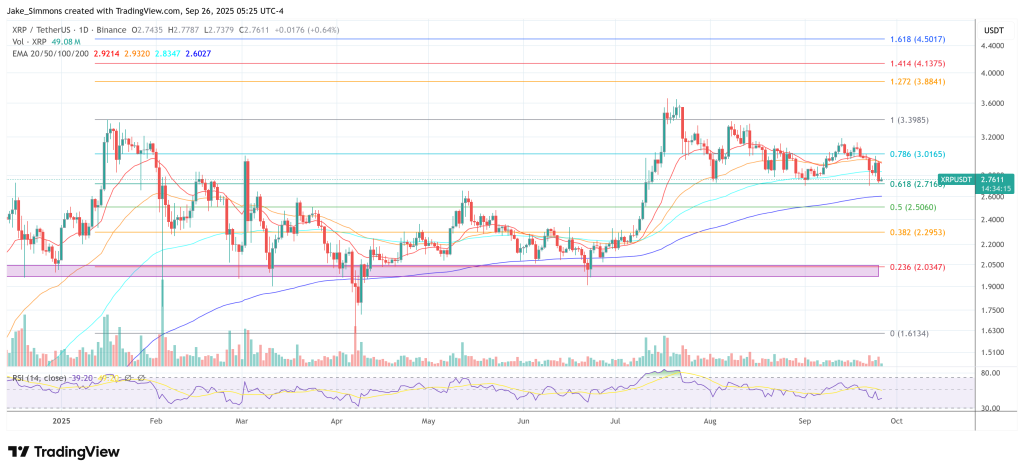
At press time, XRP traded at $2.76.
XRP price
Disclaimer: The articles reposted on this site are sourced from public platforms and are provided for informational purposes only. They do not necessarily reflect the views of MEXC. All rights remain with the original authors. If you believe any content infringes on third-party rights, please contact service@support.mexc.com for removal. MEXC makes no guarantees regarding the accuracy, completeness, or timeliness of the content and is not responsible for any actions taken based on the information provided. The content does not constitute financial, legal, or other professional advice, nor should it be considered a recommendation or endorsement by MEXC.

You May Also Like

Why It Could Outperform Pepe Coin And Tron With Over $7m Already Raised
Why It Could Outperform Pepe Coin And Tron With Over $7m Already Raised

The post Why It Could Outperform Pepe Coin And Tron With Over $7m Already Raised appeared on BitcoinEthereumNews.com. Crypto News 17 September 2025 | 20:26 While meme tokens like Pepe Coin and established networks such as Tron attract headlines, many investors are now searching for projects that combine innovation, revenue-sharing and real-world utility. BlockchainFX ($BFX), currently in presale at $0.024 ahead of an expected $0.05 launch, is quickly becoming one of the best cryptos to buy today. With $7m already secured and a unique model spanning multiple asset classes, it is positioning itself as a decentralised super app and a contender to surpass older altcoins. Early Presale Pricing Creates A Rare Entry Point BlockchainFX’s presale pricing structure has been designed to reward early participants. At $0.024, buyers secure a lower entry price than later rounds, locking in a cost basis more than 50% below the projected $0.05 launch price. As sales continue to climb beyond $7m, each new stage automatically increases the token price. This built-in mechanism creates a clear advantage for early investors and explains why the project is increasingly cited in “best presales to buy now” discussions across the crypto space. High-Yield Staking Model Shares Platform Revenue Beyond its presale appeal, BlockchainFX is creating a high-yield staking model that gives holders a direct share of platform revenue. Every time a trade occurs on its platform, 70% of trading fees flow back into the $BFX ecosystem: 50% of collected fees are automatically distributed to stakers in both BFX and USDT. 20% is allocated to daily buybacks of $BFX, adding demand and price support. Half of the bought-back tokens are permanently burned, steadily reducing supply. Rewards are based on the size of each member’s BFX holdings and capped at $25,000 USDT per day to ensure sustainability. This structure transforms token ownership from a speculative bet into an income-generating position, a rare feature among today’s altcoins. A Multi-Asset Platform…
Share
BitcoinEthereumNews2025/09/18 03:35
XRP Sees Panic Selling as Glassnode Data Shows Significant Holder Losses

XRP Sees Panic Selling as Glassnode Data Shows Significant Holder Losses

XRP’s on-chain data shows mounting stress as profitability collapses, losses deepen, and selling pressure accelerates, signaling a critical behavioral shift among
Share
Coinstats2026/02/10 09:30
TOPONE Markets Advances AI-Powered Analytical Tools, Deepens Service Presence in Vietnam

TOPONE Markets Advances AI-Powered Analytical Tools, Deepens Service Presence in Vietnam

HO CHI MINH CITY, Vietnam–(BUSINESS WIRE)–Amid growing market volatility and increasing information density across global financial markets, traders are placing
Share
AI Journal2026/02/10 10:00