Dogecoin (DOGE) is trying to base on higher timeframes as Cantonese Cat points to a potential inverse head-and-shoulders on the daily, with price compressing justDogecoin (DOGE) is trying to base on higher timeframes as Cantonese Cat points to a potential inverse head-and-shoulders on the daily, with price compressing just

Dogecoin Flirts With An Inverse Head And Shoulders: $0.15 Break Is The Trigger

2026/01/16 20:30

Dogecoin (DOGE) is trying to base on higher timeframes as Cantonese Cat points to a potential inverse head-and-shoulders on the daily, with price compressing just beneath a defined resistance shelf while holding a nearby demand zone.

Dogecoin Breakout Could Target $0.19

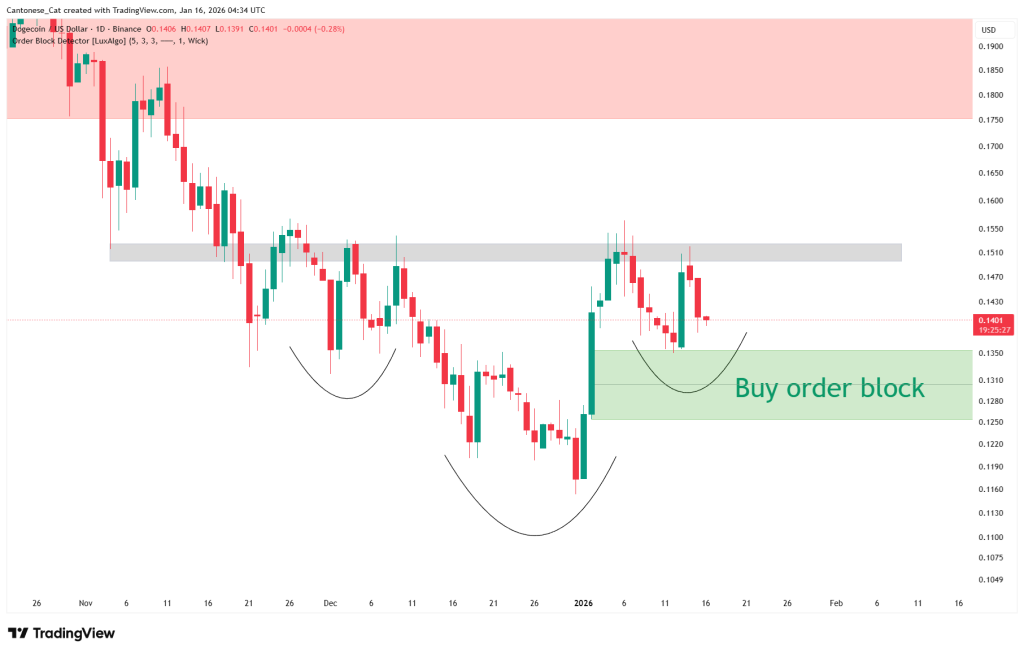
In a daily chart (DOGE/USD, Binance) shared via X on Jan. 16, Cantonese Cat overlays an inverse head-and-shoulders schematic: a left shoulder in early December, a deeper “head” into late December near the mid-$0.11s, and a developing right shoulder as price rotates lower after the early-January spike.
Dogecoin daily chart

The key feature on that daily view is a highlighted “Buy order block” spanning roughly $0.1250 to $0.1350. Price is shown pulling back toward the top of that block after failing to hold the most recent push higher, which places the current trade location in a classic “right shoulder” area if the pattern is going to remain constructive.

Above the current spot price, the chart marks a horizontal grey resistance (“the shoulder”) band at roughly $0.149–$0.152. This is the area DOGE needs to reclaim for the inverse H&S thesis to transition from “forming” to “triggering,” because it has acted as supply on recent tests.

Using Cantonese Cat’s daily inverse head-and-shoulders chart, the measured move is the neckline minus the head low, projected upward from the neckline: the neckline is the grey supply band centered near $0.151 (label on the axis), while the head prints at roughly $0.116. That gives a height of about $0.035, implying a pattern target near $0.186.

Notably, that objective runs directly into the chart’s overhead red supply zone, which begins around $0.175 and extends up toward $0.19, making that area the first obvious region where a confirmed breakout would be expected to meet meaningful resistance.

DOGE 2-Day Bollinger Bands Signal Momentum

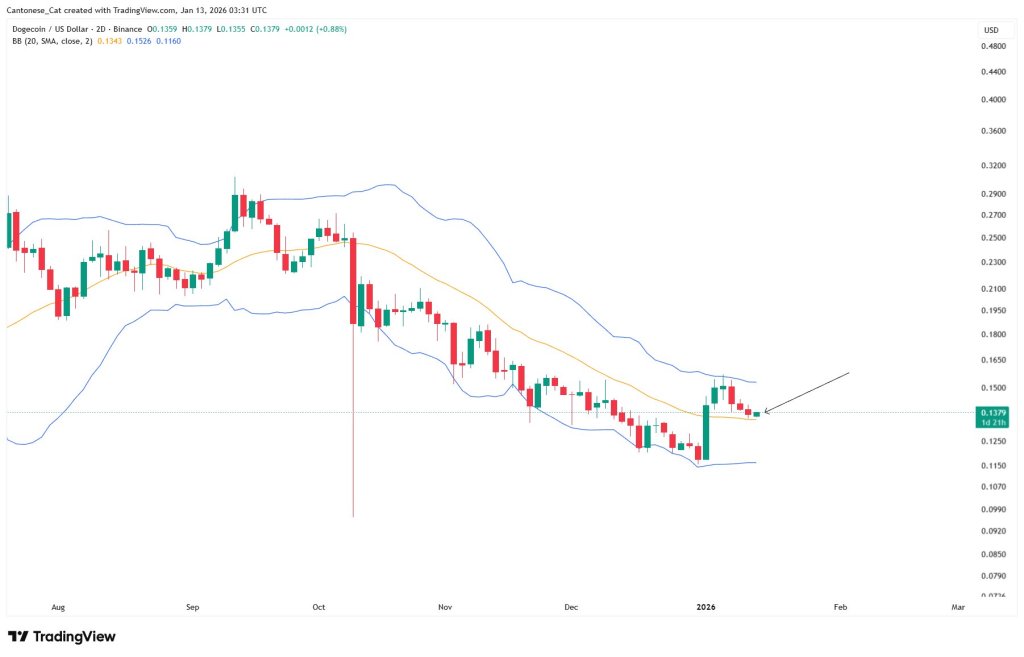
Notably, the Bollinger Bands on the 2-day chart support the mid-term bullish thesis. On Tuesday, Cantonese Cat highlighted that DOGE is trading above the Bollinger basis around $0.1343, while the upper band is near $0.1526 and the lower band near $0.1160.
Dogecoin 2-day chart

Cantonese Cat summarized the idea succinctly: “Price wanting to hang out at the top part of the Bollinger band? We have a chance here?” In practice, the “top part” framing matters because it’s a momentum tell. After an extended decline, sustained closes above the basis and into the upper half of the bands can signal that sellers are no longer controlling the volatility profile, even before price clears the obvious horizontal resistance.

That said, the 2D view also makes the immediate problem clear: the upper band sits close to the same zone highlighted on the daily as resistance. In other words, the bullish thesis is not just “hold support,” but “prove it” with acceptance above the $0.15–$0.152 region.

If DOGE continues to defend the $0.1250–$0.1350 buy-side block and reclaims the $0.149–$0.152 supply band, the inverse head-and-shoulders thesis gains credibility. The next areas the chart itself flags are the higher supply zones around $0.175 and the upper-$0.18s region, where prior selling pressure was visible.

If price loses the buy order block, the pattern read weakens materially. In that case, the Bollinger structure on the 2D chart points attention back toward the lower band region near $0.1160 and the late-December lows.

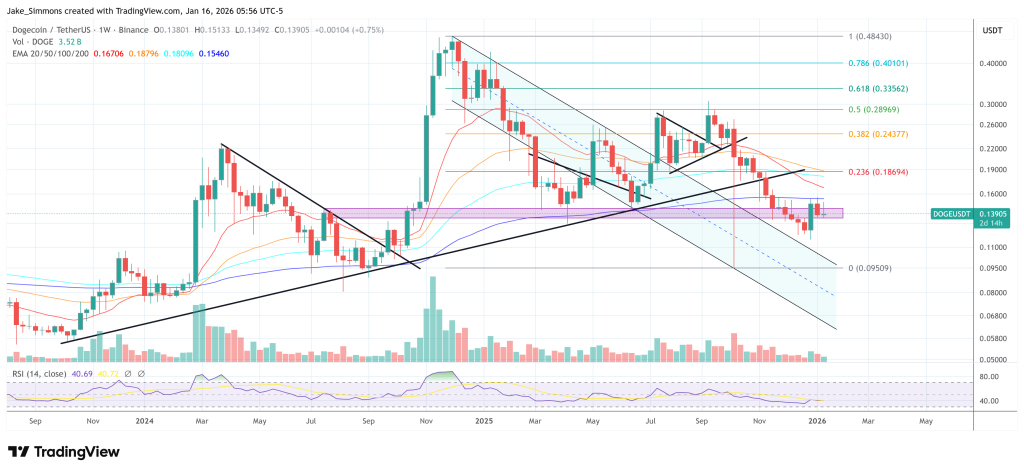
At press time, DOGE traded at $0.139.
Dogecoin price chart
Market Opportunity
DOGE Logo
DOGE Price(DOGE)
$0.10334
$0.10334$0.10334
-0.71%
USD
DOGE (DOGE) Live Price Chart
Disclaimer: The articles reposted on this site are sourced from public platforms and are provided for informational purposes only. They do not necessarily reflect the views of MEXC. All rights remain with the original authors. If you believe any content infringes on third-party rights, please contact service@support.mexc.com for removal. MEXC makes no guarantees regarding the accuracy, completeness, or timeliness of the content and is not responsible for any actions taken based on the information provided. The content does not constitute financial, legal, or other professional advice, nor should it be considered a recommendation or endorsement by MEXC.

You May Also Like

Cashing In On University Patents Means Giving Up On Our Innovation Future

Cashing In On University Patents Means Giving Up On Our Innovation Future

The post Cashing In On University Patents Means Giving Up On Our Innovation Future appeared on BitcoinEthereumNews.com. “It’s a raid on American innovation that would deliver pennies to the Treasury while kneecapping the very engine of our economic and medical progress,” writes Pipes. Getty Images Washington is addicted to taxing success. Now, Commerce Secretary Howard Lutnick is floating a plan to skim half the patent earnings from inventions developed at universities with federal funding. It’s being sold as a way to shore up programs like Social Security. In reality, it’s a raid on American innovation that would deliver pennies to the Treasury while kneecapping the very engine of our economic and medical progress. Yes, taxpayer dollars support early-stage research. But the real payoff comes later—in the jobs created, cures discovered, and industries launched when universities and private industry turn those discoveries into real products. By comparison, the sums at stake in patent licensing are trivial. Universities collectively earn only about $3.6 billion annually in patent income—less than the federal government spends on Social Security in a single day. Even confiscating half would barely register against a $6 trillion federal budget. And yet the damage from such a policy would be anything but trivial. The true return on taxpayer investment isn’t in licensing checks sent to Washington, but in the downstream economic activity that federally supported research unleashes. Thanks to the bipartisan Bayh-Dole Act of 1980, universities and private industry have powerful incentives to translate early-stage discoveries into real-world products. Before Bayh-Dole, the government hoarded patents from federally funded research, and fewer than 5% were ever licensed. Once universities could own and license their own inventions, innovation exploded. The result has been one of the best returns on investment in government history. Since 1996, university research has added nearly $2 trillion to U.S. industrial output, supported 6.5 million jobs, and launched more than 19,000 startups. Those companies pay…
Share
BitcoinEthereumNews2025/09/18 03:26
Stellar (XLM) Price Analysis for February 1

Stellar (XLM) Price Analysis for February 1

The post Stellar (XLM) Price Analysis for February 1 appeared on BitcoinEthereumNews.com. The crypto market keeps reaching new local lows, according to CoinStats
Share
BitcoinEthereumNews2026/02/02 05:21
PEPE Price Prediction: Meme Coin Targets Recovery Despite Technical Weakness

PEPE Price Prediction: Meme Coin Targets Recovery Despite Technical Weakness

The post PEPE Price Prediction: Meme Coin Targets Recovery Despite Technical Weakness appeared on BitcoinEthereumNews.com. Timothy Morano Feb 01, 2026 16:58
Share
BitcoinEthereumNews2026/02/02 05:00