

Unlocking the Annuity Puzzle: Why Canadians avoid what seems to be the perfect retirement vehicle
The Annuity Puzzle is about a curious phenomenon in Canada: while life annuities sold by insurance companies seem to have all sorts of compelling reasons to acquire them, more often than not, retirees shun them.
Financial planner Robb Engen recently tackled this puzzle in his Boomer & Echo blog, “Why Canadians avoid one of retirement’s most misunderstood tools.” Engen notes that experts like Finance professor Moshe Milevsky and retired actuary Fred Vettese believe “converting a portion of your savings into guaranteed lifetime income is one of the smartest and most efficient ways to reduce retirement risk.” Vettese has said the math behind an annuity is “pretty compelling,” especially for those without Defined Benefit pensions.
Milevsky and Alexandra Macqueen coined a great term applicable to annuities when they titled their book about the subject Pensionize Your Nest Egg, which I reviewed in the Financial Post in 2010 under the title ”A cure for pension envy?”
Engen observes that a life annuity is “the cleanest version of longevity insurance … You hand over a lump sum to an insurer, and they guarantee you monthly income for life. If you live to 100, the insurer pays you. If stock markets collapse, you still get paid. If you’re 87 and never want to look at a portfolio again, the income keeps flowing.”
In other words, annuities neutralize the two big risks that haunt retirees: longevity risk (the chance of outliving your money) and sequence-of-returns risk, the danger of suffering a stock-market meltdown early in retirement and inflicting irreversible damage on a portfolio.
Despite all the seeming positives about annuities, Engen notes that “almost nobody buys one.” He cites a Vettese estimate that only about 5% of those who could buy an annuity actually do so. Engen suggests there is a behavioural hurdle: fear of losing liquidity and control of the underlying assets. He cites research by the National Institute of Ageing’s Bonnie-Jeanne MacDonald on pooled-risk retirement income, where she wrote that such retirees are “strongly opposed to voluntary annuities, as they want to keep control over their savings.”
Compare the best RRSP rates in Canada
A chance to lock in recent portfolio gains?
Even so, the new Retirement Club created by former Tangerine advisor Dale Roberts earlier this year (see the blog posted on my own site in June) recently featured a guest speaker who extolled the virtues of annuities: Phil Barker of online annuities firm Life Annuities.com Inc.
Barker said many clients tell him they’ve done really well in the markets over the last 20 years and now they’d like to lock in some of those gains. They may be looking for fixed-income strategies, and many were delighted with GIC returns when they were a bit higher than they are now (some in the range of 6-7%). But they are less happy with the new rates on GICs now reaching maturity. Meanwhile, annuities have just come off a 20-year high in November 2023 so the time to consider one has never been better, Barker told the Club in August.
With annuities, you can lock in a rate for the rest of your life—so if your timing is good, it may make sense to allocate some funds to them.
Barker said eight life insurance companies offer annuities in Canada: Desjardins, RBC Life Insurance, BMO Life Insurance, Canada Life, Manulife, Sun Life, Equitable Life and Empire Life. All are covered under Assuris, a third-party organization that guarantees 100% of an annuity up to $5,000 per month. So if one of those companies failed, the annuity would be honored by one of the other firms via Assuris.
Barker described an annuity as simply a “personal-funded pension.” To set one up you can take registered or non-registered funds and send the capital to an insurance company. In return, they give you an income stream for as long as you live: this is the traditional life annuity. Unlike annuities in the U.S., you cannot add funds to an existing annuity, Barker told the club, nor can you co-mingle funds from for example RRSPs and non-registered funds.
However, you can buy a new annuity each time you need to. There is no medical underwriting for annuities, unlike life insurance. Joint annuities for couples are a great value, he said, but the tax slips are sent to the primary annuitant. Nor is income splitting possible under current CRA rules.
When annuities shine
Annuities shine when you are confident about your health and prospects for living a long time. Having $X,000 a month assured income to live on means your other sources of income that fluctuate with stock markets can be weathered, Barker said. “We’re seeing people getting 6.5% to 8.5% a year for the rest of their lives, depending on their age.”
As Dale Roberts commented during Barker’s talk, having enough to live on just from the pension bucket (annuities, pensions, CPP/OAS etc.) frees you up to take some risk in other areas, like stocks and equity ETFs.
Funding by registered vs. non-registered accounts
Registered funds transfer to an annuity tax-free; that’s because money is not being deregistered, but rather going from one registered environment into another registered environment. It will be fully taxed when it comes out. The monthly income from the annuity is then fully taxable in the year it is received.
If you fund with non-registered money, the taxation is considerably different. For one, if your non-registered account has unrealized capital gains you’ll have to realize them and pay tax on them. Other than that, so-called prescribed annuities are relatively tax-efficient. The capital that is used to fund the annuity is not taxed, only the gain is, Barker says. “Therefore, the taxable portion of the annuity income is a very small amount. Prescribed means that the taxation is the same or level for the entire life of the annuity.”
The Club has also covered other retirement income products that may resemble annuities in some respects: the Vanguard Retirement Income Fund (VRIF) and the Purpose Longevity Fund, both of which I have small chunks in. Dale adds that the Longevity Fund has the potential to be a “nice complement to annuities,” as it “is designed to increase payments quite nicely in the later years thanks to the mortality credits. Those with very long lives are subsidized by those who pass away much earlier.”
I wrote about annuities several times for MoneySense when I was in my 60s, but it wasn’t until I reached 71 and the RRIF age before I seriously started to consider them (last year). See, for example the Retired Money column I wrote about Vettese several years ago, where I reviewed his then just-published book Retirement Income for Life.
I suspect the Club’s session on annuities was enough to get a few members off the fence, including my own family. I have long been impressed by a suggestion by the aforementioned Fred Vettese, who argues those preparing to convert their RRSPs into RRIFs might opt to annuitize 20 or 30% of the amount, thereby transferring a chunk of investment risk from the do-it-yourself investor on to the shoulders of a Canadian life insurance company.
As of now, I’ve not yet personally made the plunge into annuities for myself as, unlike my wife, I do have two employer-sponsored defined benefit pension plans, albeit small ones from past publishing employers (I call them the mini pension and the micro pension).
Keep in mind, too, that most Canadians will get the two government-guaranteed pensions called CPP and OAS, which, for all intents and purposes, behave like annuities.
Have a personal finance question? Submit it here.
Evaluate your overall financial trajectory before making the plunge
More than a year ago, after researching the topic for an article and consulting financial planner Rona Birenbaum, we decided to put a small experimental chunk of my wife’s LIRA into an annuity. Birenbaum is founder and president of Toronto-based Caring for Clients. A year later, with her own RRSP-to-RRIF conversion date looming, we also decided to annuitize a chunk of her RRSP/RRIF. We are now considering deploying some taxable funds into prescribed annuities, ideally from fixed-income investments rather than equities with sizable unrealized gains.
“Before purchasing an annuity, I always recommend that Canadians evaluate how introducing an annuity changes their overall financial trajectory,” Birenbaum told me for this column. “Tax-sensitive planning software is extremely helpful for illustrating the differences.” She cites the example of one client who was enthusiastic about annuitizing until the projections showed that doing so would likely require her to downsize her home or borrow against her home equity earlier than desired.
“It’s common for an insurance product to look appealing on a stand-alone basis, but once it’s integrated into a full financial plan, the shortcomings become clear … The industry shift away from product sales toward planning-driven solutions is happening very slowly in the life insurance industry.”
How much can annuities pay?
At the Retirement Club, Dale Roberts recently posted the following sample payout amounts for $100,000 annuities for males and females of various ages:
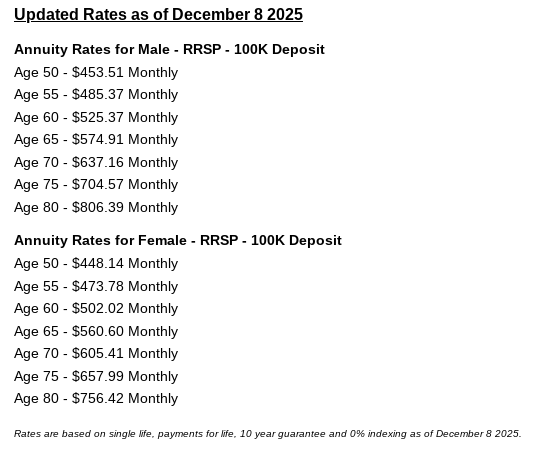
From where I sit, those returns seem relatively attractive. So again, why don’t Canadians flock to annuities?
Engen’s blog cited at least six reasons, led by loss of liquidity and control and worries about dying early and reducing bequests for heirs. Consumers tend to perceive annuities as complex and so have low product awareness. There may also be some bias from advisors in a position to sell them.
All these factors conspire to trump longevity math, and the problem is exacerbated by the fact that Canada does not offer fully inflation-indexed annuities. Engen concludes that annuities can play an important supporting role for the right retirees: those who want secure income, reduced portfolio stress, and peace of mind late in life.
Annuities should be regarded as part of a diversified retirement income plan that blends guaranteed income with growth assets,” Engen concludes. They may not be perfect but deserve some consideration, as “the people who benefit most from annuities are the ones who genuinely worry about running out of money. Once that income floor is set, everything else becomes much easier.”
My own takeaway is similar to what Vettese has argued: it’s not an all-or-nothing decision to annuitize. As Engen puts it, “I’m not suggesting you turn every penny of a million-dollar portfolio into an annuity, but carving out a portion to create your own personal pension will add another valuable and guaranteed income stream that you never have to worry about managing in retirement.”
Get free MoneySense financial tips, news & advice in your inbox.
Read more about Retired Money:
- The 4% rule, revisited: A more flexible approach to retirement income
- Who you gonna trust: Barry Ritholtz or Jim Cramer?
- Why retirement planners are getting defensive
- How financial journalists plan their own retirement
The post Unlocking the Annuity Puzzle: Why Canadians avoid what seems to be the perfect retirement vehicle appeared first on MoneySense.
You May Also Like

U.S. Court Finds Pastor Found Guilty in $3M Crypto Scam

MSCI’s Proposal May Trigger $15B Crypto Outflows
